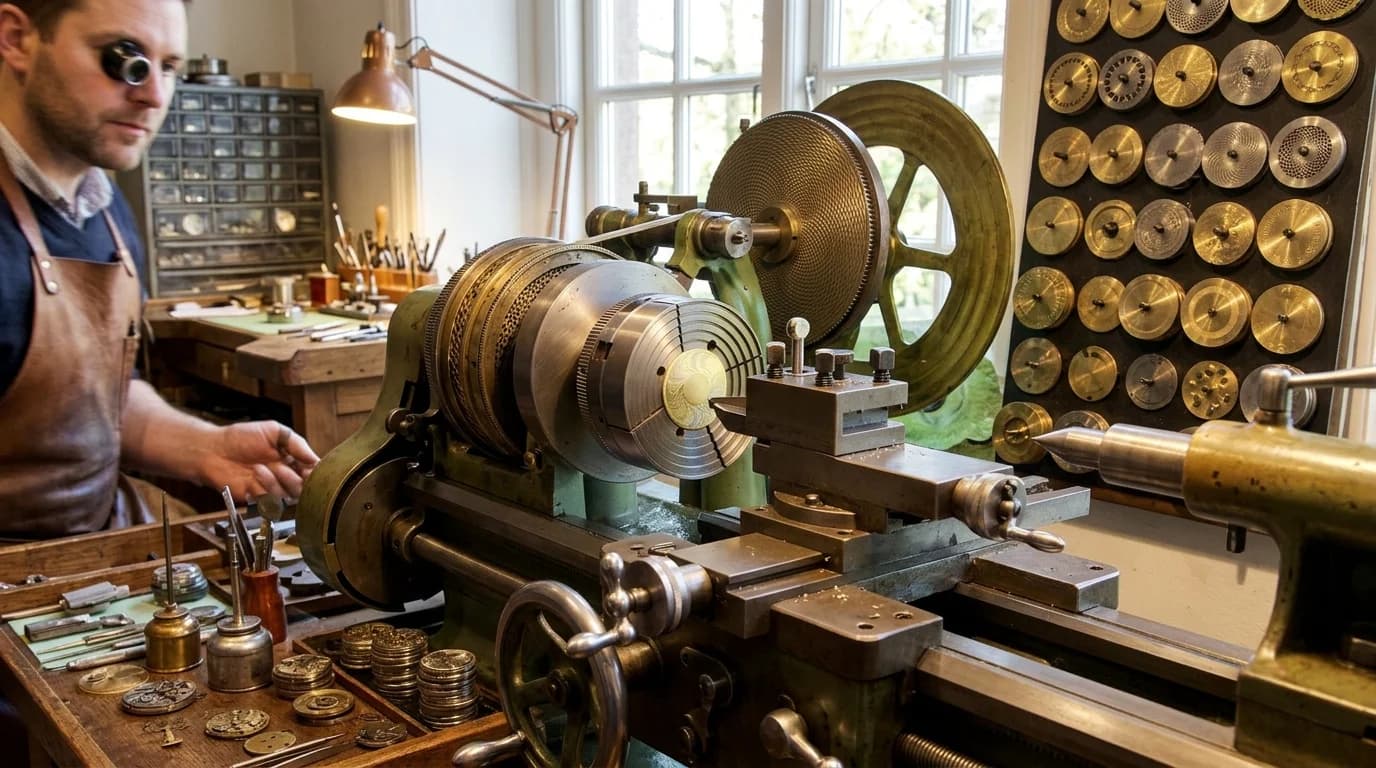
Look closely at certain dials and you will see a pattern that seems to move as the light shifts across it, a grid of tiny pyramids, a sunburst of engraved lines, a checkerboard cut so fine it looks woven. That is guilloche. It is one of the oldest decorative techniques in watchmaking, and one of the few that machines still cannot fully replace.
This post includes AI-generated images built from real reference photography of the watches and tools discussed, verified by our team for accuracy before publishing.
The short answer
Guilloche is a decorative technique where a repeating geometric pattern is engraved into a metal dial, either by hand on a manually operated rose engine lathe or by a modern CNC machine copying the same motion. True hand guilloche is cut one pass at a time by a watchmaker guiding a cutting tool against a rotating and oscillating dial blank. Brands still doing it by hand include Breguet, Patek Philippe, Audemars Piguet (on select Jules Audemars and vintage-inspired pieces), Jaeger-LeCoultre, and independent specialist Chronoswiss. The most common patterns are Clous de Paris, Grain d'orge, Soleil, and Flinque.
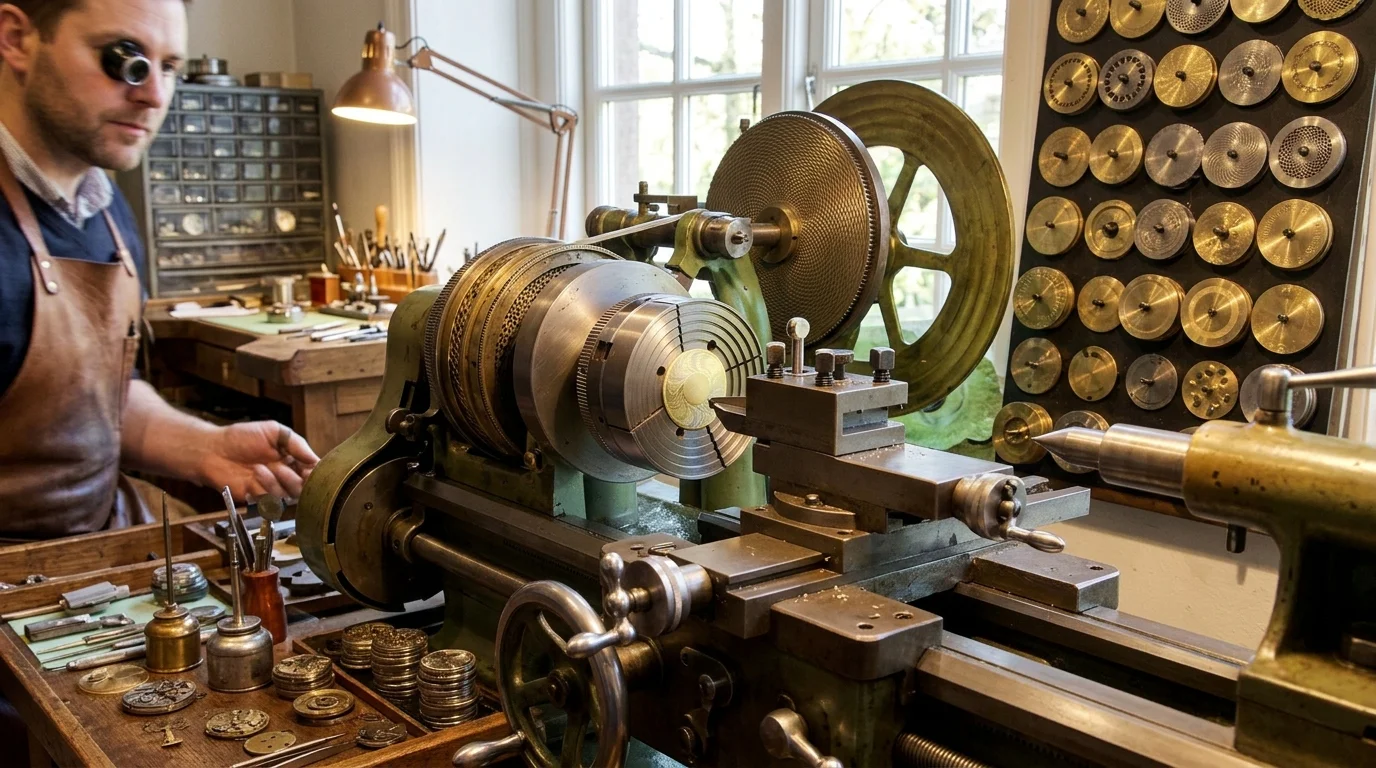 A rose engine lathe cuts one repeating pass at a time. The discs on the wall behind it are rosettes, each one controlling a different pattern.
What guilloche actually is
Guilloche is engine turning. A dial blank is mounted on a lathe and rotated against a fixed cutting tool while a separate cam, called a rosette, forces the blank to oscillate at the same time.
Two motions, one pattern
The rotation cuts a circular pass. The rosette's oscillation adds a wave to that pass. Change the rosette, and the same lathe cuts a completely different pattern.
That is why a single rose engine lathe, in skilled hands, can produce dozens of distinct guilloche patterns just by swapping which rosette is engaged.
How it is actually done, by hand versus by machine
There are two ways a modern dial gets a guilloche pattern, and the difference matters for both cost and how the finished dial reads under light.
Hand guilloche on a rose engine lathe
A watchmaker sets the rosette, adjusts the cutting tool by hand, and turns a hand crank to advance the pattern one line at a time. Each line is cut individually, checked, and the tool is reset for the next.
A complex hand-guilloche dial can take a trained engraver a full day or more to complete. The lines are not perfectly identical, which is part of what gives a hand-cut dial its depth and slightly organic shimmer.
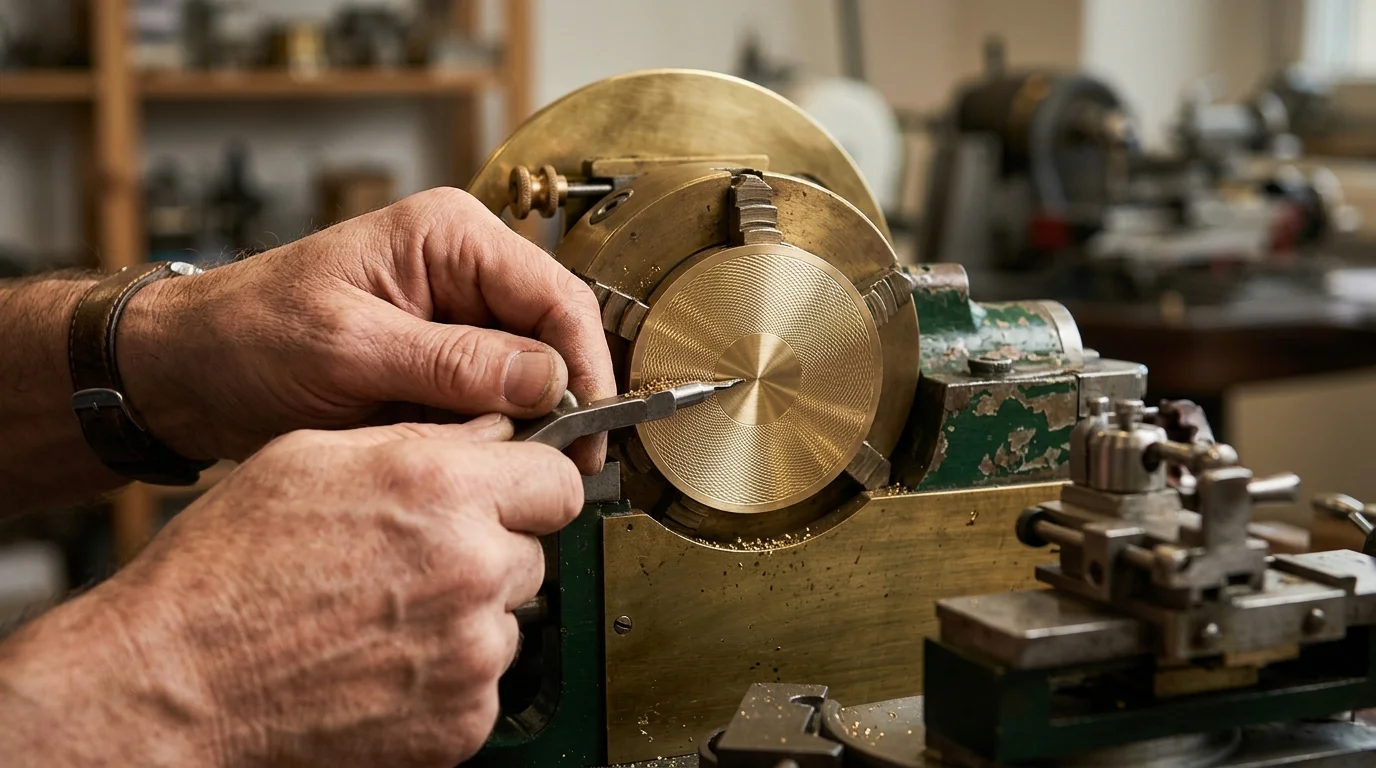 Every pass on a rose engine lathe is guided by hand. The watchmaker feels the cut through the tool, not just watches it.
CNC-cut and stamped imitations
Most watches with a guilloche-style dial today are not hand-cut. A CNC machine can reproduce the geometry of a guilloche pattern with total consistency, and a stamped or pressed dial can fake the visual texture from a few feet away.
Neither is dishonest on its own. The problem is when a brand implies hand craftsmanship without doing the hand work, which is why the phrase "guilloche-style" or "guilloche pattern" on a spec sheet is worth reading closely against "hand guilloche."
The patterns collectors should actually know
Five patterns show up again and again across guilloche dials, and each one has a distinct look and history.
| Pattern | Look | Common use |
|---|---|---|
| Clous de Paris | Small pyramids in a grid, also called hobnail | Full dials, sub-dial rings |
| Grain d'orge | Fine parallel barleycorn-shaped ridges | Sub-dials, center sections |
| Soleil | Radiating straight lines from the center | Full dials, dress watches |
| Flinque | Wavy, water-like radial lines, often under translucent enamel | Dress and complication dials |
| Nid d'abeille | Honeycomb hexagon grid | Accent rings, sub-dials |
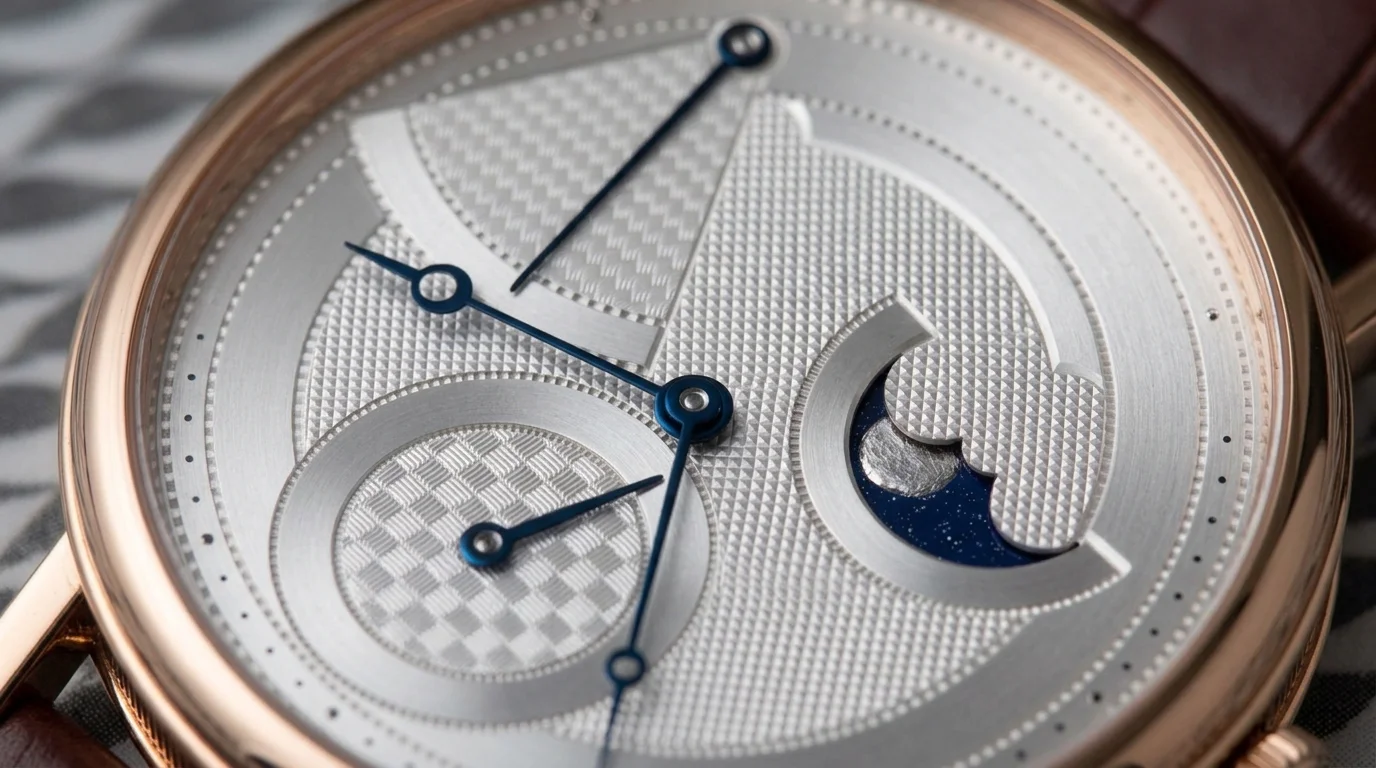 Breguet mixes multiple guilloche patterns on a single dial to visually separate the time display from the moonphase and sub-seconds.
Why Breguet is the reference point
Breguet dials often combine two or three different guilloche patterns on the same face, one for the main chapter ring, another for a sub-dial, a third for the moonphase aperture surround. It is a signature the brand has carried since Abraham-Louis Breguet's own workshop in the late 18th century.
The brands still cutting it by hand
A short list of brands still committing real bench time to hand guilloche, and where it shows up.
Breguet remains the clearest standard-bearer, with Clous de Paris and Grain d'orge patterns across the Classique line, including references like the 7137 with a hand-guilloche dial and moonphase.
Patek Philippe applies sunburst and geometric guilloche to select Calatrava and Grand Complications dials, most visibly on references like the 5178G and 6300GR.
Audemars Piguet's Petite Tapisserie waffle pattern on the Royal Oak is a form of guilloche, historically hand-cut and now largely CNC-reproduced to the same geometry on current production.
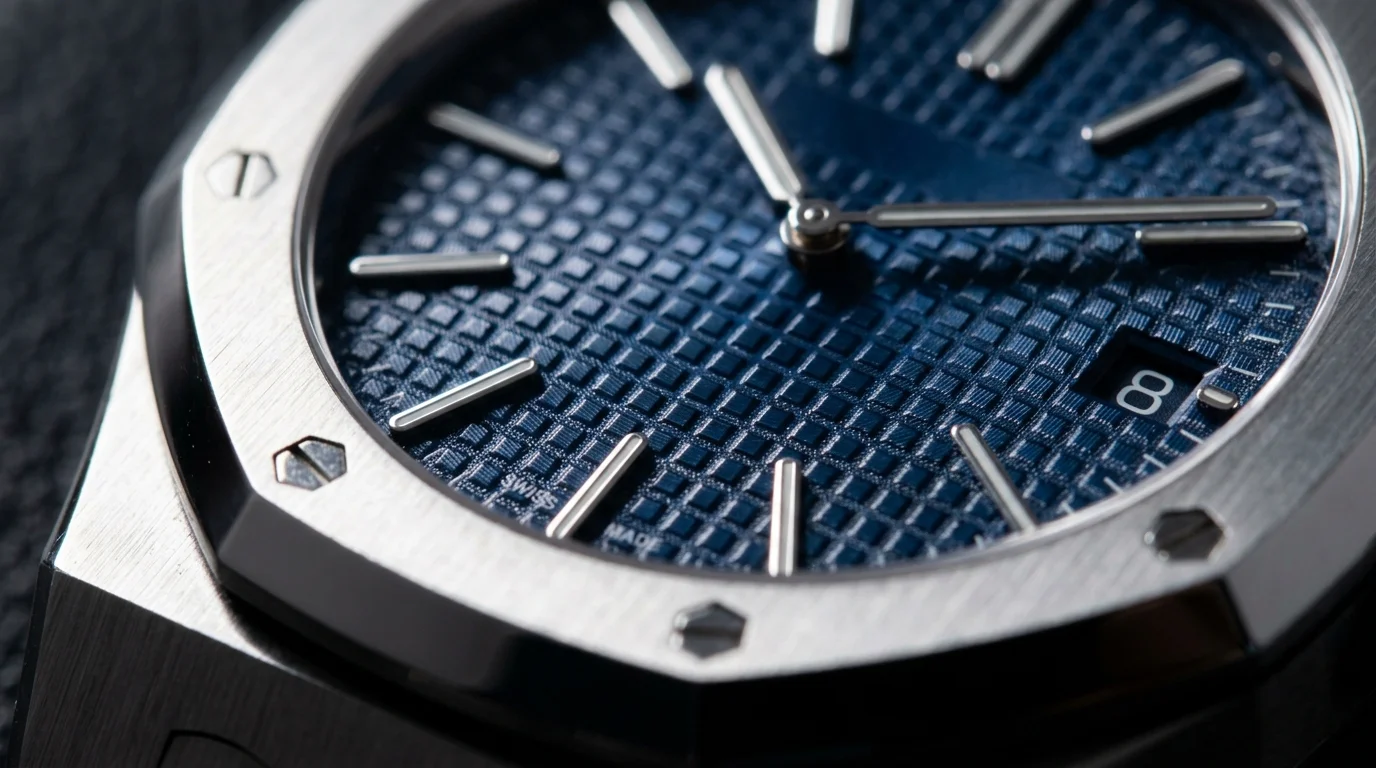 The Petite Tapisserie waffle grid is one of the most recognized guilloche patterns in modern watchmaking, and one of the most imitated.
Jaeger-LeCoultre and independent specialist Chronoswiss both maintain in-house guilloche capability, cutting patterns to order on select Reverso and dress references.
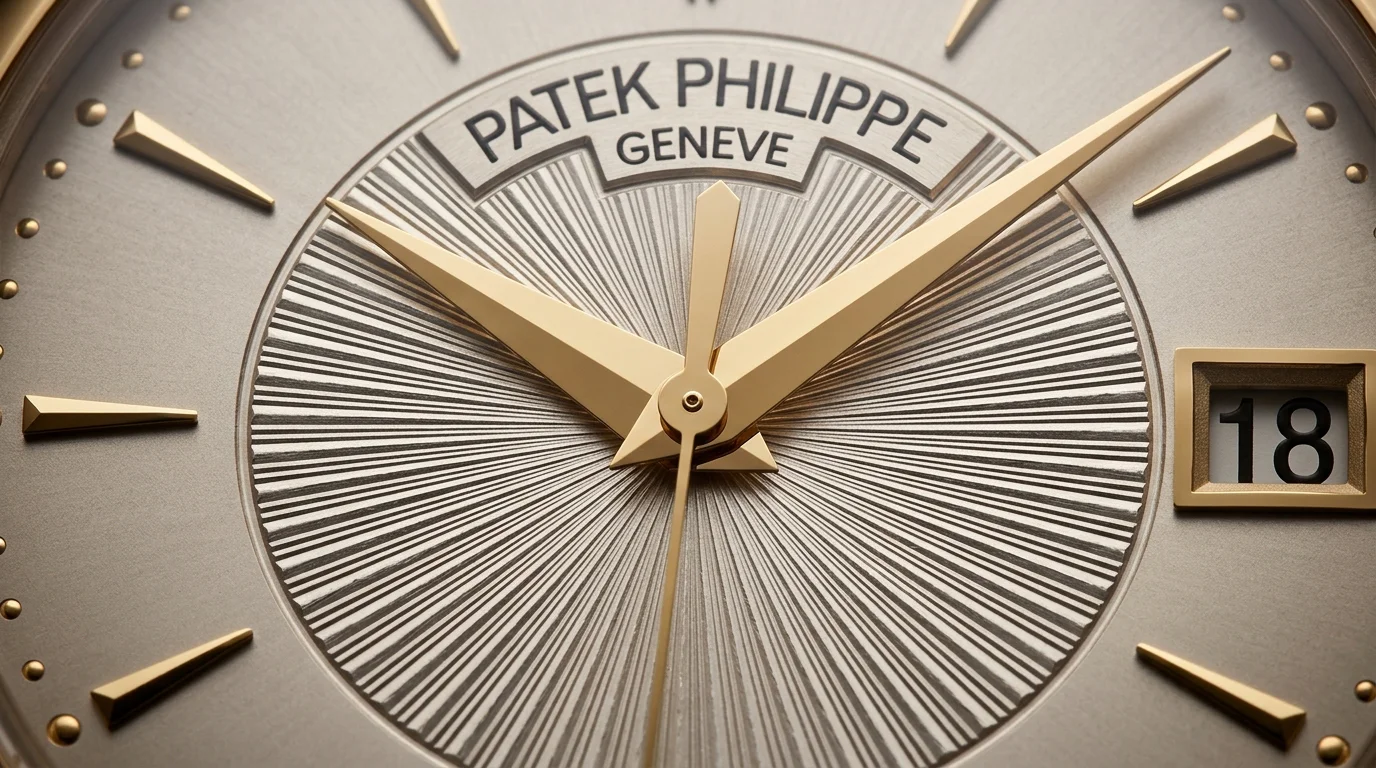 A sunburst guilloche pattern on a Calatrava dial reads completely differently depending on the angle of the light hitting it.
How to tell real guilloche from a stamped imitation
A few checks that work without a loupe.
Tilt the watch under a single light source. Hand-cut guilloche shows subtle irregularity between passes and genuine depth. A stamped pattern looks flatter and more perfectly uniform.
Look at the edges where the pattern meets an applied index or a sub-dial ring. Hand-cut work tends to terminate cleanly at these transitions because the watchmaker cut around them. Stamped patterns can look slightly compressed or distorted near obstacles.
Check the brand's own language. "Hand guilloche" or "hand-engraved" are specific claims. "Guilloche pattern" or "guilloche-style" often signal a CNC or stamped reproduction.
FAQ
Is guilloche the same as engine turning?
Yes. Guilloche and engine turning describe the same technique, cutting a repeating geometric pattern into metal using a rotating and oscillating lathe. Guilloche is the French term most commonly used in watchmaking.
Is hand guilloche still done today?
Yes, though it is rare. Brands including Breguet, Patek Philippe, and Jaeger-LeCoultre maintain in-house rose engine capability and still hand-cut dials for select references, though most guilloche-pattern dials on the market today are CNC-reproduced.
Does hand guilloche affect a watch's value?
Generally yes, particularly on vintage and independent pieces, since hand-cut dials require significant skilled labor and cannot be mass produced. A documented hand-guilloche dial is a meaningful factor collectors weigh when comparing otherwise similar references.
What is the difference between Clous de Paris and Soleil patterns?
Clous de Paris is a grid of small raised pyramids, also called hobnail. Soleil is a pattern of straight lines radiating outward from the dial's center, resembling sunburst rays.
Can guilloche be applied to any metal?
In practice, guilloche is almost always cut into gold, silver, or brass dial blanks, since these metals cut cleanly without tearing or excessive tool wear. Steel can be guilloche-cut but requires harder tooling and more time.
Related reading
For more on how dial texture affects both looks and light performance, see Sunburst vs Matte Dial: How to Tell Them Apart and Why It Matters. For a related dial-detail comparison, read Applied vs Printed Indices: What the Difference Actually Costs You. For another decorative complication with a long hand-finishing history, see The Moonphase Complication, Explained. And for a finish that lives or dies by the kiln rather than the cutting tool, read Grand Feu Enamel Dials Explained.