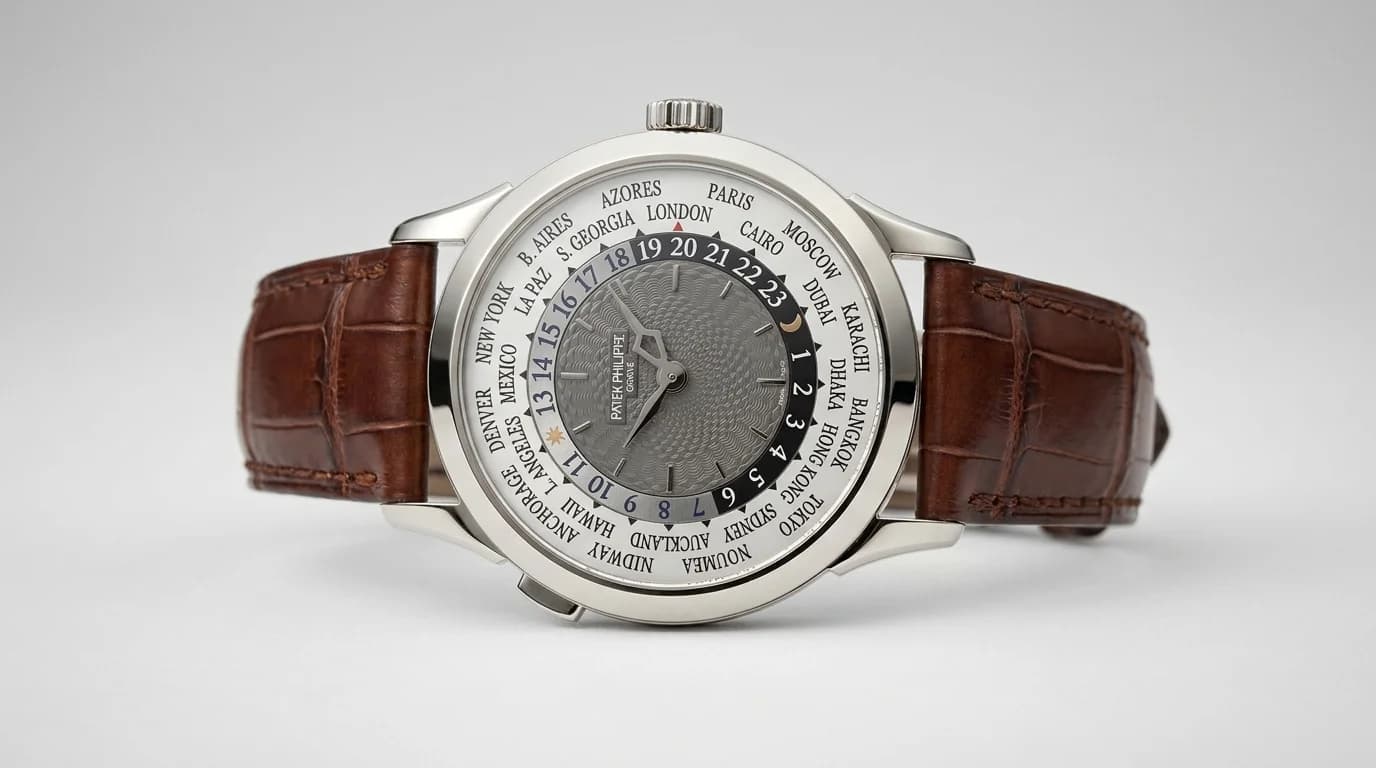
A GMT watch tells you one other time zone. A world time watch tells you all twenty-four at once, on the same dial, without touching a single pusher. That difference sounds small until you actually try to use one crossing time zones for real.
The images in this article were generated with AI for illustration. They show recognizable world time watches and mechanisms based on real reference photography, but are not photographs of a specific watch for sale.
The Short Answer
- A world time complication displays all 24 global time zones simultaneously using a rotating 24-hour ring paired with a fixed or rotating city ring.
- The complication was patented in 1931 by Genevan watchmaker Louis Cottier, who built the first world time pocket watch that same year.
- Cottier's mechanism went into production for Vacheron Constantin starting in 1932, then Patek Philippe starting in 1937.
- A world time watch is more complex than a GMT watch, which only tracks a second time zone rather than all of them.
- Modern references include the Patek Philippe 5230, the Vacheron Constantin Traditionnelle World Time, and Chopard's L.U.C Time Traveler One.
What Makes It a World Timer and Not Just a GMT
Both complications solve the same basic problem, tracking time somewhere else, but they solve it at very different scales.
A GMT watch tracks one other zone
A standard GMT complication adds a fourth hand that makes one rotation every 24 hours, pointing to a second time zone on a fixed or rotating bezel. It is genuinely useful for one specific relationship, home time versus the place you are visiting, and nothing beyond that.
A world timer tracks all of them
A world time watch replaces that single extra hand with an entire rotating 24-hour ring working alongside a ring of city names representing each of the planet's time zones. Read any city's current time by matching it against the 24-hour ring, all at a glance, with no math and no second hand to interpret.
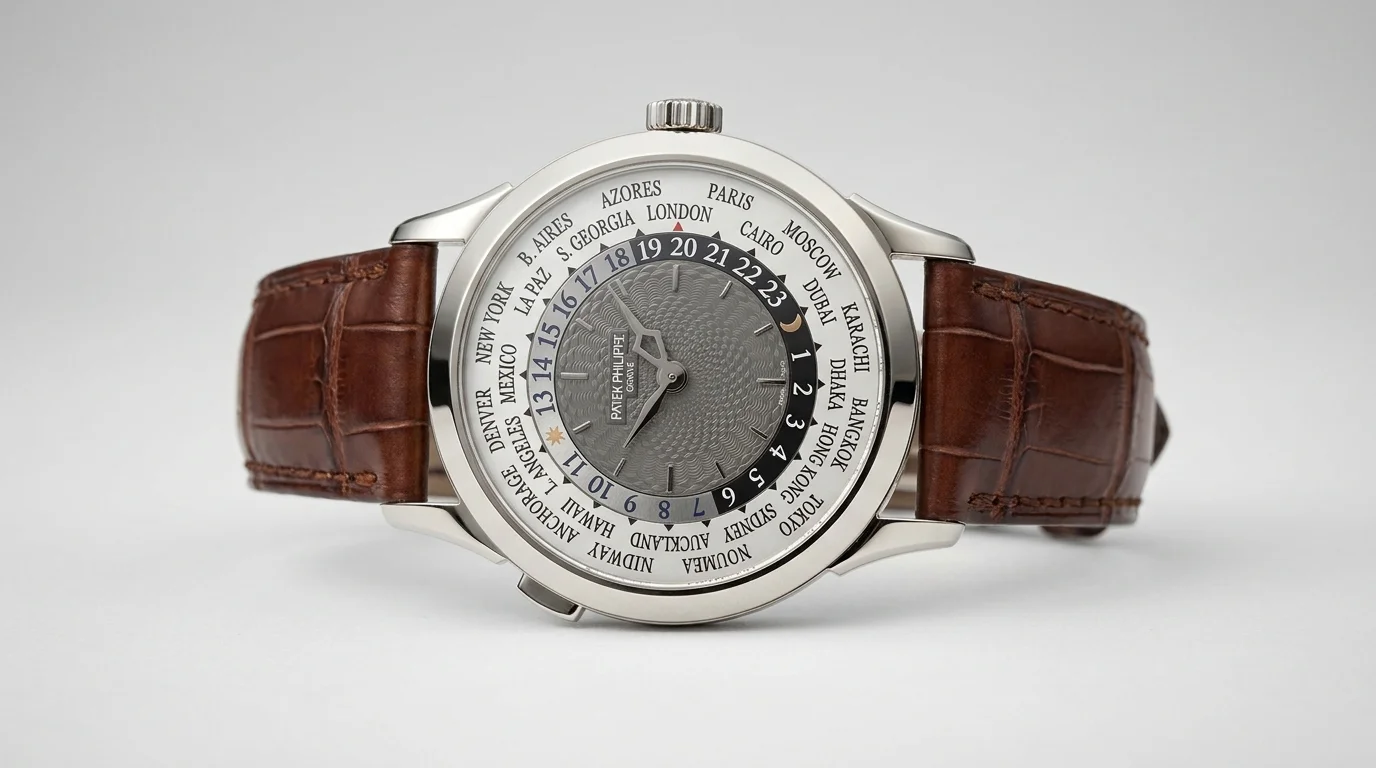 Every city on the outer ring lines up with its current hour on the 24-hour ring. That is the entire mechanism, read in one glance.
Where the Complication Actually Came From
The world timer is not an old complication by watchmaking standards. It has a specific inventor, a specific patent, and a specific origin story.
Louis Cottier's 1931 patent
Genevan watchmaker Louis Cottier patented the world time mechanism in 1931 and built the first world time pocket watch that same year for Baszanger, a Geneva jewelry retailer. In Cottier's original design, the main hands moved clockwise while the city ring itself rotated counterclockwise beneath them, a mechanically elegant solution that later Cottier-built watches carried forward.
Cottier did not just invent a complication. He built nearly every world time watch case made through the mid-20th century by hand, working directly with Vacheron Constantin and Patek Philippe rather than licensing the idea broadly.
Vacheron and Patek both built on Cottier's work
Vacheron Constantin began producing Cottier-designed world timers in 1932. Patek Philippe followed in 1937, and its references from that era, along with the later 2523 and 2523-1 produced between 1953 and 1957, are now among the most collected vintage Patek references that exist.
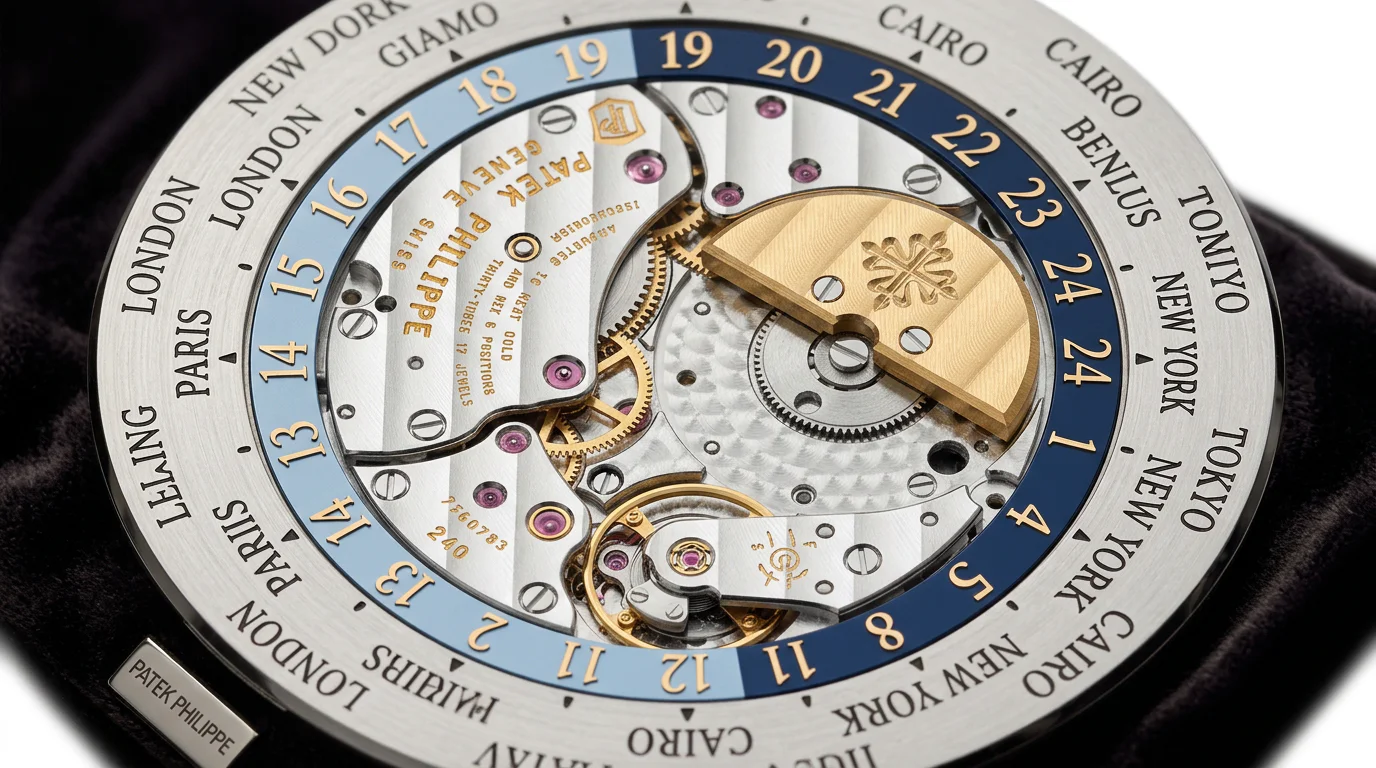 The gear train linking the 24-hour ring to the rotating city disc has to advance both by exactly the right amount, once every 24 hours, with zero drift.
How to Actually Read One
Reading a world timer takes a few seconds the first time and becomes automatic after that.
Setting your home city
Rotate the city ring until your home city sits at 12 o'clock, aligned with the main hour and minute hands showing local time. Every other city on the ring now shows its correct current hour by reading straight across to the 24-hour ring.
Reading any other city
Find the city you want on the outer ring, then read the number on the 24-hour ring directly next to it. That number is the current hour in that city, no calculation required. Traveling changes only one step: rotate the city ring so your new location sits at 12, and every other city's time updates relative to it automatically.
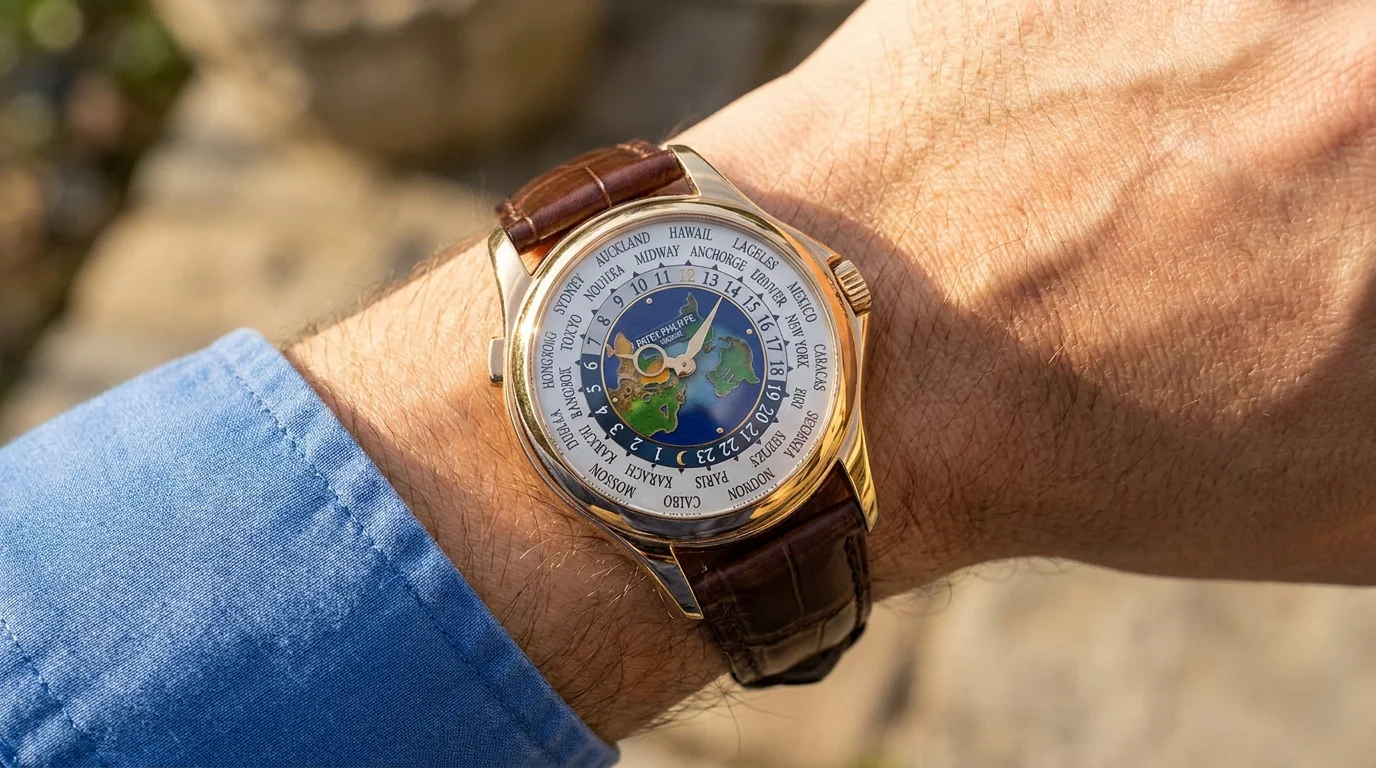 Once the home city is set, every other time zone on the dial reads correctly without any further adjustment.
Why Modern World Timers Are Easier to Use
Early Cottier-era world timers required careful manual synchronization between the hour hand, the 24-hour ring, and the city disc, and getting it wrong meant every city read incorrectly.
The 2000 breakthrough
Patek Philippe's reference 5110, launched in 2000 after nearly a 50-year gap in the brand's world timer production, introduced a single pusher at 10 o'clock that advances the hour hand, the 24-hour disc, and the city ring together in one-hour increments. That single mechanical fix is what made world timers genuinely practical for a traveler again rather than a beautiful but fussy complication.
How far the complication has gone since
Vacheron Constantin's Traditionelle World Time, introduced in 2011, pushed the complication further still, displaying all 37 real-world time zones including the fractional offsets some countries use, like Nepal's GMT+5:45, through a more sophisticated cam system driving both the hour and minute hands.
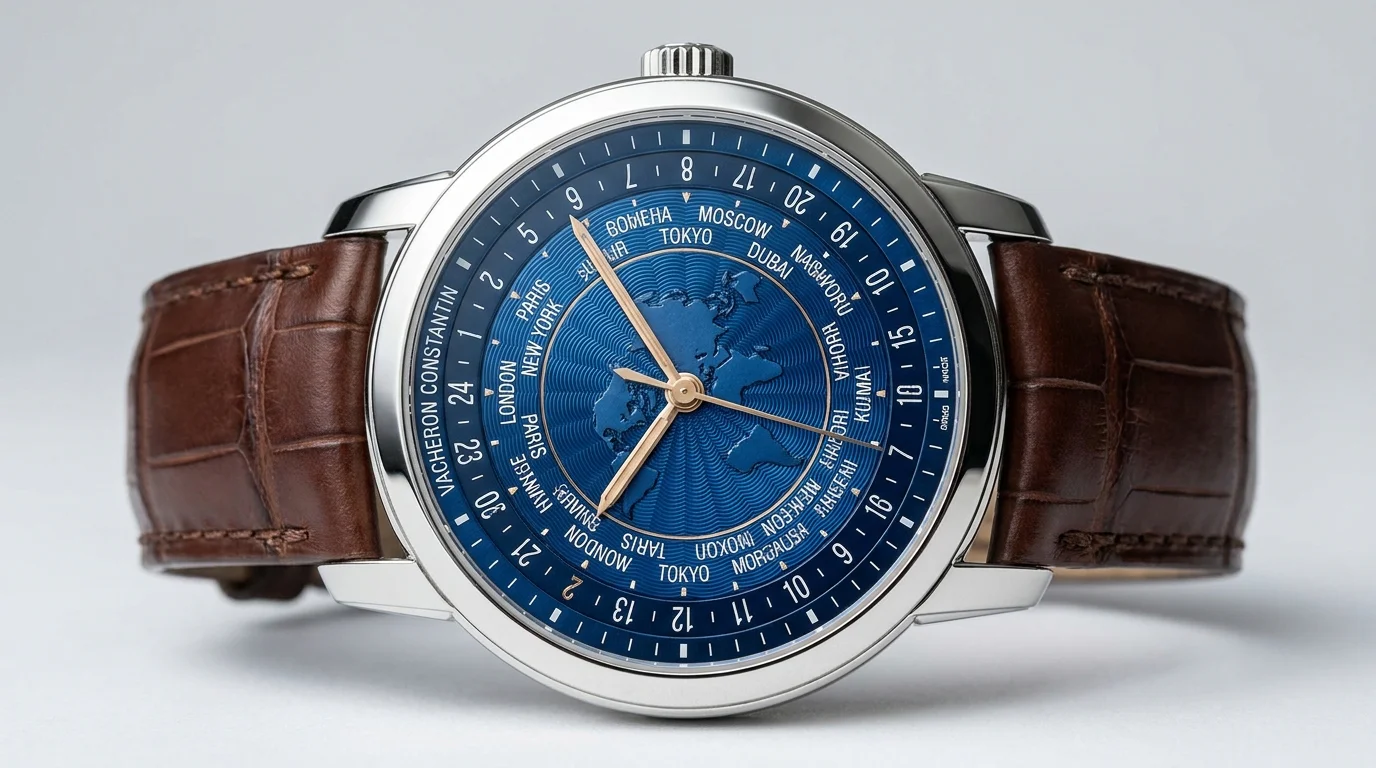 Handling all 37 real-world time zone offsets, including the 45-minute and 30-minute variants a handful of countries use, takes a genuinely complex gear train.
Notable World Time References
| Watch | Notable feature | Approx. context |
|---|---|---|
| Patek Philippe 5230 | Direct descendant of the 5110, single-pusher city and hour sync | Six-figure range |
| Vacheron Constantin Traditionnelle World Time | Displays all 37 global time zone offsets including 45-minute variants | Six-figure range |
| Chopard L.U.C Time Traveler One | In-house automatic world timer at a more accessible price point | Five-figure range |
| Vintage Patek Philippe 2523 | 1953-1957 production, among the most collected vintage Patek references | High six to seven figures at auction |
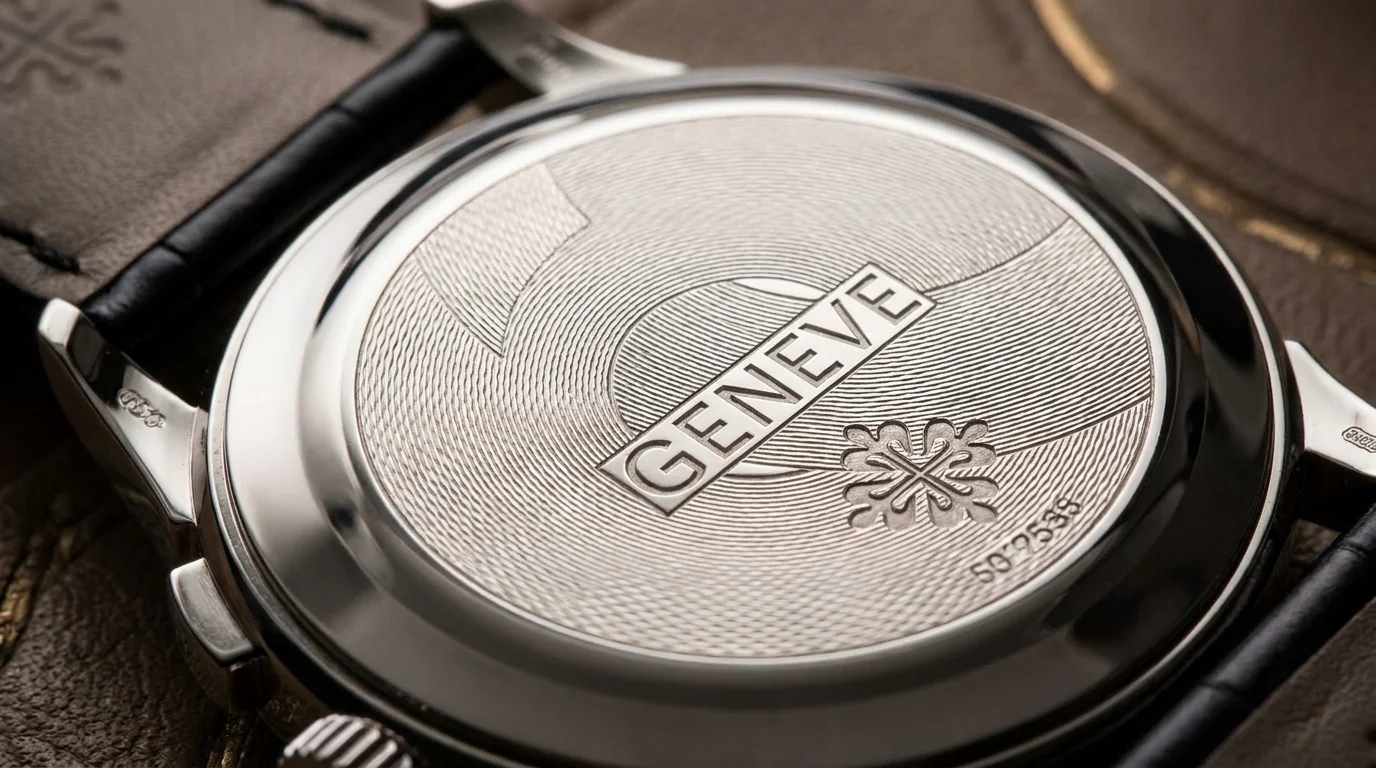 The Geneva hallmark on a case back is a quality certification, not a marketing sticker. It requires the movement inside to meet strict finishing standards.
Is a World Timer Worth Owning
Buy one if you actually think in multiple time zones, whether from real travel or from working with teams scattered across the globe, and want that information on your wrist without opening a phone. It is a genuinely useful complication in a way a lot of haute horlogerie is not, since the problem it solves is one most frequent travelers actually have.
For a Rolex-specific take on tracking time across zones, our Rolex GMT-Master II Buying Guide covers the simpler single-second-zone GMT approach most travelers actually end up buying.
Browse authenticated pre-owned complicated and travel watches at 5dwatches.com.
Related Reading
- The Rolex GMT-Master II Buying Guide: Every Modern Reference, the Discontinued Pepsi, and the Vintage Lineage
- Equation of Time Explained: Why Your Watch and the Sun Disagree
- What Is a Tourbillon, and Is It Ever Worth the Money?
Frequently Asked Questions
What is the difference between a GMT watch and a world time watch?
A GMT watch tracks one additional time zone using a single 24-hour hand. A world time watch displays all 24 global time zones simultaneously using a rotating 24-hour ring paired with a city ring, letting you read any zone's current time at a glance.
Who invented the world time complication?
Genevan watchmaker Louis Cottier patented the world time mechanism in 1931 and built the first world time pocket watch that same year. He went on to build world timers for Vacheron Constantin starting in 1932 and Patek Philippe starting in 1937.
How do you read a world time watch?
Rotate the city ring so your home city aligns with 12 o'clock, where the main hands show local time. Every other city on the ring then shows its current hour by reading straight across to the 24-hour ring next to it.
What was the breakthrough that made world timers easier to use?
Patek Philippe's reference 5110, launched in 2000, added a single pusher that advances the hour hand, the 24-hour disc, and the city ring together in one-hour increments, replacing the fussy manual synchronization earlier world timers required.
How many time zones does a modern world timer display?
Most modern world timers display the standard 24 hour-based zones. The Vacheron Constantin Traditionnelle World Time goes further, displaying all 37 real-world time zone offsets, including fractional zones like Nepal's GMT+5:45.