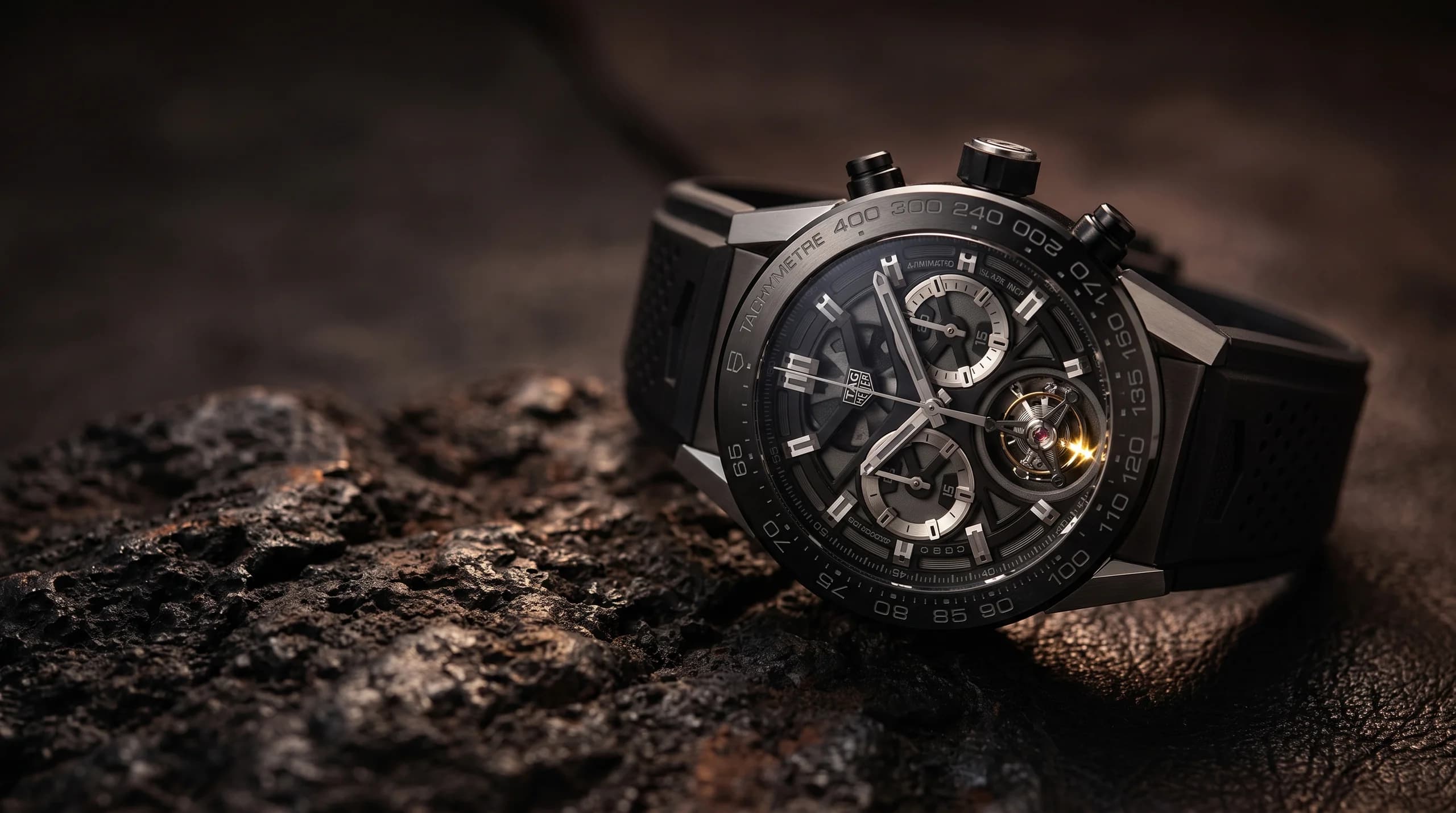
A tourbillon is a small rotating cage that holds the parts of a watch that keep time, spinning them slowly to cancel out the effect of gravity. It is the most famous complication in watchmaking, and also the most misunderstood. It was a clever fix for an old problem, it mostly does not solve that problem in a wristwatch, and it is still one of the most beautiful things a watch can do. Here is what a tourbillon actually is, and whether it is worth the money.
The images in this article are AI-generated for illustration. They are built from real reference photos of the actual watches discussed and are not photographs of specific inventory.
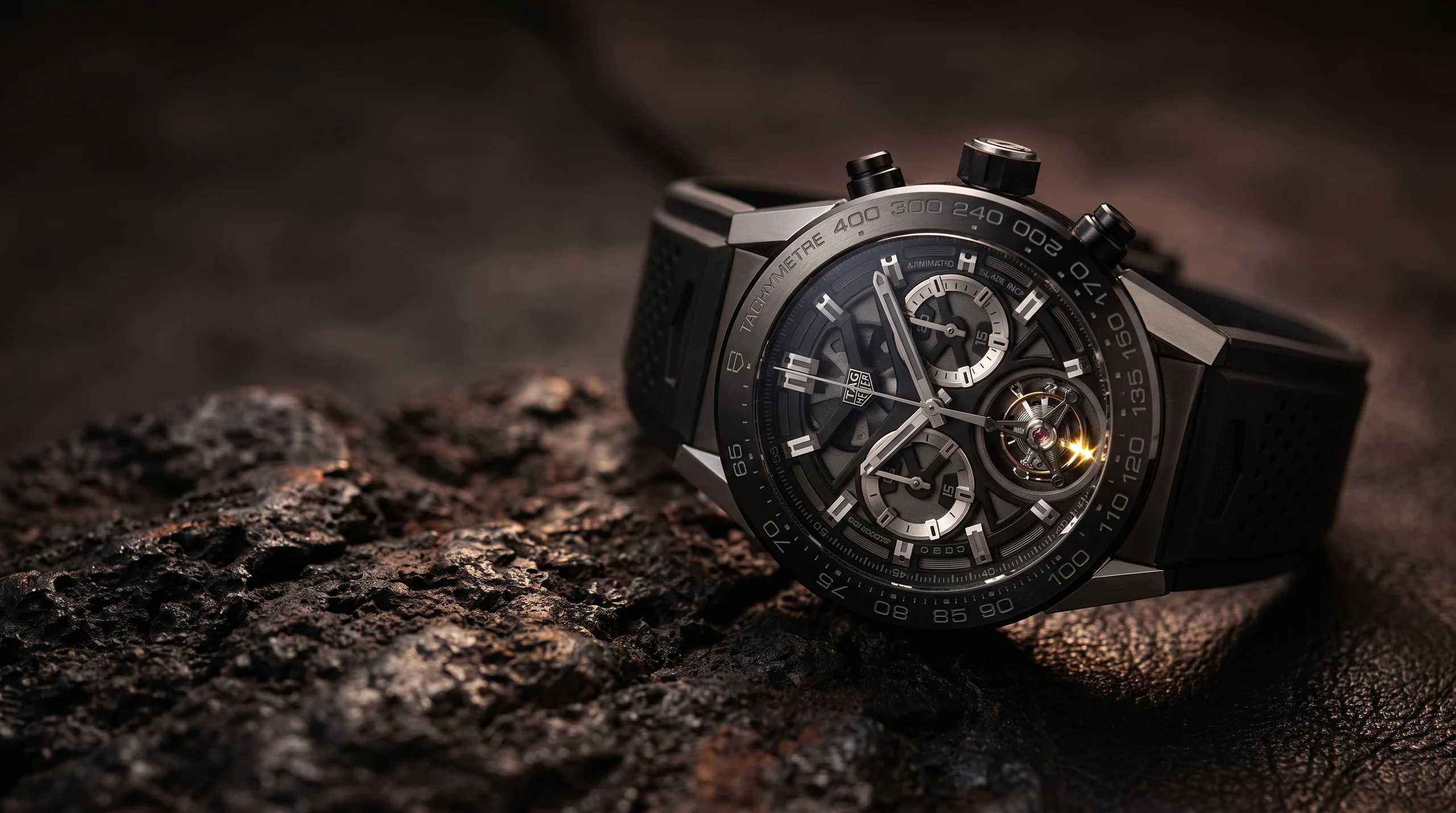 A tourbillon on display at 6 o'clock. The spinning cage is the whole point, and the reason people pay for it.
The short answer
A tourbillon puts the balance wheel and escapement, the timekeeping heart of the watch, inside a cage that rotates once a minute. In a pocket watch that sits in one position, that rotation averages out gravity's pull and improves accuracy. In a wristwatch that moves all day, the benefit is tiny. So a modern tourbillon is mostly a demonstration of watchmaking skill and a mesmerizing thing to watch, not a meaningful accuracy upgrade. Whether it is worth it depends entirely on how much you value craft.
How a tourbillon works
Every mechanical watch keeps time with an oscillating balance wheel regulated by the escapement. Gravity pulls on that balance, and when a watch sits in one vertical position for hours, that pull makes it run slightly fast or slow.
Abraham-Louis Breguet's idea, patented in 1801, was to mount the whole escapement and balance in a rotating carriage. As the cage turns, usually once per minute, the watch passes through every vertical position in turn, so the gravity errors average out instead of adding up. In a pocket watch carried upright in a waistcoat, that genuinely improved timekeeping.
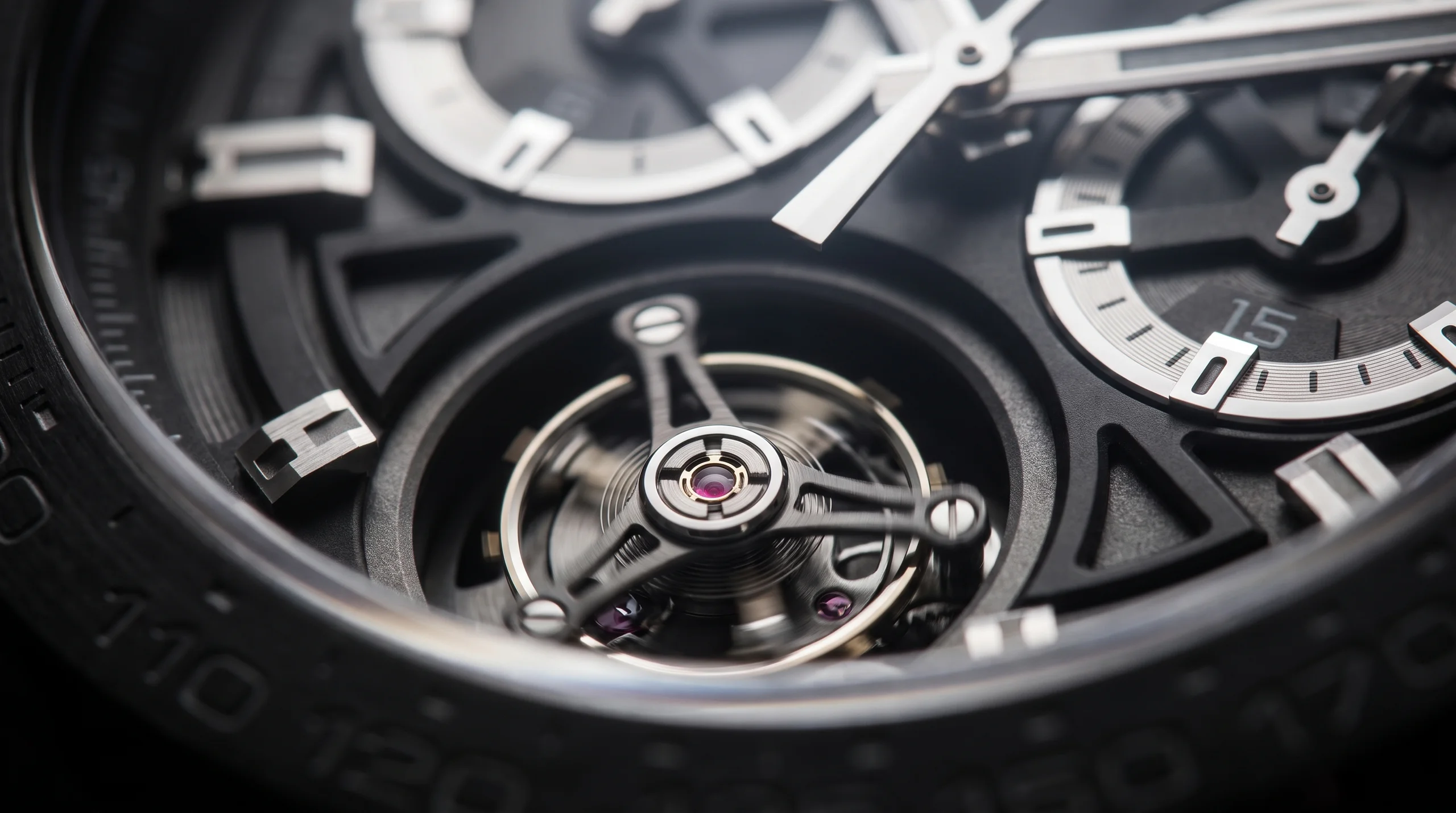 Inside the cage: the balance wheel and escapement, mounted so the whole assembly rotates.
Why it barely helps a wristwatch
Here is the honest part a lot of marketing skips. A wristwatch does not sit still. Your wrist moves it through countless positions every hour, which already averages out most of the gravity error a tourbillon was built to fix. Modern materials and regulation do the rest.
So in a wrist watch, a tourbillon adds very little accuracy, and it also adds complexity, weight, and cost that can work against precision. Nobody buys a tourbillon in 2026 because it keeps better time. They buy it for what it represents and how it looks.
What you are actually paying for
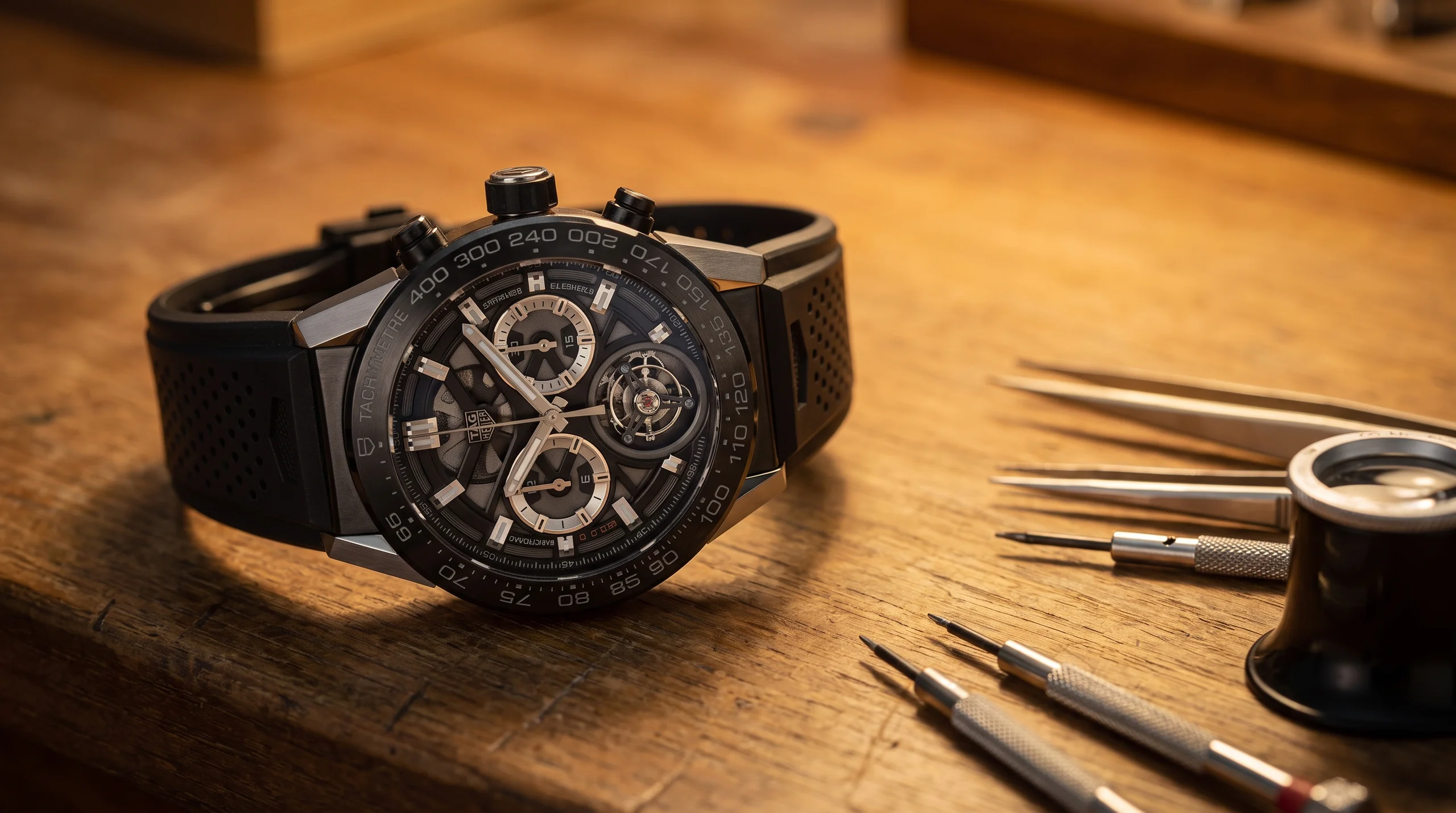 A tourbillon cage is one of the hardest things to build and finish by hand. That difficulty is the product.
A tourbillon cage is tiny, intricate, and brutally hard to build. It has to be light enough not to sap energy, perfectly balanced, and finished to a standard you can see under a loupe. Making one well is a genuine test of a watchmaker, which is exactly why it became the status complication.
That craft is the product. Prices start around 15,000 dollars for the most accessible options and climb into the hundreds of thousands for the top independents. Very cheap tourbillons exist, but they are usually about the look rather than the finishing, so buy on the maker, not the label. For where this sits in high-end watchmaking, see our reads on Richard Mille and the A. Lange & Söhne Lange 1. Not every independent chases the tourbillon at all. MB&F skipped it entirely on its Legacy Machine Sequential EVO, the brand's first chronograph, choosing to solve a switching problem between two independent chronographs instead. H. Moser & Cie. went the opposite direction with its Cosmic Rain, pairing a tourbillon with a cylindrical hairspring, a further refinement on Breguet's original fix, inside a minute repeater case.
Flying, multi-axis, and other variations
The classic tourbillon has a bridge over the top of the cage. A flying tourbillon, developed by Alfred Helwig in 1920, removes that upper bridge and supports the cage only from below, so it appears to float. It is harder to make and more dramatic to look at.
From there it escalates. Multi-axis tourbillons rotate the cage on two or three axes at once, which looks spectacular and averages gravity even in theory-defying ways. These are pure horological showpieces, closer in spirit to the complications we cover in our Vacheron Twin Beat piece than to anything practical.
A tourbillon fights gravity. A different complication entirely, the equation of time, exists to track something bigger: the actual gap between solar time and clock time. Our Equation of Time Explained piece covers the kidney-cam mechanism behind that one. A world timer solves a third, unrelated problem, showing every global time zone on one dial at once. Our World Time Complication Explained piece covers Louis Cottier's mechanism for that. And for a chiming complication built for a totally different purpose, Angelus recently revived its Tinkler 1958 Quarter Repeater.
Is a tourbillon worth it?
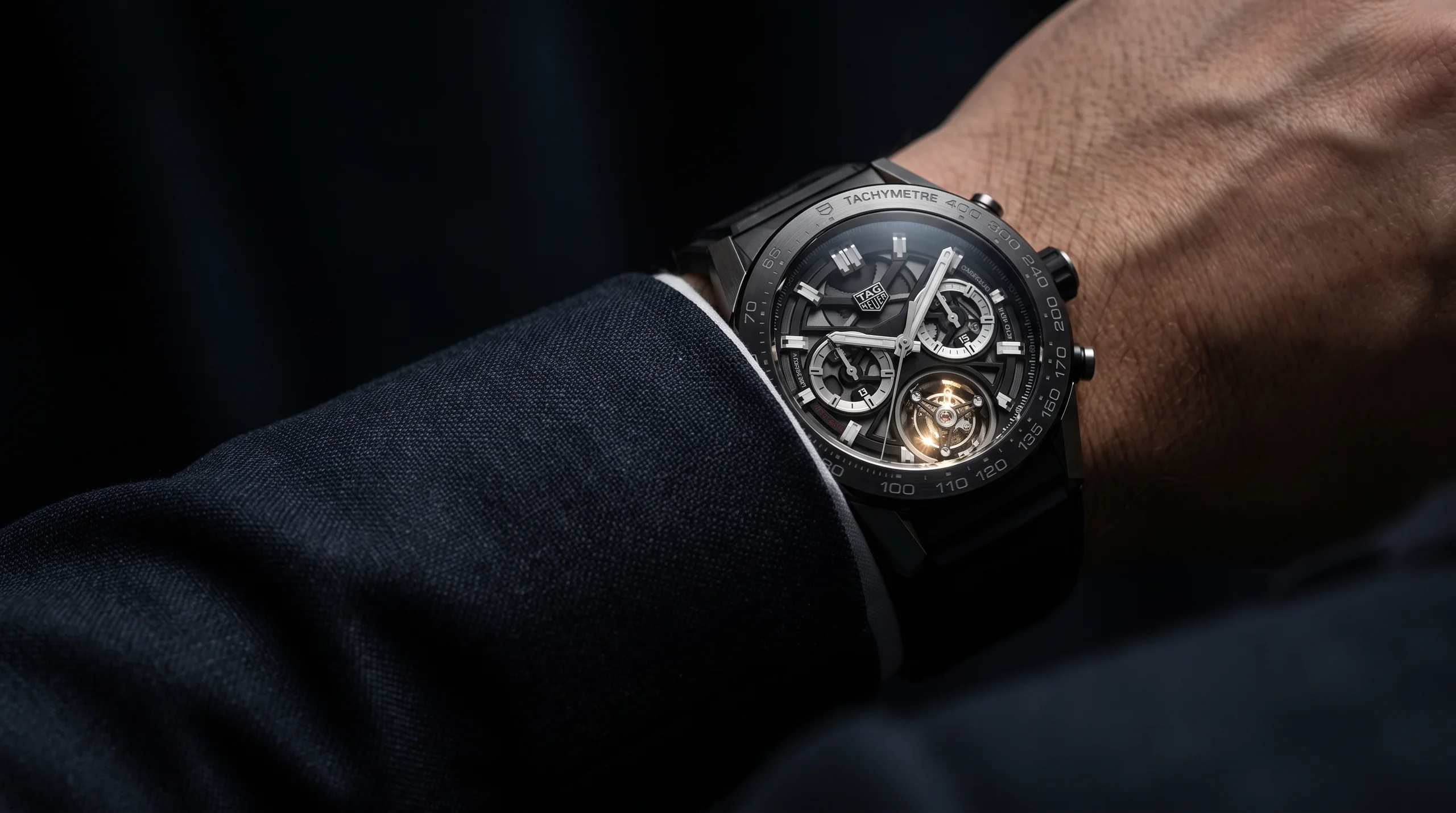 If you love watching it spin, that is a good enough reason. If you want accuracy, it is not.
If you want the best accuracy for the money, a tourbillon is the wrong purchase, and a good chronometer or a quartz watch will beat it. If you love mechanical watchmaking and the sight of a cage spinning on your wrist genuinely moves you, then it is worth exactly what it costs to you and not a cent more. Buy it with open eyes: for the art, not the timekeeping.
FAQ
What is a tourbillon?
A tourbillon is a mechanism that mounts a watch's balance wheel and escapement inside a small cage that rotates, usually once a minute. It was invented to average out the effect of gravity on the movement's accuracy. Today it is prized mainly as a display of watchmaking skill.
Does a tourbillon make a watch more accurate?
In a pocket watch held in one position, a tourbillon genuinely improved accuracy by averaging out gravity errors. In a wristwatch, which constantly changes position on its own, the benefit is negligible, so a tourbillon does not meaningfully improve accuracy today.
Who invented the tourbillon?
The tourbillon was invented by the watchmaker Abraham-Louis Breguet, who patented it in 1801. It was designed for the pocket watches of his era, which spent long periods in a single vertical position.
What is a flying tourbillon?
A flying tourbillon is a tourbillon with no bridge over the top of the cage, supported only from below. Developed by Alfred Helwig in 1920, it makes the cage appear to float, and it is more difficult to build than a classic tourbillon.
Is a tourbillon worth the money?
For accuracy, no, since a chronometer or quartz watch keeps better time for far less. For the craftsmanship, beauty, and the experience of owning one, a tourbillon is worth it if you personally value those things. It is a purchase of art and skill, not of precision.
Browse authenticated pre-owned complicated and haute horlogerie watches at 5dwatches.com, where every piece is inspected and authenticated before it ships.