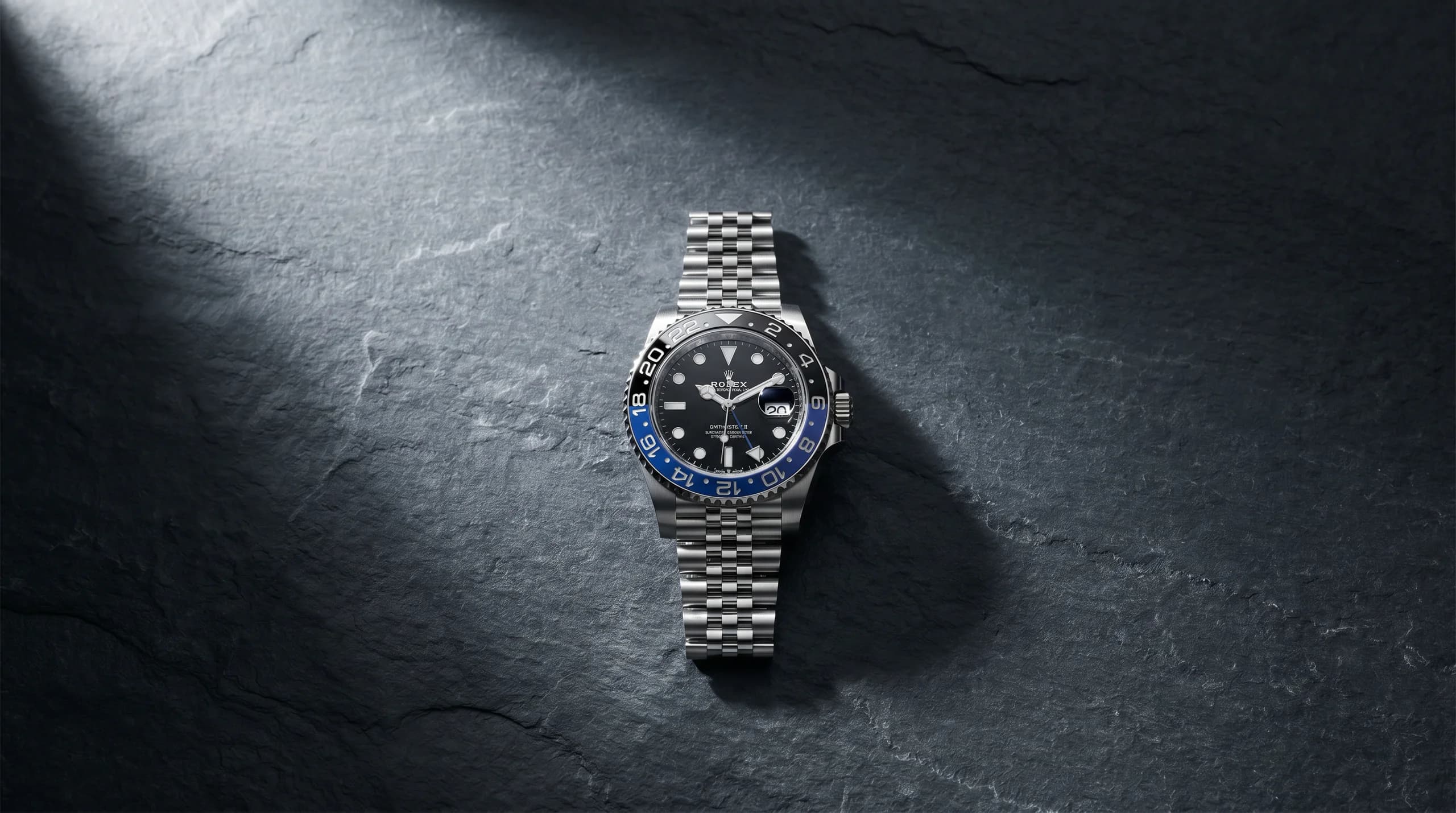
The Rolex GMT-Master II is the only purpose-built travel watch in the Rolex catalog and the most actively traded sport reference outside the Submariner. At Watches and Wonders 2026, Rolex restructured the lineup by quietly removing the Pepsi (126710BLRO in steel, 126719BLRO in white gold) from the new-models listing. The Coke replacement everyone expected did not arrive. That single change shifted the current steel GMT conversation from four colorways to three: Batman, Bruce Wayne, and Sprite.
This guide decodes every modern GMT-Master II reference: the current 126710/126720 family with caliber 3285, the 116710 ceramic generation that ran from 2007 to 2019, the two-tone and gold variants in both generations, the discontinued white gold Pepsi 116719BLRO, the LHD Sprite, and the vintage 16710 with the aluminum bezel still actively traded on the secondary market. Plus the 1675 and 16760 Fat Lady territory at the bottom edge of the lineup. All retail and pre-owned pricing as of May 2026.
All images in this post are AI-generated and may not perfectly represent the actual watch references discussed. They are intended for illustration only.
The Short Answer
The steel Batman/Batgirl 126710BLNR retails at $11,800 on Oyster and $12,000 on Jubilee. It trades on the secondary market between $15,500 and $17,500 depending on bracelet and condition. The Bruce Wayne 126710GRNR retails at $11,100/Oyster and $11,300/Jubilee, but trades higher than Batman at $19,000 to $23,000 secondary, the result of more constrained production. The Sprite 126720VTNR is the left-hand crown configuration with a green and black bezel, retailing in line with Batman.
The Pepsi 126710BLRO and the white gold Pepsi 116719BLRO were both removed from Rolex's 2026 new-models listing at Watches and Wonders. Neither was officially announced as discontinued (Rolex rarely does that directly), but the absence has been treated as a discontinuation across the dealer network. Secondary market prices climbed roughly $3,000 in the first 90 days after the W&W signal.
The previous-generation 116710LN (black bezel, 2007-2018) trades at $11,000 to $13,500. The original 116710BLNR Batman (2013-2019) sits at $14,000 to $16,500. Vintage 16710 with the aluminum bezel runs $11,000 to $18,000 depending on dial era and serial range.
For the decision tree: Batman/Batgirl for liquidity, Bruce Wayne for the most restrained current aesthetic, Sprite for the LHD novelty, the discontinued Pepsi for scarcity premium, vintage 16710 for collector territory.
A Brief Note on Generations
Three eras define the modern GMT-Master II conversation.
The 126710/126720 generation launched in 2018 with the Pepsi reintroduction. It carries the caliber 3285 with a 70-hour power reserve, the second-generation Cerachrom ceramic bezel, and the integrated bezel-into-case construction. The Batman/Batgirl on Jubilee bracelet (126710BLNR) joined the lineup in 2019. The Sprite (126720VTNR) launched in 2022 as the first LHD modern GMT. The Bruce Wayne (126710GRNR) debuted at Watches and Wonders 2024.
The 116710 generation ran from 2007 to 2019. The 116710LN (black bezel) was the first GMT-Master II with a Cerachrom bezel, replacing the engraved aluminum bezel that defined the reference for 50 years. The original Batman 116710BLNR launched in 2013 on Oyster bracelet only. The white gold 50th anniversary Pepsi 116719BLRO came in 2014.
The 5- and 6-digit generation covers the aluminum-bezel references. The 16710 (1989-2007) introduced caliber 3185 with three independently set hands. The 16700 (1988-1999) was the entry-level no-quickset version. The 16760 "Fat Lady" (1983-1988) was the first official GMT-Master II reference, introducing the independently adjustable 12-hour hand that defined the platform. Earlier than the 16760 sits the original GMT-Master 1675 (1959-1980), which is GMT-I territory rather than GMT-II.
The Current Steel Lineup: 126710 and 126720
The Pepsi exit reshaped this segment. Three colorways remain: Batman/Batgirl, Bruce Wayne, and Sprite. All share the 40mm Oystersteel case, the caliber 3285 movement, and the second-generation Cerachrom bezel. The differentiator is colorway and, for the Sprite, the LHD crown placement.
Batman/Batgirl: 126710BLNR
The 126710BLNR carries a blue-and-black Cerachrom bezel and ships on either Oyster (the "Batman") or Jubilee (the "Batgirl") bracelet. The 2019 launch on Jubilee earned the Batgirl nickname; the Oyster option was added in 2021. Both share the same reference number and identical mechanical specifications.
| Spec | Detail |
|---|---|
| Case | 40mm Oystersteel, 12mm thick, 100m water resistance |
| Bezel | Blue/black Cerachrom ceramic, 24-hour scale |
| Movement | Caliber 3285, 70-hour power reserve |
| Bracelet | Oyster (126710BLNR-0003) or Jubilee (126710BLNR-0002) |
| Retail (May 2026) | $11,800 Oyster / $12,000 Jubilee |
| Secondary market | $15,500 - $17,500 |
WatchCharts data through April 2026 puts the Batgirl Jubilee variant as the most popular GMT-Master II reference in production by transaction volume, ahead of even the Pepsi prior to its discontinuation. The Jubilee bracelet trades at roughly a 5% premium over the Oyster on the secondary market.
The Batman/Batgirl has never traded below retail across its entire price history. That has been true through every market correction since the reference launched.
Bruce Wayne: 126710GRNR
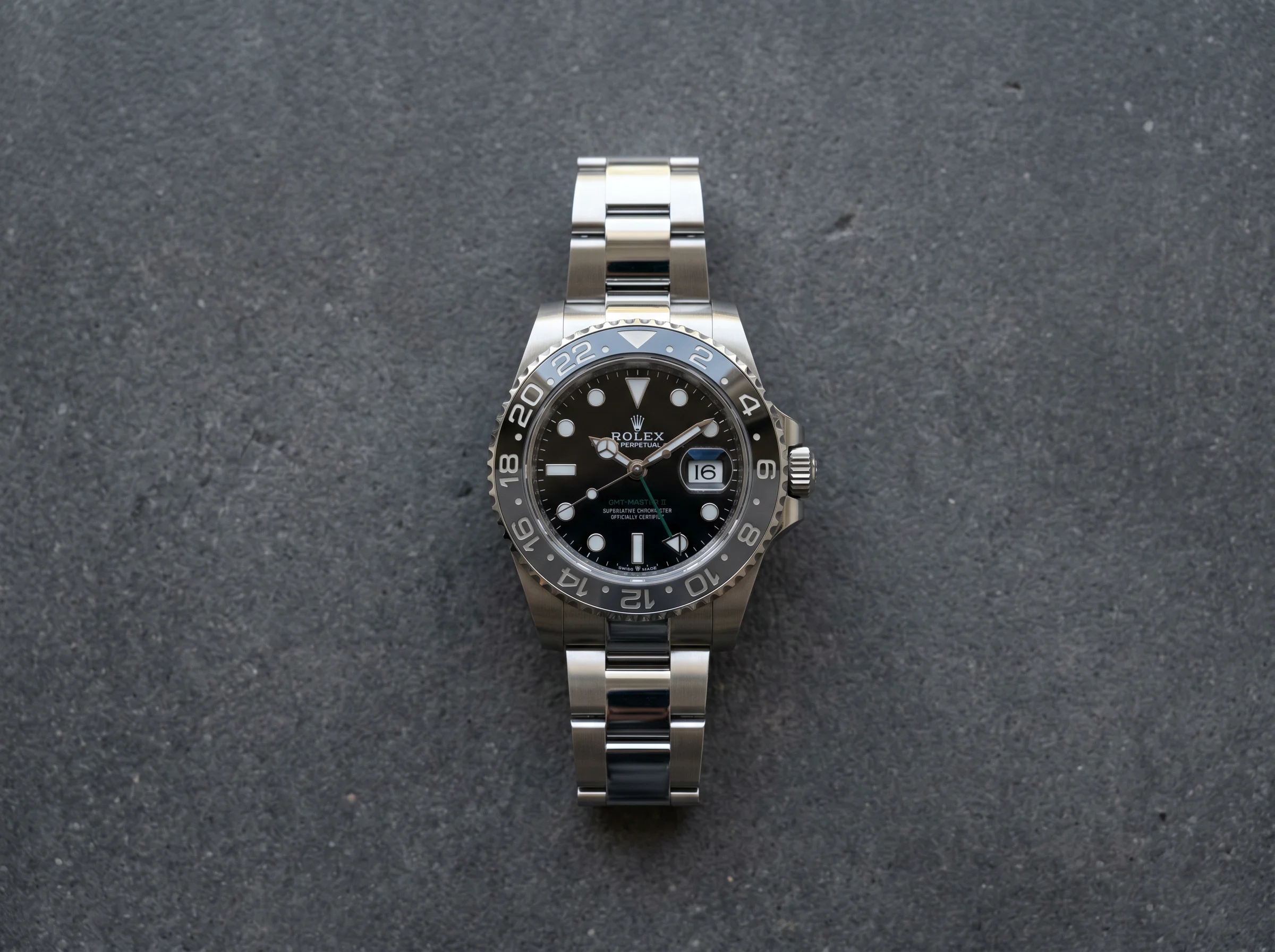 The Bruce Wayne pairs a grey and black Cerachrom bezel with a green GMT hand. The grey/black combination is the most restrained current colorway and trades at the largest premium over retail in the steel lineup.
The Bruce Wayne debuted at Watches and Wonders 2024 as the only steel sport release Rolex unveiled that year. The grey-and-black colorway is the most monochromatic configuration in the current steel lineup, which has driven strong office-wear demand. The reference uses a green GMT hand, the only steel GMT-Master II with this detail.
| Spec | Detail |
|---|---|
| Case | 40mm Oystersteel |
| Bezel | Grey/black Cerachrom ceramic |
| GMT hand | Green-tipped triangular |
| Retail (May 2026) | $11,100 Oyster / $11,300 Jubilee |
| Secondary market | $19,000 - $23,000 |
The Bruce Wayne trades at the largest premium over retail in the entire current steel lineup, more than the Batman/Batgirl and approaching former Pepsi premiums. WatchCharts categorizes the reference at a 58/100 risk score, classified as High Risk for short-term depreciation, which reflects the unusually wide gap between retail and secondary pricing on a current-production reference.
That divergence is the post-Pepsi market story. Bruce Wayne demand has absorbed a meaningful share of buyers who would have been on the Pepsi waitlist 18 months ago. See our breakdown in Batman, Bruce Wayne, or Sprite: Your Steel GMT-Master II Options Now for the comparison-level decision tree.
Sprite: 126720VTNR
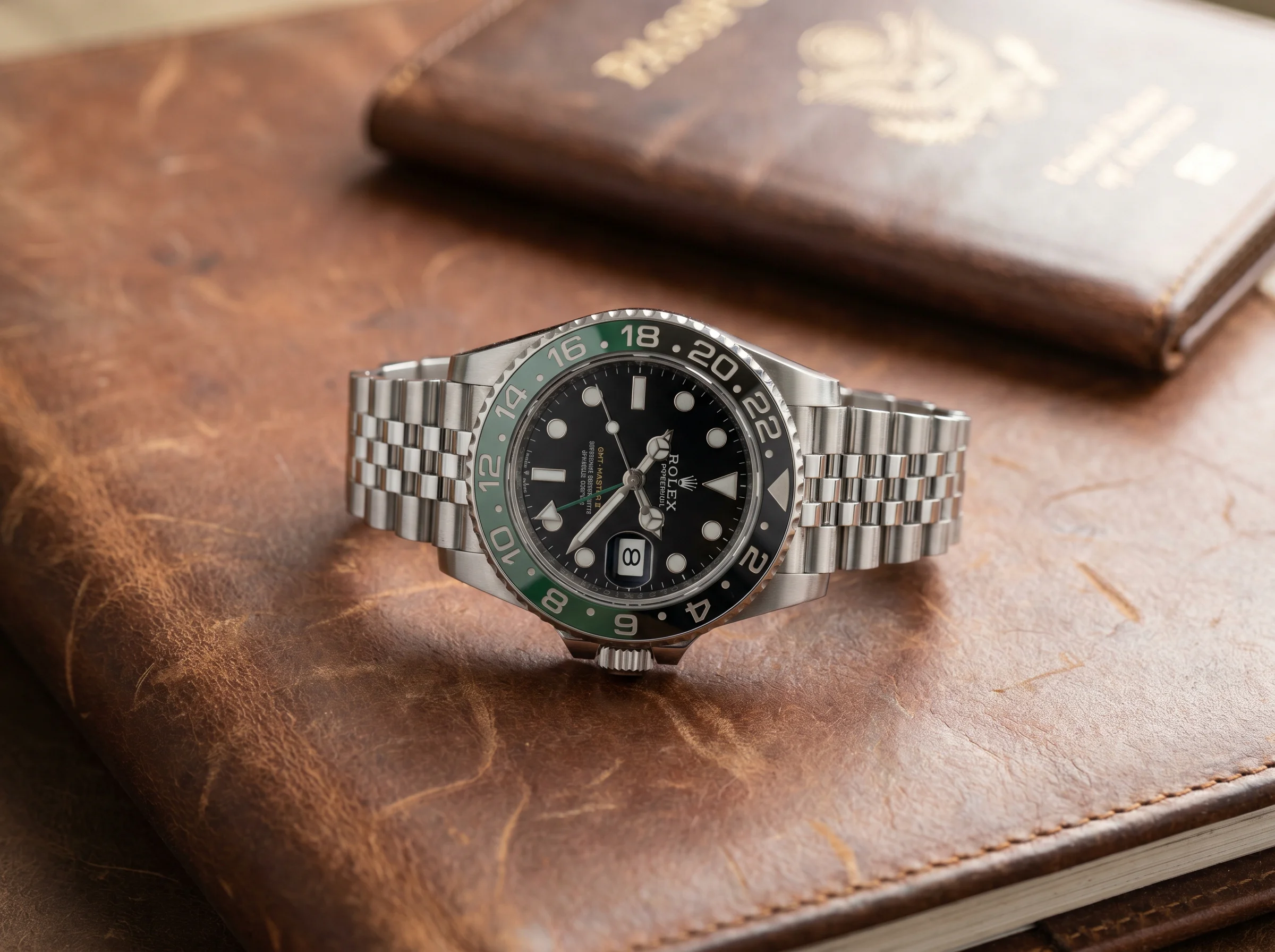 The Sprite is the first modern LHD Rolex sport watch. Crown and date window flipped to the 9 o'clock side. The reference number 126720 (not 126710) signals the left-hand configuration.
The Sprite launched in 2022 as the first left-handed (LHD or "destro") configuration in the modern Rolex sport catalog. The crown sits at 9 o'clock rather than 3, and the date window is flipped to the 9 o'clock position. The green-and-black Cerachrom bezel is unique to this reference.
| Spec | Detail |
|---|---|
| Reference | 126720VTNR |
| Case | 40mm Oystersteel, LHD configuration |
| Bezel | Green/black Cerachrom ceramic |
| Crown position | 9 o'clock (LHD) |
| Bracelet | Jubilee only |
| Retail (May 2026) | $11,800 |
| Secondary market | $16,500 - $19,000 |
The LHD configuration is the entire pitch. Lefties get a crown that no longer digs into the back of the hand. Right-handers buy it for the novelty. The Sprite has settled into a smaller secondary premium than Bruce Wayne but a larger one than Batman, reflecting limited LHD demand combined with constrained production.
The Pepsi: 126710BLRO (Discontinued at W&W 2026)
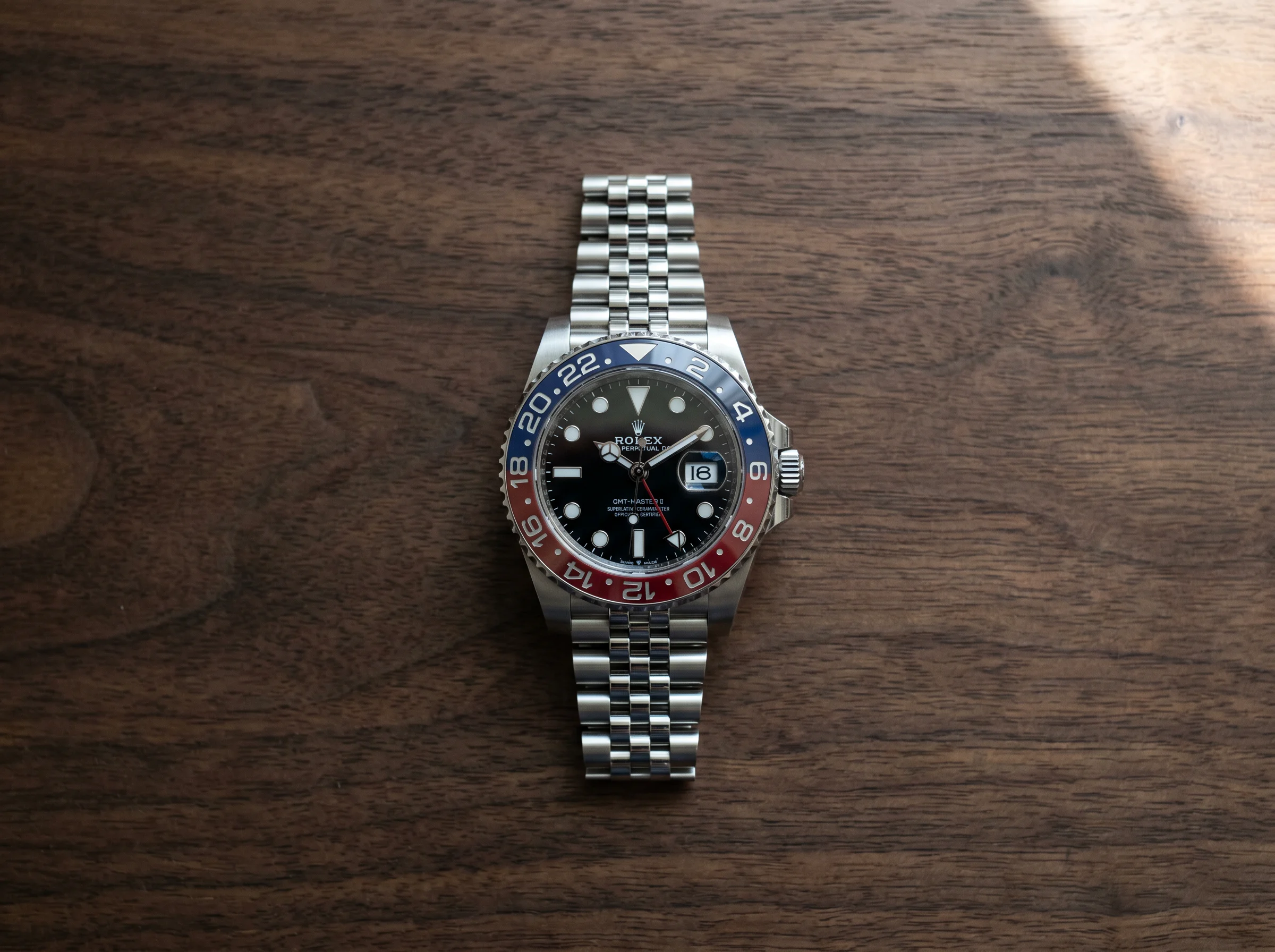 The 126710BLRO Pepsi was removed from Rolex's 2026 new-models listing in April. Secondary market prices climbed roughly $3,000 in the first 90 days after the W&W signal.
The 126710BLRO Pepsi was the headline discontinuation at Watches and Wonders 2026. It returned to the Rolex catalog in 2018 (the first steel Pepsi since 1999), ran for 8 years, and was quietly removed from the new-models listing this April. No Coke replacement arrived. We covered the market response in detail in our Pepsi GMT discontinuation market impact piece and the waitlist dealer advice for buyers who were in line at authorized dealers.
For pre-owned buyers, the Pepsi is now a secondary-market-only reference. Current pricing sits at $20,000 to $25,000, up roughly $3,000 from the W&W signal. The white gold Pepsi 116719BLRO is also gone from the catalog and trades from $35,000 to $45,000 on the secondary market depending on year and condition.
Whether the Pepsi returns in a future Watches and Wonders is the open question. Rolex has historically reintroduced discontinued references after multi-year breaks (the Pepsi itself returned in 2018 after a long gap). The market is pricing in some return probability but not a guaranteed one.
Two-Tone Rolesor and Gold
The 2024 expansion of the Bruce Wayne colorway into precious metals added several references to the catalog. The two-tone and full-gold tier in the current generation:
| Reference | Configuration | Retail (approx.) |
|---|---|---|
| 126711CHNR | Two-tone Rolesor, brown/black "Root Beer" | ~$16,800 |
| 126713GRNR | Two-tone Rolesor, grey/black "Two-Tone Bruce Wayne" | ~$17,500 |
| 126715CHNR | Everose all gold, brown/black Root Beer on Oysterflex | ~$38,400 |
| 126718GRNR | Yellow gold all gold, grey/black Bruce Wayne | ~$43,500 |
Two-tone Rolesor GMT-Master IIs trade close to retail on the secondary market, sometimes at a small discount. Full gold variants follow the broader gold sport-watch pattern: secondary pricing often beats retail thanks to the structural difficulty of getting through the boutique allocation line.
The Root Beer two-tone 126711CHNR has been steadily building a collector following since launch, helped by the brown-and-black colorway's connection to the vintage 16753 "Nipple Dial" Root Beer references. For buyers ready to step into two-tone, this is the most narratively interesting current option.
White Gold
Two white gold references in the current generation. One is discontinued.
126719BLRO Pepsi white gold: Removed from the 2026 catalog alongside the steel Pepsi. Retailed at $42,650 when active. Secondary market currently runs $35,000 to $45,000 depending on year and condition. This was always the lower-volume Pepsi configuration; the discontinuation eliminates the entire white gold Pepsi pathway.
126729VTNR Sprite white gold: Launched in 2024 alongside the steel Bruce Wayne. White gold case, green-and-black Cerachrom bezel, and a green ceramic dial (a Rolex first). Retail around $43,000. This reference replaces what would have been the white gold Bruce Wayne in the catalog logic, but the green colorway gives it its own identity.
The Previous Generation: 116710 Family
The 116710 generation ran from 2007 to 2019. The defining mechanical change was the caliber 3186 in the 116710LN, replaced by the caliber 3186 across the family. Cerachrom replaced aluminum for the bezel insert. The case proportions tightened slightly versus the outgoing 16710.
116710LN (Black Bezel, 2007-2018)
The 116710LN is the only modern Rolex GMT-Master II with an all-black Cerachrom bezel. Production ran from 2007 to 2018, when it was discontinued without direct replacement. The 24-hour bezel is solid black ceramic, which gives the reference its monochromatic identity in a lineup otherwise defined by colorways.
The 116710LN trades on the secondary market at $11,000 to $13,500 depending on year and condition. This is the most accessible modern ceramic GMT-Master II and the only path into a black-bezel modern Rolex GMT since the reference was discontinued. WatchCharts has consistently flagged it as the value entry point of the modern GMT-Master II family.
116710BLNR (Original Batman, 2013-2019)
The original Batman launched in 2013, the first GMT-Master II with the blue-and-black Cerachrom bezel. It shipped on Oyster bracelet only across its production run. Discontinued in 2019 when the 126710BLNR replaced it.
The 116710BLNR trades on the secondary market at $14,000 to $16,500. Clean examples with full sets command a premium. The reference benefits from being the first ceramic Batman, but the current-generation 126710BLNR offers an Oyster option, the Jubilee option, and the upgraded caliber 3285 at retail. For most buyers, the previous Batman is a value play rather than a collector play.
116719BLRO (White Gold Pepsi 50th Anniversary, 2014-2018)
The 50th anniversary Pepsi launched in 2014 in white gold. It carried the blue dial (a configuration that did not return in any 116710 successor) and the Cerachrom red-and-blue Pepsi bezel. Discontinued in 2018. Secondary market trades at $28,000 to $35,000 depending on condition and year.
Two-Tone and Gold 116xxx Variants
The 116710 generation included:
- 116713LN two-tone Rolesor with black bezel (2007-2019)
- 116718LN yellow gold all gold with black bezel (2007-2019)
Both follow the same secondary market pattern as their modern equivalents: two-tone trades close to retail, full gold often beats retail on the secondary market.
Vintage Territory: 16710, 16700, and the 16760 Fat Lady
 The 16710 ran from 1989 to 2007 with three bezel options: black, Pepsi, and Coke (red and black). The aluminum bezel ages with character that ceramic cannot reproduce, which is the entire collector pitch.
The 16710 reference ran from 1989 to 2007 with three aluminum bezel options: black ("Black"), red and blue ("Pepsi"), and red and black ("Coke"). The reference is the most actively traded modern-vintage GMT-Master II on the secondary market. Production spanned 18 years across multiple caliber updates and dial generations.
| 16710 Variant | Secondary Market |
|---|---|
| 16710 Pepsi (aluminum) | $13,000 - $18,000 |
| 16710 Black | $11,000 - $14,500 |
| 16710 Coke | $14,000 - $19,000 |
The serial range drives most of the pricing variation. Early "Spider Dial" examples (1989-1990) carry meaningful premiums when documented. Tritium-dial examples (pre-1998) sit on a separate market from Luminova-era examples (1998-2007). The transition to Super-LumiNova happened around 2004.
The 16700 is the no-quickset version that ran from 1988 to 1999. The 16700 shipped only with the Pepsi or black bezel. Secondary market sits at $10,000 to $14,000 with clean Pepsi examples commanding the top of the range. The lack of quickset date means setting the watch requires advancing through 24 hours, which is a real-world inconvenience that the 16710 solved.
The 16760 "Fat Lady" ran from 1983 to 1988. This was the first GMT-Master II reference, introducing the independently adjustable 12-hour hand that has defined the platform since. The case is noticeably thicker than the 16710 ("Fat Lady"). Production was limited; clean Fat Lady examples trade at $16,000 to $24,000. This is the start of the GMT-Master II lineage and the most historically significant reference in vintage territory.
For authentication on any 5- or 6-digit GMT-Master II, see our pre-owned Rolex authentication checklist and Frankenwatch primer. Vintage GMT-Master II references attract more parts-swap attempts than almost any other Rolex sport reference, particularly around dial and bezel insert originality.
The Movement: Caliber 3285 in Context
The caliber 3285 launched with the Pepsi 126710BLRO in 2018. It is the second generation of the in-house GMT-Master II movement, following the caliber 3186 (2007-2018) and the caliber 3185 (1989-2007).
| Spec | Caliber 3285 |
|---|---|
| Frequency | 4 Hz (28,800 vph) |
| Power reserve | 70 hours |
| Jewels | 31 |
| GMT | Independently adjustable local hour hand, 24-hour bezel |
| Balance spring | Blue Parachrom paramagnetic |
| Shock protection | Paraflex |
| Certification | Superlative Chronometer (-2/+2 sec/day) |
| Hacking | Yes |
The mechanical character of the 3285 is the independently adjustable local hour hand, which is the function that defines a true GMT-Master II. The local hour hand can be jumped forward or backward in one-hour increments without affecting the minute hand, the seconds hand, or the home-time GMT hand. That capability is what separates the GMT-Master II from a 24-hour "caller" GMT like the standard Datejust GMT movement.
The 3285 carries a 70-hour power reserve, up from the 50-hour 3186. The Chronergy escapement is the same upgraded escapement Rolex introduced across the 32xx caliber family. The blue Parachrom hairspring is paramagnetic and shock-resistant to roughly 10 times the level of a traditional Nivarox spring.
Service intervals run 7 to 10 years on a properly worn 3285, consistent with the broader Rolex caliber 32xx family. Master Chronometer is not a Rolex designation; the brand uses its own Superlative Chronometer certification, which holds the movement to -2/+2 seconds per day across a full test protocol.
What Should You Actually Buy?
If you want maximum liquidity: The steel Batman/Batgirl 126710BLNR. It is the most actively traded GMT-Master II reference in production, the easiest to sell when you want to exit, and the colorway with the strongest brand recognition outside collector circles. Jubilee bracelet for collectors, Oyster for daily-wear simplicity.
If you want value per dollar: The 116710LN. The only modern Rolex GMT-Master II with an all-black bezel, discontinued in 2018, currently trades $4,000 to $6,000 below the current Batman. Same case dimensions, same 40mm proportions, slightly older caliber 3186 with 50-hour power reserve instead of 70. For a daily-wear buyer, the difference is negligible.
If you want the most restrained current colorway: The Bruce Wayne 126710GRNR. The grey-and-black Cerachrom reads as monochromatic and works equally under a cuff or with a polo. The green GMT hand is the only flash of color. Trades at the largest current-production premium over retail, which is the cost of the office-friendly aesthetic.
If you want LHD novelty: The Sprite 126720VTNR. The crown on the left genuinely changes how the watch wears. Lefties get an obvious functional benefit. Right-handers buy it for the visual story.
If you want the discontinued Pepsi: The 126710BLRO or the white gold 116719BLRO. Both are secondary-market-only now. The steel runs $20,000 to $25,000, the white gold $35,000 to $45,000. Whether the Pepsi returns in a future Watches and Wonders is unknown. Current pricing has not yet absorbed full scarcity premium.
If you want vintage territory: The 16710 with the aluminum Pepsi bezel. Production from 1989 to 2007, three bezel options, aluminum patina that ceramic cannot reproduce. Tritium-dial examples (pre-1998) carry the most collector weight. Clean examples with full sets trade at the top of the range. For the start of the GMT-Master II lineage, the 16760 Fat Lady is the historical reference.
If you want a GMT but not a Rolex: The Tudor Black Bay 58 GMT. 39mm METAS-certified, half the price, and an honestly competitive alternative for buyers who don't need the Rolex crown specifically. See our Tudor BB58 GMT analysis for the case we made when the reference launched.
The Working Dealer's Bottom Line
The GMT-Master II is the Rolex sport reference most directly affected by the 2026 catalog restructuring. The Pepsi exit removed the colorway that defined the lineup since 1955. The Bruce Wayne expansion in 2024 added a new pricing anchor at the top of the steel range. The Sprite established LHD as an active platform rather than a novelty. The discontinued 116710LN remains the most actively traded black-bezel modern GMT.
For collectors building a Rolex sport pillar alongside the Submariner, Datejust, and Daytona, the GMT-Master II is the travel anchor. The 126710BLNR is the modern conversation. The 16710 is the vintage entry. The discontinued 126710BLRO Pepsi is the scarcity statement. The Bruce Wayne is the current premium play.
If a GMT feels like overkill for how you actually travel, our 5 Best Rolex Watches to Buy in 2026 still names the Pepsi 126710BLRO the pick for travel, alongside the strongest current option in every other lane.
For buyers approaching their first Rolex sport watch, see our Submariner versus GMT-Master II first-sport-watch comparison for the decision tree between those two specifically. For broader 2026 Rolex catalog context, our 30-day post-W&W market check covers the Pepsi surge, the Cookie Monster surprise, and other knock-on effects from the spring discontinuations.
Pricing across the GMT-Master II lineup will continue to move on Pepsi-return speculation and on the broader Rolex Market Index direction. Buyers who treat secondary-market pricing as the real retail floor and authorized-dealer pricing as a theoretical allocation discount will read the market correctly.
Browse authenticated pre-owned Rolex GMT-Master II at 5dwatches.com/shop/rolex?series=GMT+Master-II.