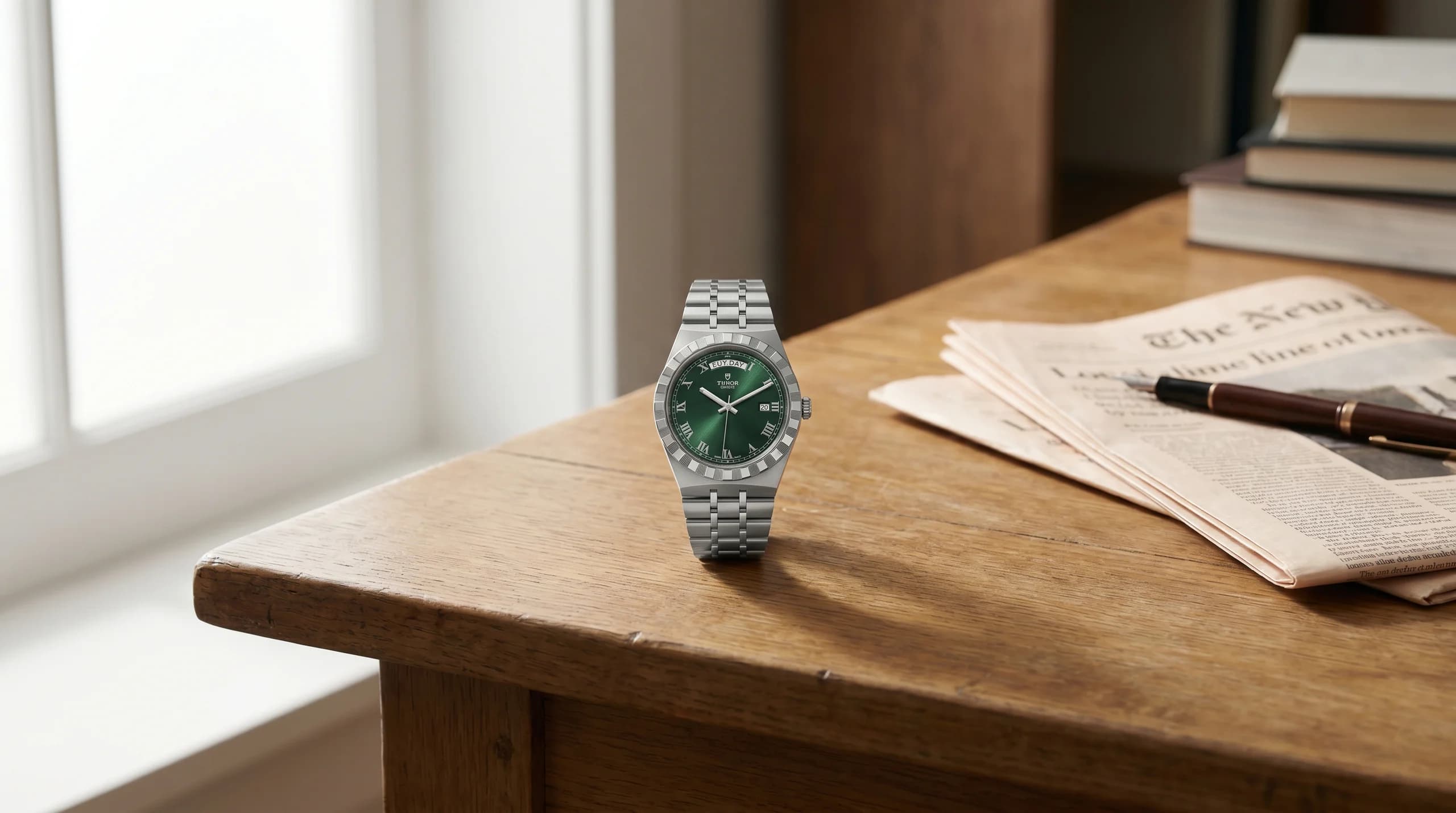
The short answer: The Tudor Royal has spent years as the line enthusiasts loved to dismiss: a derivative, integrated-bracelet Datejust impression running a bought-in movement. The 2026 relaunch quietly fixed nearly every legitimate complaint. It now carries in-house COSC chronometer calibers, a real day-date at 40mm, and cleaner dials, starting at $3,250 in steel. The reflex to write it off is out of date.
Ask a watch enthusiast about the Tudor Royal and you will usually get a smirk. For most of its life it earned that reaction.
Then Tudor relaunched the entire line at Watches and Wonders 2026, in the brand's centenary year, and the smirk stopped making sense. This is the rare update that addressed the actual criticisms rather than just reshuffling dial colors.
The images below are AI-generated illustrations created for this article and do not represent specific watches offered for sale.
The case against the old Royal was fair
Let us steelman the critics, because they were not wrong.
The previous Royal looked like a budget mashup of a Datejust and a Day-Date, integrated bracelet and all. It ran the T601, an outsourced Sellita-based movement, which sat awkwardly against the in-house calibers powering the rest of Tudor's catalog. The size range of 28, 34, 38, and 41mm was scattered, and the lower half of the dial sat empty in a way that read as unfinished. For a brand that built its modern reputation on the Black Bay and Pelagos, the Royal felt like the afterthought.
What 2026 actually changed
The relaunch is not cosmetic. Tudor rebuilt the mechanical core and tightened the range.
| Old Royal (2020-2025) | 2026 Royal | |
|---|---|---|
| Movement | Outsourced, Sellita-based T601 | In-house MT, COSC chronometer |
| Sizes | 28 / 34 / 38 / 41mm | 30 / 36 / 40mm |
| 40mm function | Date-day on the 41mm | True day-date (MT5633) |
| Dial | Roman numerals, empty lower half | Cleaner baton option, chronometer text |
| Clasp | Standard | T-Fit micro-adjust |
Each size now gets its own manufacture caliber: the MT5201 in the 30mm time-only with a 50-hour reserve, the MT5412 in the 36mm date model, and the MT5633 in the 40mm day-date, the latter two carrying 70-hour reserves. All three are COSC-certified at -2/+4 seconds per day, in 100m water-resistant cases. The cleaner stick-marker dials, shown below, are the visual fix the line always needed.
 The 36mm with baton markers and a light blue dial is the version reviewers keep singling out.
The day-date is the real headline
The 40mm is where this gets interesting. It is a genuine day-date, the complication enthusiasts associate with the Rolex Day-Date, in an integrated-bracelet steel sports watch at $3,675.
The comparison writes itself. People look at the new Royal and name two Rolex models: the Day-Date for the layout and the new Land-Dweller for the integrated bracelet. The Royal delivers that silhouette and a manufacture chronometer movement for a fraction of either. This is the same value gap we covered in Rolex versus Tudor, now applied to the dressier end of the catalog.
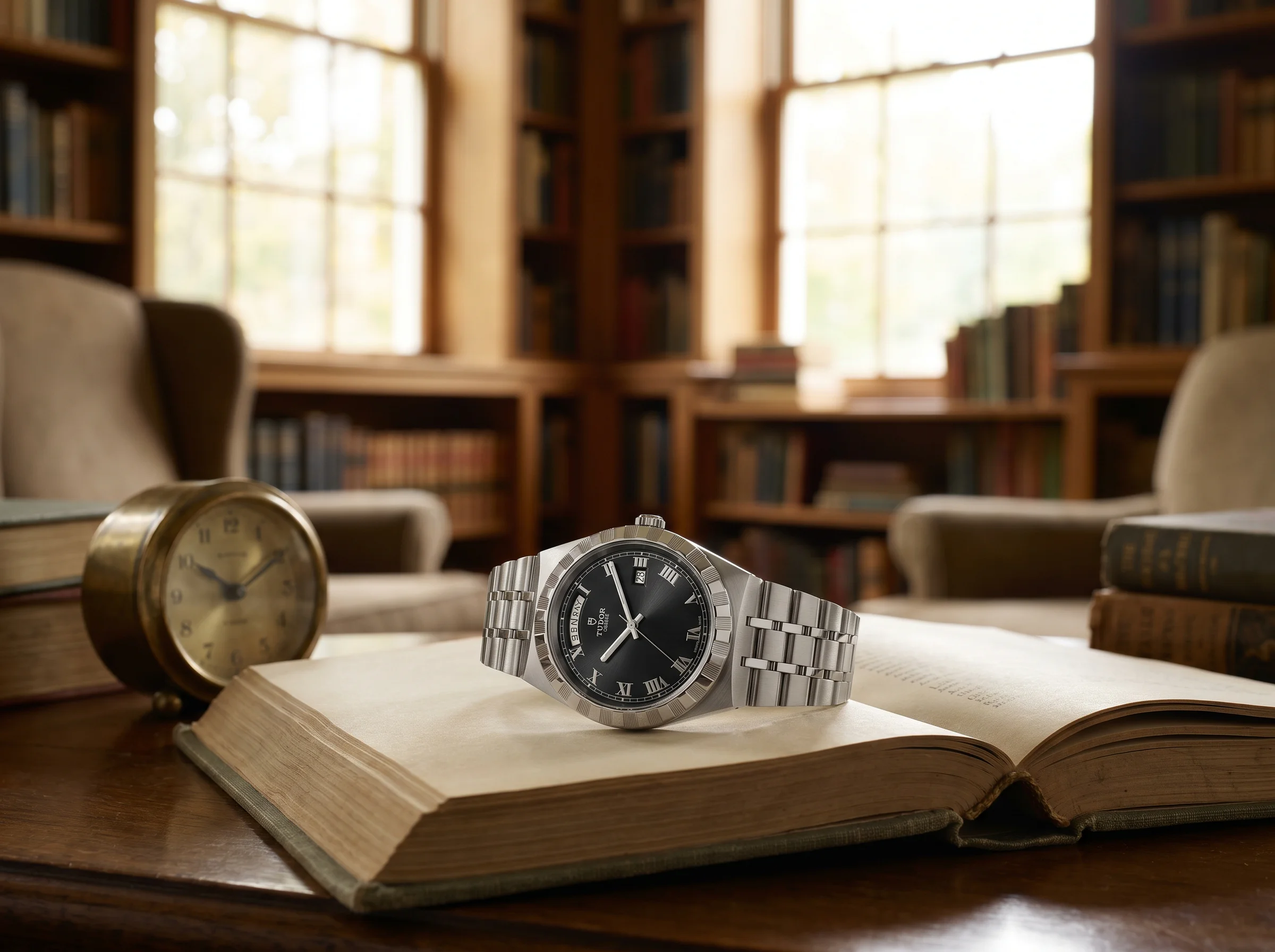 The 40mm day-date is the configuration that earns the Royal a second look.
Pricing is still the Tudor story
Steel models run $3,250 for the 30mm, $3,425 for the 36mm, and $3,675 for the 40mm. Two-tone steel and yellow gold adds roughly $2,500, pushing the 40mm two-tone to $6,325, with diamond-set options higher still. The collection spans 23 references in total.
For most buyers the steel 40mm at $3,675 is the sweet spot, and the 36mm light blue at $3,425 has become the reviewer favorite. The two-tone exists for a specific taste.
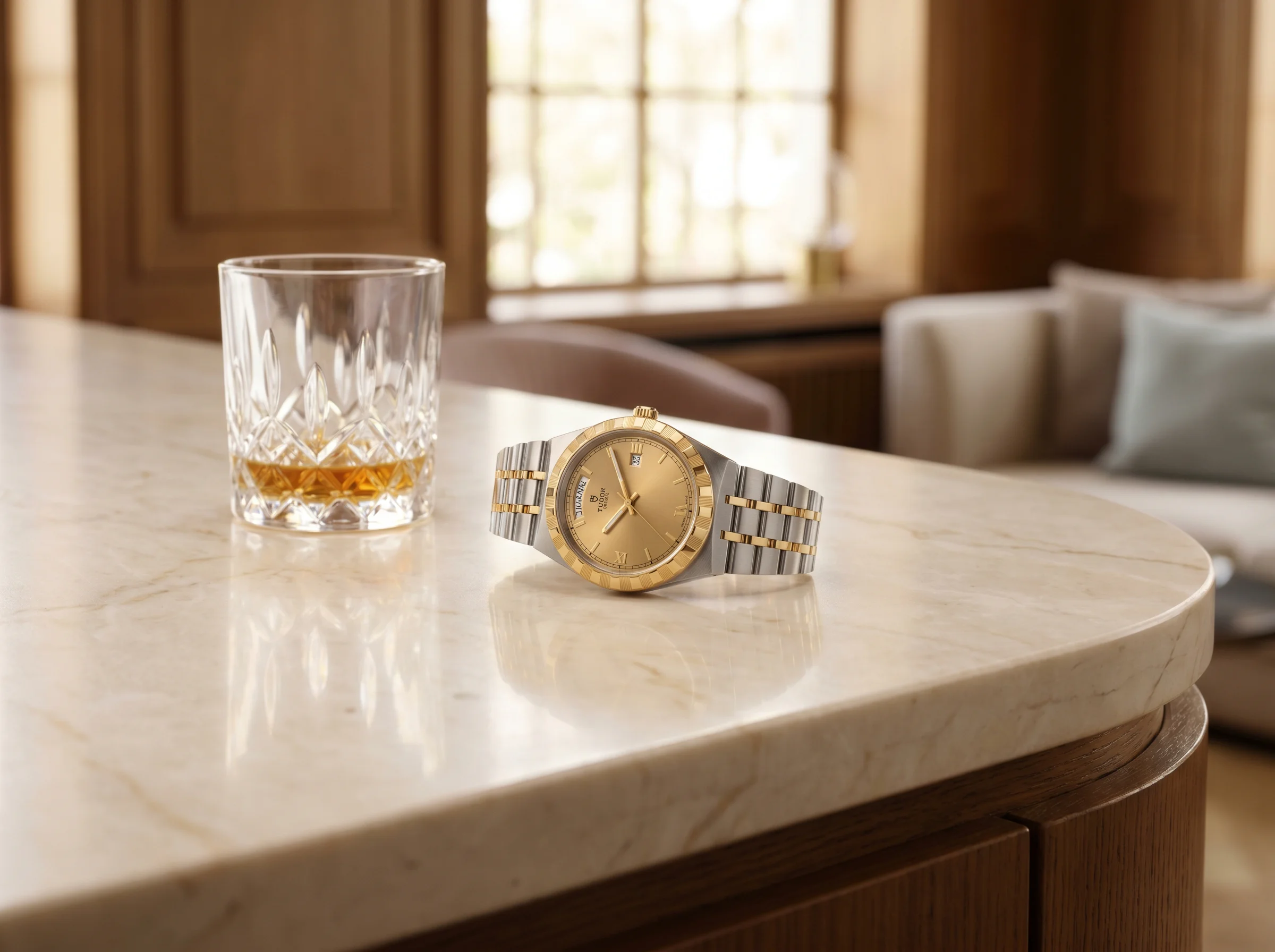 The two-tone champagne is the most divisive branch of the new range.
Where it still falls short
This is not a coronation. The honest caveats matter.
The Royal still wears its influences openly, and the engine-turned checkerboard bezel remains a love-it-or-hate-it detail. The two-tone is a hard sell at over $6,000 when the steel does the same job for less. And the larger truth for any buyer: Tudor's secondary-market values are soft, and the Royal has historically depreciated faster than the Black Bay or Pelagos.
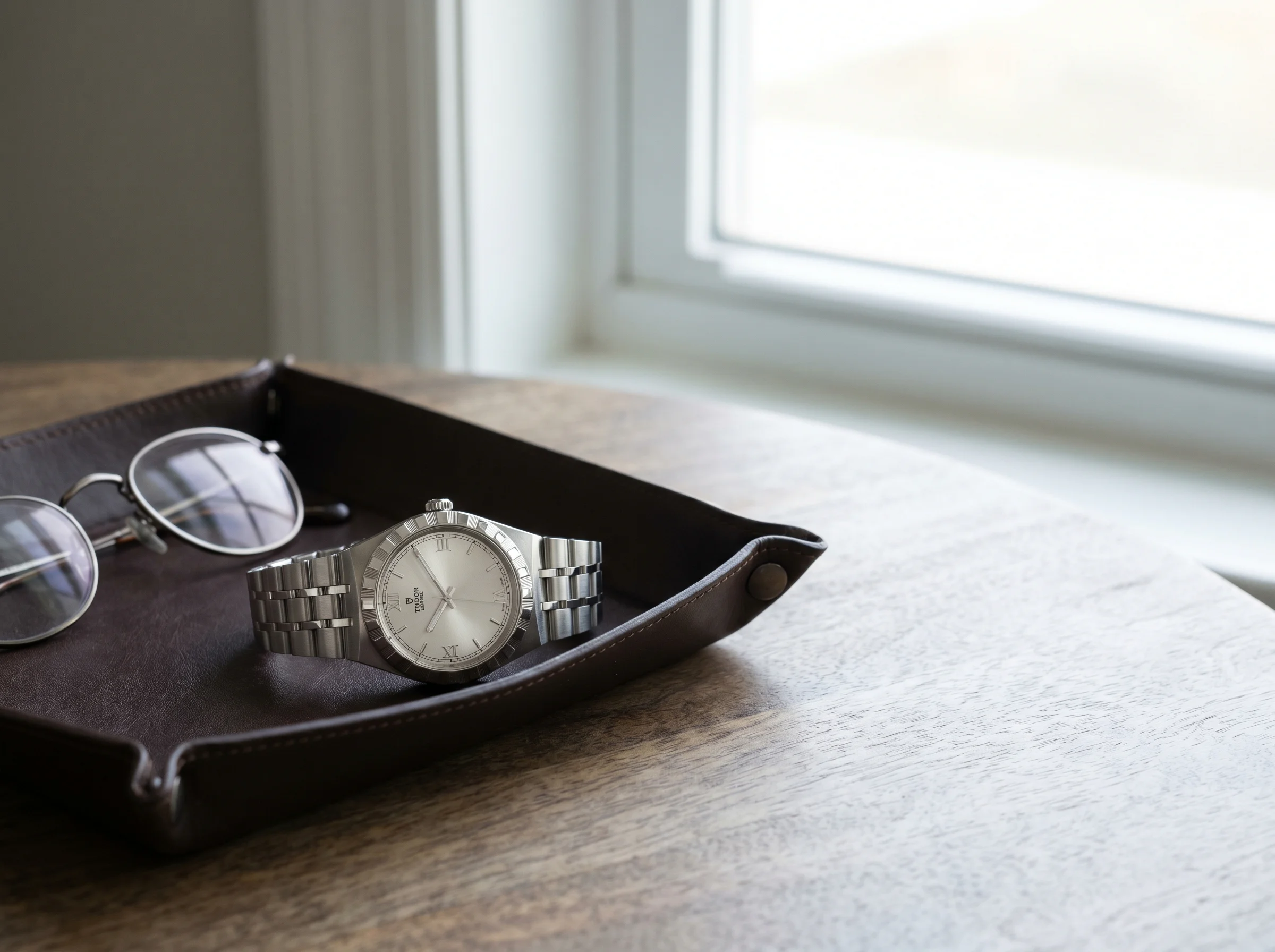 The 30mm no-date rounds out the range for smaller wrists.
The dealer's read
There are two honest ways to play the Royal.
Buy it new if you want the most watch-for-money integrated day-date on the market, a manufacture COSC chronometer with Rolex looks at $3,675, and you can accept that it will lose value the way most Tudors do. That depreciation is not a flaw in the watch, it is just the brand's reality, and it sits squarely in the contracting middle of the market we mapped at 5dwatches.com/blog/swiss-watch-market-barbell-split-2026.
The value play is the other side of that coin. The now-discontinued 28, 34, 38, and 41mm Royals are sliding toward $2,000 on the secondary market, and that is real money for an integrated-bracelet automatic, even with the older movement. We made the broader version of this argument in the value that built Tudor's name now living in its outgoing pre-owned models, and the Royal is the cleanest example yet. For the contrarian buyer, the line everyone dismissed is finally worth a serious look, and so is the revived Monarch beside it.
Browse our authenticated pre-owned Tudor at 5D Watches.