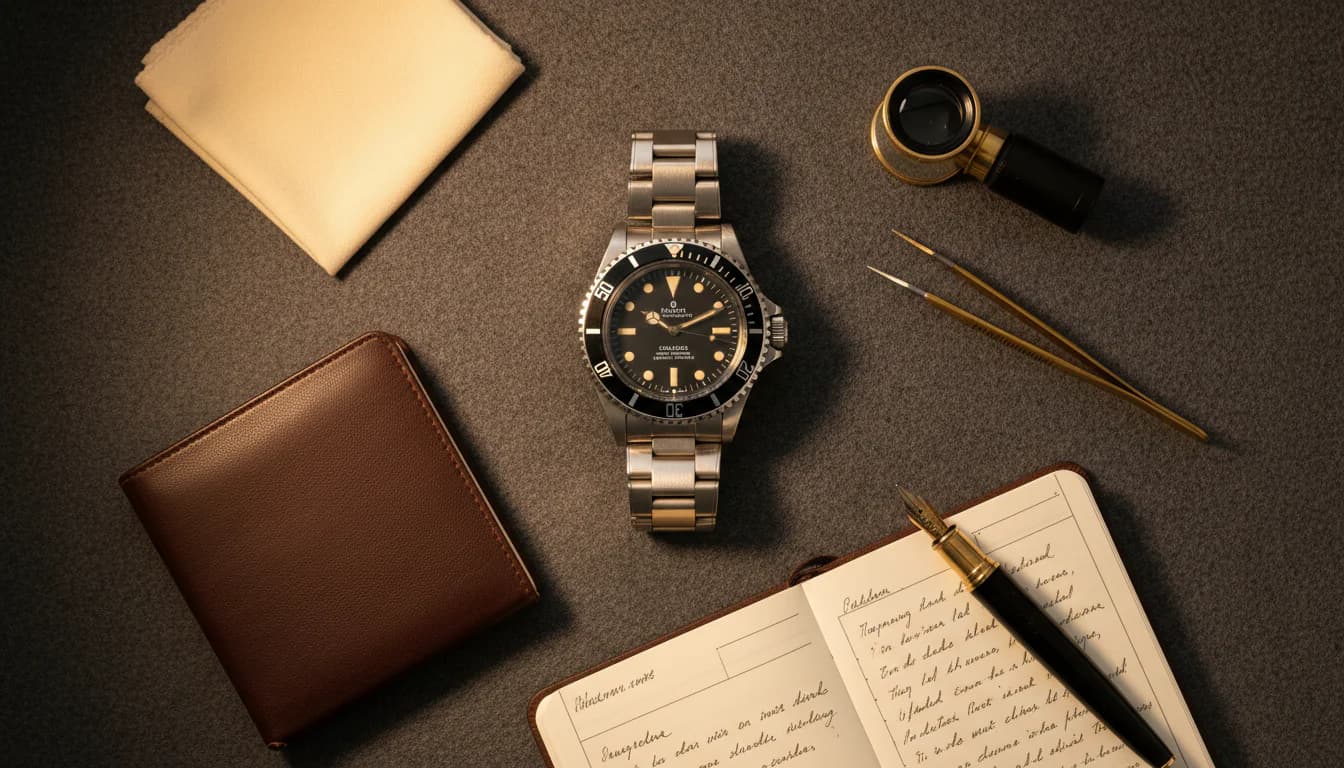
"Frankenwatch" is the most overused phrase in the vintage Rolex market. It also covers a real risk every pre-owned buyer should understand. Here is the practical primer, with the specific things that betray a frankenwatch and the gray areas that do not.
All images in this post are AI-generated and may not perfectly represent the actual watch references discussed. They are intended for illustration only. For verified Rolex reference photography, see rolex.com.
The short answer
A frankenwatch is a watch with parts swapped between references or eras and presented as if it left the factory that way. That is the line. A modified watch that the seller fully discloses ("service dial replaced in 2019, hands relumed by an independent watchmaker") is honest. A watch with the same modifications described as "all original" is a frankenwatch.
The dial alone can drive up to 90% of a vintage Rolex's market value. Authentication is the difference between buying smart and buying a $30,000 lemon.
Why frankenwatches exist
There are four common reasons a Rolex ends up with mixed parts.
Authorized service replacement
Rolex Service Centers offer to replace aged parts during a service: a dial with detached lume, hands with corroded fill, a faded bezel insert, a bracelet with stretch. The replacement parts are genuine Rolex. They are also typically newer-production examples that do not match the rest of the watch. Per Bob's Watches' guide to vintage Rolex dials, even when Rolex itself uses authentic factory parts to update an older watch, the deviation from original configuration reduces collector value.
If the previous owner asked for a service dial in 2018 and did not keep the original, that is a service-dial Submariner. Genuine. Not original.
Independent watchmakers and the parts bin
Watchmakers servicing vintage Rolex outside the factory sometimes use whatever genuine parts are available, especially when an original has been damaged beyond repair. Sometimes the swap is well-intentioned. Sometimes the original part goes back into circulation as a frankenwatch component for the next watch.
Deliberate fakery
The deliberate version is straightforward: a seller assembles a desirable configuration from parts of varying provenance and lists it at a price the original would command. Per Chrono24 Magazine, the line between a disclosed modified watch and a frankenwatch is the seller's intent. Disclosure is the line.
Recasing and rebuilding
The extreme case: a vintage movement housed in a modern case, or a complete watch built from disparate parts that resemble a known reference. These are functionally new watches wearing old DNA.
The dial: where authentication starts
The dial is the single most important authentication target on a vintage Rolex. Three things matter most.
Lume material text
Rolex's lume formulation has changed several times since the 1950s, and the small text near the bottom of the dial (typically around the 6 o'clock position) records which era the dial is from.
| Lume era | Dial text | Approximate years |
|---|---|---|
| Radium | "SWISS" or no marking | Pre-1962 |
| Tritium | "SWISS T<25", "T SWISS T", "T<25" | ~1962 to 1998 |
| Luminova | "SWISS" | 1998 to 1999 |
| Super-LumiNova / Chromalight | "SWISS MADE" | 2000 onward |
If the dial reads "SWISS MADE" but the case serial dates the watch to 1980, the dial has been replaced.
Service replacement markers
Rolex sometimes marks service-replacement dials with subtle differences from original-production dials: small asterisks, different printing depth, brackets around lume markings. These markers vary by era and are best verified against confirmed period reference imagery.
Aging consistency
A 1975 dial should show 50 years of aging. A glass-clear, sharp-printed, bright-lume dial on a 1975 case is either a service dial or a complete redial. The first is genuine but newer. The second is fake.
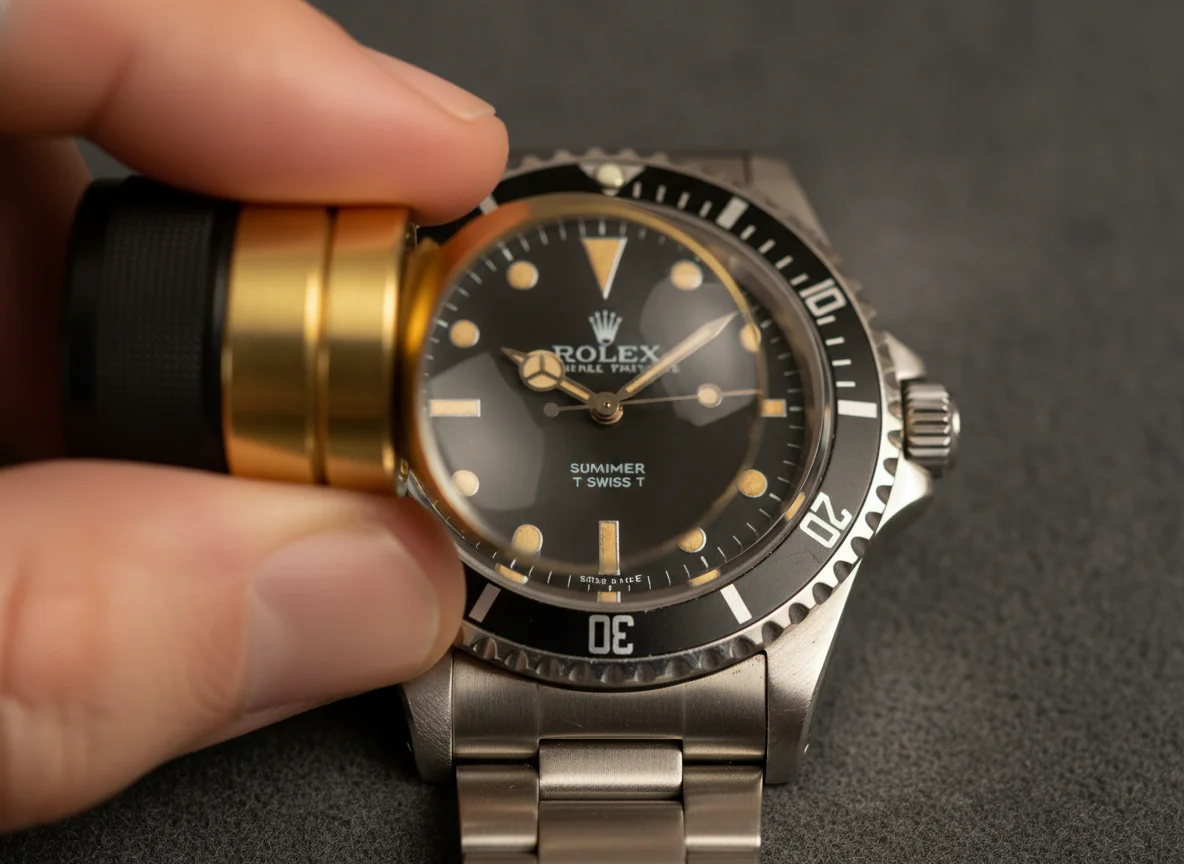 Lume text at the 6 o'clock position is the first thing a working authenticator checks.
The hands
Rolex hands age with the dial they are paired with. The lume on the hands and the lume on the dial markers should match in color and in degree of aging. A bright cream-toned dial paired with stark white hand lume is a mismatch.
Mercedes-style hour hands on Submariners follow a specific shape evolution by reference and era. The most common parts swap in vintage Rolex authentication is hands. They are small, they are frequently replaced at service, and they are often mistakenly considered "neutral." They are not.
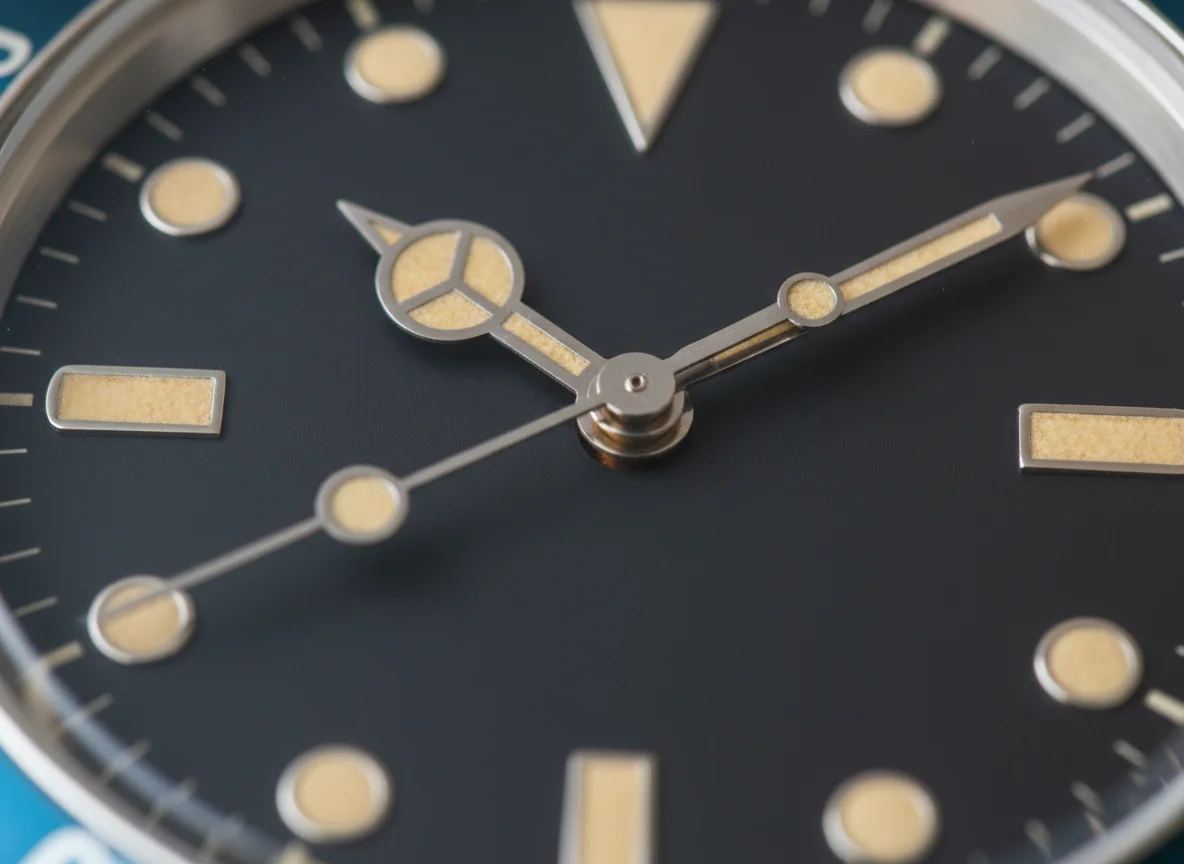 Hand lume should match dial-marker lume in color and patina depth. Mismatched lume is a top three frankenwatch flag.
The bezel insert
Aluminum bezel inserts on vintage Submariners and GMTs fade and crack with sun and saltwater exposure. They get replaced. They are also widely available as aftermarket parts, both genuine and counterfeit.
The font weight, numeral spacing, and the specific shade of black or color (Pepsi blue/red, Coke red/black) varies by production era. A bezel insert with crisp white printing and uniform black field on a watch with a heavily aged dial is a flag.
The triangle pip lume color should match the dial markers and hands. If it does not, the insert is from a different era or has been relumed.
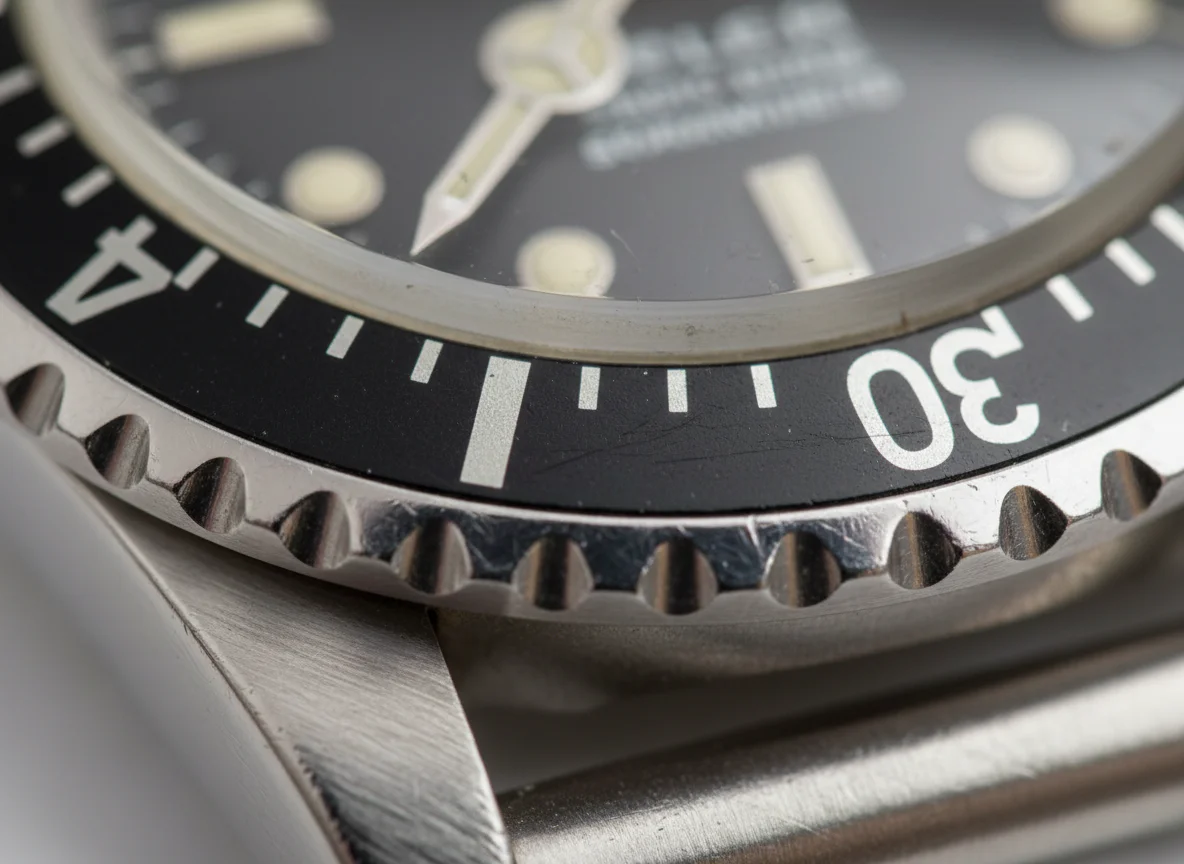 Font weight and numeral spacing on the bezel insert. Replacement inserts give themselves away here more often than anywhere else.
The case and crown
Most vintage Rolex cases have been polished at least once during their service history. Polishing is normal. Heavy polishing erodes the bevels along the lugs and the chamfer between the brushed top and polished sides, fundamentally altering the case geometry.
Compare the lug profile to verified period reference imagery before buying. If the bevels are gone and the lugs look rounded rather than crisply edged, the case has been over-polished, and the price should reflect that.
The crown on a vintage Submariner or GMT-Master should display the period-correct Rolex coronet logo. Crown logos changed shape over the decades, and replacement crowns are common.
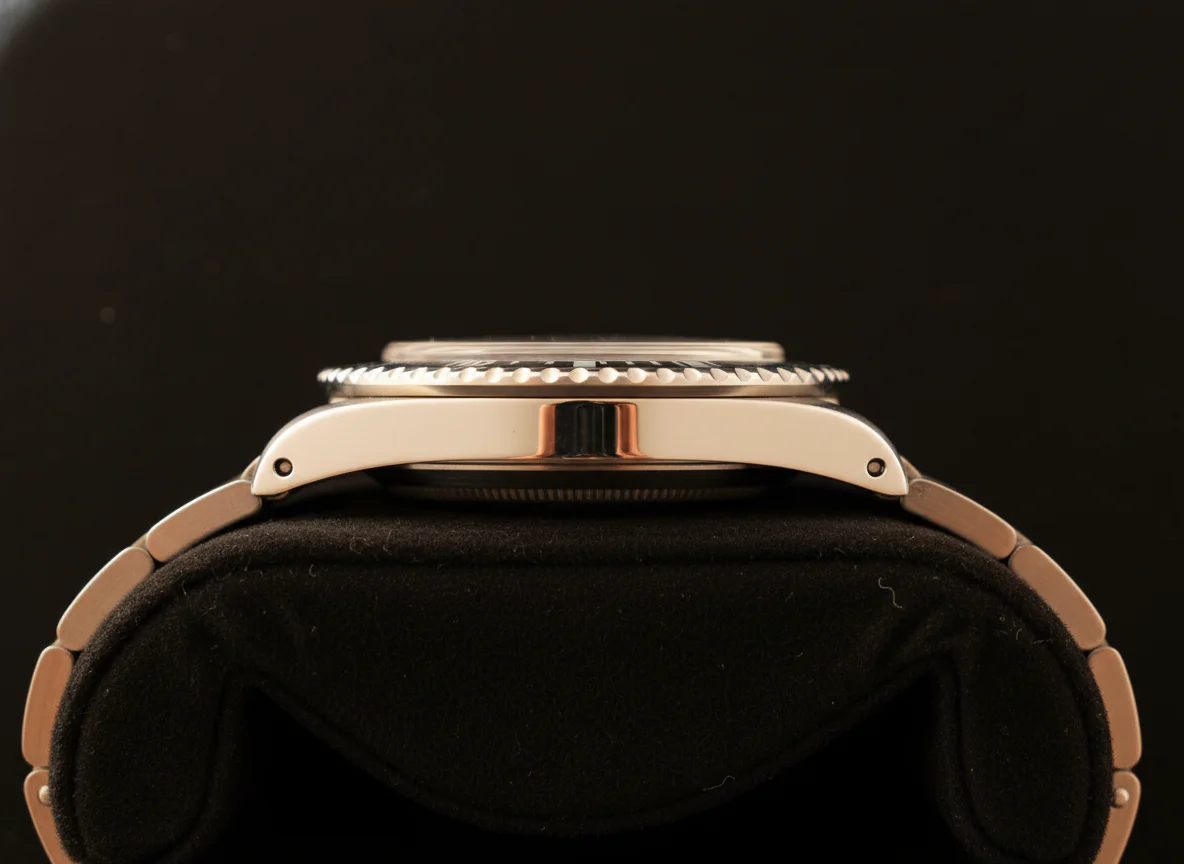 Lug bevels visible from the side. A case that has been polished into rounded lugs is no longer geometrically original.
The movement
The movement caliber must match the reference. A Submariner reference 1680 should run a caliber 1575. A 5513 should run a 1530 or 1520. A Daytona 6263 should run a Valjoux 727. A movement that does not match the reference number is either a parts-bin swap or a recased watch.
Examine the movement serial alongside the case serial when possible. They will not be identical, but they should both be plausible for the watch's claimed production year.
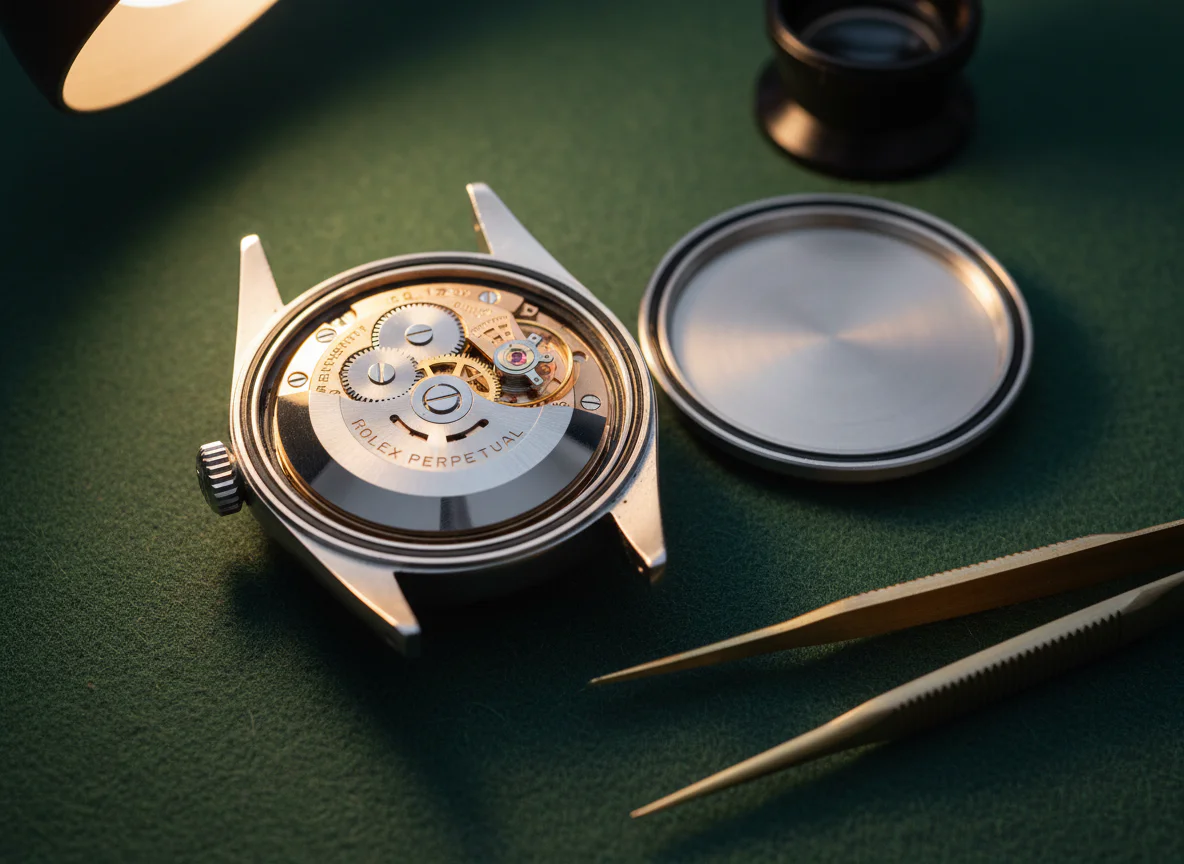 Movement inspection through an open caseback. Caliber designation must match the case reference number.
The bracelet
Vintage Rolex bracelets have date codes stamped on the clasp interior. The clasp date should fall within the watch's production window. End links must be the correct shape and size for the case reference. Generic aftermarket Oyster bracelets are common on serviced vintage watches.
Bracelet stretch is normal at this age. Bracelet replacement is not automatically a problem if disclosed.
The 10-minute pre-purchase checklist
Before money changes hands, run through this list.
- Dial lume text matches the production year of the case serial
- Hand lume color matches dial-marker lume color and aging
- Bezel insert font and pip lume consistent with the rest of the watch
- Case lug bevels still visible and not polished into roundness
- Crown logo style correct for the era
- Movement caliber matches the reference number
- Bracelet clasp date code within the production window
- Photos of the watch align with verified period imagery for the reference
- Seller documentation includes service history and original papers if available
- Provenance disclosed in writing, with any service replacements named explicitly
If any of these fail and the seller has not disclosed it upfront, the watch is either a frankenwatch or the seller does not know enough to be pricing it where they have. Either way, walk.
When a service-part watch is acceptable
Most vintage Rolex on the pre-owned market has at least one service replacement. That is not automatically disqualifying.
A service-dial Submariner reference 5513 with the original everything else and full disclosure typically trades at 25 to 40% below an all-original example. That gap is the price of a known parts swap. If you understand what you are buying and the price reflects reality, a service-part watch is a legitimate purchase.
What is not legitimate: paying all-original prices for a partly-replaced watch. The dealer who tells you "service replacement, but Rolex did it, so it is fine" is hoping you do not know the difference.
What dealer authentication actually involves
At 5D Watches, every pre-owned Rolex is examined under loupe magnification with comparison against verified period reference imagery before listing. We document parts that have been replaced at service. We disclose anything we find. For a deeper walkthrough of our standard process, see our pre-owned Rolex authentication checklist.
The watch that does not pass: we do not list it. The watch with known service replacements: we describe them, photograph them, and price accordingly.
Bottom line
Skepticism is the right default in the pre-owned vintage Rolex market. The combination of high prices, soft documentation, and decades of service history means that pristine, all-original examples are genuinely rare. The frankenwatch problem is not going away.
The defense is the same as it has been for thirty years: work with dealers who guarantee authentication, demand written documentation, and walk away from anything that does not add up.
Browse authenticated pre-owned Rolex at 5dwatches.com.