The Rolex Datejust is the best-selling Rolex of all time. The reference launched in 1945 as the first wristwatch with an automatically changing date, and 80 years of continuous production has made it the most-bought, most-imitated, and most-traded watch in the brand's catalog.
The 2026 lineup runs across four sizes (28mm Lady, 31mm, 36mm, 41mm), four bezel options (smooth, fluted, gem-set, diamond), four bracelet options (Oyster, Jubilee, President, Pearlmaster), and dozens of dial configurations. The combination math gives you several hundred Datejust variations to choose from across current and discontinued references. The choices can feel paralyzing for first-time buyers.
This is the comprehensive 2026 buying guide. Every modern reference, every size, every meaningful configuration decoded with retail prices, secondary market data, and the honest dealer read on which to buy.
All images in this post are AI-generated and may not perfectly represent the actual watch references discussed. They are intended for illustration only.
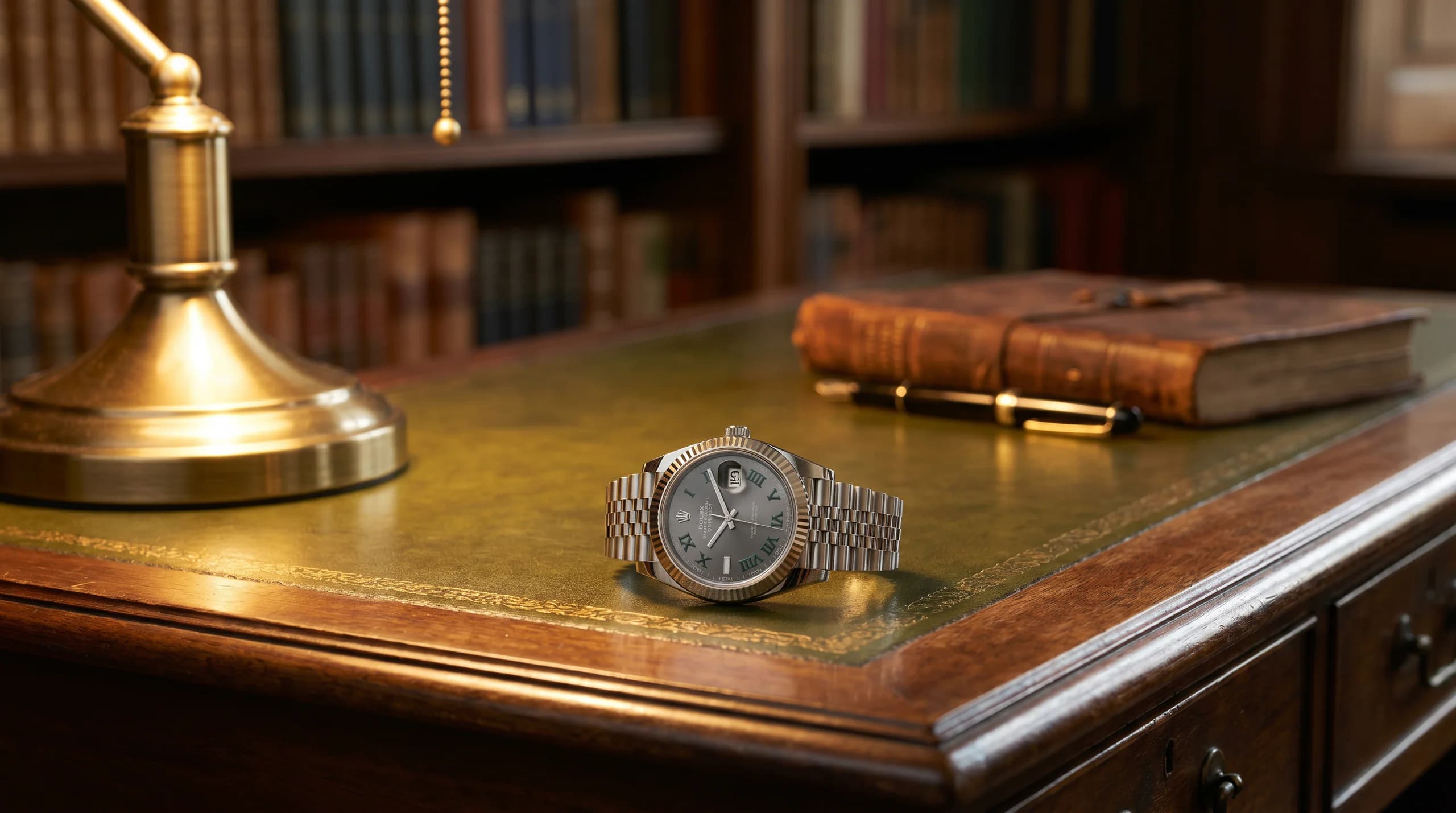
The Rolex Datejust 41 reference 126334 with the famed slate Wimbledon dial, green Roman numerals, and 18k white gold fluted bezel. The most-searched Datejust configuration on the secondary market in 2026.
The Short Answer
If you are scanning, the buy logic compresses to a few decisions.
- For most first-time buyers: the 126234 (36mm, steel with white gold fluted bezel, Jubilee) at $9,900 to $12,750 retail or $10,500 to $14,500 on the secondary market.
- For the modern look: the 126300 (41mm, steel, smooth bezel) at $9,250 retail or $9,500 to $12,500 secondary.
- For the hot dial-driven play: any Wimbledon dial reference (slate dial, green Roman numerals) trades $2,000 to $5,000 above its non-Wimbledon equivalent.
- For the classic luxury feel: the 126233 or 126333 in two-tone Yellow Rolesor with champagne dial and fluted gold bezel, $13,000 to $20,000.
- For value at vintage proportions: the 16200 or 1601 from the neo-vintage and vintage eras at $4,500 to $11,000.
- What Rolex discontinued at W&W 2026: the Datejust 31 floral motif dials and serif Roman numeral dials on the 36 and 41.
The Datejust has appreciated steadily for 30+ years on the secondary market and ranks in the top 1 percent of all Rolex references by resale volume.
The Modern Generation: 2018 to Present
The current Datejust generation arrived in 2018 with the 36mm references and rolled through 2019 with the 41mm. Every modern Datejust runs the caliber 3235 (date with chronograph-grade Chronergy escapement, 70-hour power reserve, and improved magnetic resistance over the previous caliber 3135).
The case proportions slimmed from the previous generation. Lugs became more refined. The Cyclops magnifier sits at the same 3 o'clock position. The Twinlock crown remains. What changed is the movement, the bracelet refinement, and the dial palette options that have expanded year over year.
Datejust 36mm Modern References
The 36mm size is the classic Datejust dimension. It is the original case size from 1945 and the proportion most collectors consider "correct" for a Datejust.
- 126200: Oystersteel case, smooth steel bezel. Retail $8,150, secondary $7,500 to $11,500.
- 126234: Oystersteel case, 18k white gold fluted bezel. Retail $9,900 to $12,750, secondary $10,500 to $14,500.
- 126233: Yellow Rolesor (Oystersteel and 18k yellow gold), fluted yellow gold bezel. Retail $13,500 to $15,500, secondary $13,000 to $20,000.
- 126231: Everose Rolesor (Oystersteel and 18k Everose gold), fluted Everose bezel. Retail $13,500 to $16,000, secondary $14,000 to $22,000.
The 126234 (steel with white gold fluted bezel) is the textbook first Datejust. The white gold fluted bezel adds substantial wrist presence and visual interest without committing to a two-tone or precious metal case. The Jubilee bracelet pairing is the canonical Datejust look.
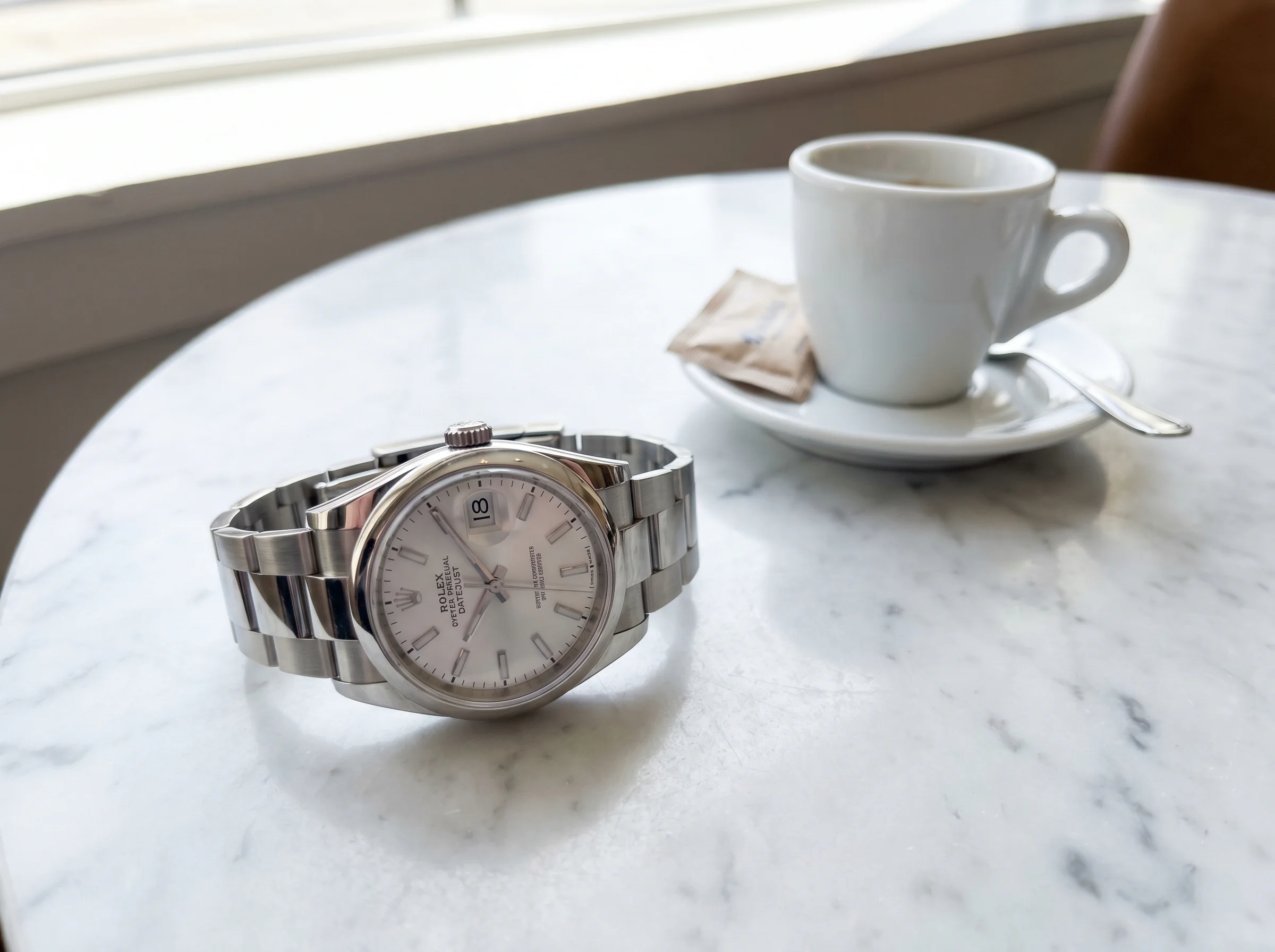 The Datejust 36 reference 126200 in Oystersteel with smooth bezel and Oyster bracelet, the most accessible modern Datejust entry point at $8,150 retail.
Datejust 41mm Modern References
The 41mm size launched in 2016 as the successor to the discontinued Datejust II (2009-2016). The proportions feel modern, the wrist presence is bolder, and the lugs are more refined than the chunkier Datejust II era.
- 126300: Oystersteel case, smooth steel bezel. Retail $9,250, secondary $9,500 to $12,500.
- 126334: Oystersteel case, 18k white gold fluted bezel. Retail $11,650 to $13,750, secondary $13,500 to $19,500.
- 126333: Yellow Rolesor, fluted yellow gold bezel. Retail $15,500 to $17,500, secondary $17,000 to $22,000.
- 126331: Everose Rolesor, fluted Everose bezel. Retail $15,500 to $17,500, secondary $18,000 to $22,000.
The 126334 (steel with white gold fluted bezel) is the most-sold modern 41mm Datejust. The futures-market platform Kalshi has run pricing contracts on the 126334 reference (specifically the 126334-0022) since 2023, with the watch consistently trading $2,500 to $5,000 above retail on the secondary market.
The Wimbledon Dial Story
The Wimbledon dial is the most-searched Datejust configuration on the secondary market in 2026. The dial features a slate grey base with applied green Roman numeral hour markers, paying tribute to Rolex's role as the official timekeeper of the Wimbledon Championships since 1978.
The dial appears across both sizes in current production:
| Reference | Size | Bezel | Bracelet | Secondary |
|---|---|---|---|---|
| 126200 | 36mm | Smooth steel | Oyster | $10,500-$12,500 |
| 126234 | 36mm | Fluted white gold | Oyster or Jubilee | $13,000-$17,000 |
| 126233 | 36mm | Fluted yellow gold | Oyster or Jubilee | $16,000-$20,000 |
| 126231 | 36mm | Fluted Everose | Oyster or Jubilee | $18,000-$22,000 |
| 126300 | 41mm | Smooth steel | Oyster or Jubilee | $11,000-$14,000 |
| 126334 | 41mm | Fluted white gold | Oyster or Jubilee | $13,500-$19,500 |
| 126333 | 41mm | Fluted yellow gold | Oyster or Jubilee | $18,000-$22,000 |
| 126331 | 41mm | Fluted Everose | Oyster or Jubilee | $20,000-$25,000 |
A Wimbledon dial typically adds $2,000 to $5,000 to a Datejust's secondary market value over the same reference with a standard dial. The combination of slate plus green Romans plus a Jubilee bracelet produces the highest visual contrast in the lineup, which has driven sustained demand since the dial first appeared on the Datejust II 116334 around 2010.
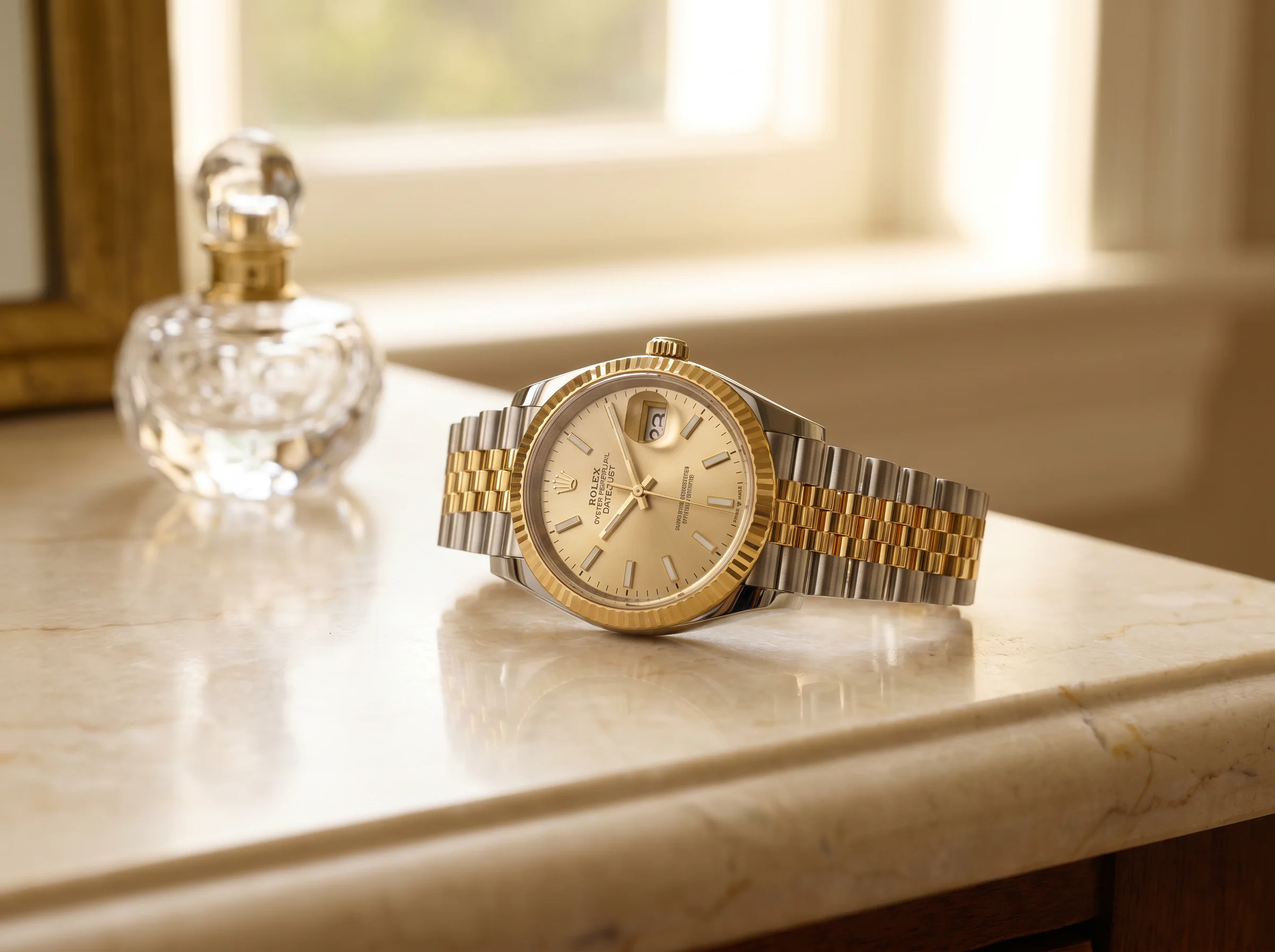 The Datejust 36 reference 126233 in Yellow Rolesor two-tone with champagne dial and yellow gold fluted bezel, the classic Datejust luxury configuration.
The Previous Generation: 2009 to 2018
The 116200 series ran from roughly 2009 to 2018 with the caliber 3135 (48-hour power reserve, no Chronergy escapement). The case proportions are slightly thicker, and the dial finishing is one half-generation behind current production.
- 116200: Oystersteel, smooth bezel. Secondary $5,500 to $7,500.
- 116234: Oystersteel, fluted white gold bezel. Secondary $7,500 to $9,500.
- 116233: Two-tone Yellow Rolesor, fluted yellow gold bezel. Secondary $6,500 to $10,500.
The Datejust II Era (2009-2016)
The Datejust II was the original 41mm Datejust, produced from 2009 to 2016 before being replaced by the Datejust 41 in 2016. The Datejust II has a chunkier "Super Case" with broad lugs that some collectors love and others find too thick for the Datejust template.
- 116300: Oystersteel, smooth bezel. Secondary $7,500 to $9,500.
- 116334: Oystersteel, fluted white gold bezel. Secondary $9,500 to $12,500.
- 116333: Two-tone Yellow Rolesor. Secondary $11,000 to $14,000.
The Datejust II is a polarizing reference. The thick lugs and oversized case do not appeal to every buyer, but the watches are mechanically robust, fully ceramic-era proven, and trade at meaningful discount to the modern Datejust 41 generation. For buyers prioritizing value over current production proportions, the Datejust II is one of the smartest plays in pre-owned Rolex.
The Neo-Vintage Era: 1988 to 2009
The 16200 series ran from approximately 1988 to 2009. Caliber 3135 inside, glossy dials with white gold surrounds, 36mm Oystersteel cases, and the older Twinlock crown design. This is the value tier of the modern Datejust market.
- 16200: Oystersteel, smooth bezel. Secondary $4,500 to $6,500.
- 16234: Oystersteel, fluted white gold bezel. Secondary $5,500 to $7,500.
- 16233: Two-tone Yellow Rolesor. Secondary $5,500 to $8,500.
The 16200 series is the textbook neo-vintage Rolex. Most pre-owned Datejust inventory globally is from this generation because the production run was long, the watches are reliable, and the prices remain accessible. Clean examples with full sets and matching boxes trade at the upper end of the range.
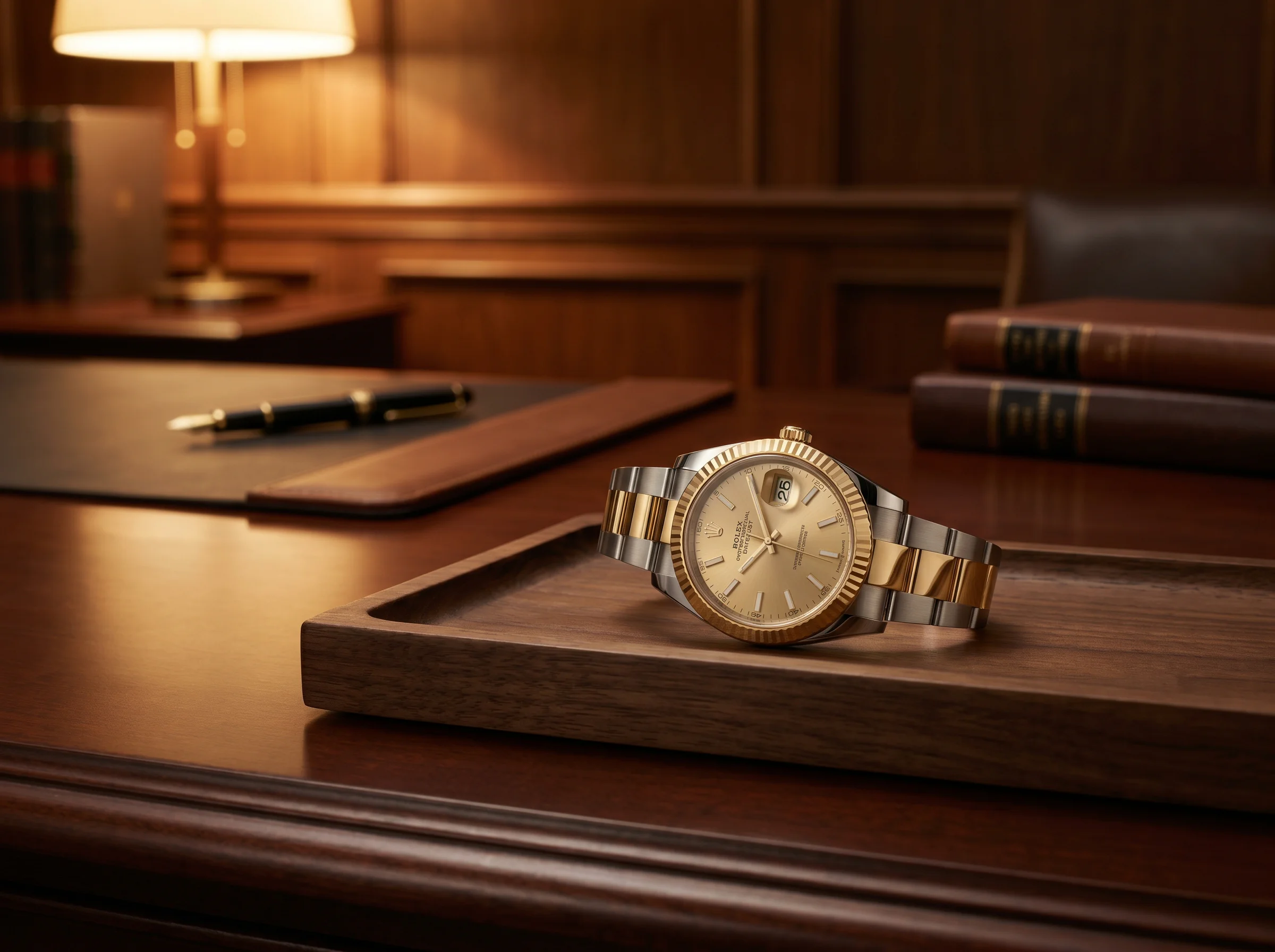 The Datejust 41 reference 126333 in Yellow Rolesor two-tone, the modern 41mm interpretation of the classic two-tone champagne Datejust at $15,500 retail.
The Vintage Era: 1945 to 1988
The 4-digit reference era runs from 1945 through 1988 with the calibers 1570 and 3035. The case proportions are thinner than modern Datejust, dials show genuine patina, and the watches trade in a different collector economy than the modern references.
- 1601: 1959-1976, fluted bezel, caliber 1570. Secondary $4,500 to $9,500.
- 1603: 1960-1977, engine-turned bezel, caliber 1570. Secondary $4,500 to $8,500.
- 16013: 1977-1989, two-tone yellow gold and steel, caliber 3035. Secondary $4,500 to $8,000.
The 1601 with patina'd silver dial on the original Jubilee bracelet remains one of the most accessible entry points into vintage Rolex collecting. Clean examples with original tritium lume, unpolished cases, and matching boxes can reach the upper $9,000 to $11,000 range. The watch wears smaller than modern Datejust references at 36mm because the lugs are slimmer and the case is thinner.
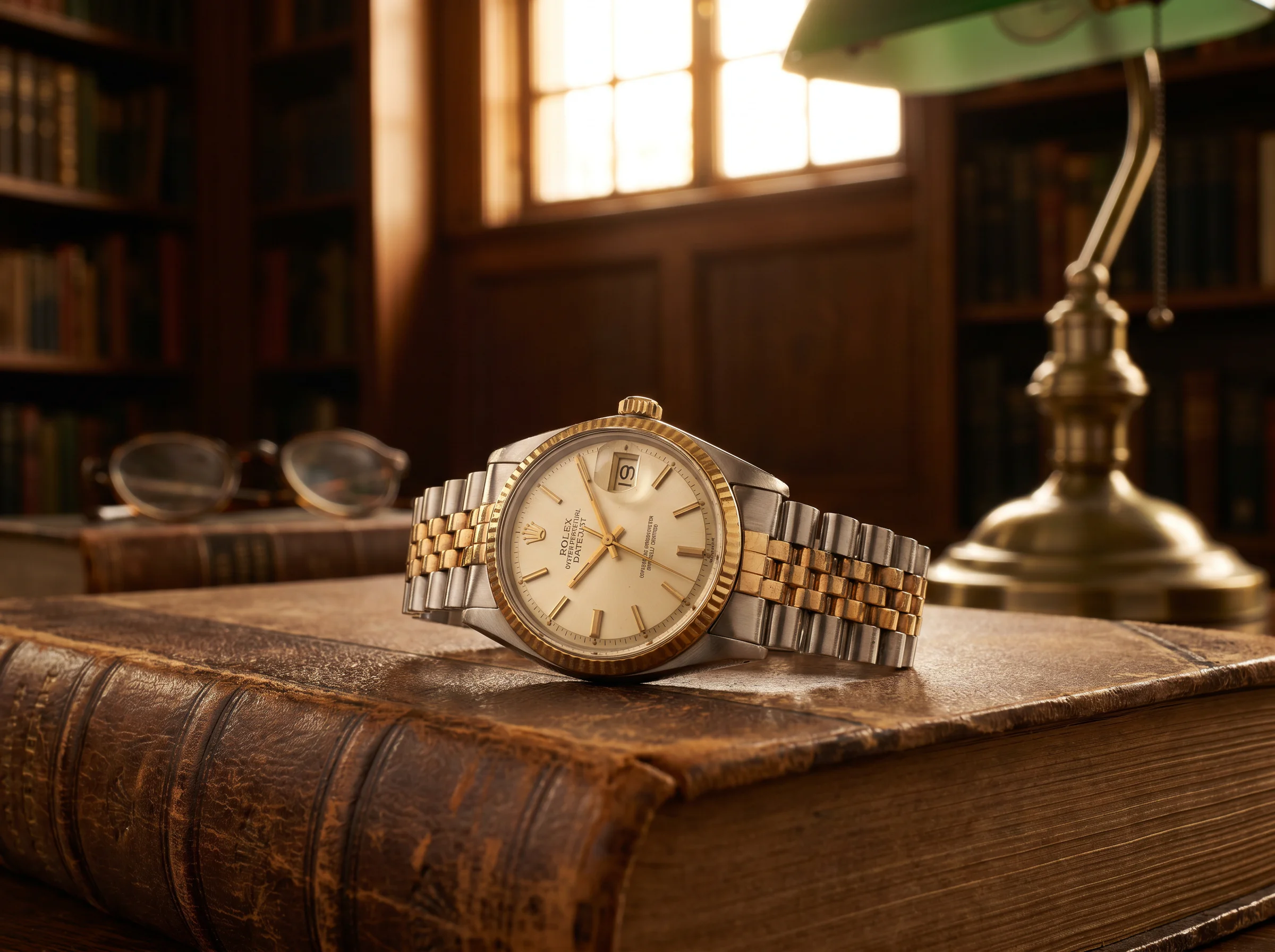 The vintage Rolex Datejust 1601 from the 1970s with aged tritium patina and fluted yellow gold bezel, the accessible entry point into vintage Datejust collecting.
Sizes: 28mm, 31mm, 36mm, 41mm
The Datejust comes in four contemporary sizes, each with distinct collector positioning.
The 28mm Lady-Datejust (current references 279xxx) is the smallest production Datejust, designed primarily for smaller wrists. Secondary market pricing runs $4,500 to $7,500 for steel and $18,000 to $25,000 for Everose gold.
The 31mm Datejust (current references 278xxx) is the medium-size Datejust, popular for both women and men with smaller wrists. The size was central to the floral motif dial discontinuation at W&W 2026.
The 36mm Datejust is the original Datejust dimension and the proportion most collectors consider definitive. It is wearable on both small and large wrists, it photographs well, and it carries the strongest collector pedigree.
The 41mm Datejust is the modern bestseller. It carries the boldest wrist presence in the lineup and the broadest dial color and configuration options in current production. For buyers under 40 with larger wrists, the 41mm is the dominant choice.
Bezels, Bracelets, Dials
Bezels
Datejust bezels split four ways. The smooth bezel is the most understated choice, providing clean modern proportions. The fluted bezel is the signature Datejust look, with the multi-faceted ridged finish that catches light from every angle and adds substantial visual presence. The engine-turned bezel is a vintage-era option that fell out of production in the early 1980s. The diamond-set bezel is the high-jewelry option, common on Lady-Datejust and high-end gold configurations.
The fluted bezel adds $1,500 to $3,500 to a Datejust's secondary market value over the same reference with a smooth bezel. The white gold fluted bezel is the most common configuration because it pairs with stainless steel cases.
Bracelets
The Datejust ships on three main bracelets. The Oyster is the three-link bracelet, with brushed center links and polished outer links. It is the sportier, more modern option. The Jubilee is the five-link bracelet developed in 1945 specifically for the Datejust. It is the dressier, more classic option. The President appears on Lady-Datejust and Datejust 36 references in solid gold, with three-piece links.
The Jubilee versus Oyster decision is a personal preference question. Both bracelets ship at the same retail. On the secondary market, the Jubilee tends to trade slightly higher because the look is more distinctive and harder to replicate elsewhere in the Rolex catalog.
Dial Variety
Modern Datejust dials run across colors (white, black, blue, silver, slate, champagne, mother of pearl, olive, aubergine, pink, mint green), patterns (Wimbledon Roman numerals, Palm motif, Floral motif, sunray, sunburst), and finishing (matte, glossy, lacquered, diamond-set, mother of pearl).
The current production hot-list of dial premiums on the secondary market:
| Dial Configuration | Premium Over Standard |
|---|---|
| Wimbledon (slate, green Romans) | +$2,000 to $5,000 |
| Mint Green | +$2,500 to $4,500 |
| Palm Motif (discontinued W&W 2026) | +$1,500 to $3,500 |
| Mother of Pearl with Diamonds | +$2,000 to $4,000 |
| Tahitian Mother of Pearl | +$1,500 to $3,000 |
| Black Roman Numerals | Standard |
| Silver | Standard |
| Champagne | +$500 to $1,500 (on two-tone) |
The Modern Datejust Price Matrix
| Reference | Size | Material | Bezel | Retail (2026) | Secondary |
|---|---|---|---|---|---|
| 126200 | 36mm | Oystersteel | Smooth | $8,150 | $7,500-$11,500 |
| 126234 | 36mm | Oystersteel | Fluted WG | $9,900-$12,750 | $10,500-$14,500 |
| 126233 | 36mm | Yellow Rolesor | Fluted YG | $13,500-$15,500 | $13,000-$20,000 |
| 126231 | 36mm | Everose Rolesor | Fluted Everose | $13,500-$16,000 | $14,000-$22,000 |
| 126300 | 41mm | Oystersteel | Smooth | $9,250 | $9,500-$12,500 |
| 126334 | 41mm | Oystersteel | Fluted WG | $11,650-$13,750 | $13,500-$19,500 |
| 126333 | 41mm | Yellow Rolesor | Fluted YG | $15,500-$17,500 | $17,000-$22,000 |
| 126331 | 41mm | Everose Rolesor | Fluted Everose | $15,500-$17,500 | $18,000-$22,000 |
| 116200 | 36mm | Oystersteel | Smooth | Discontinued | $5,500-$7,500 |
| 116234 | 36mm | Oystersteel | Fluted WG | Discontinued | $7,500-$9,500 |
| 116333 | 41mm | Yellow Rolesor | Fluted YG | Discontinued | $11,000-$14,000 |
| 16200 | 36mm | Oystersteel | Smooth | Discontinued | $4,500-$6,500 |
| 16233 | 36mm | Yellow Rolesor | Fluted YG | Discontinued | $5,500-$8,500 |
| 1601 | 36mm | Oystersteel | Fluted | Discontinued | $4,500-$9,500 |
How to Choose: Buyer Profile Matrix
First-Time Datejust Buyer
The 126234 (36mm, steel with white gold fluted bezel) is the textbook starting point. The white gold fluted bezel adds presence over the smooth-bezel 126200 without requiring a two-tone or precious metal commitment. The Jubilee bracelet pairing is the canonical Datejust look. Retail sits at $9,900 to $12,750, secondary market around $10,500 to $14,500.
If you prefer the modern 41mm proportions, the 126300 (smooth bezel) or 126334 (fluted bezel) are the equivalent starting points at $9,250 to $13,750 retail.
Daily Wear with Classic Luxury
The 126233 or 126333 in two-tone Yellow Rolesor with champagne dial and fluted yellow gold bezel is the most recognizable luxury Datejust configuration. The two-tone metals catch light from every angle, the warm dial pairs naturally with most clothing, and the watch reads luxury without crossing into ostentation.
The 126231 or 126331 in Everose Rolesor offers the same template with rose gold accents in place of yellow gold. The Everose patina has aged well over the past decade, and the warmer rose-gold-and-steel combination has built a permanent collector following.
Value Play at Vintage Proportions
The 16200 series from the neo-vintage era trades at meaningful discount to modern production while delivering the full Datejust template. The 16234 (steel with white gold fluted bezel) at $5,500 to $7,500 is one of the best dollar-per-Rolex values in the pre-owned market.
For deeper vintage, the 1601 from the 1970s in clean condition with original tritium lume offers genuine vintage Rolex provenance at $4,500 to $9,500.
Hot Dial Driven Play
Any Wimbledon dial reference in current production. The slate dial with green Roman numerals carries the strongest secondary market demand of any current Datejust dial configuration. The dial premium runs $2,000 to $5,000 over the standard equivalents.
W&W 2026 Datejust Discontinuations
Rolex made two notable Datejust changes at Watches and Wonders 2026.
The Datejust 31 floral motif dials were discontinued. The decorative floral dial configurations had appealed to a narrower collector base than the standard Datejust 31 lineup, and Rolex consolidated the offering around cleaner dial options.
The serif Roman numeral dials on the Datejust 36 and 41 were replaced with updated applied Roman numerals in a cleaner, sans-serif style. The change affected multiple dial variations including white and blue dials on both sizes. The Wimbledon dial (with serif green Romans) and the Datejust 31 serif Romans both retained their original design for now.
These are quiet catalog adjustments, not major discontinuations. The change creates a meaningful collector premium on the discontinued serif Roman dial variants in the secondary market over the coming 12 to 18 months, similar to the pricing trajectory seen after the GMT-Master II Pepsi discontinuation at the same show.
A Working Dealer's Read
The Datejust is the most versatile watch in the Rolex catalog. It dresses up, it dresses down, it adapts to four sizes and dozens of dial configurations. For 80 years it has been the answer to "what watch should I buy" for buyers who want a single watch that does everything.
For most first-time buyers, the 126234 (36mm steel fluted Jubilee) or 126334 (41mm steel fluted Jubilee Wimbledon) is the right answer. For collectors completing a Rolex set, a vintage 1601 with patina or a modern 126333 two-tone provides distinct positioning. For investors, Wimbledon dial references and the newly discontinued Palm and Floral motif dials are the most likely 2026 appreciators.
Browse authenticated pre-owned Datejust at 5dwatches.com. The Datejust inventory at 5D Watches spans the modern 41mm and 36mm references, two-tone Rolesor configurations, and neo-vintage 16200-series watches that anchor the strongest value plays in the pre-owned market.
Frequently Asked Questions
What is the current Rolex Datejust retail price?
In 2026, the Datejust 36 starts at $8,150 for the 126200 (steel, smooth bezel) and the Datejust 41 starts at $9,250 for the 126300. Steel models with white gold fluted bezels run $9,900 to $13,750. Two-tone Yellow Rolesor configurations run $13,500 to $17,500. Solid gold and Everose Rolesor variants run $15,500 to $45,000 depending on size and dial.
Which Datejust holds value best?
Wimbledon dial references have outperformed standard Datejust dial configurations over the past five years, with secondary market premiums of $2,000 to $5,000 above non-Wimbledon equivalents. The 126234 in 36mm with white gold fluted bezel and Jubilee bracelet has appreciated over 30 percent in the past five years according to dealer market data.
Is the 36mm or 41mm Datejust the better buy?
Both are excellent. The 36mm is the original Datejust dimension and the proportion most collectors consider definitive. The 41mm carries bolder wrist presence and broader dial options in current production. The 36mm tends to hold value better in vintage and neo-vintage configurations. The 41mm tends to outperform in current production Wimbledon configurations.
What was discontinued from the Datejust line at Watches and Wonders 2026?
Rolex discontinued the Datejust 31 floral motif dials and replaced the serif Roman numeral dials on the Datejust 36 and 41 with updated sans-serif applied Romans. The Wimbledon dial (with serif green Romans) and the Datejust 31 serif Romans were retained.
What is the Wimbledon dial and why is it expensive?
The Wimbledon dial features a slate grey base with applied green Roman numeral hour markers, paying tribute to Rolex's role as official Wimbledon Championships timekeeper since 1978. The dial first appeared on the Datejust II 116334 around 2010 and has carried sustained collector demand ever since. Wimbledon configurations trade $2,000 to $5,000 above standard Datejust equivalents in 2026.
Where should I buy a pre-owned Datejust?
Buy authenticated pre-owned from a dealer with verifiable authentication standards. Browse authenticated pre-owned Datejust at 5dwatches.com. Avoid private sales without box and papers, avoid grey market listings without provenance documentation, and avoid any seller who cannot answer specific questions about serial number ranges, dial variants, and service history.