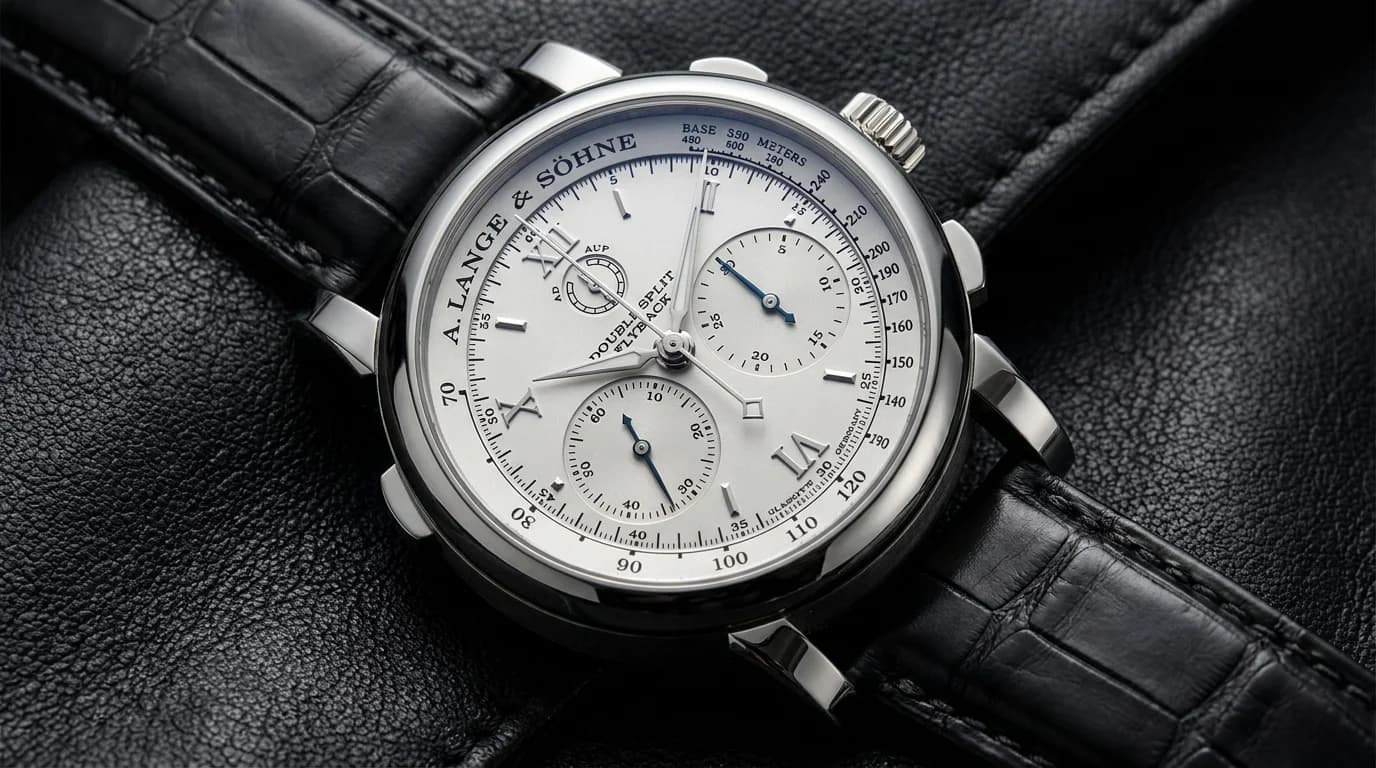
A rattrapante chronograph has two chronograph seconds hands stacked on top of each other instead of one. Most of the time they move together, perfectly overlapping, so the watch looks like an ordinary chronograph. Press a second pusher and one hand stops while the other keeps running. Press it again and the stopped hand snaps forward to catch back up with its twin.
That catching-up action is where the name comes from. Rattraper is French for "to catch up."
The images in this article were generated with AI for illustration. They show recognizable chronograph mechanisms and watches based on real reference photography, but are not photographs of a specific watch for sale.
The Short Answer
- A rattrapante, or split-seconds chronograph, has two overlapping chronograph hands that can be stopped independently, letting you time two events that start together but end at different moments.
- The key mechanism, a heart-shaped zero-reset cam, was patented by Adolphe Nicole in 1844 and is still used in most mechanical chronographs today.
- Split-seconds hands first appeared in a wristwatch in 1912.
- A. Lange & Söhne's Double Split (2004) and Triple Split (2018) extended the idea to timing multiple laps over 30 minutes and 12 hours.
- Prices run from roughly $10,000 for an accessible independent-brand example up toward $200,000 for a Patek Philippe 5370P.
What Problem This Actually Solves
A regular chronograph times one thing. Start, stop, reset. That covers most everyday uses, but it falls apart the moment you need to time two runners in the same race, or measure a lap time without losing the running total.
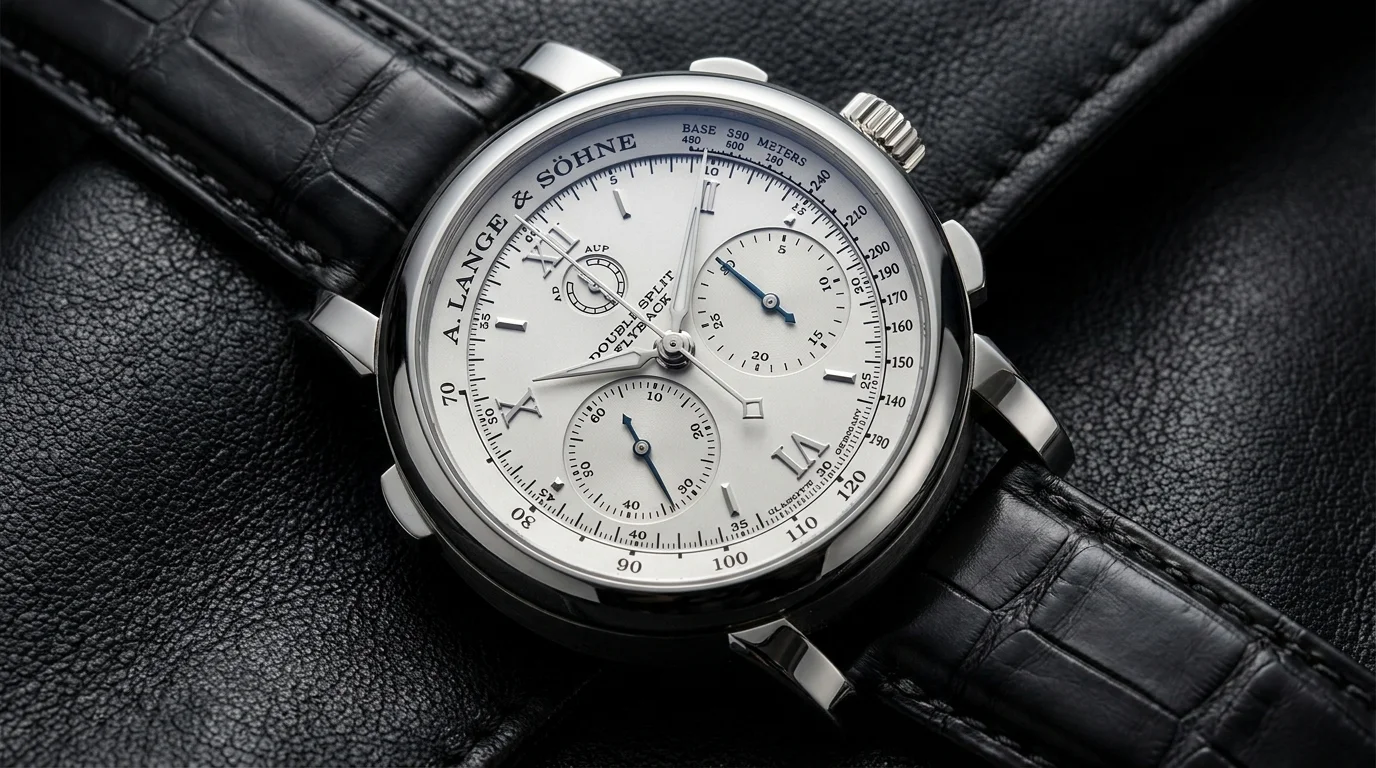 Two chronograph seconds hands, perfectly overlapping until the split function separates them. This is the entire premise of a rattrapante.
A rattrapante solves this by giving you a second hand that can pause without touching the main chronograph function. Start both hands together. Stop the split hand to read the first finisher's time. Press the split pusher again and the hand jumps forward to rejoin the main hand, still running, ready to split again for the next reading.
Who actually needs this
Historically: racing officials timing multiple cars, doctors timing multiple patients' pulses, anyone comparing two durations that start at the same moment. Today, almost nobody needs a rattrapante for its original job. People buy them because the mechanism is a genuine engineering achievement, not because they are timing horse races.
How It Physically Works
The chronograph's main seconds hand sits on a wheel. The split-seconds hand sits on its own separate wheel directly beneath it, normally locked to the main wheel so both hands move as one.
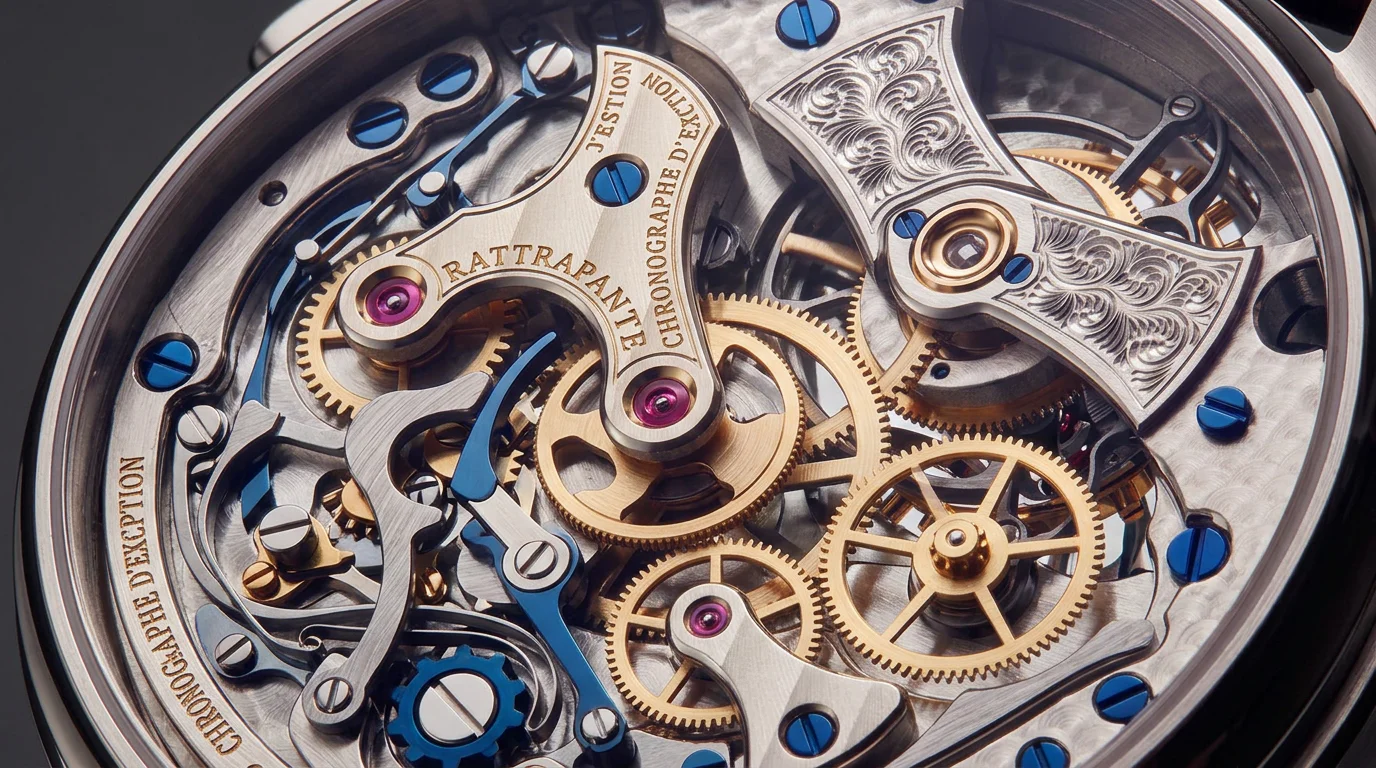 The split-seconds mechanism adds a second, independent seconds wheel and a set of clamps and levers layered directly on top of the standard chronograph works.
The clamp and the catch-up spring
Press the split pusher and a pair of clamps physically grip the split wheel, holding it still while the main wheel keeps turning underneath. The split hand freezes. You read your time.
Press the split pusher again and the clamps release. A small spring, wound tight while the split wheel sat idle, snaps the split hand forward until it catches the main wheel and locks back into step. This is the moment the watch is named for.
Why the heart cam matters
None of this would reset to zero cleanly without the innovation Adolphe Nicole patented in 1844: a heart-shaped cam that a lever rides against to snap a hand precisely back to its zero position. That single component became standard across nearly all mechanical chronographs, rattrapante or not, and a split-seconds watch needs two of them instead of one, doubling the precision problem.
A Short History
Split-seconds timing is older than the wristwatch itself.
- 1831: Joseph Thaddaeus Winnerl builds the chronoscope, the first pocket watch with a stoppable seconds hand.
- 1838: Winnerl develops the first split-seconds mechanism with two independently controllable hands.
- 1844: Adolphe Nicole patents the heart-shaped zero-reset cam.
- 1880s: Auguste Baud relocates the mechanism to the caseback and adds a minute counter, the layout that still defines the complication today.
- 1912: Split-seconds hands appear in a wristwatch for the first time.
- 1940s to 1960s: Production surges, then declines as the quartz era approaches.
- 2004: A. Lange & Söhne's Double Split adds a second split hand on the minute counter, extending split timing to 30 minutes.
- 2018: Lange's Triple Split adds a third split function on the hour counter, extending the range to 12 hours.
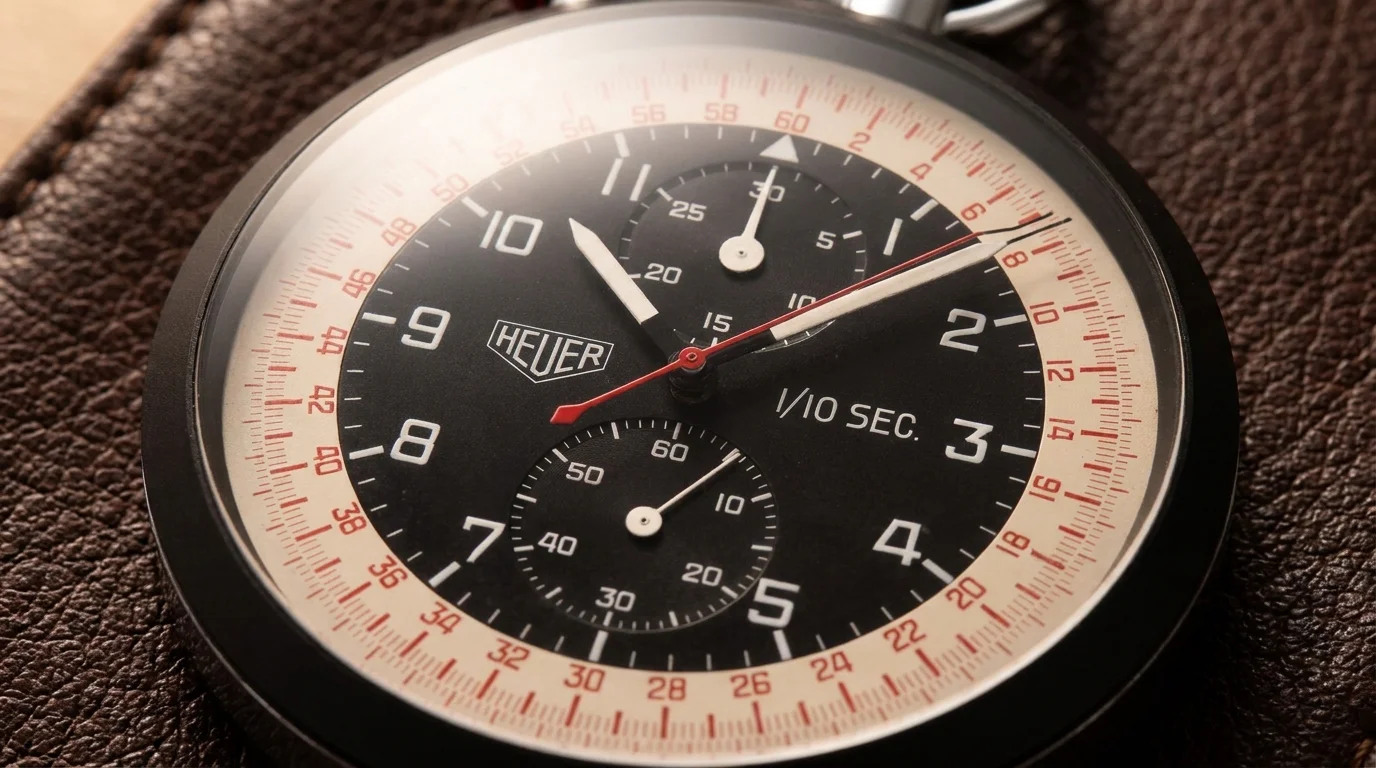 Vintage split-seconds chronographs often used a contrasting color, red against white or black, to make the two overlapping hands easy to tell apart at a glance.
Why It Is So Hard to Build
Fitting a second full chronograph gear train, a clamp system, and a catch-up spring into a standard wristwatch-sized movement is a genuine miniaturization problem. A regular chronograph already asks a lot of a movement barely 30mm across. A rattrapante roughly doubles the moving parts dedicated to that one function.
The finishing problem
Every lever, cam, and spring in the split-seconds module still needs the same hand-finishing as the rest of a high-end movement: polished bevels, black-polished steel, properly rounded pivots. More parts means more surfaces to finish by hand, which is most of why these watches cost what they do.
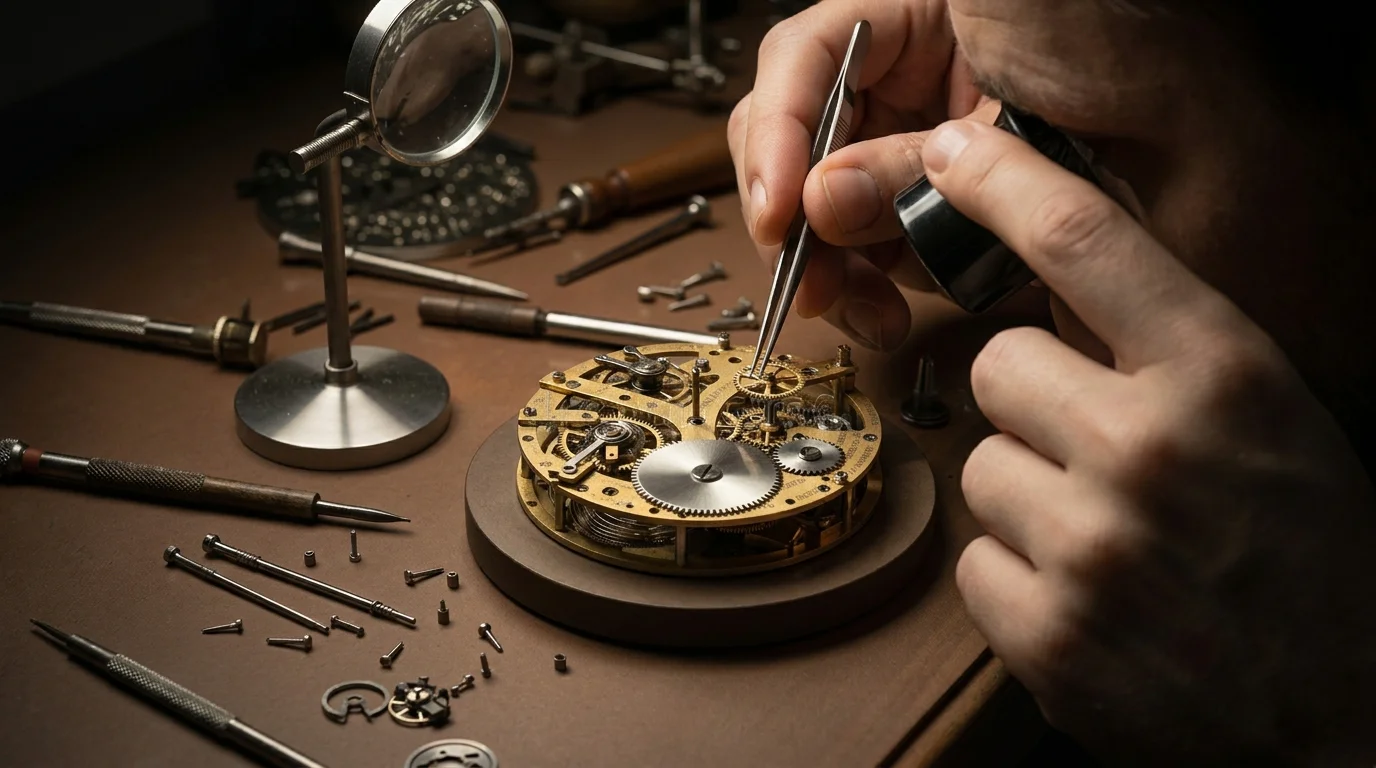 A rattrapante movement has roughly double the small parts of a standard chronograph, and nearly all of them still need to be finished and adjusted by hand.
Servicing is its own specialty
Not every watchmaker will service a rattrapante. The clamp pressure, the catch-up spring tension, and the alignment between the two wheels all have to be set precisely or the split hand will not snap back to a true zero. This narrows the pool of shops qualified to work on one, which is worth knowing before you buy.
Notable Modern Examples
| Watch | Notable feature | Approx. price range |
|---|---|---|
| A. Lange & Söhne Double Split | First wristwatch to split both seconds and minutes | high six figures on the secondary market |
| Patek Philippe 5370P | Column-wheel rattrapante, manually wound, platinum case | approaching $200,000 |
| Vacheron Constantin Traditionnelle Split-Seconds Ultra-Thin | One of the thinnest rattrapante movements made | high six figures |
| Habring2 Doppel-Felix | Simplified cam-based split mechanism, built to be genuinely affordable | historically listed under $10,000 |
The Habring2 is the outlier worth knowing about. Richard Habring, who engineered IWC's Doppelchronograph, built his own split-seconds movement using a simpler cam-lever system instead of the traditional column wheel, cutting both part count and cost without cutting the core function.
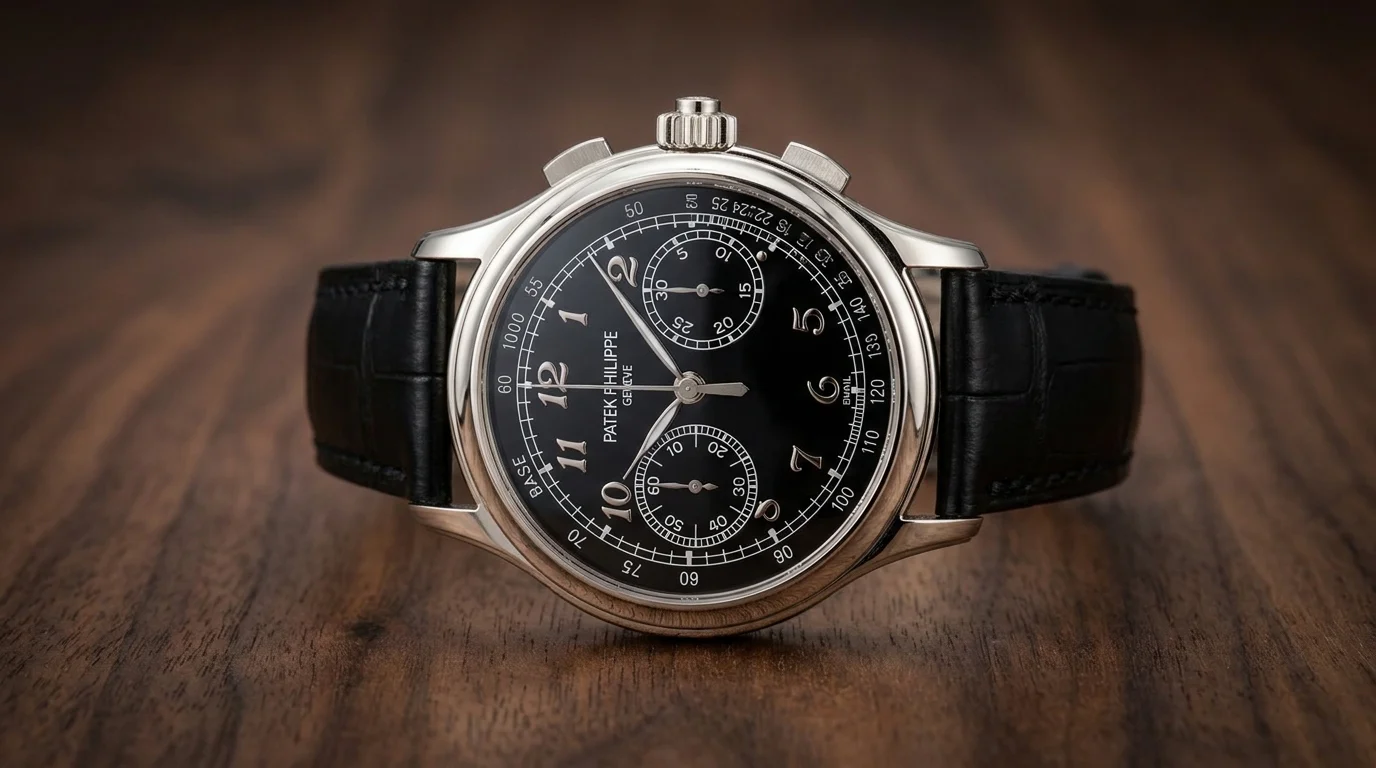 A modern platinum rattrapante chronograph. At this tier, the complication sits alongside the highest level of hand-finishing a brand offers.
Is a Rattrapante Worth Buying
Buy one if you genuinely appreciate mechanical complexity for its own sake, or if you specifically want the thinnest, most technically dense chronograph you can put on a wrist. This is a collector's complication bought for the engineering, not for daily practical use.
Skip it if your budget tops out where a standard high-end chronograph already satisfies you. A Speedmaster, a Daytona, or a Zenith Chronomaster Sport times things just as well for a fraction of the price and complexity. For the broader chronograph category this complication sits inside, our What Is a Chronograph? explainer covers the fundamentals, and our Tachymeter Explained piece covers the scale most chronographs, rattrapante included, are built around. If mechanical complexity for its own sake is what draws you to this complication, our Minute Repeater explainer covers the one complication that arguably tops even this one for sheer difficulty to execute.
Related Reading
- What Is a Chronograph? How the Stopwatch on Your Wrist Actually Works
- Tachymeter Explained: How That Scale on Your Chronograph Actually Works
- Micro-Rotor Watches Explained: How They Work and Why They Cost More
- What Is a Minute Repeater? The Chiming Complication, Explained
Frequently Asked Questions
What does rattrapante mean?
Rattrapante comes from the French rattraper, meaning "to catch up." It describes the moment the stopped split-seconds hand snaps forward to rejoin the main chronograph hand.
How does a split-seconds chronograph work?
Two chronograph seconds hands normally overlap and move together. A second pusher activates a clamp that holds one hand still while the other keeps running, letting you read an intermediate time. Pressing the pusher again releases the clamp and a spring snaps the stopped hand forward to catch back up.
Why are rattrapante watches so expensive?
The mechanism roughly doubles the moving parts of a standard chronograph, and nearly every added lever, cam, and spring requires the same hand-finishing as the rest of a high-end movement. That extra labor, combined with the precision needed to align two independent gear trains, drives the price well above a standard chronograph.
What is the difference between a Double Split and a standard rattrapante?
A standard rattrapante splits only the seconds hand. A. Lange & Söhne's Double Split, introduced in 2004, adds a second split function on the minute counter, letting you time two events up to 30 minutes apart. The 2018 Triple Split adds a third split on the hour counter, extending that to 12 hours.
Is there an affordable rattrapante chronograph?
Yes, relative to the category. Habring2's Doppel-Felix uses a simplified cam-based split mechanism instead of a traditional column wheel, historically bringing rattrapante pricing down to roughly a tenth of what brands like Patek Philippe or A. Lange & Söhne charge for the same core function.