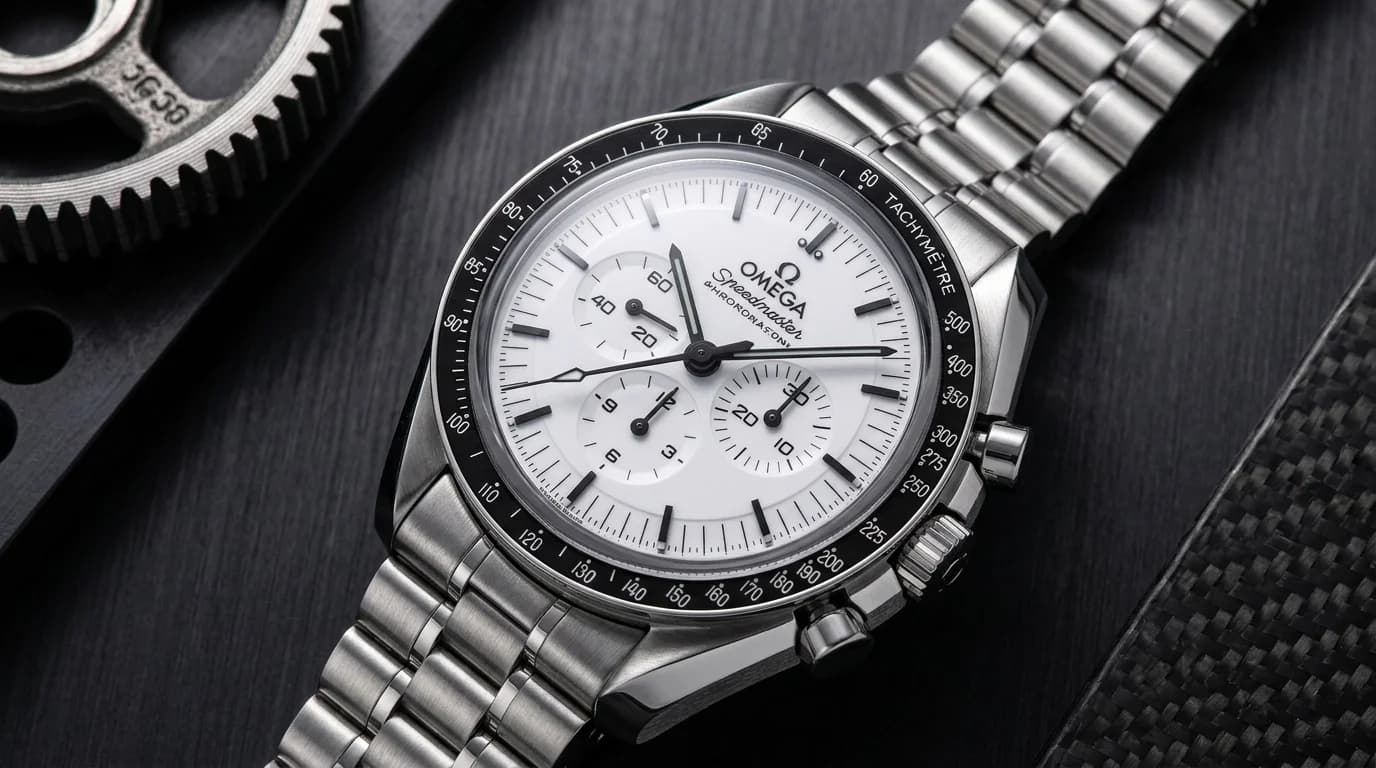
Every Speedmaster and Daytona owner has been asked what those small numbers around the edge of the dial mean. Most give some version of "it measures speed" and leave it there. The actual mechanism is simple once you see it, and understanding it changes how you look at that bezel entirely.
This post includes AI-generated images built from real reference photography of the watches discussed, verified by our team for accuracy before publishing.
The short answer
A tachymeter is a fixed scale, printed on a chronograph's bezel or the outer edge of its dial, that converts elapsed time into a rate per hour. Start the chronograph at the beginning of a measured distance, stop it when that distance is covered, and the seconds hand points directly at your average speed on the scale. It works because there are 3,600 seconds in an hour: the math is simply 3,600 divided by your elapsed seconds. The tradeoff is that it only works for events under 60 seconds and over roughly 60 units per hour, which is why it's more decorative than functional on most watches today.
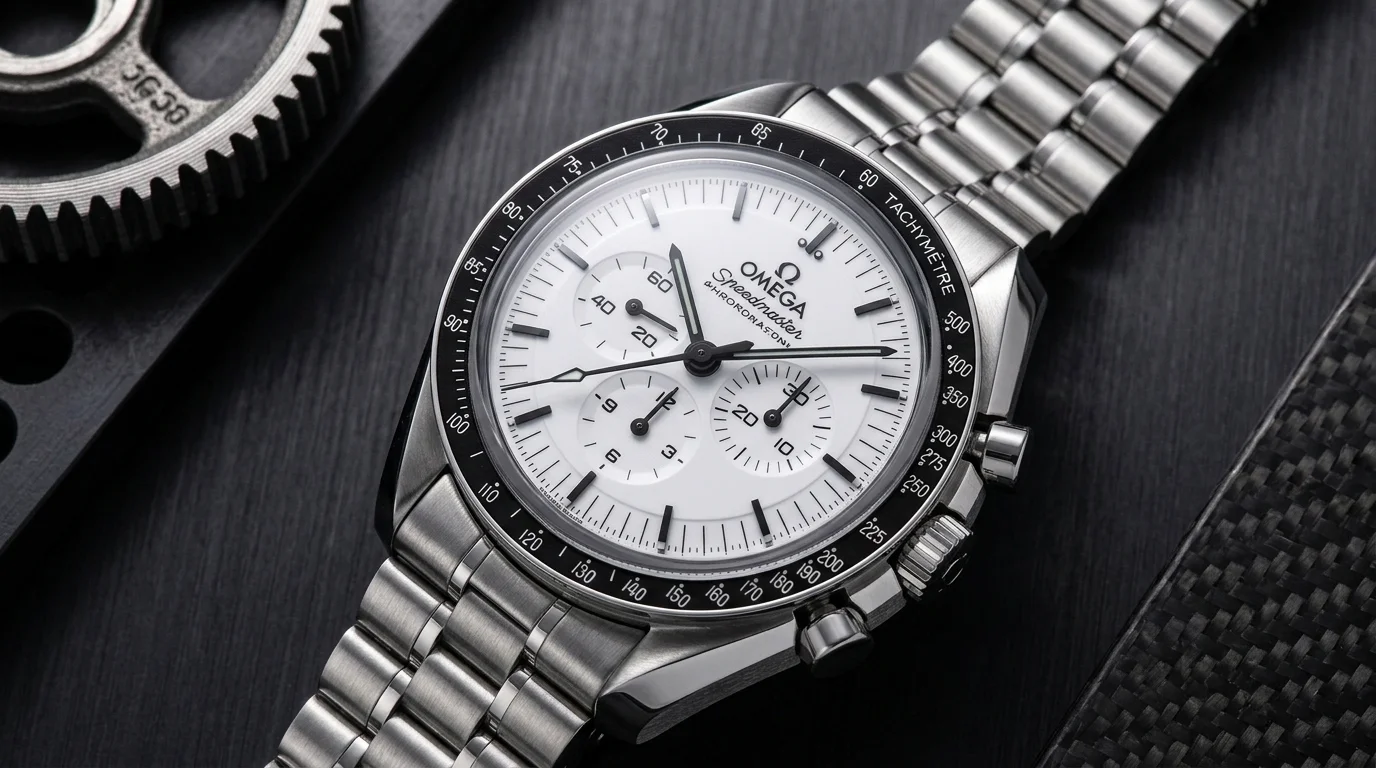 The tachymeter scale runs around the outer edge, the numbers getting closer together as speed increases.
The math behind the scale
The formula is nothing more complicated than unit conversion. There are 3,600 seconds in one hour. If an event takes 30 seconds, that event happens 3,600 divided by 30, or 120, times in an hour.
That is the entire calculation. The tachymeter bezel just does this division for you visually, so you never touch a calculator.
Why the numbers aren't evenly spaced
Look closely at a tachymeter scale and the numbers bunch together as they climb: 400, 300, 250, 200 sit close, while 60, 70, 80 spread out generously. This isn't a design choice, it's the direct result of the 3,600-divided-by-seconds formula, which produces a logarithmic curve rather than a straight line.
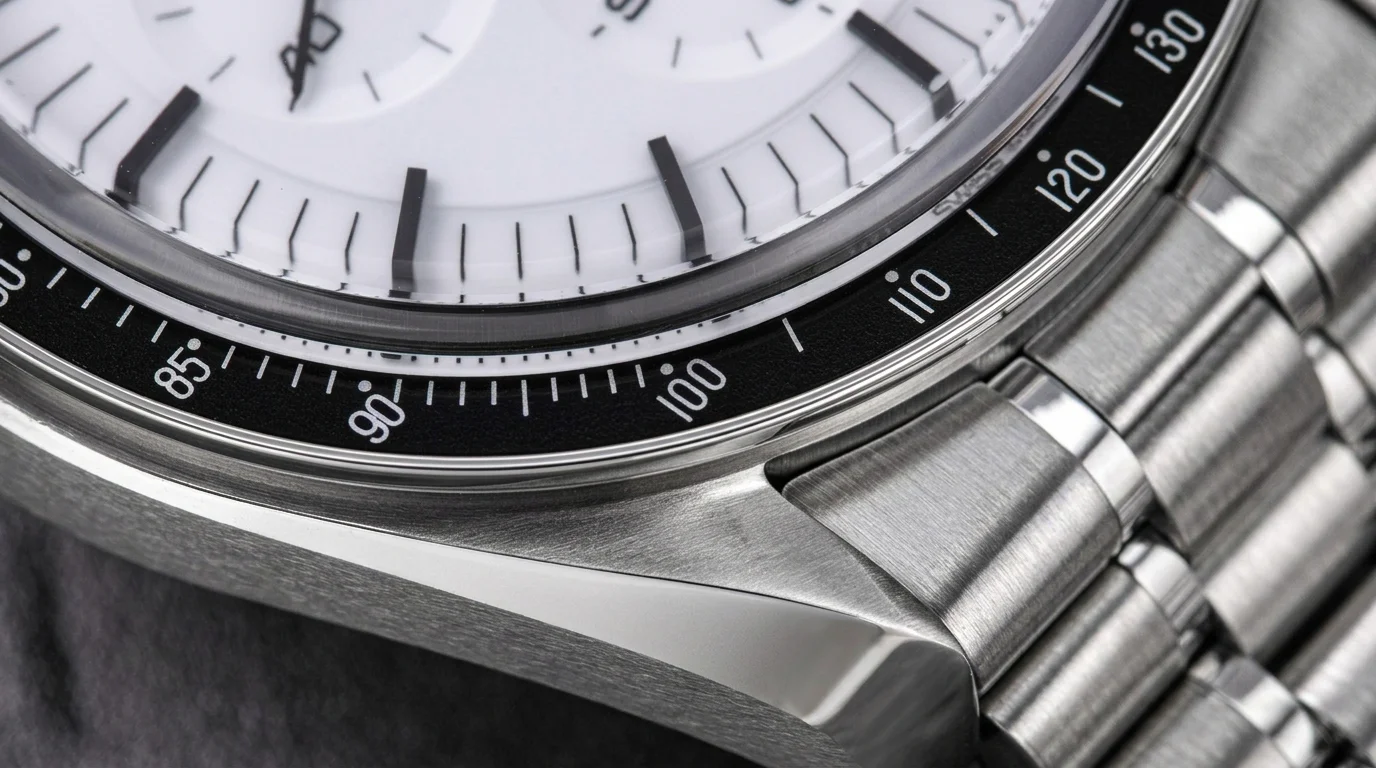 The tighter spacing at higher speeds is math, not aesthetics. Faster events take less time, so their numbers compress together.
How to actually use it
The process takes three steps, and it works identically whether the scale sits on a rotating bezel or is printed as a fixed ring on the dial itself.
Start the chronograph the instant an object passes your starting marker, whether that's a mile marker on a highway, the start line of a track, or the beginning of any measured distance.
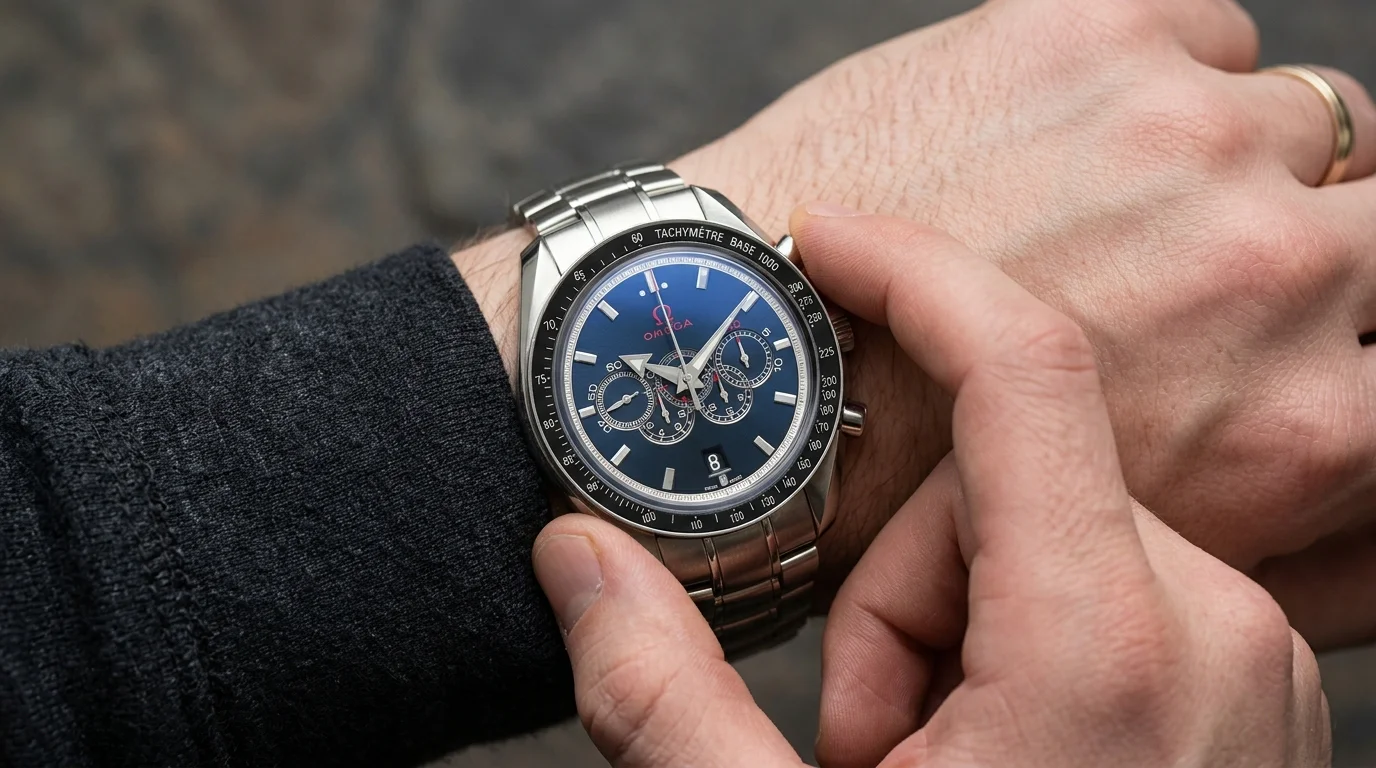 Press the top pusher the instant the object crosses your starting point.
Stop the chronograph when the object covers exactly one unit of that distance, one mile, one kilometer, whatever unit the bezel is calibrated for.
Read the number the chronograph's running seconds hand is pointing at on the tachymeter scale. That number is your average speed in units per hour, no further math required.
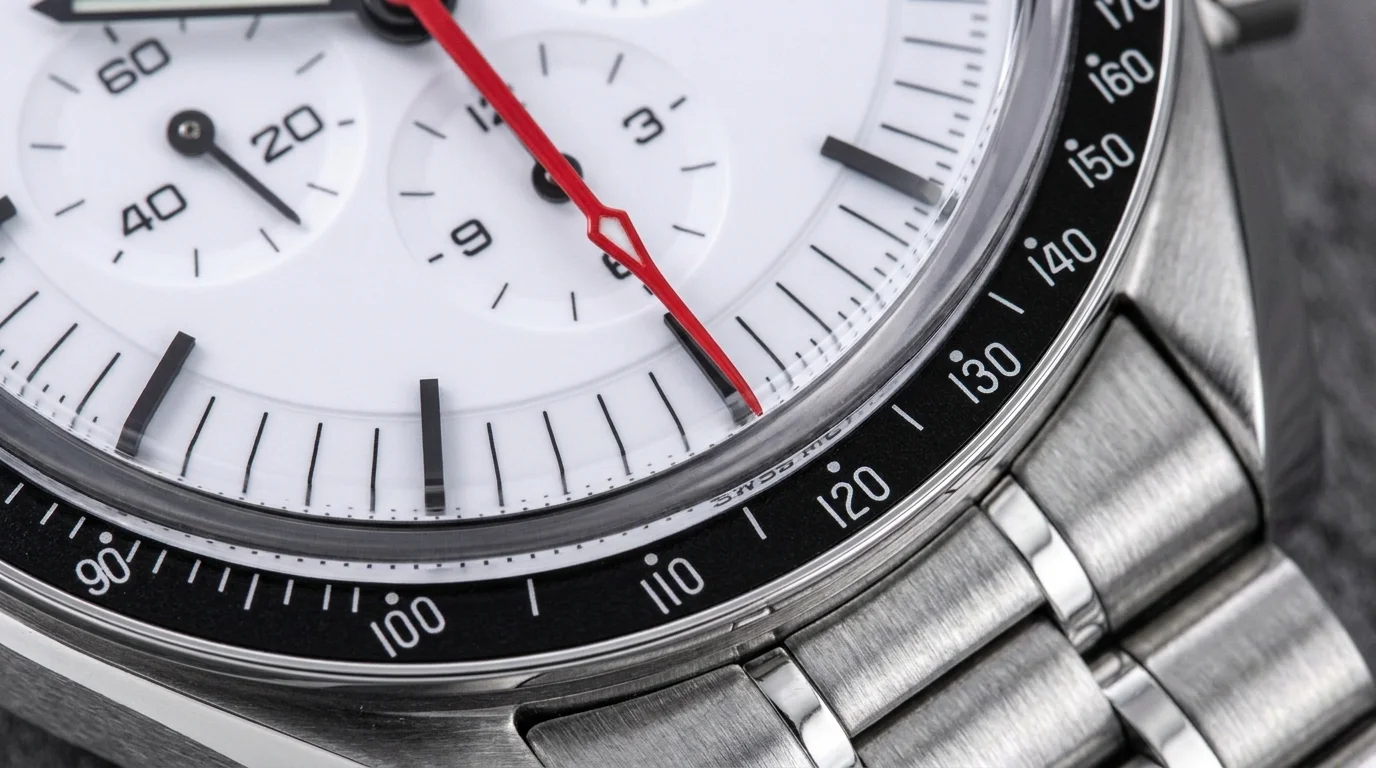 Wherever the seconds hand lands when you stop it is your average speed, read straight off the scale.
Where it breaks down
A tachymeter only measures average speed over the timed interval, not instantaneous speed at any single moment. Cover a mile at wildly varying speed and the scale still just gives you the average across the whole mile.
The scale also has a practical floor. Most tachymeter bezels bottom out around 60 units per hour, since anything slower takes longer than 60 seconds to cover one unit of distance, and a standard chronograph seconds hand can't track past a single rotation of the dial. Below that speed, you'd need to do the 3,600-divided-by-seconds math yourself, or use a movement with an extended chronograph function.
Fixed dial scale versus rotating bezel
Not every tachymeter lives on the bezel. The Omega Speedmaster keeps its scale on a fixed bezel ring, a shift that started with the 1957 original and became the format most brands followed. Older references and some dress chronographs instead print the tachymeter as a fixed ring around the outer edge of the dial itself, inside the crystal.
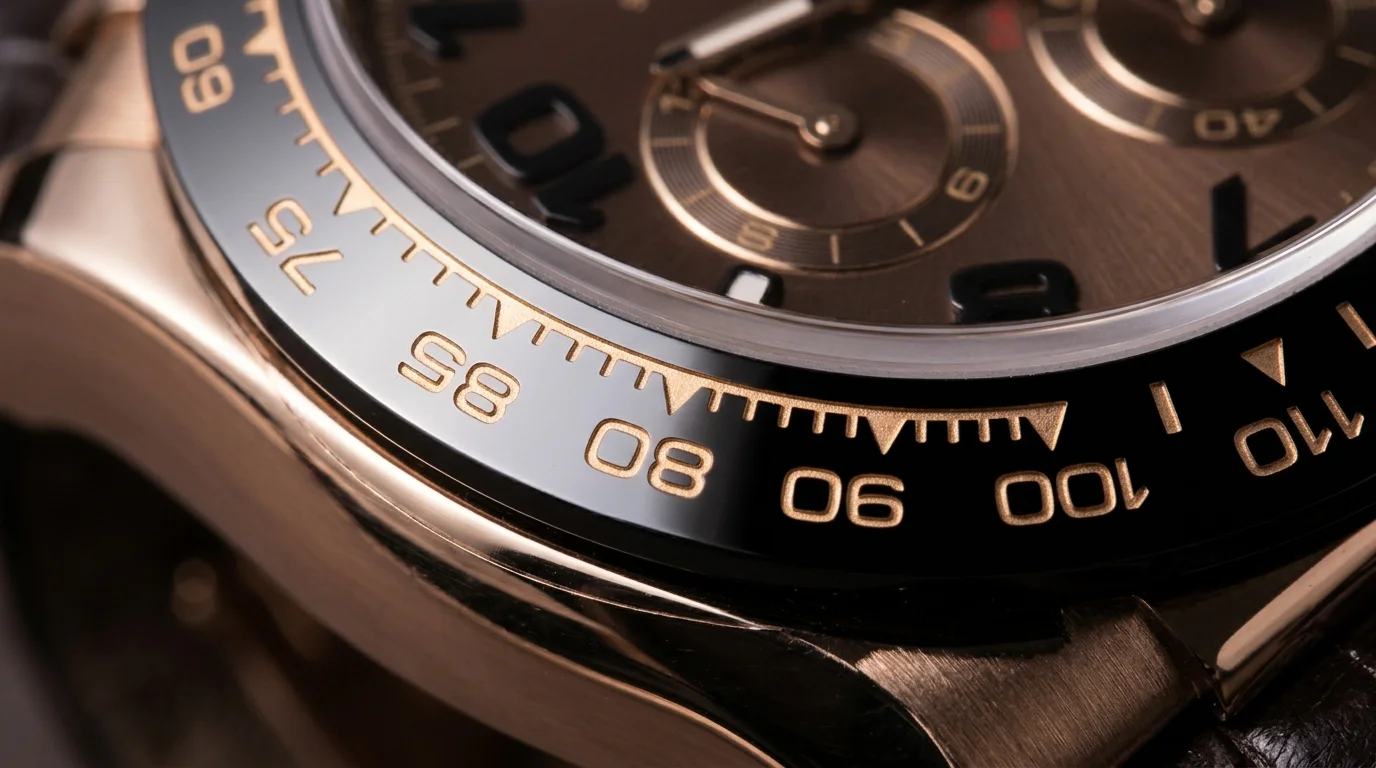 The Rolex Daytona engraves its tachymeter directly into the bezel metal rather than printing it, a detail collectors specifically look for.
Either placement works identically from a function standpoint. The difference is purely aesthetic and, in some cases, a matter of durability, since an engraved metal bezel like the Daytona's resists fading in a way a printed dial ring or lacquered bezel insert eventually won't.
FAQ
What is the fastest speed a tachymeter can measure?
There's no hard upper limit, since faster events simply compress the reading toward the high end of the scale. Most tachymeter scales print numbers up to around 500 or 600 units per hour before the markings become too tight to read precisely.
Do I need to know the exact distance for a tachymeter to work?
Yes. The tachymeter assumes you are timing exactly one unit of distance (one mile, one kilometer, whatever the scale is calibrated for). If your measured distance is off, the resulting speed reading will be proportionally off too.
Why do some watches have a tachymeter and others don't?
A tachymeter only makes sense on a chronograph, since it depends on the chronograph's stopwatch function to work. Non-chronograph watches simply have no elapsed-time mechanism to plot on the scale, so the feature doesn't apply.
Is a tachymeter still useful today, or just decorative?
For most owners today it's largely decorative, since phones and car dashboards measure speed far more easily. It remains genuinely useful in a few niche cases, like timing a runner's pace or estimating speed in situations with no other tool available.
Which watches are known for their tachymeter bezels?
The Omega Speedmaster and Rolex Daytona are the two most recognized tachymeter watches, both associated with motorsport heritage. The Speedmaster popularized moving the scale to a fixed bezel ring in 1957, while the Daytona is known for engraving its scale directly into the metal.
Related reading
For the full picture of how a chronograph works beyond the tachymeter, see What Is a Chronograph? How the Stopwatch on Your Wrist Actually Works. For a head-to-head on the two most famous tachymeter watches, read Speedmaster vs Daytona. And for the broader chronograph buying picture, see The Best Chronograph Watches to Buy in 2026.