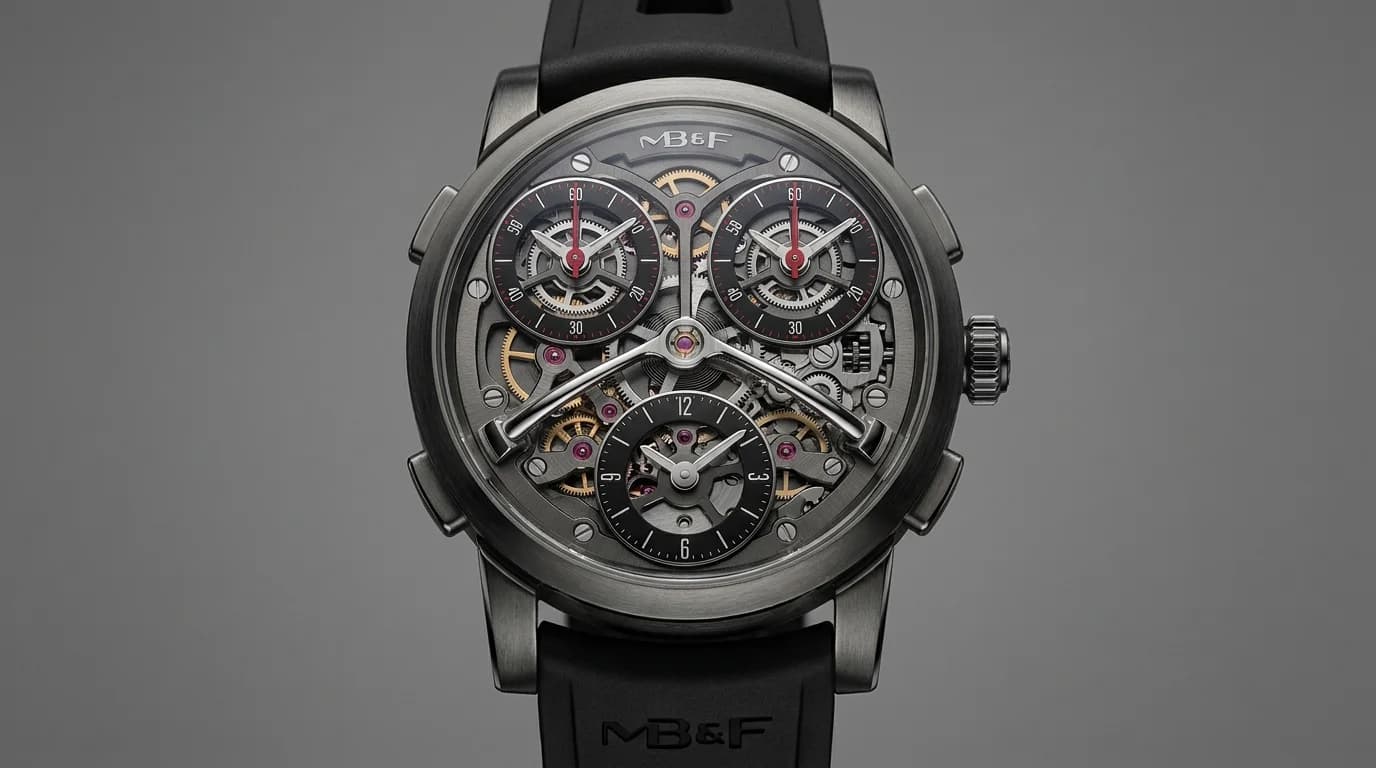
Most brands build their first chronograph in year one or two. MB&F waited until 2022, its 17th year, to release one. The Legacy Machine Sequential EVO is the result, and it does not behave like a normal chronograph.
AI disclosure: images in this post are AI-generated renderings conditioned on real reference photography of the actual watch. They are illustrative, not photographs. Specs, prices, and dates are sourced and cited below.
The short answer
The MB&F Legacy Machine Sequential EVO is the brand's first-ever chronograph. It runs two fully independent chronographs from a single in-house movement, uses one central "Twinverter" pusher to start, stop, and reset both together, and is built by Stephen McDonnell, the independent watchmaker behind MB&F's Legacy Machine Perpetual. It launched in May 2022 in a 44mm x 18.2mm zirconium case at CHF 160,000 (about $180,000), and it is not a numbered limited edition. MB&F simply cannot build them fast enough to flood the market.
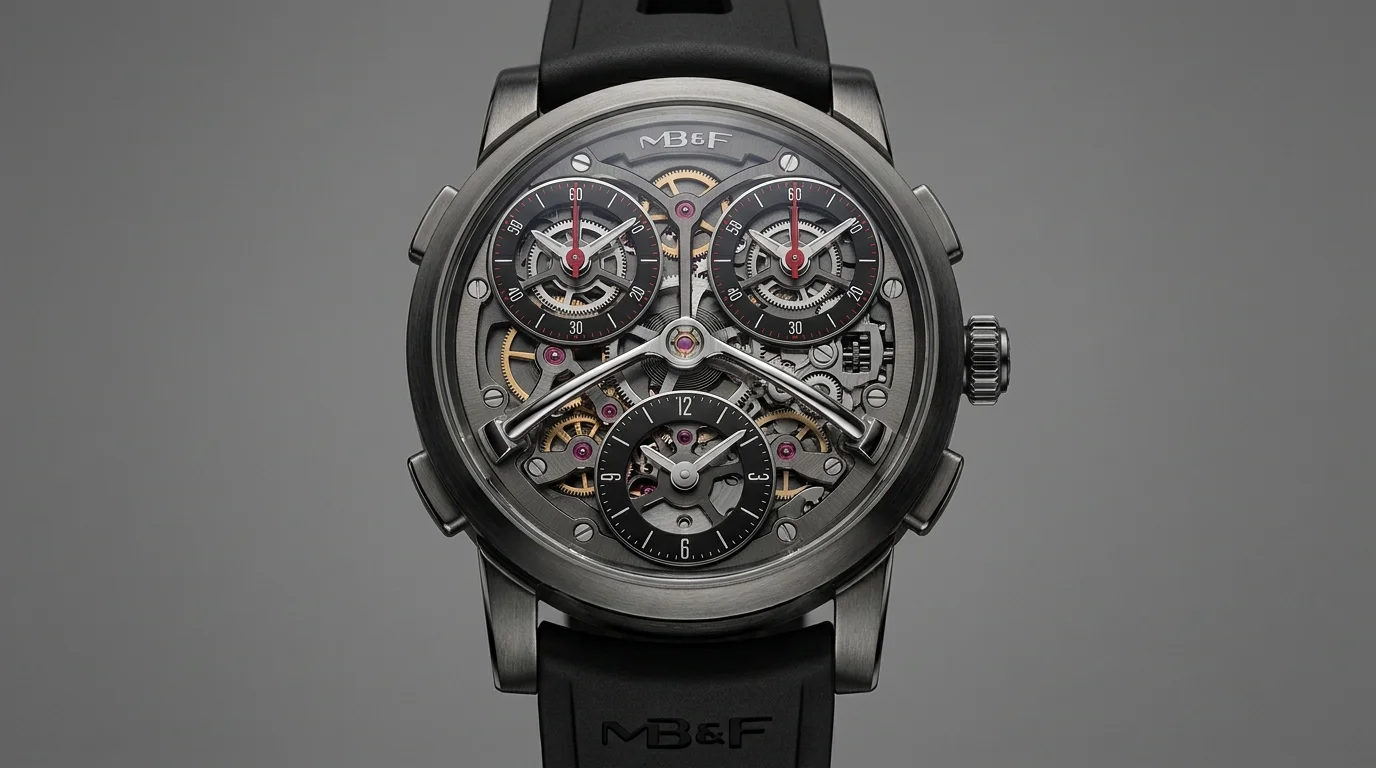 The two 60-minute counters sit side by side, each running its own independent chronograph off a shared gear train.
Why MB&F took 17 years to build a chronograph
Max Busser founded MB&F in 2005 on a simple rule: never build a complication the industry has already perfected unless there is a genuinely new mechanical idea behind it. A chronograph is the most common complication in fine watchmaking. For MB&F to touch one, it needed a reason.
The idea: two chronographs, one switch
That reason arrived as a question. What if a chronograph could time two separate events, or the same event twice, from a single case? The engineering answer became the Twinverter: one large central pusher that fires both chronographs simultaneously, whether starting, stopping, or resetting. A second pusher lets the wearer split the two functions apart, so one chronograph can keep running while the other stops, restarts, or resets independently.
That sounds like a gimmick until you use it. A pilot timing a rolling takeoff and a fuel burn. A referee timing a match and a substitution window. A collector who just wants to see two mechanical brains argue on the same dial. MB&F built the complication for the mechanism itself, not for a marketing hook.
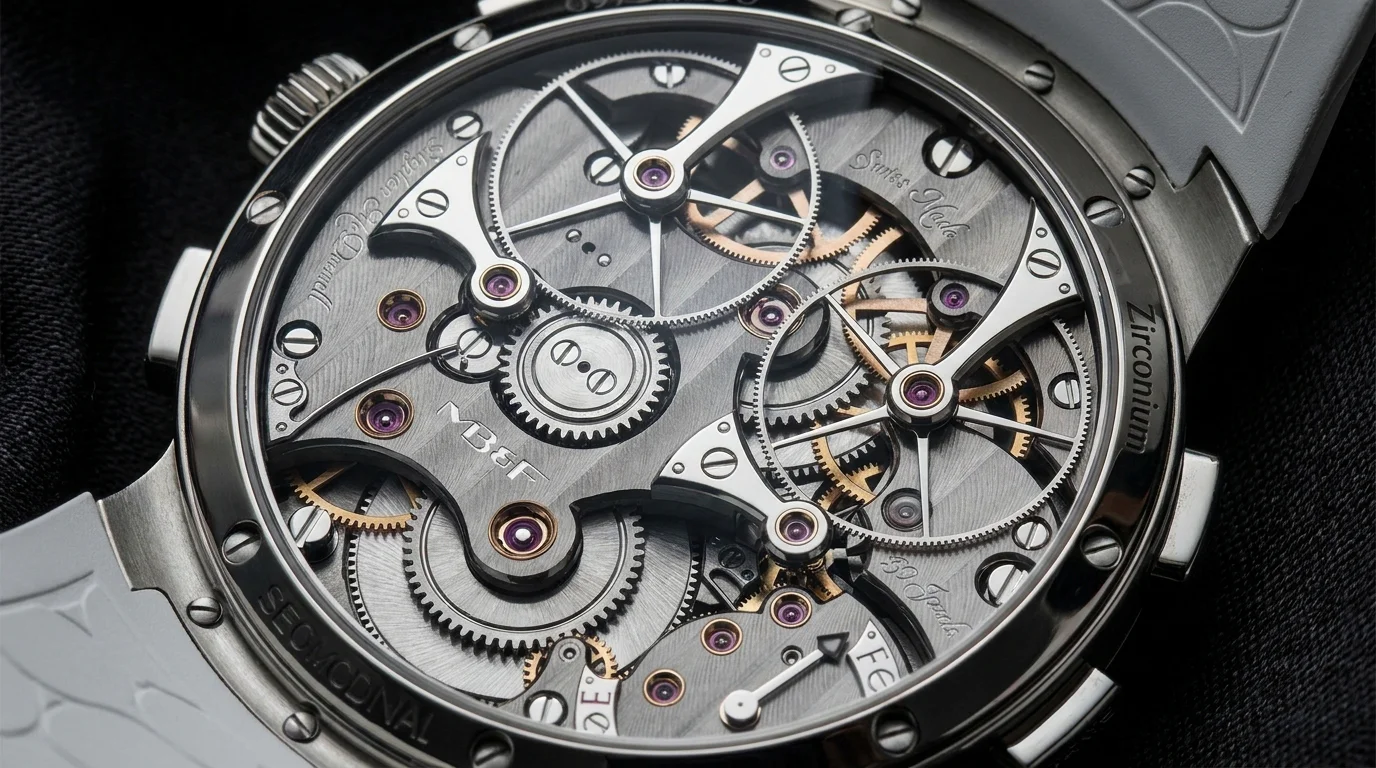 The caseback shows the full in-house architecture, hand-finished to MB&F's usual Geneva stripe and anglage standard.
The movement: built by Stephen McDonnell, not adapted
Stephen McDonnell is the same independent watchmaker who designed MB&F's Legacy Machine Perpetual, a perpetual calendar with no leap year correction needed until the year 2100. For the Sequential EVO, he built the chronograph movement from a blank sheet rather than modifying an existing caliber.
Key specs:
| Spec | Detail |
|---|---|
| Movement | In-house, hand-wound, Stephen McDonnell design |
| Power reserve | 72 hours |
| Jewel count | 59 jewels |
| Frequency | 3Hz (21,600 vph) |
| Case material | Grade 5 zirconium, 44mm x 18.2mm |
| Water resistance | 30m |
| Price at launch (2022) | CHF 160,000 / approx. USD 180,000 |
The 3Hz beat rate is deliberately low for a modern chronograph. Most sport chronographs run at 4Hz for tighter 1/8th-second timing. McDonnell chose 3Hz because the Twinverter mechanism relies on precisely timed column wheels and levers, and a slower beat gives the switching architecture more margin for reliability over decades of use. It is a trade a mainstream brand would rarely make. MB&F made it because durability of the mechanism mattered more than a spec sheet number.
Zirconium: an unusual case choice
Zirconium is not a common watch case material. It resists corrosion and scratching better than most steels, takes a bright polish close to platinum in appearance, and is considerably lighter than a precious metal case of the same size. MB&F has used it before on the Horological Machine line, but the Sequential EVO was the first Legacy Machine built in it. Grey and black dial versions followed the original launch, along with a Flyback complication variant added in later years.
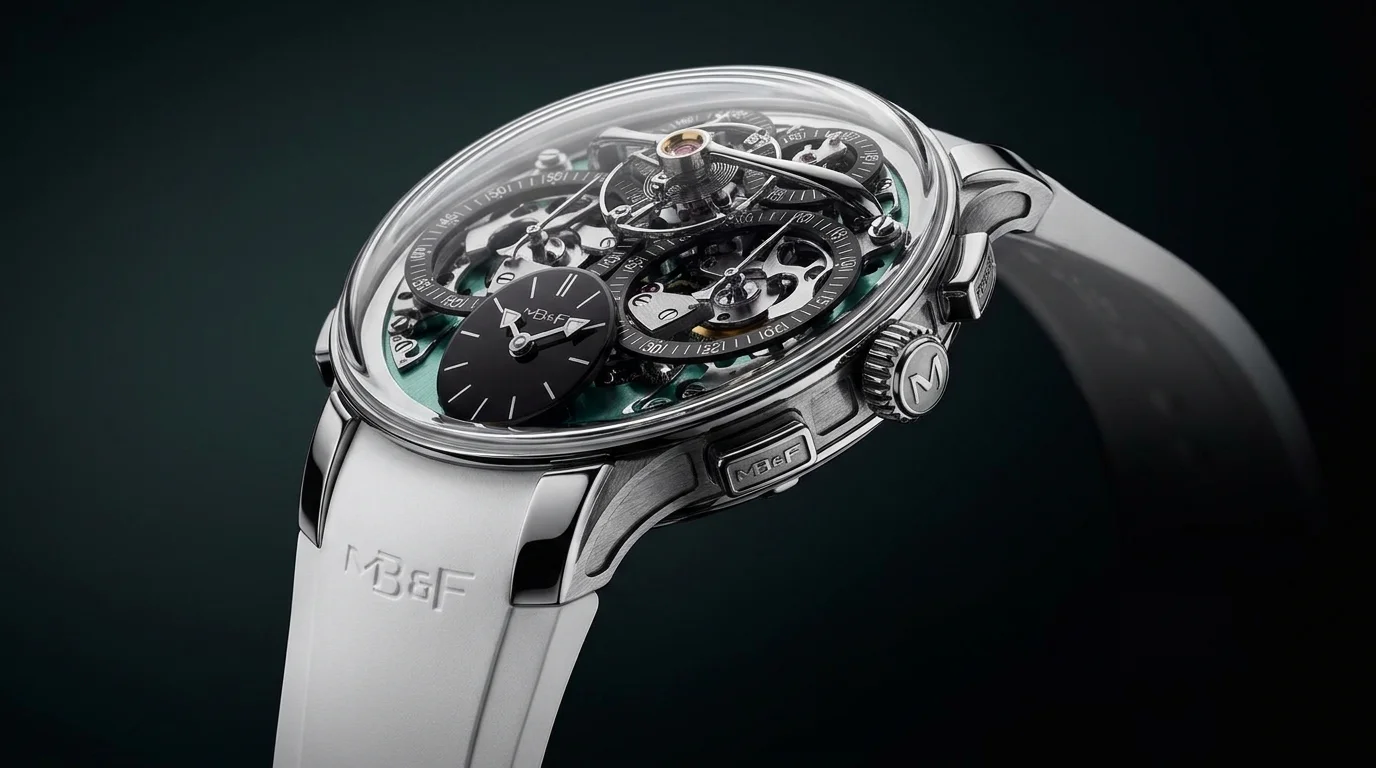 The tall, domed sapphire crystal is a signature MB&F silhouette, needed to clear the raised architecture underneath.
How it wears
At 44mm wide and 18.2mm thick, the Sequential EVO is not a small watch, and the dome adds visual height beyond the case spec. MB&F designs its Legacy Machine EVO cases with an ergonomic profile that hugs the wrist better than the thickness number suggests, but this is still a watch that announces itself. Buyers coming from a Rolex Daytona or an Omega Speedmaster should expect a noticeably larger, taller presence on the wrist.
Reference this against the brand's core buyer: MB&F sells to collectors who already own two or three "normal" watches and want something that does not resemble anything else in the case. This is not a first luxury watch, and MB&F does not market it as one.
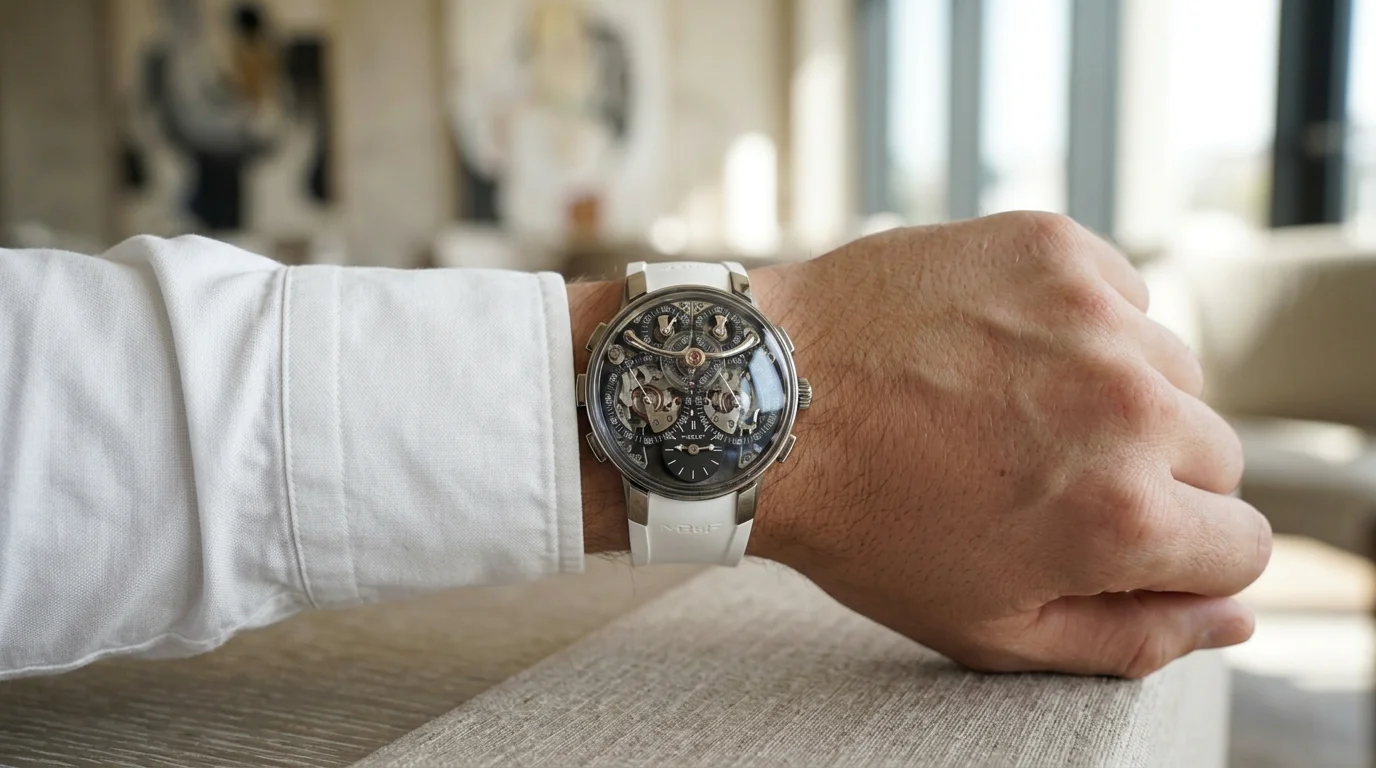 White rubber was one of several strap options MB&F offered alongside black and grey at launch.
Buying pre-owned: what to check
Independent watchmaking brands like MB&F carry different risk than mainstream Swiss houses when you buy secondary market. Here is what matters:
- Service history. A hand-finished, low-volume movement like McDonnell's chronograph should only be serviced by MB&F's own workshop or an authorized partner. Ask for paperwork.
- Twinverter function test. Have the seller demonstrate both the combined start/stop/reset and the split independent function before you buy. This is the mechanism most likely to show wear first.
- Box and papers. MB&F's low production numbers make full sets meaningfully more valuable than watch-only listings, more so than with high-volume brands.
- Authorized dealer network. MB&F sells through a small, curated list of retail partners (M.A.D.Gallery among them). A pre-owned example with an unclear ownership chain deserves extra scrutiny.
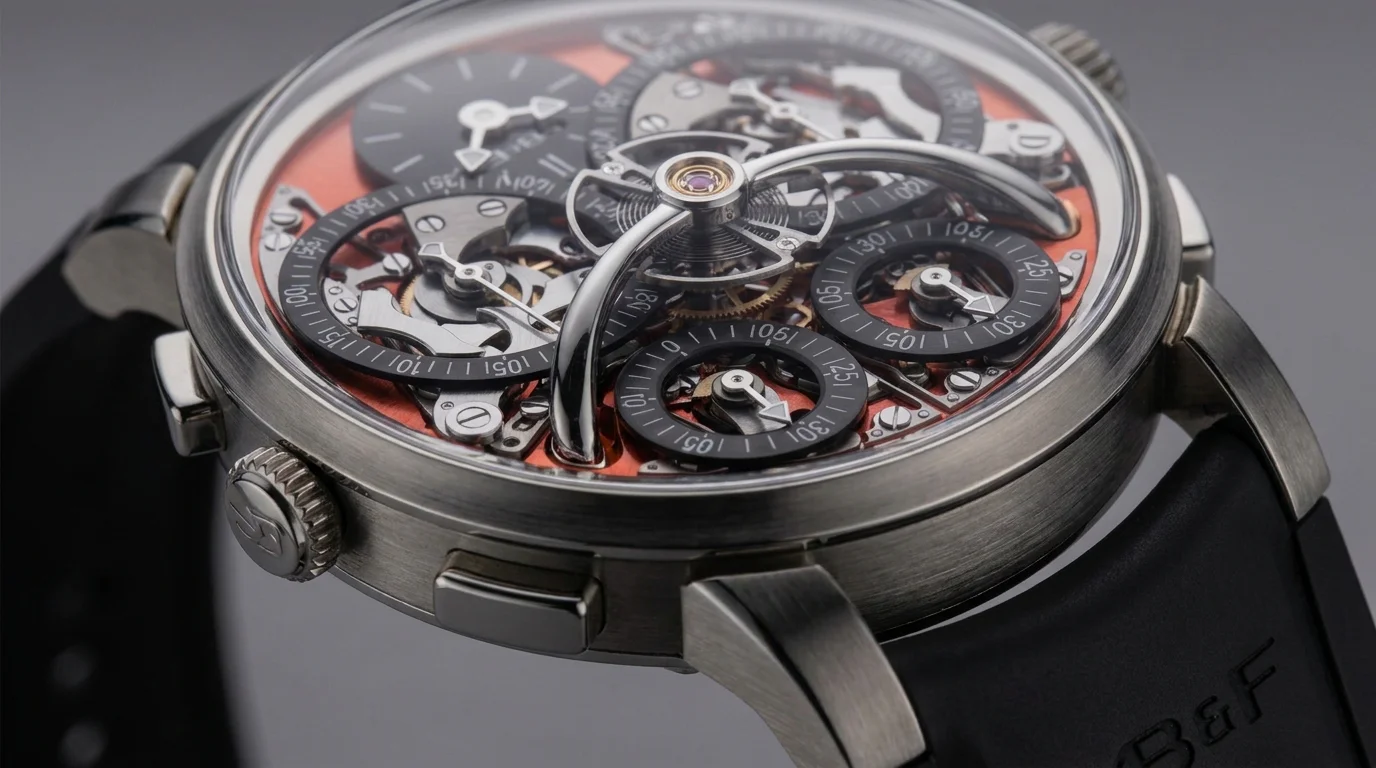 The central Twinverter pusher, the mechanical idea the entire watch was built around.
Where it sits against MB&F's other complications
MB&F's most famous complication before the Sequential EVO was its tourbillon work across the Horological Machine and Legacy Machine lines. If you want the plain-English version of what a tourbillon actually does and whether it is worth paying for, we cover that separately in our tourbillon explainer. The Sequential EVO takes a different approach entirely: instead of fighting gravity, it solves a switching problem no one else had bothered to solve.
For collectors weighing an independent chronograph against the establishment names, our Speedmaster vs Daytona comparison and Zenith Chronomaster Sport review are useful contrast points on what "mainstream" chronograph engineering looks like at a fraction of the price.
FAQ
What does the MB&F Legacy Machine Sequential EVO cost?
It launched in May 2022 at CHF 160,000, roughly USD 180,000 at the time, before local taxes. Pre-owned examples trade based on condition, box and papers, and dial variant.
Is the Legacy Machine Sequential EVO a limited edition?
No. MB&F has not capped production at a fixed number. Availability is limited by the brand's hand-finishing capacity, not by a stated edition size.
Who makes the movement?
Independent watchmaker Stephen McDonnell designed the chronograph movement from scratch. He is best known for MB&F's Legacy Machine Perpetual, a perpetual calendar that does not need correcting until the year 2100.
What is the Twinverter?
It is the single central pusher that starts, stops, and resets both of the watch's independent chronographs at once. A second pusher lets the wearer split the two chronographs apart so each can be controlled on its own.
Is zirconium a good watch case material?
Yes. Zirconium resists corrosion and scratching well, polishes to a finish close to platinum, and weighs less than a precious metal case of comparable size. It is uncommon in watchmaking largely because it is difficult to machine.
Browse authenticated pre-owned independent and haute horlogerie watches at 5dwatches.com.