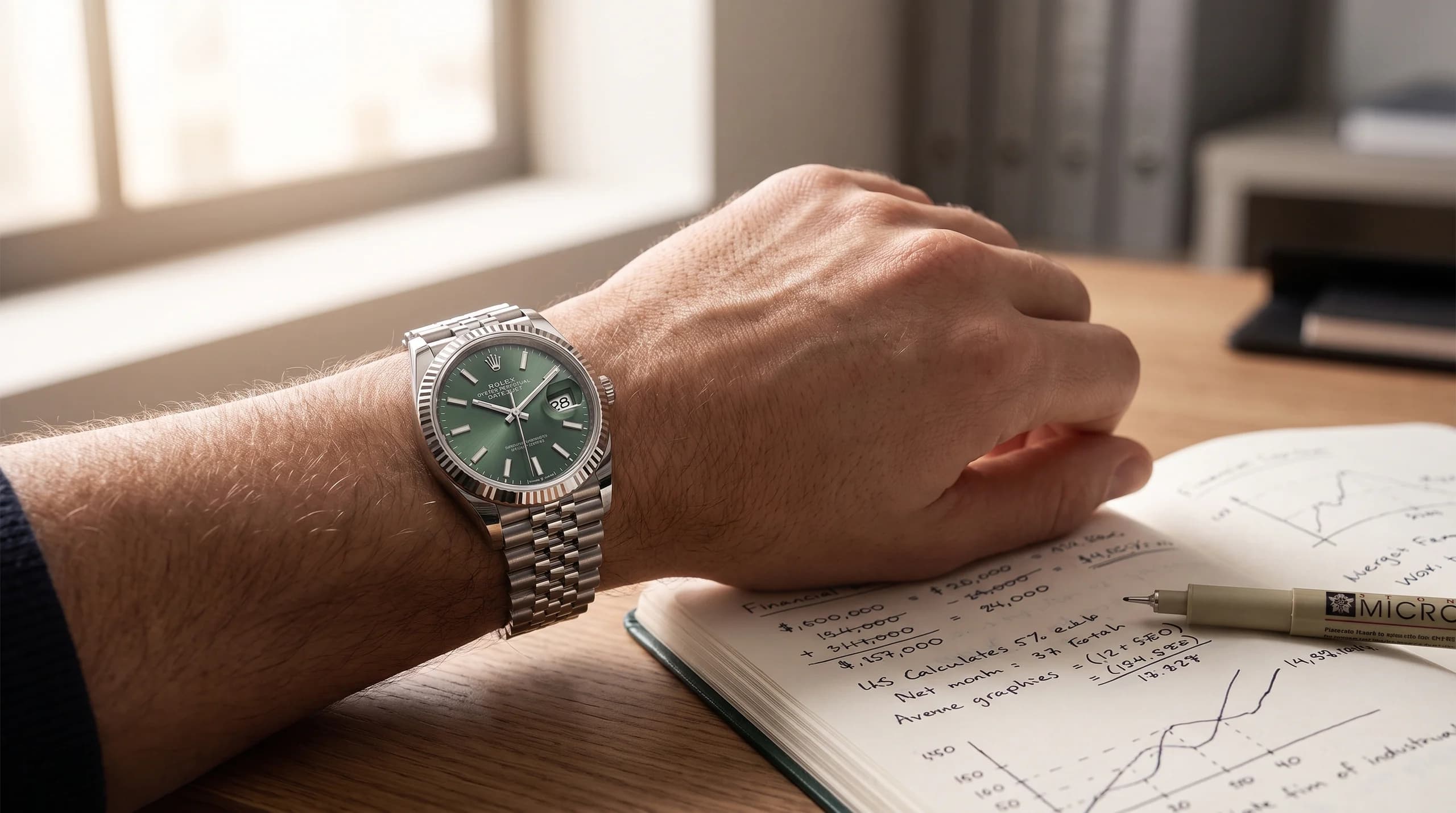
Customers ask us this at least once a week: do I actually need to insure this watch, or am I paying for peace of mind I don't need? The honest answer depends on price, how you use the watch, and how much cash you'd be out if it walked off your wrist tomorrow.
The Short Answer
If a watch is worth more than about $5,000 and you'd genuinely struggle to replace it out of pocket, insure it. Below that, and if you'd shrug off the loss, self-insuring is often the more rational choice. This is a decision framework, not a how-to. For the mechanics of appraisals, riders, and claims, see our full guide to insuring a luxury watch.
 Before you call an insurer, run the actual numbers. AI-generated editorial image built from real reference photography.
Run the Actual Math First
Specialty watch insurance runs roughly 1 to 2% of appraised value per year, according to Jewelers Mutual, one of the larger underwriters in this space. On a $10,000 watch, that is $100 to $200 a year. On a $50,000 watch, it is $500 to $1,000 a year, every year, whether or not anything ever happens.
Over ten years of ownership, that is $1,000 to $2,000 on the cheaper watch and $5,000 to $10,000 on the expensive one. That is real money, and it is worth comparing against the actual risk you are covering.
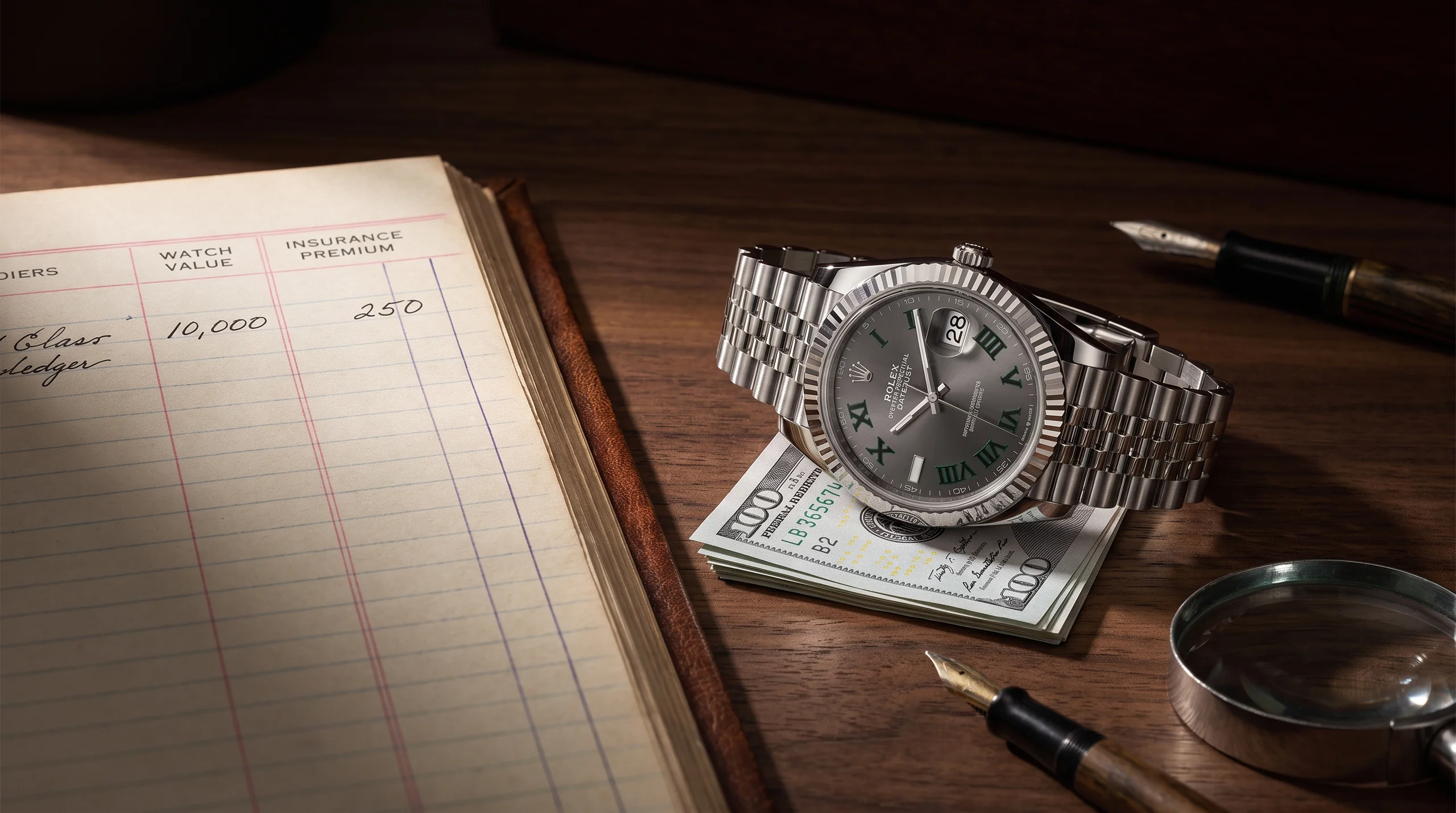 Weighing the annual premium against the watch's actual value is the whole exercise. AI-generated editorial image built from real reference photography.
The Self-Insuring Math
Self-insuring means setting that same premium aside yourself instead of paying it to an insurer. If you can comfortably absorb a total loss without financial strain, and you keep the watch reasonably secure, the math often favors skipping the policy on a single mid-range watch.
The math flips once you own more than one or two pieces worth insuring, or once any single watch is worth more than you could replace without changing your spending elsewhere. At that point, spreading the risk to an insurer for 1 to 2% a year is cheap relative to the downside.
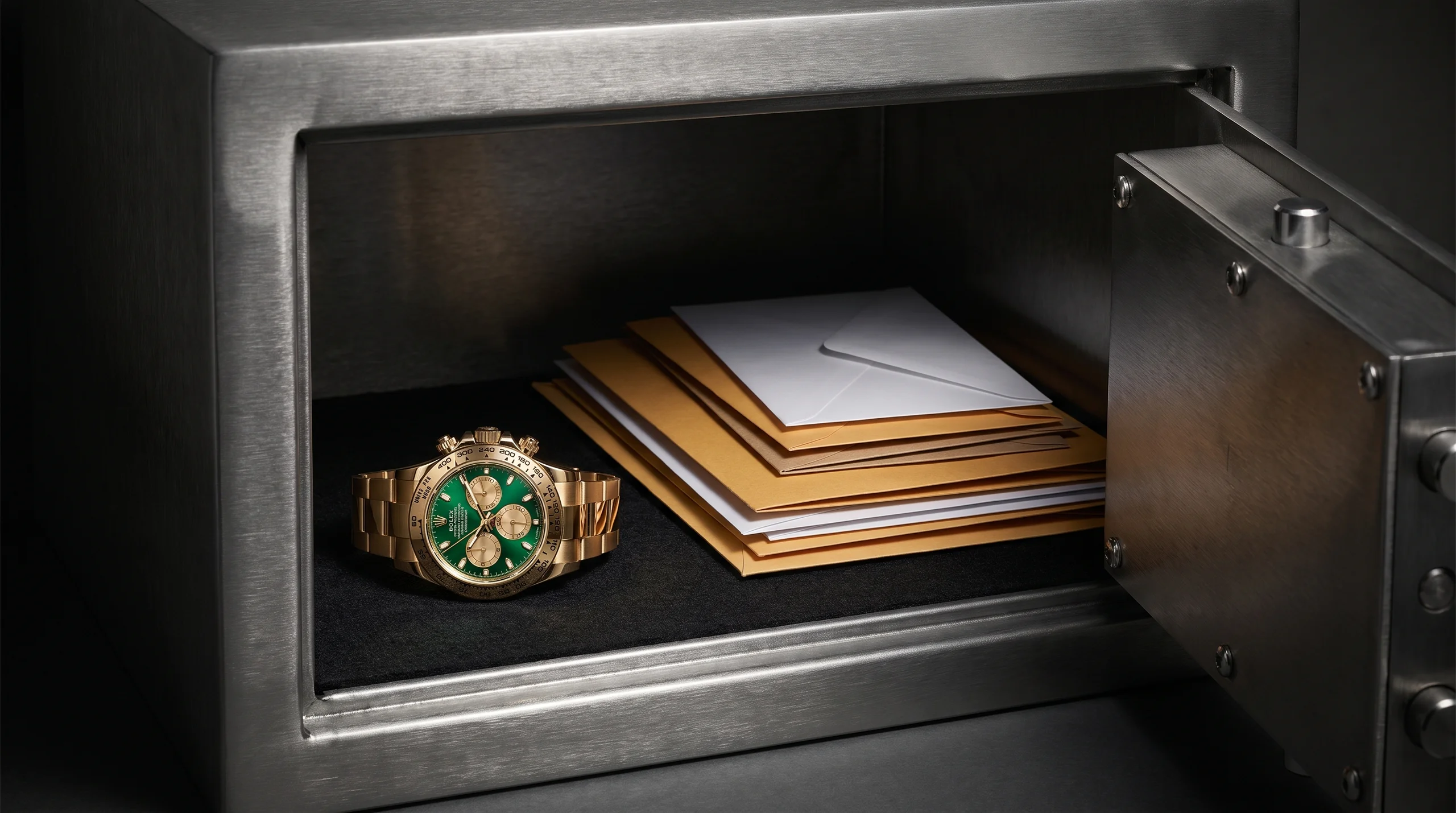 Self-insuring means the safe and the savings do the job a policy would otherwise do. AI-generated editorial image built from real reference photography.
Which Watches Actually Need Coverage
Not every watch in a collection needs the same treatment. We tell clients to sort by three questions: what would it cost to replace, how often does it leave the house, and what would actually happen to your finances if it disappeared tomorrow.
Under $3,000 to $5,000: Most homeowners or renters policies already provide some baseline sub-limit coverage for jewelry, even without a rider. If the watch is worn casually and the loss would sting but not hurt, a policy add-on may not be worth the annual cost.
$5,000 to $15,000: This is the real decision zone. A single loss here is painful for most households but usually not catastrophic. Weigh the 1 to 2% annual cost against how frequently you travel with it, wear it outside secure environments, or work in a field where damage risk is elevated.
$15,000 and up: Insure it. At this price point, a total loss is a meaningful financial event for almost anyone, and the annual premium is small next to that downside. This is also where most standard homeowners sub-limits stop being relevant entirely, since they typically cap out around $1,500 to $5,000 total across all jewelry.
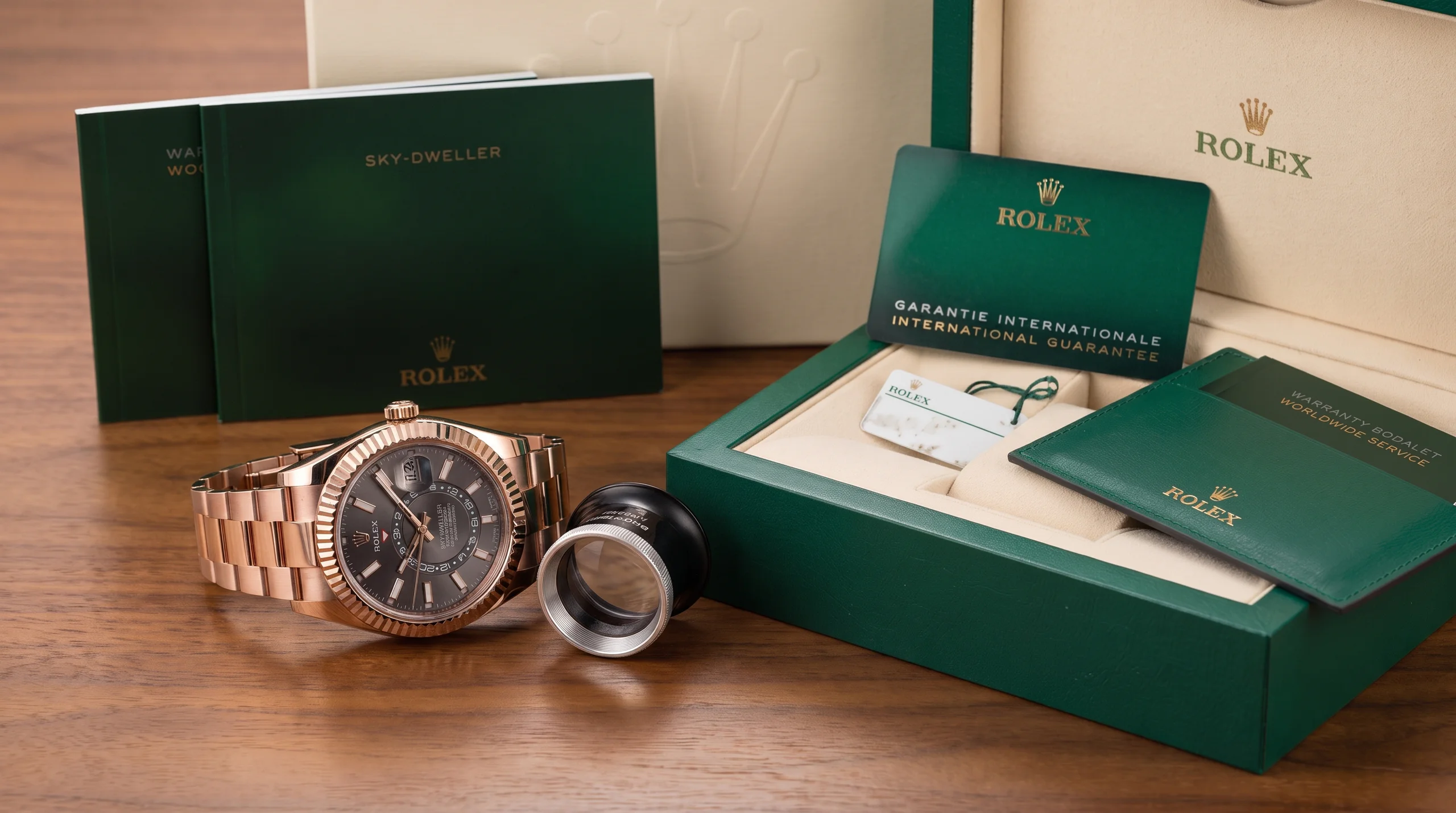 Getting the paperwork right, down to the exact reference number, matters as much as the coverage decision itself. AI-generated editorial image built from real reference photography.
What Insurance Does Not Protect You From
Insurance covers loss, theft, and often accidental damage. It does not protect you from a bad purchase, a fake, or a watch that loses value because the market moved.
If you are buying to reduce risk, the highest-leverage move happens before you own the watch: buying authenticated pre-owned through a dealer with documented provenance, rather than a private-party listing with no paper trail. Insurance protects the watch you already have. It does nothing for a watch that was never what the seller claimed.
Routine servicing matters here too. A watch that has been neglected is more likely to fail in ways insurance was never designed to cover, like a seized movement from a decade without service.
The Working Dealer's Rule of Thumb
Here is the shortcut we actually give clients standing at the counter. If you can name the exact dollar figure you would need to replace the watch, and that figure would not change your month, skip the policy and keep the cash. If saying that number out loud makes you wince, get the rider.
One more variable worth naming honestly: if the watch has sentimental value beyond its resale price, that changes the calculation regardless of price. A number cannot always replace what was actually lost.
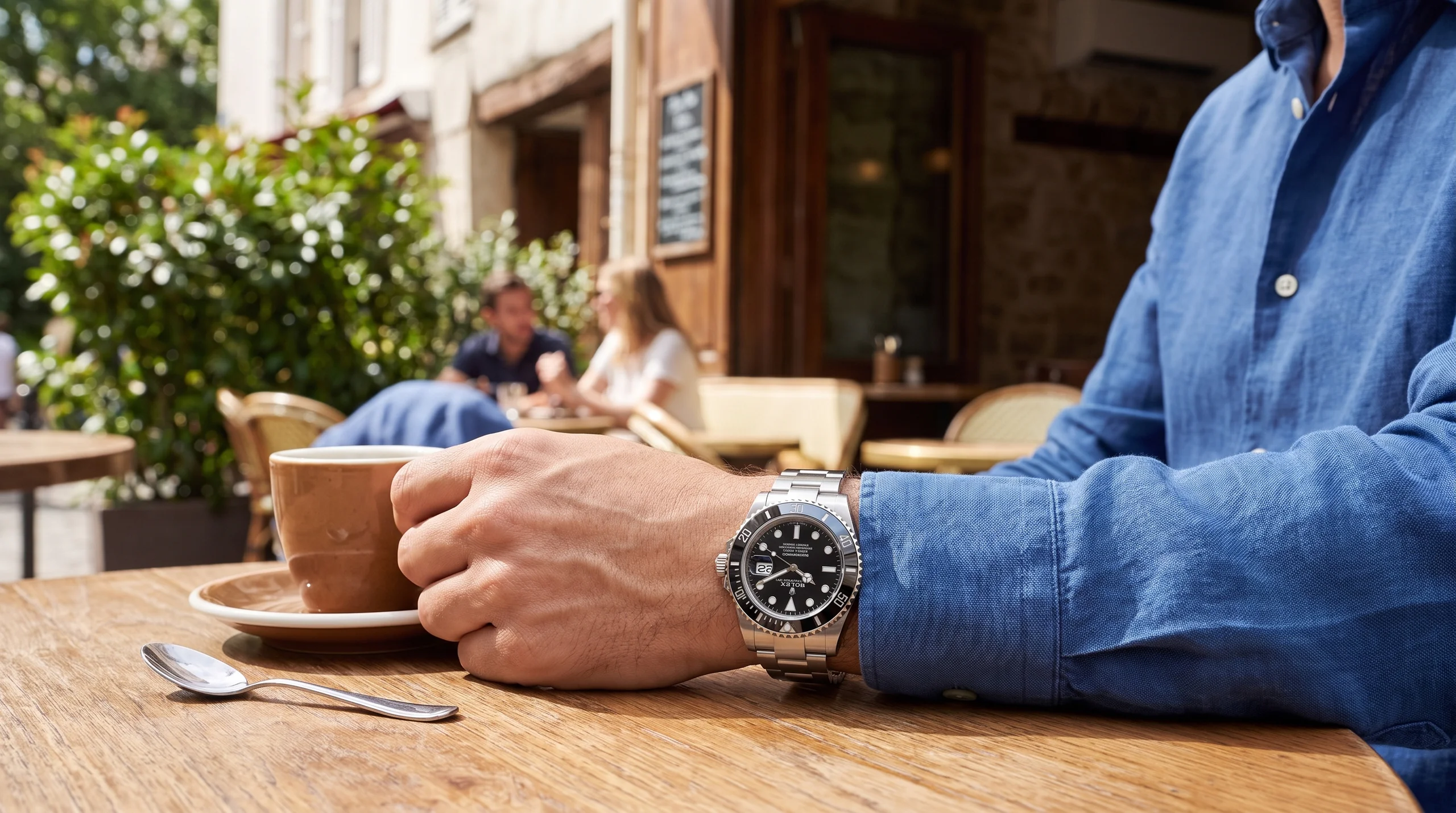 Properly covered, or comfortably self-insured, means actually wearing it. AI-generated editorial image built from real reference photography.
FAQ
Do I need insurance for a watch under $5,000?
Usually not required, but check what your existing homeowners or renters policy already covers before deciding. Many policies include a small jewelry sub-limit that covers modest watches without an added rider.
Is watch insurance worth it for a $20,000 watch?
Generally yes. At this value, a total loss is a significant financial hit for most owners, and the annual premium (roughly 1 to 2% of value) is small relative to that risk.
What does self-insuring a watch mean?
Instead of paying an insurer, you set aside the equivalent premium yourself and accept the risk of a total loss. It can make sense for a single mid-value watch you could comfortably replace.
Does watch insurance cover a fake or misrepresented watch?
No. Insurance covers loss, theft, and damage to the watch you actually own. It has nothing to do with authenticity disputes from the purchase itself.
How is this different from a guide on how to insure a watch?
This post helps you decide whether coverage makes sense for your situation. Our companion guide covers the mechanics once you have decided: appraisals, riders versus standalone policies, and filing a claim.
Browse authenticated pre-owned watches at 5dwatches.com.