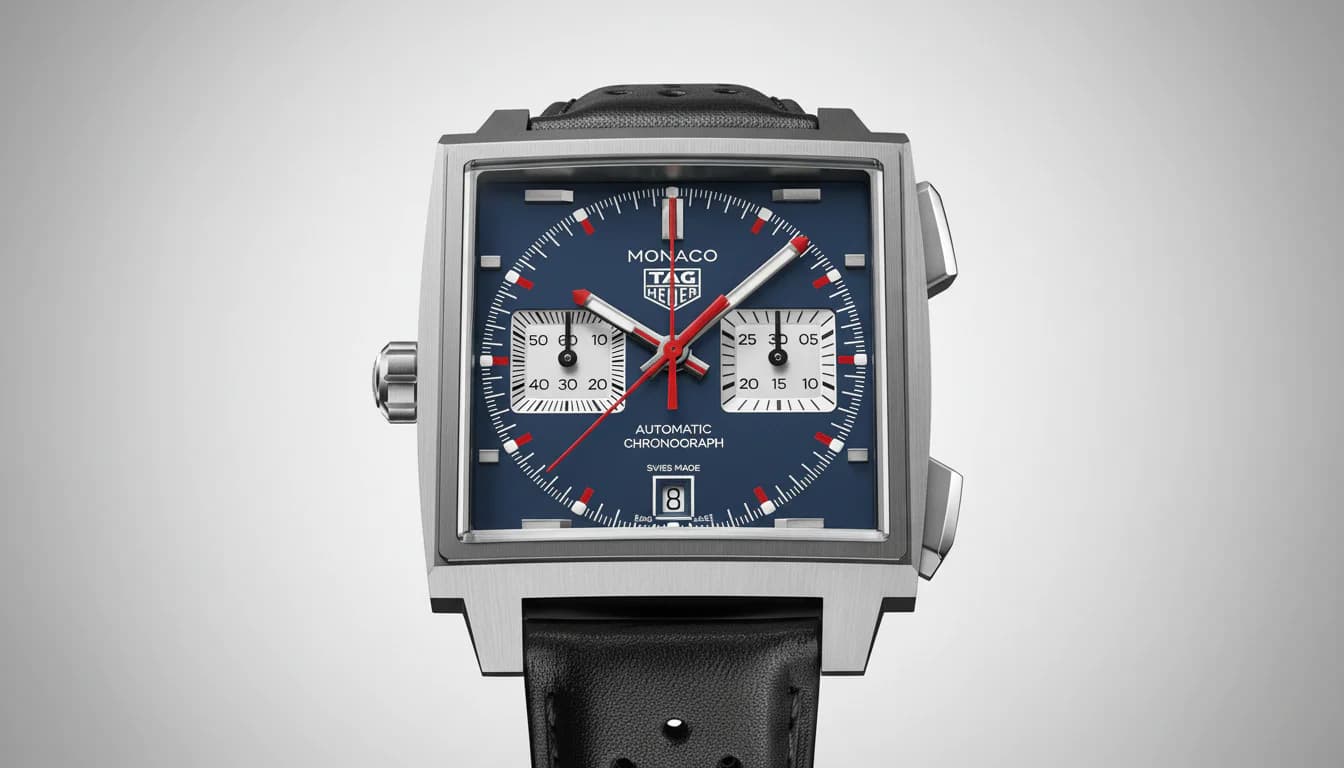
Most square watches disappear off a wrist. The Monaco does the opposite, and it has been doing it since 1969.
This post includes AI-assisted images built from real reference photos of the actual watches discussed. All specifications, reference numbers, and pricing are researched and verified against manufacturer and trade sources, not invented.
The short answer: The current TAG Heuer Monaco chronograph is reference CDW2181.FC8360 (blue dial), CDW2180.FC8360 (black dial), or CDW2150.FC8360 (green dial), all in 39mm grade 5 titanium running the in-house Calibre TH20-11 with an 80-hour power reserve. Retail runs $9,350 in titanium and $13,050 in a two-tone titanium and rose gold case. The Monaco traces back to 1969, when it became one of the first automatic chronographs ever sold and the watch Steve McQueen wore in Le Mans.
Where The Square Case Actually Comes From
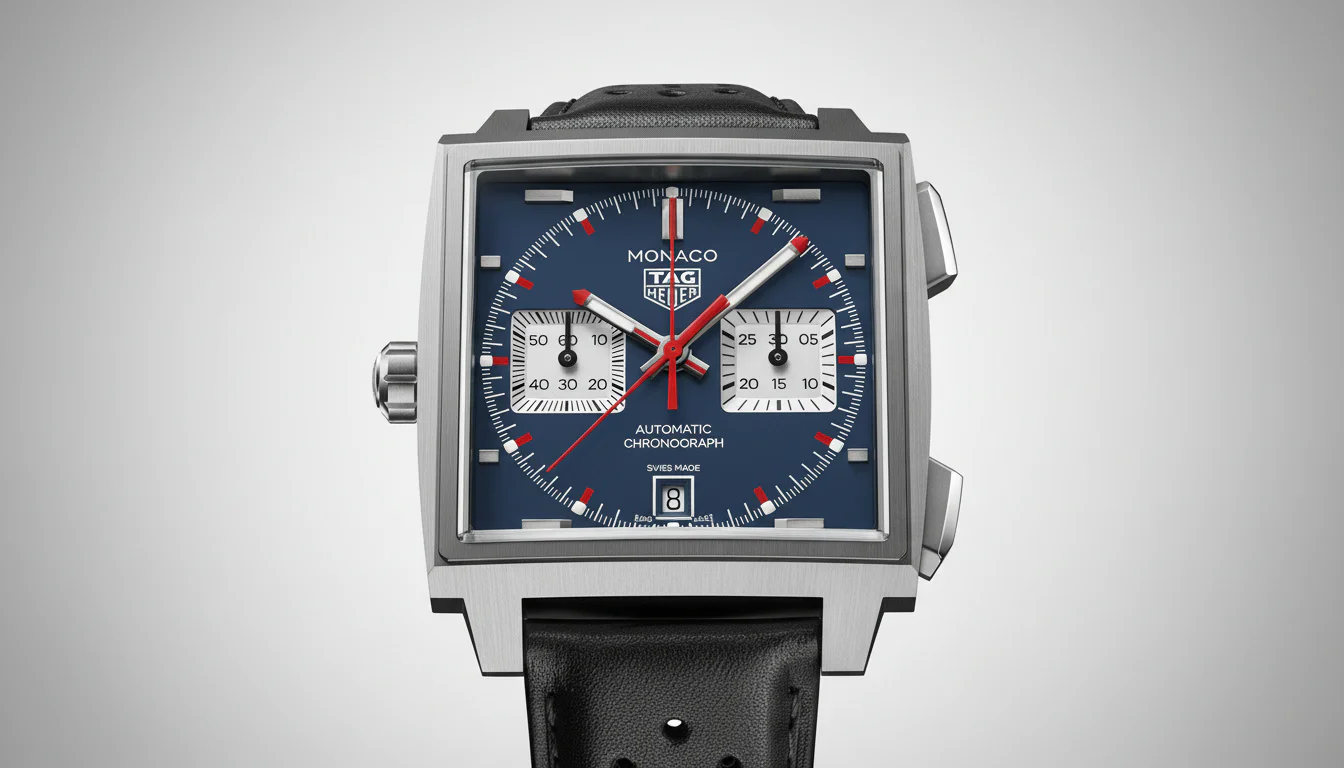 The blue dial, the bi-compax layout, the left-hand crown. All three have carried through from 1969 to today.
Heuer launched the Monaco on March 3, 1969, the same day Zenith announced the El Primero and roughly the same window Seiko released its own automatic chronograph in Japan. All three brands were racing to claim the first automatic chronograph movement, and Heuer's Calibre 11 (co-developed with Breitling, Hamilton-Buren, and Dubois-Depraz under the "Chronomatic" project) got there first by a matter of weeks.
The square case was not a styling accident. Water resistant square cases were genuinely difficult to seal in 1969, and Heuer used the achievement as part of the watch's launch story. The crown sits on the left side of the case because the Calibre 11 movement wound from that side, a quirk of the automatic module rather than a design choice, and TAG Heuer has kept it on every Monaco since as a signature rather than fixing it.
Steve McQueen Made It A Legend By Accident
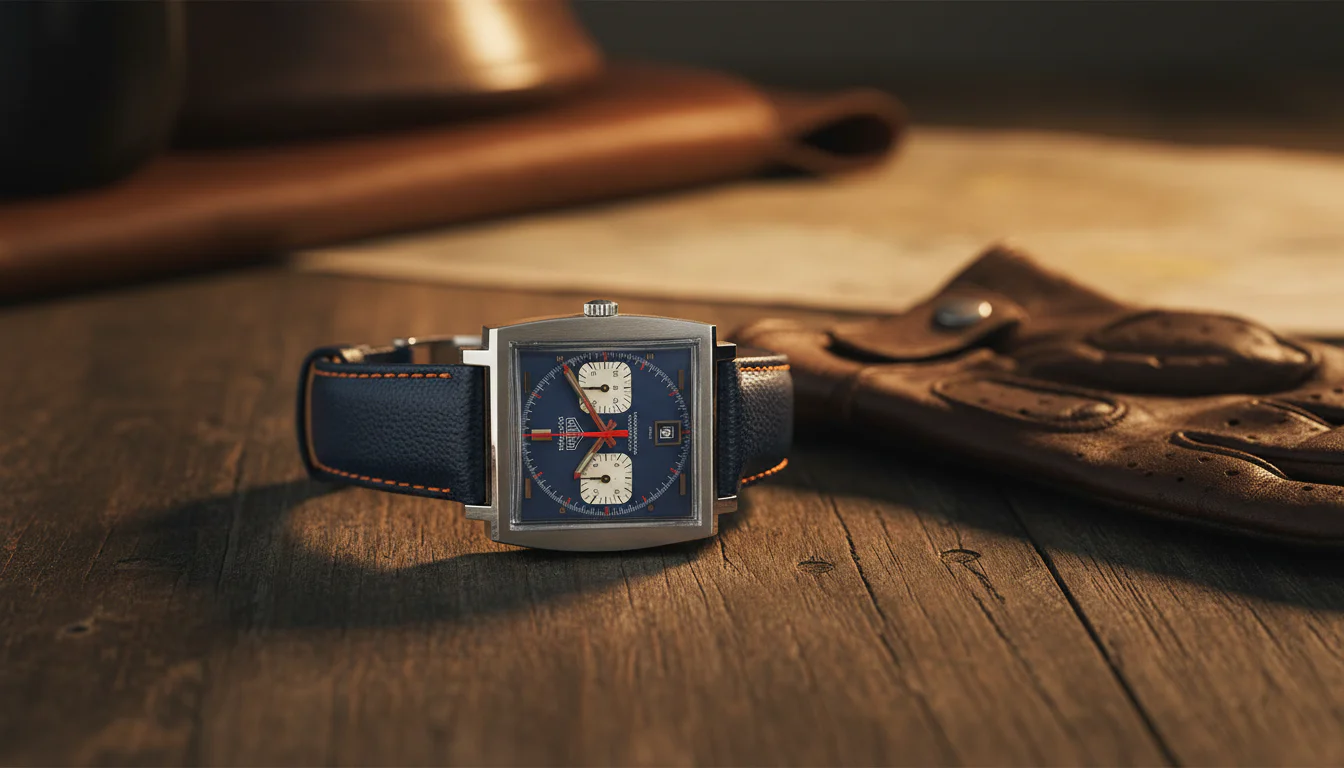 The blue dial and orange chronograph hands are the exact combination McQueen wore on screen in 1971.
Steve McQueen wore a Monaco reference 1133B in the 1971 film Le Mans, at the suggestion of his racing advisor Jo Siffert, who was sponsored by Heuer at the time. McQueen kept the watch after filming, and its presence on his wrist in one of the most watched racing films of the era did more for the Monaco's reputation than any advertising campaign Heuer ran. That single reference is now among the most valuable vintage chronographs in the market, regularly clearing six figures at auction.
The 2026 Monaco: What You're Actually Buying New
The current generation moved to Calibre TH20-11, TAG Heuer's in-house automatic chronograph movement, replacing the outsourced Sellita-based Calibre 11 used in the prior generation.
| Spec | 2026 Monaco (CDW2181.FC8360) |
|---|---|
| Case material | Grade 5 titanium |
| Case size | 39mm |
| Movement | Calibre TH20-11, in-house automatic |
| Power reserve | 80 hours |
| Warranty | 5 years |
| Dial options | Blue, black, green |
| Retail (titanium) | $9,350 |
| Retail (titanium/rose gold) | $13,050 |
What actually changed for 2026: a more pronounced curved case profile for better wrist ergonomics, a square sapphire crystal replacing the older domed glass, and the jump from an outsourced movement to the in-house TH20-11. The bi-compax dial layout (chronograph minutes at 3 o'clock, running seconds at 9 o'clock) and the angled date window at 6 o'clock carry over from the outgoing generation.
The Twin Pushers And Left-Hand Crown Are Non-Negotiable
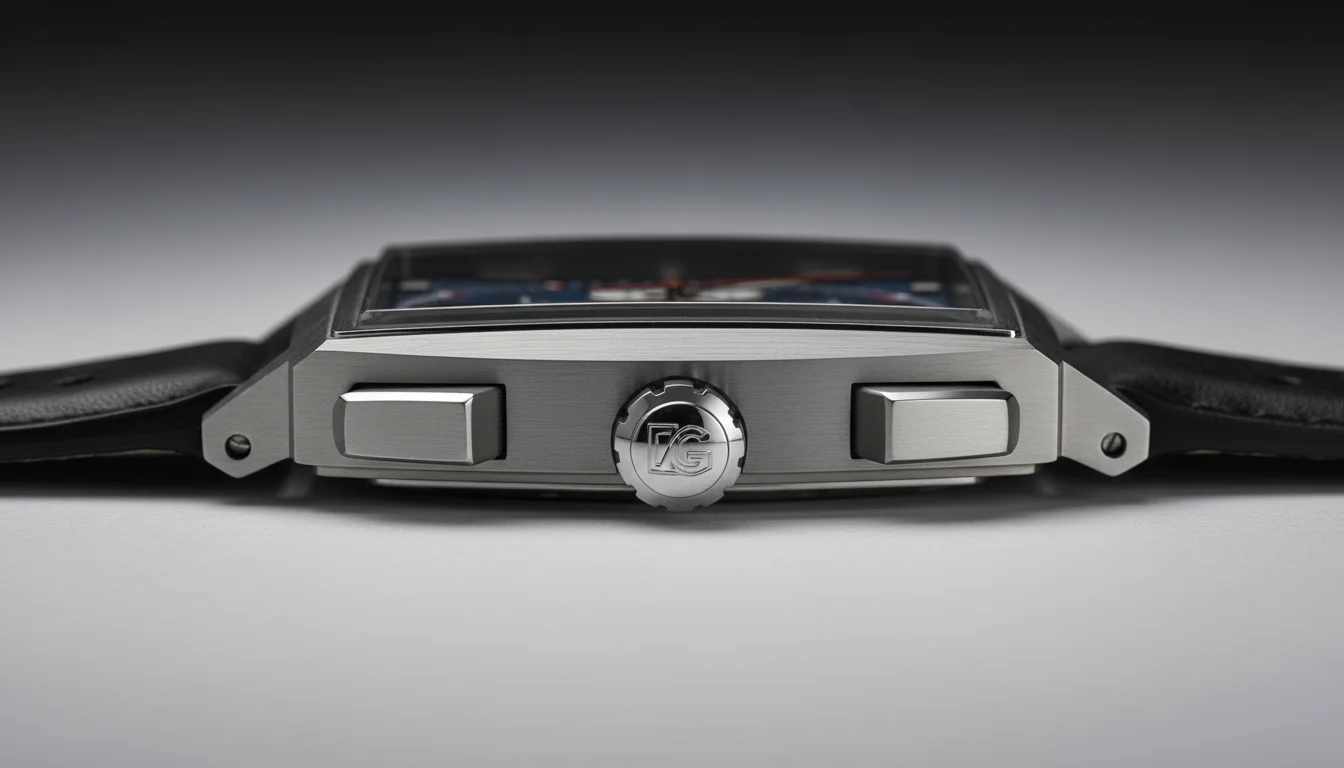 Every Monaco since 1969 has worn its crown on the left. It is the single detail that identifies the watch at a glance.
If a square TAG Heuer chronograph has its crown on the right side of the case, it is not a Monaco. TAG Heuer has never moved the crown to the conventional side on any mainline reference, vintage or modern, and the left-side crown alongside the twin chronograph pushers is the fastest way to confirm you are looking at a genuine Monaco rather than a different square-cased chronograph in the catalog.
Pre-Owned Monaco Pricing And What To Check
Pre-owned pricing on the current-generation Monaco tracks close to retail given the watch is still in active production and demand has stayed steady since the 2026 update. Older Calibre 11-based references (produced roughly 1998 to 2026 in various relaunches) trade at a meaningful discount to the new TH20-11 generation, generally 20 to 30 percent below the current retail equivalent, since they carry an outsourced movement rather than the in-house caliber.
What to check before buying pre-owned: confirm the crown side and pusher placement match genuine Monaco proportions (a resized or aftermarket case swap is a real risk on square-cased vintage chronographs), verify the case has not been over-polished since sharp, flat case edges are part of what makes the Monaco's silhouette read correctly, and ask specifically which caliber generation you're buying since the difference between a Calibre 11 Monaco and a TH20-11 Monaco is a meaningful gap in both movement pedigree and price.
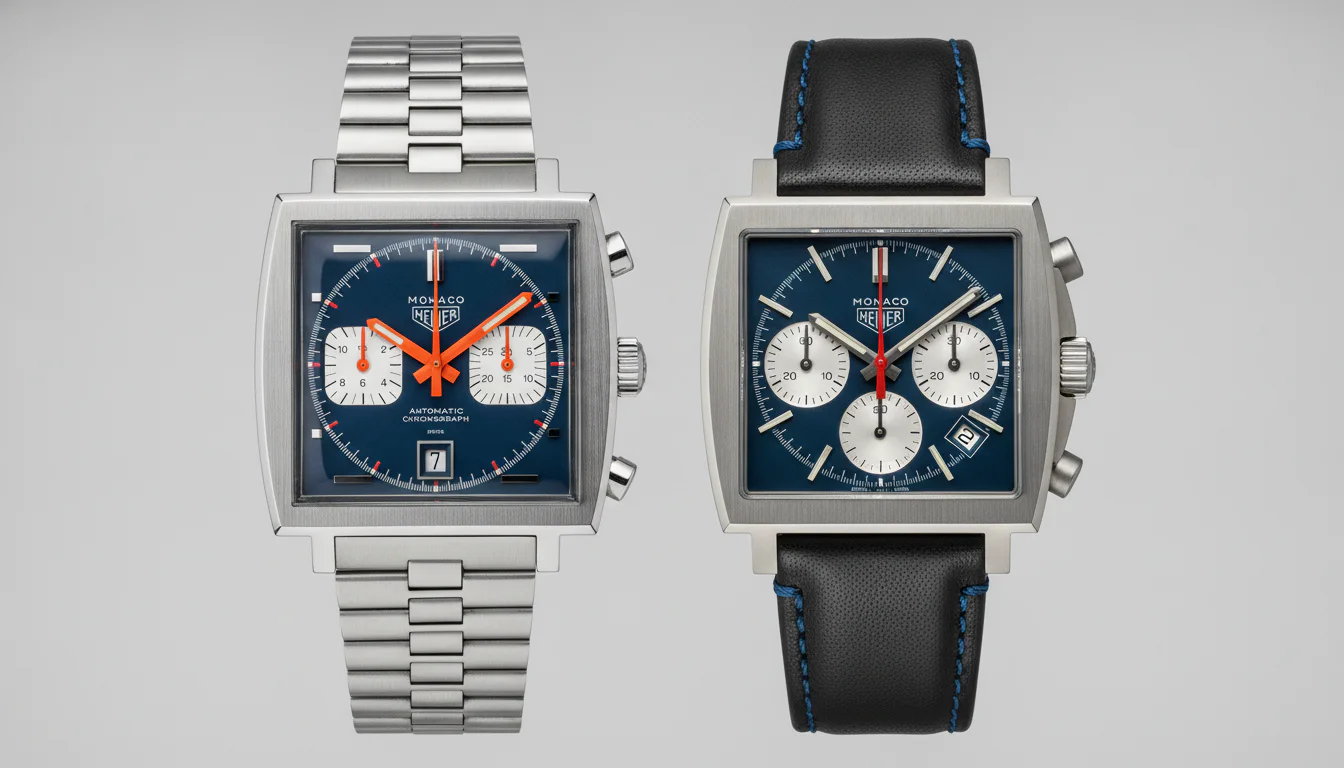 Fifty-plus years apart, and the family resemblance is still obvious. That continuity is a big part of why the Monaco holds collector interest.
Who The Monaco Actually Fits
The Monaco is not a subtle watch. It wears larger than its 39mm case size suggests because a square case reads differently on the wrist than a round one, and the blue dial with orange or red chronograph accents draws attention by design. It suits someone who already owns a round everyday chronograph and wants a genuinely different silhouette, or a collector specifically chasing the McQueen connection and the first-automatic-chronograph history rather than shopping purely on specs.
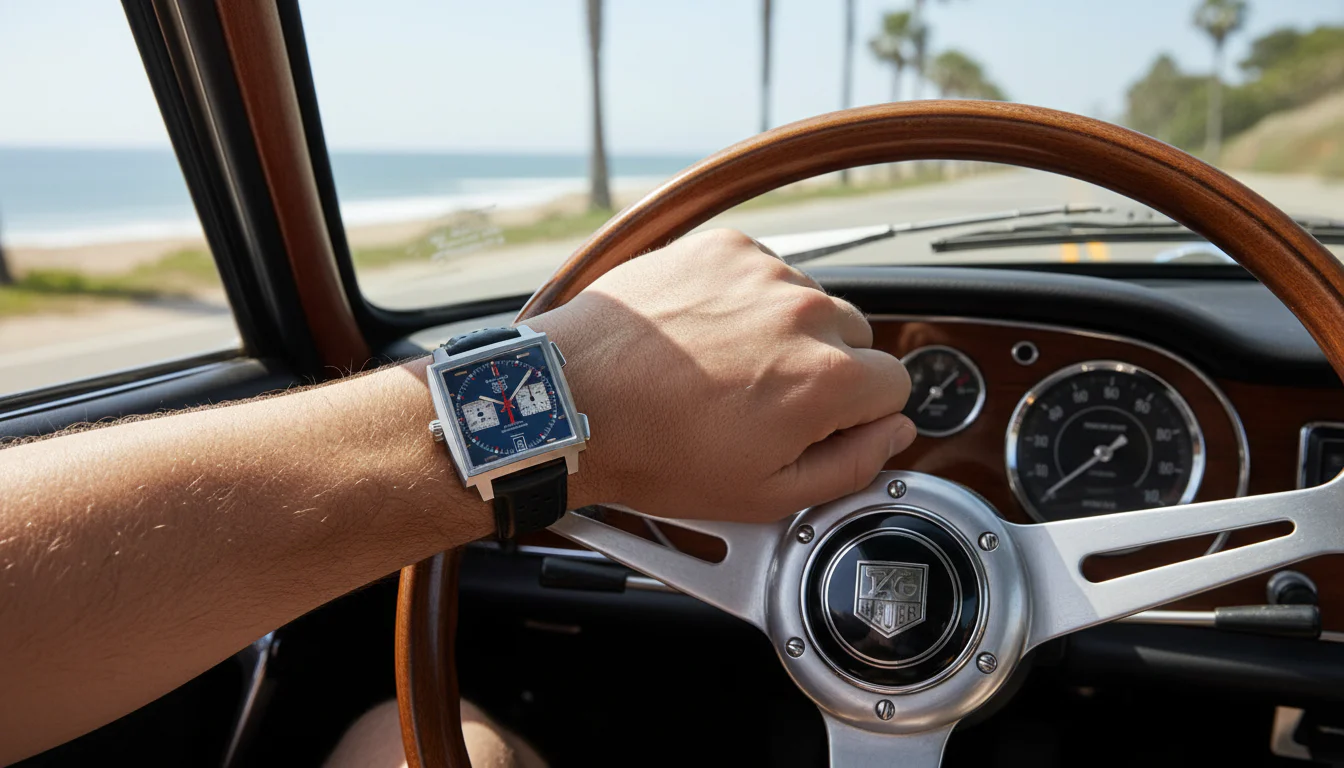 The Monaco's racing pedigree is not a marketing invention. It has been genuinely tied to motorsport since the day it launched.
If your priority is a chronograph you can wear in a boardroom without comment, the TAG Heuer Carrera fits that brief better. If your priority is a chronograph with real horological firsts behind it and a design that still looks nothing like anything else on the market, the Monaco is the answer, alongside its motorsport-named sibling the Monza, built for a different corner of TAG Heuer's racing history.
FAQ
What is special about the TAG Heuer Monaco?
The Monaco was one of the world's first automatic chronographs when it launched in 1969, alongside the Zenith El Primero, and it was the first square, water-resistant chronograph case ever produced. Its left-side crown is a byproduct of that original Calibre 11 movement and has remained a Monaco signature ever since.
How much does a TAG Heuer Monaco cost?
The current 2026 generation in grade 5 titanium retails for $9,350, with a titanium and rose gold configuration at $13,050. Pre-owned Calibre 11-based generations trade roughly 20 to 30 percent below current retail.
Did Steve McQueen actually own his Monaco?
Yes. McQueen wore a Heuer Monaco reference 1133B in the 1971 film Le Mans and kept the watch afterward. That reference is now one of the most valuable vintage chronographs in the collector market.
What movement does the current TAG Heuer Monaco use?
The 2026 generation runs Calibre TH20-11, TAG Heuer's in-house automatic chronograph movement with an 80-hour power reserve, replacing the outsourced Calibre 11 used in earlier relaunches.
Is the TAG Heuer Monaco a good first chronograph?
It can be, but it is a deliberately unconventional choice. Someone wanting a chronograph that blends into daily wear should look at a round case like the TAG Heuer Carrera first. The Monaco suits a buyer who specifically wants the square silhouette and the history behind it.