
The Short Answer
A retrograde complication moves a hand across a fixed arc instead of a full circle, then snaps it back to the starting point instead of continuing around. A spring-loaded cam, usually snail-shaped or heart-shaped, drives the hand forward as it rotates, then releases it the instant the cam's edge drops off, letting the spring pull the hand back almost instantly. Vacheron Constantin gets the credit for reviving the complication in modern wristwatches, tracing back to its 1994 Mercator and 1997 Saltarello references, decades after retrograde displays first appeared in 18th-century clocks and pocket watches.
It shows up most often on date and day indications, though hour and minute versions exist too, and it costs more to build and service than a standard rotating hand because fewer watchmakers are trained on the mechanism.
 A retrograde hand reads left to right across the month, then jumps back to day one overnight.
The watch photos in this article were generated with AI image tools, conditioned on real reference photography of retrograde watches and movement components so the dial layouts and mechanical details are accurate representations.
How the Mechanism Actually Works
A normal date or seconds hand travels in a continuous circle. A retrograde hand travels across a printed arc, maybe a third or half of the dial, then has to get back to its starting position without simply continuing around, since the scale ends where it began. Watchmakers solve this with a cam, a shaped piece of metal that a lever or finger rides against as it rotates.
The most common version uses a snail cam, named for its spiral shape that gradually increases in radius. As the cam turns, the growing radius pushes the lever, and the hand, steadily forward across the scale. When the cam completes its rotation, the radius drops sharply back to its starting point, the lever falls off that edge, and a loaded spring snaps the hand back to zero almost instantly. Some retrograde and chronograph reset functions instead use a heart-shaped cam, which produces a similar snap-back effect through a different profile.
 A biretrograde watch runs two of these mechanisms side by side, one for the day, one for the date.
A Complication With a Real History
Retrograde displays are not new. Sources trace early retrograde mechanisms to clocks and pocket watches as far back as the mid-18th century, and the complication became genuinely fashionable in Art Deco pocket watches of the 1920s and 1930s, where retrograde hands were built into animated figures like magicians and clowns with moving arms.
The modern wristwatch revival belongs to Vacheron Constantin, which traces its own retrograde lineage back to a jumping-hour pocket watch from 1824 and a run of Art Deco pieces from the 1930s and 1940s. The brand brought the complication into wristwatches directly with the Mercator in 1994, a bi-retrograde hour and minute display with compass-needle-shaped hands sweeping across a hand-painted map dial, followed by the Saltarello in 1997.
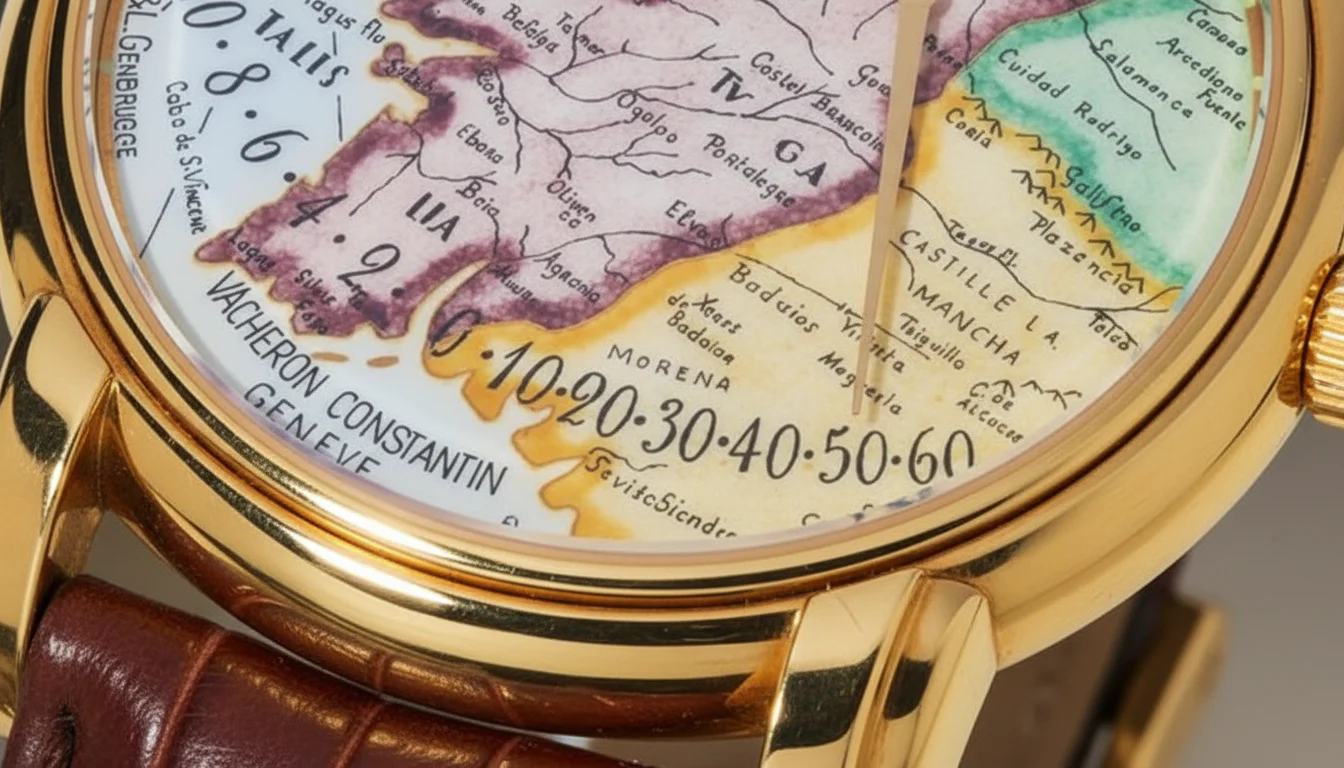 The Mercator turned the retrograde arc into a literal map, with the hands acting as compass needles.
Modern References Worth Knowing
Vacheron Constantin still builds the complication into current production, including the Patrimony Retrograde Day-Date and the Overseas Moon Phase Retrograde Date, both showing a single retrograde arc alongside a standard moon phase subdial. Roger Dubuis takes the idea further with its Excalibur Biretrograde Calendar, which runs two independent retrograde displays side by side, one for the day of the week and one for the date, wrapped around an open-worked movement.
Cartier has used retrograde date functions in past Tank Américaine perpetual calendar references, and the mechanism shows up across other independent and haute horlogerie brands whenever a maker wants a calendar display that reads as a deliberate design statement rather than a plain date window.
The Honest Maintenance Caveat
A retrograde mechanism is a delicate one, and the spring-loaded snap-back needs correct calibration to return accurately and reliably every time it fires. That calibration work is specialized, and servicing a retrograde watch generally costs more than servicing a standard three-hand or date watch, largely because fewer watchmakers have hands-on experience with the mechanism rather than because of any dramatically higher failure rate.
 The heart-shaped cam is the same basic idea used in chronograph reset mechanisms, just applied to a calendar display instead of a stopwatch function.
Before buying a pre-owned retrograde watch, ask specifically whether the snap-back function has been serviced and confirm the seller or a watchmaker has tested it through several full cycles, not just glanced at the dial.
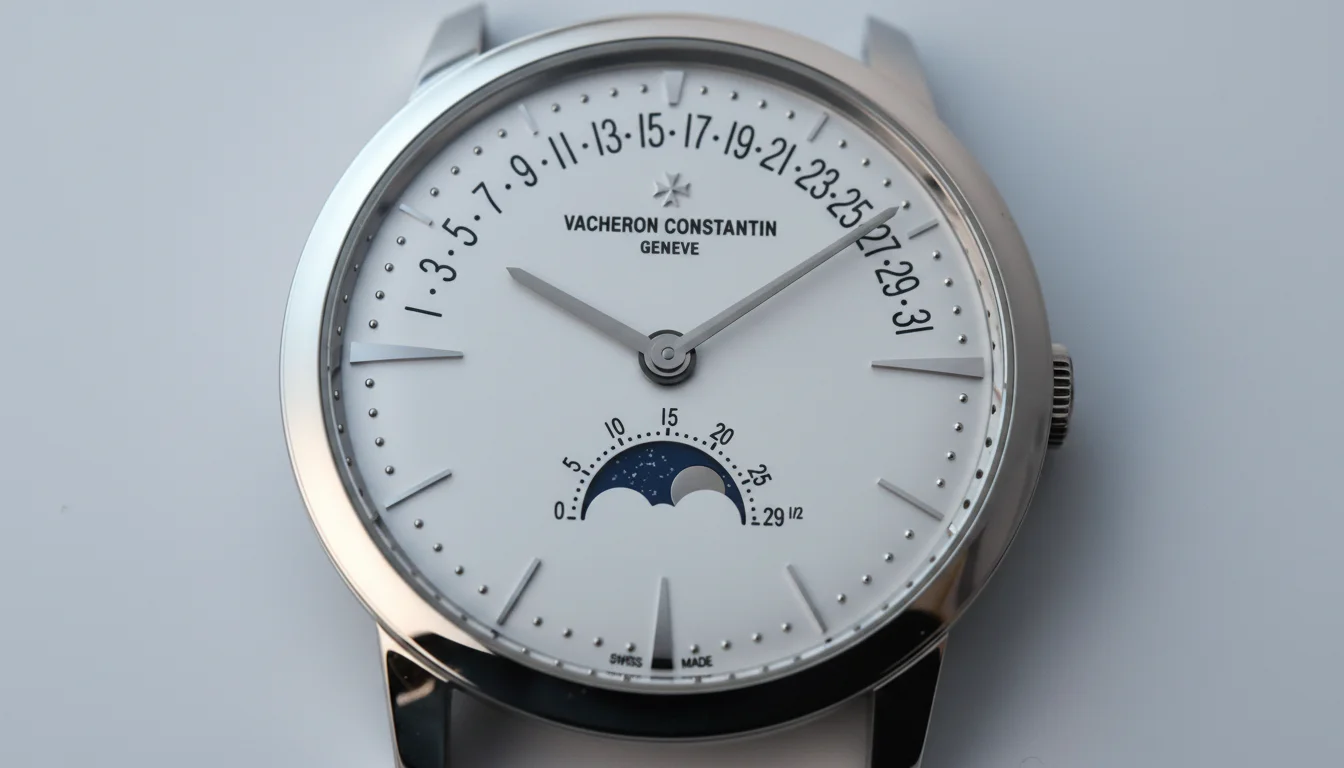 A clean, fast snap back to day one is the single best functional test a retrograde watch can pass.
FAQ
What is a retrograde watch complication?
A retrograde complication moves a hand across a fixed arc rather than a full circle, then snaps it back to its starting point instead of continuing around. It most commonly appears on date and day displays.
How does the retrograde mechanism work?
A spring-loaded cam, usually snail-shaped or heart-shaped, drives a lever attached to the hand. As the cam rotates, it pushes the hand forward across the printed scale, then releases it at the end of its travel so a loaded spring snaps the hand back to zero.
Which brand revived the retrograde complication in wristwatches?
Vacheron Constantin is credited with the modern wristwatch revival, bringing the complication into production with the Mercator in 1994 and the Saltarello in 1997, building on its own retrograde history in 18th and 19th century pocket watches.
Does a retrograde mechanism wear out faster than a normal hand?
There is no strong data showing a dramatically higher failure rate. The real cost is service complexity: the snap-back spring needs careful calibration, and fewer watchmakers are trained on the mechanism, which makes servicing more expensive than a standard three-hand watch.
What is a biretrograde watch?
A biretrograde watch runs two independent retrograde mechanisms on the same dial, typically one for the day of the week and one for the date, as seen in the Roger Dubuis Excalibur Biretrograde Calendar.
Related Reading
- Perpetual Calendar Explained: How a Watch Knows It's Not February 30th
- The Moonphase Complication, Explained: How the Prettiest Useless Feature in Watchmaking Actually Works
- Vacheron Just Pushed Its 70-Day Perpetual Calendar Closer to Reality
- Jumping Hour Watches Explained: The Complication With No Hour Hand