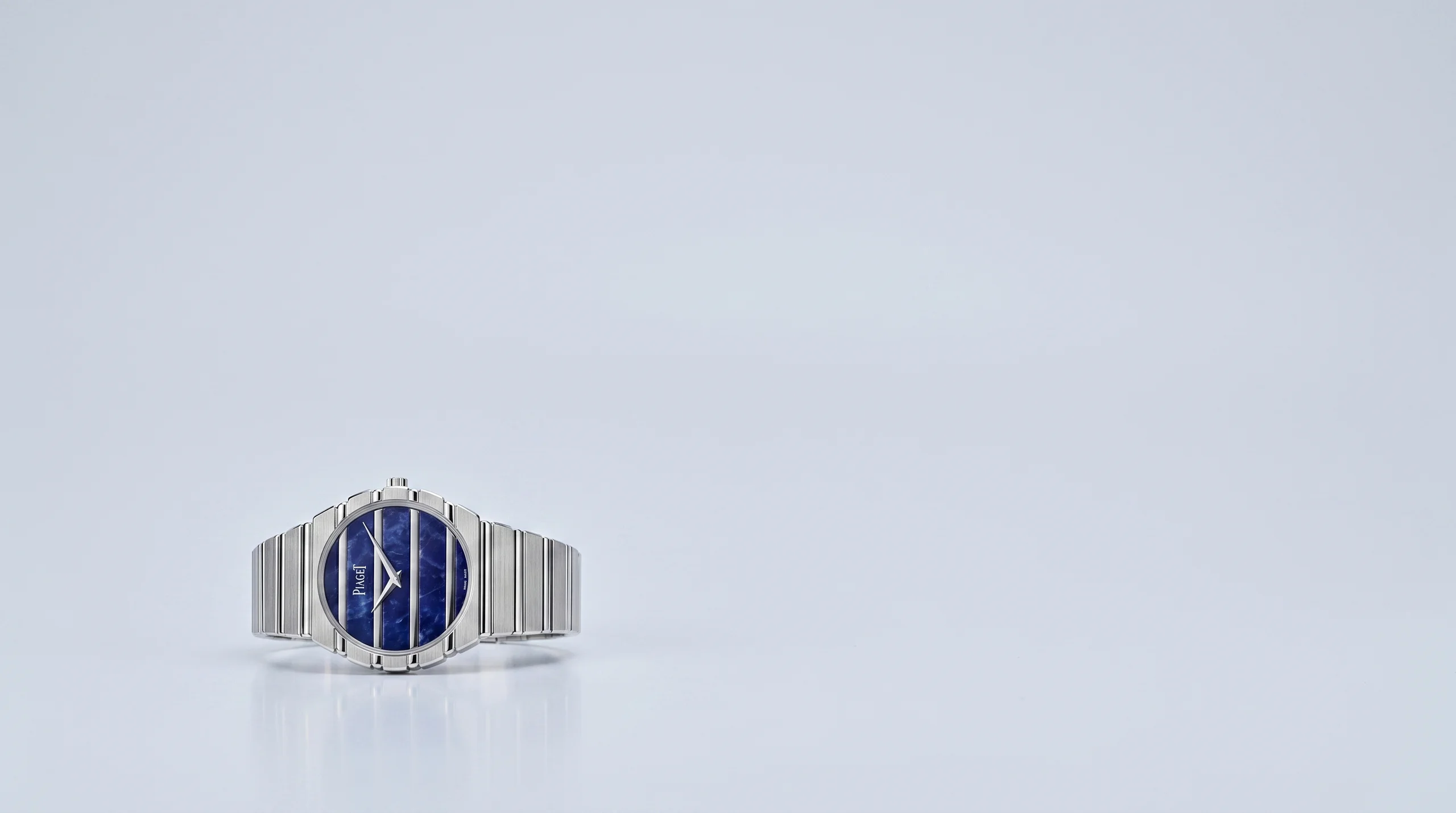
Gerald Genta gets the credit for the integrated sports watch, and he earned it. The steel Royal Oak arrived in 1972, the Nautilus in 1976, and between them they wrote the rulebook every luxury sports watch has followed since. Piaget read the same room at the end of that decade and went the opposite direction.
In 1979 the brand answered with the Polo, and it answered in the opposite key: solid gold instead of steel, a jeweler's watch instead of a tool watch, ultra-thin, and originally powered by quartz. It was the sports watch for people who were never going to dive or fly anywhere. For 2026, Piaget has revived that exact idea in its most convincing modern form, the Polo 79 in 18k white gold with a deep blue sodalite dial. It is one of the prettiest watches of the year, and it costs CHF 84,500, which is where a working dealer has to stop admiring and start being honest.
The images in this article are AI-generated illustrations created for editorial purposes. They are not photographs of a specific watch offered for sale.
The short answer: the white gold sodalite Polo 79 is a beautiful, historically grounded piece with a genuine ultra-thin manufacture movement. At CHF 84,500, roughly €103,000, for a time-only watch, it is priced as jewelry rather than value. If you want the Piaget integrated sports watch and you care about the money, the real opportunity is the pre-owned steel Polo, which trades for a small fraction of the halo piece.
What Piaget actually built
The new reference keeps the modern Polo 79 formula: a 38mm case just 7.45mm thick in 18k white gold, built monobloc so the case and integrated bracelet flow into one another. The signature is the gadroon pattern, alternating brushed and polished horizontal ridges that run without interruption across the bracelet, the case, and the dial. Fratello describes the ridges as moving seamlessly across all three surfaces, and in the metal that continuity is the whole trick.
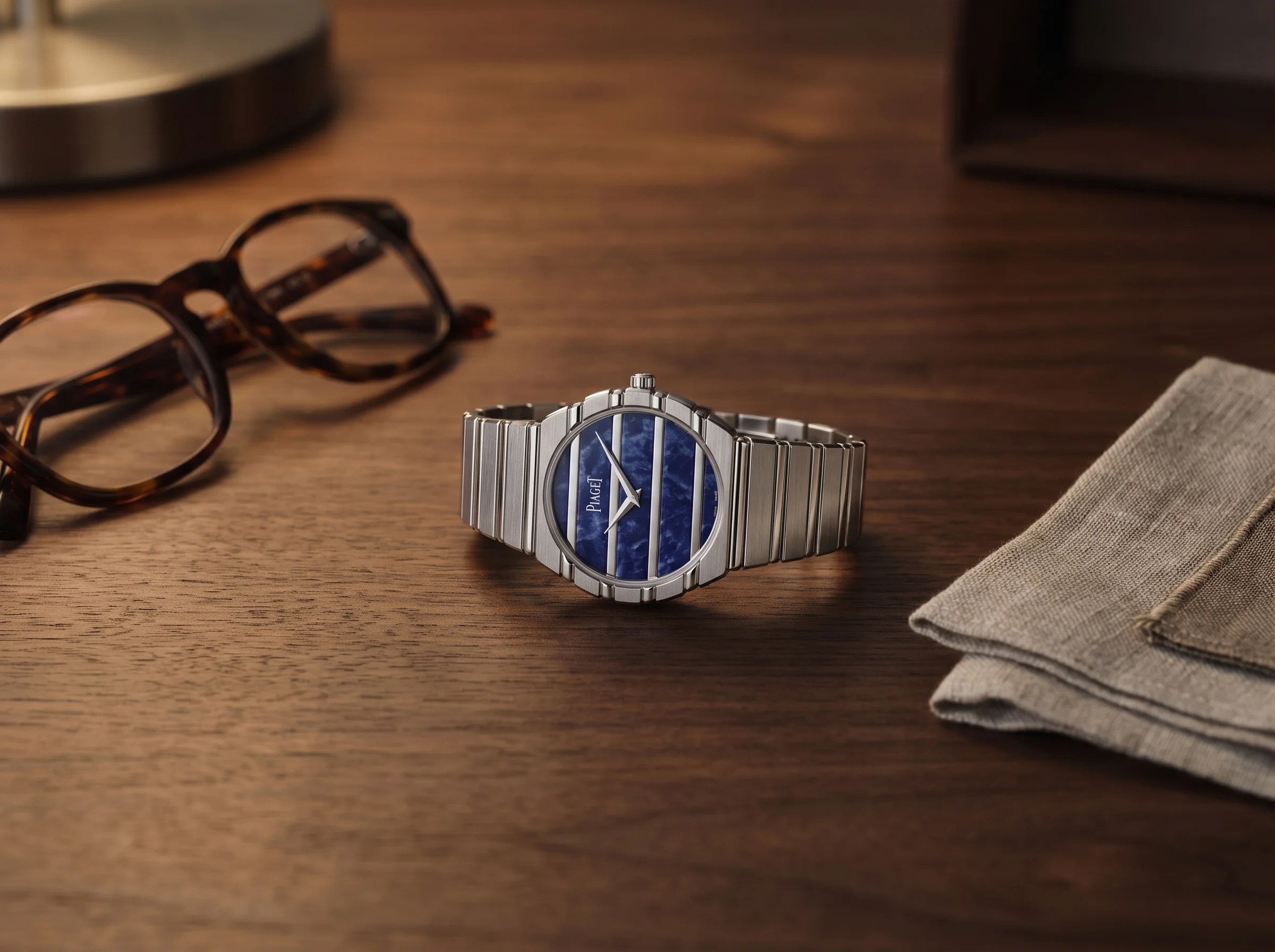 The Polo 79 in white gold, its gadroon ridges running unbroken from bracelet to dial.
The dial is the reason this version exists. It is cut from sodalite, a royal-blue mineral shot through with natural white veining, so no two examples read exactly alike. Piaget frames the stone between polished white gold bars, finishes it with slim dauphine hands, and drops the minute-track dots the earlier editions carried. It is a throwback to the brand's 1960s and 70s hardstone dials, and the white veining against white gold is genuinely well matched.
The movement, and why 2.35mm matters
Under that stone sits the in-house caliber 1200P1, an ultra-thin automatic with a micro-rotor. It runs at 21,600 vibrations per hour with a 44-hour power reserve and measures just 2.35mm thick. The 1916 Company traces the caliber to its 2010 debut and explains the point of the micro-rotor: because it sits in the same plane as the rest of the movement rather than on top of it, the whole watch can stay thin despite a full gold case. This is the part that earns real horological respect. Piaget has chased thinness records since the 1950s, and the Polo wears that heritage honestly.
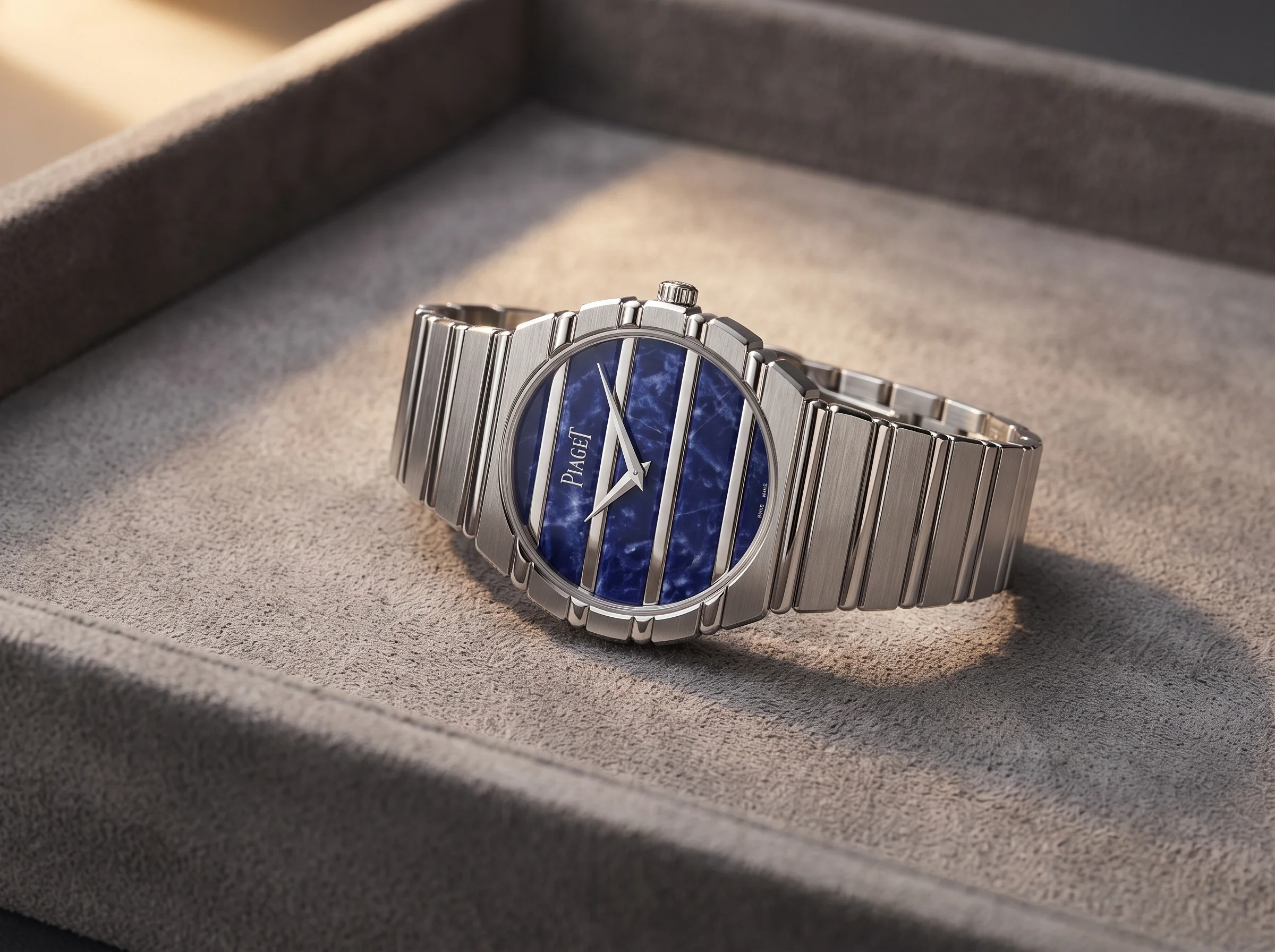 The gadroon pattern up close: alternating brushed and polished bands, the detail that defines the Polo.
The honest part: CHF 84,500 for time-only
Here is the tension. The Polo 79 tells the time and nothing else. There is no date, no seconds hand, no complication of any kind. For that, Piaget is asking CHF 84,500, about €103,000 in euro markets, a figure Fratello flatly called a gargantuan price even while praising the watch.
The metal does not explain it. The case and bracelet carry close to 200 grams of gold, but even with gold near $4,100 an ounce that is only around $26,000 of intrinsic value. The rest is design, finishing, and the name on the dial. That can be a fair trade for the right buyer, though nobody should mistake it for a lot of watch for the money.
The reaction tells you something
When Piaget priced the two-tone Polo 79 earlier in 2026, the enthusiast response was blunt, with commenters arguing the watch should cost a fraction of the ask. The sodalite version lands in the same bracket. When the audience that most wants to love a watch keeps flinching at the price, that is information, not noise.
Where the real Piaget value lives
None of this makes Piaget a bad buy. It makes the halo piece the wrong entry point. The Polo has a deep back catalog, and the secondary market prices it sensibly. The line has long been pitched as a value-based alternative to Vacheron and Audemars Piguet, and the pre-owned numbers back that up.
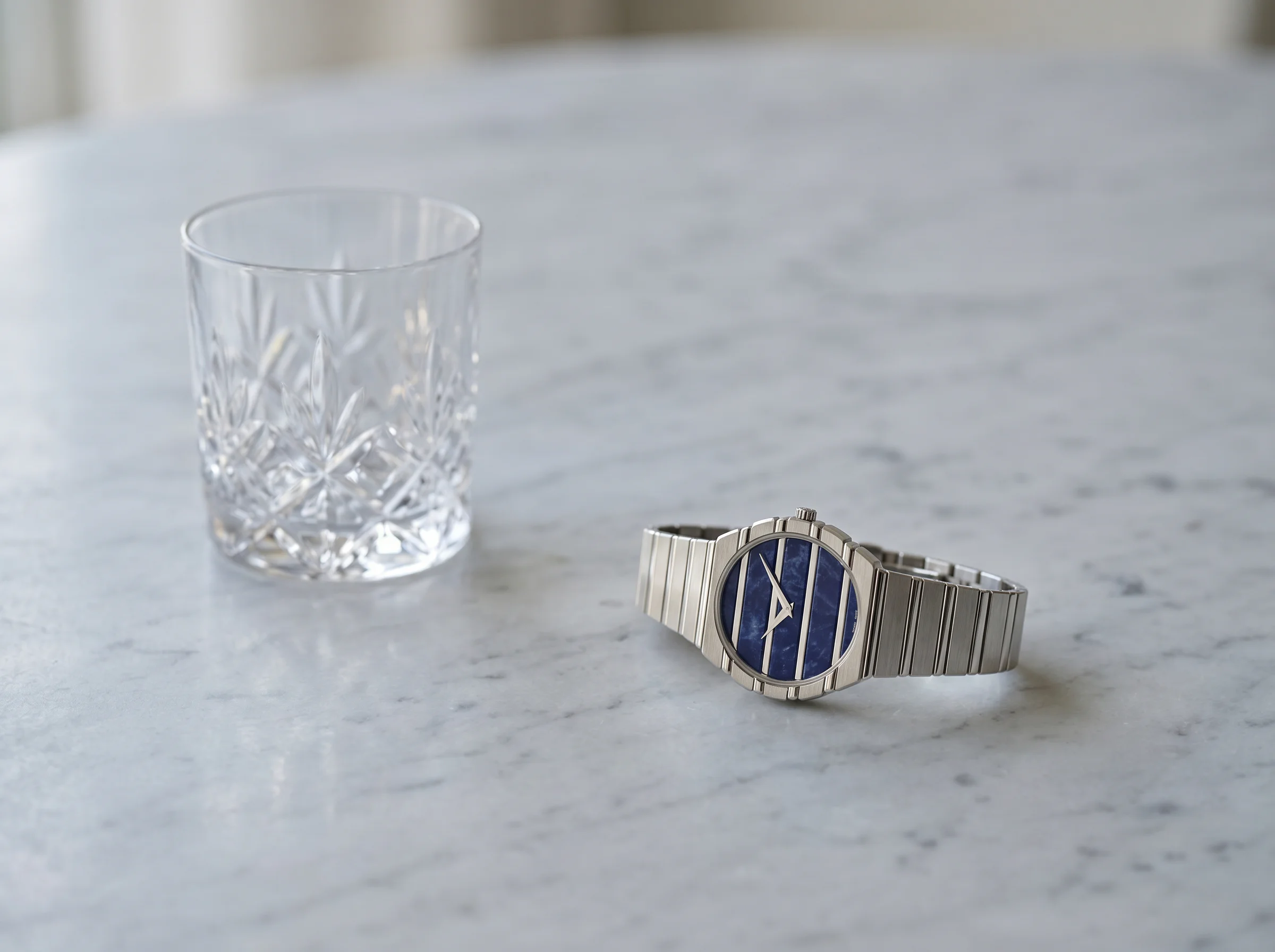 The sodalite dial shifts with the light, royal blue veined in natural white calcite.
The accessible way in is the steel Polo, the 2016 Polo S and its current Polo Date successor. On Chrono24, a 42mm steel Polo Date, reference G0A47014, trades around $11,400, a rounding error next to the white gold sodalite piece. Step up to rose gold and the same platform shows the Polo Date near $31,000, still less than half the new halo watch, with a solid-gold case and the identical design language.
| Piaget Polo (pre-owned) | What it is | Approx. price |
|---|---|---|
| Polo Date G0A47014 | 42mm steel, three-hand | ~$11,400 |
| Polo Date, two-tone with diamonds | 42mm steel and gold | ~$23,000 |
| Polo Date, rose gold | 42mm solid gold | ~$31,000 |
| Polo 79, white gold sodalite | 38mm white gold, new | CHF 84,500 |
The catch, stated plainly
Piaget is not a value-retention champion, and you should buy it knowing that. The steel Polo has softened on the secondary market over the past year, in line with much of the mid-luxury gold and steel field, so this is a buy-to-wear rather than a buy-to-flip. The upside is that the depreciation is exactly what makes a pre-owned Polo interesting: you let the first owner absorb it, then buy a genuine manufacture piece for sane money. Liquidity is reasonable too, with clean examples turning over in roughly three weeks.
Where it sits against the trinity
The Polo belongs in the same conversation as the steel sports watches from the big three, and it usually gets left out of it. If you are cross-shopping integrated luxury sports watches, it helps to see how the whole field prices, from the Vacheron Overseas most buyers forget exists to the full Aquanaut, Royal Oak, and Overseas comparison. The Polo sits alongside another quietly overlooked option from the same 1970s wave, the Girard-Perregaux Laureato.
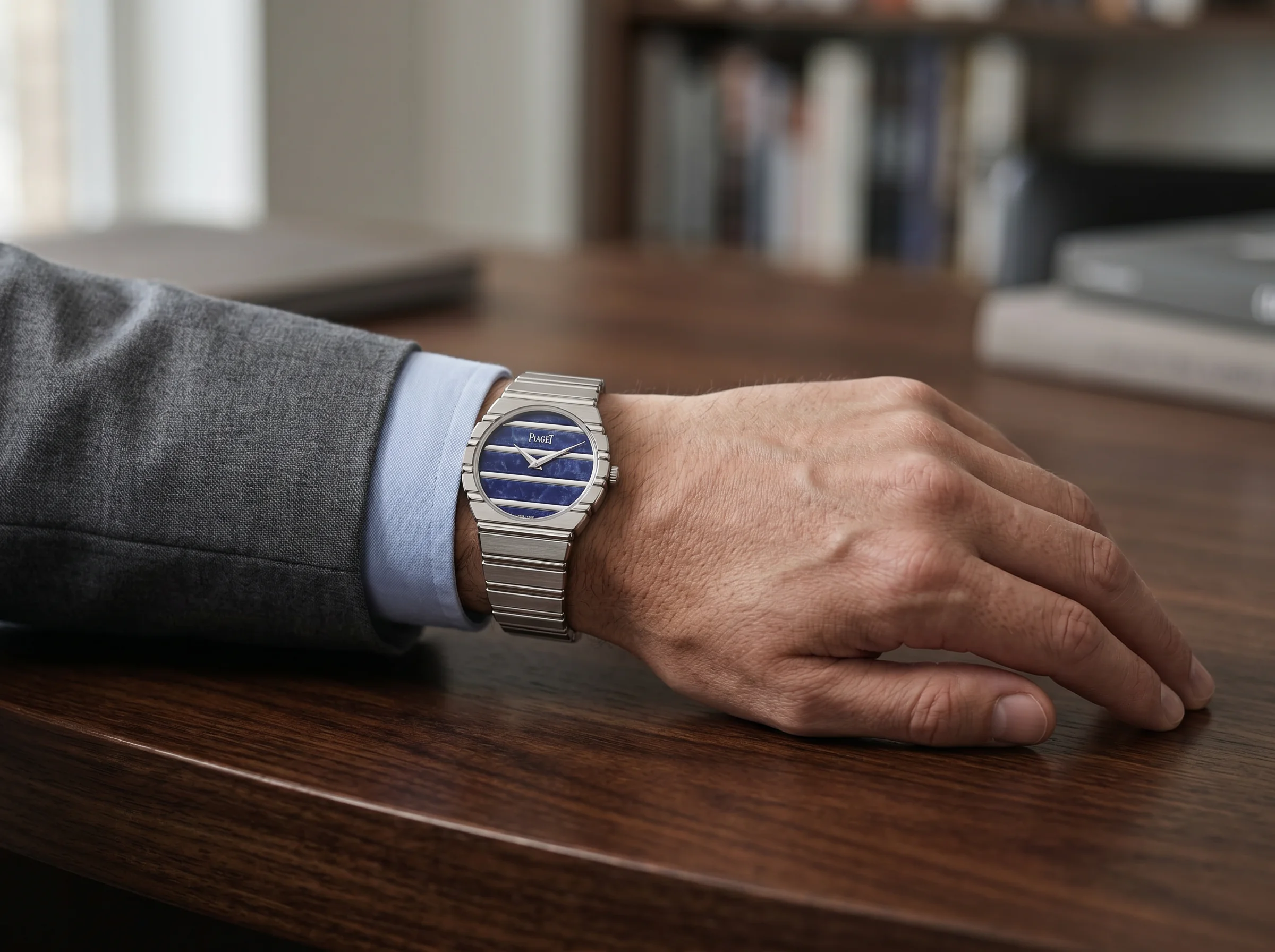 At 38mm and 7.45mm thick, the Polo 79 wears like the jeweler's watch it has always been.
The Polo 79 sodalite is a beautiful object and a real piece of Piaget history brought convincingly up to date. As a purchase, it is a want, not a value. If the integrated luxury sports watch is the itch, though, the watch that started the entire category is one we can actually help you buy.
Browse authenticated pre-owned Audemars Piguet Royal Oak at 5dwatches.com.