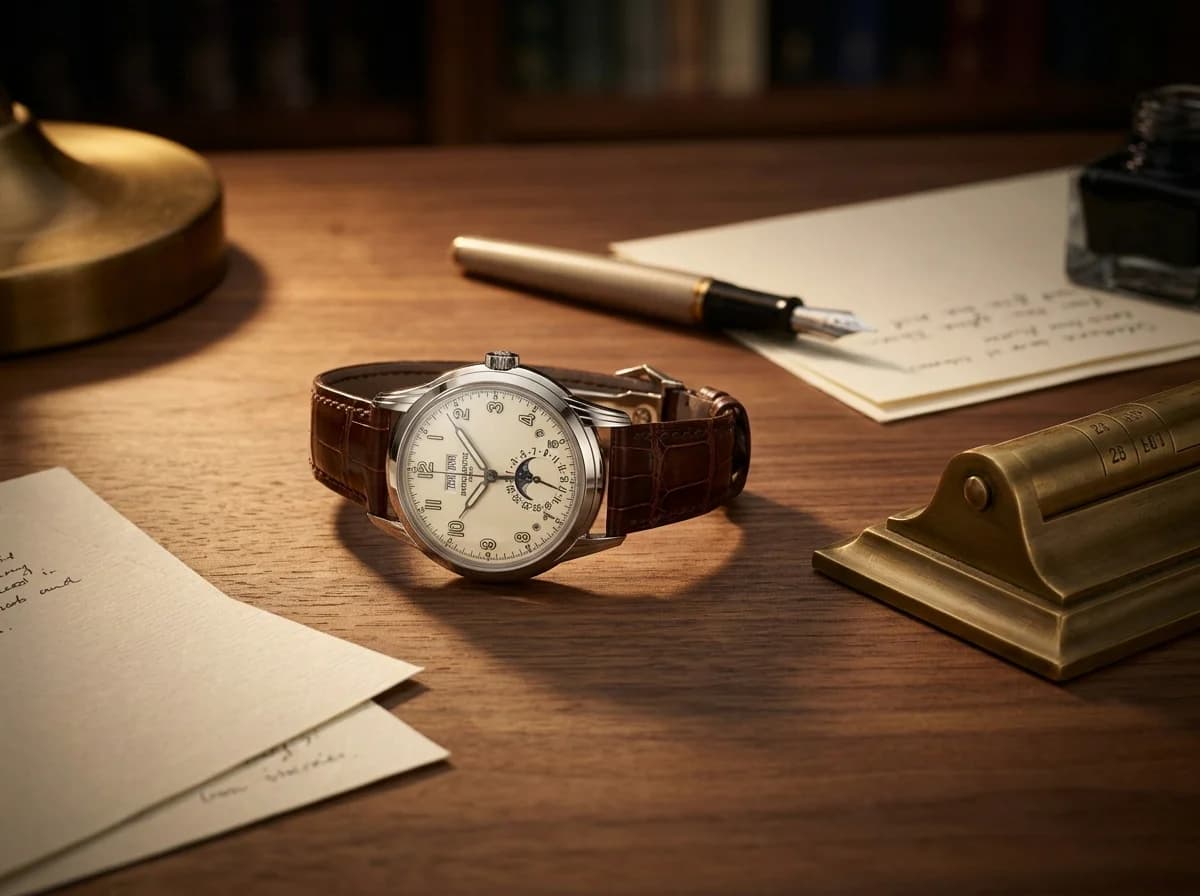
A watch that shows the day, the date, and the month sounds like one feature. It is actually three separate complications, and the differences between them come to thousands of dollars and a lifetime of small chores.
Calendar mechanisms are some of the most satisfying watchmaking has to offer, and some of the most misunderstood at the moment of purchase. Here is how the three main types differ, and which one is actually worth your money.
The images in this post are AI-generated illustrations for editorial purposes and may not exactly represent the actual watch, its dial, or its finishing.
The short answer
All three show the date. What separates them is how often you have to correct the watch, and how much you pay for the privilege. The triple calendar needs setting five times a year, the annual calendar once, and the perpetual calendar not until 2100. For most buyers the annual calendar is the sweet spot, delivering nearly the convenience of a perpetual at a fraction of the cost. The perpetual is a prestige object you rarely need, and the triple date is the charming, affordable way in if you do not mind the upkeep.
The three calendars, plainly
Start with what each one actually knows about the calendar.
A triple calendar, also called a complete calendar, shows day, date, and month, usually with a moonphase. What it does not know is that months have different lengths. Every time a month ends with fewer than 31 days, the date rolls to a phantom 31st and you fix it by hand. That happens five times a year, after February, April, June, September, and November. WatchTime points out this is the oldest of the calendar displays, around since the early twentieth century.
An annual calendar adds the one thing the triple lacks: it knows which months have 30 days and which have 31. It still does not account for February's short count, so it needs a single correction each year, on March 1. Patek Philippe invented it in 1996 with the reference 5035, and Quill & Pad fairly calls it the Goldilocks complication, neither too simple nor too complex.
A perpetual calendar knows everything, leap years included. Kept running, it will not need a correction until the year 2100, when the Gregorian calendar skips a leap year. Patek built the first perpetual calendar wristwatch back in 1925, and the complication still counts as one of watchmaking's high-water marks.
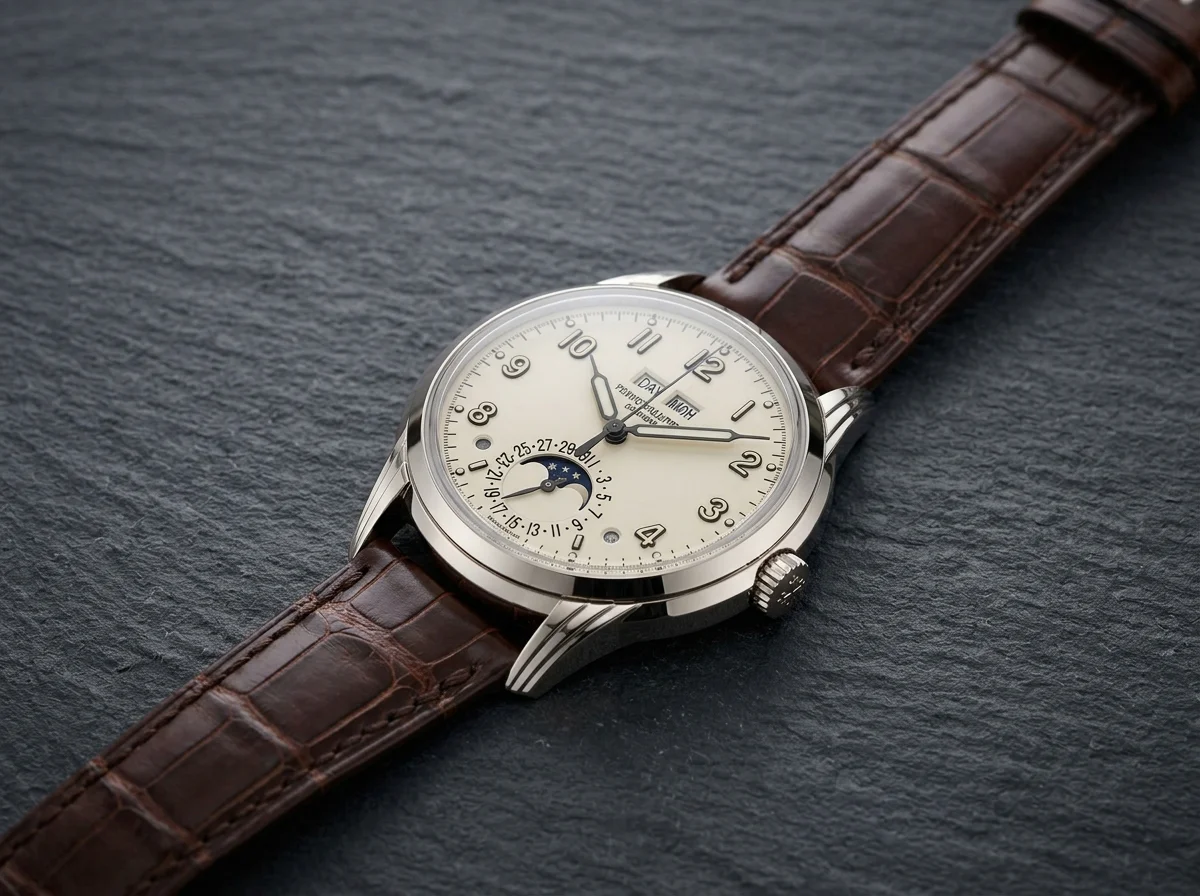 A classic perpetual calendar layout: day and month at 12, date and moonphase at 6. (AI-generated illustration.)
What you are actually paying for
The convenience scales with complexity, and so does the price.
A triple calendar is mechanically the simplest of the three, which is why it anchors the most accessible end of the category. Brands like Longines and Frederique Constant offer handsome complete calendars in the low four figures, and the vintage market is full of charming examples. An annual calendar sits in the middle, with the Rolex Sky-Dweller bringing it into the steel sports-watch world and Patek's own annual calendars climbing well into five figures.
A perpetual calendar is another tier entirely. The mechanism can run to hundreds of additional parts, every one hand-finished and adjusted, and the prices follow. Patek's vintage-styled 5320G, for example, lists around CHF 73,000. You are paying for genuine mechanical achievement, and you are also paying for prestige, so it is worth being honest with yourself about how much of each you actually want.
 A perpetual buys you hundreds of extra parts, and a good deal of prestige. (AI-generated illustration.)
The setting hassle nobody mentions
Here is the part that does not show up on the spec sheet.
A perpetual calendar is only perpetual while it keeps running. Let it wind down on a shelf and you are back to setting day, date, month, moonphase, and leap year by hand, often through recessed case pushers in a careful sequence. You also have to avoid adjusting it during the hours around midnight, when the calendar is mid-change and forcing it can damage the movement. A watch winder solves this, but the irony stings: the most maintenance-free calendar can be the most fiddly to recover.
An annual calendar asks for one easy correction a year and nothing else. A triple calendar asks for five, but each takes seconds, and plenty of owners enjoy the small ritual. The quiet truth is that a perpetual's convenience is conditional, while an annual's is close to absolute for how most people actually wear a watch.
 The catch with a perpetual: it stays correct only while it keeps ticking. (AI-generated illustration.)
A working dealer's read
If you are buying a calendar watch to wear, buy the annual calendar. It gives you the part of the perpetual you actually feel day to day, the worry-free date, without the price jump or the recovery headache when it stops. The most painless entry point is the Rolex Sky-Dweller, which I laid out in full in the argument for Rolex's most overlooked complication.
Buy the perpetual only if the mechanism itself is the point, if you want to own one of watchmaking's great achievements and will keep it running. Even then, the smartest versions are the ones solving a real problem, like Vacheron's 70-day Twin Beat, which keeps the calendar alive in a drawer for over two months. And buy the triple date if you love the look and the ritual and want the most affordable way into full-calendar watchmaking.
 Match the complication to how you will live with it, not to the spec sheet. (AI-generated illustration.)
Whichever way you lean, these take their steepest depreciation early, which is exactly the pre-owned buyer's opening. Our authenticated range is the place to start.