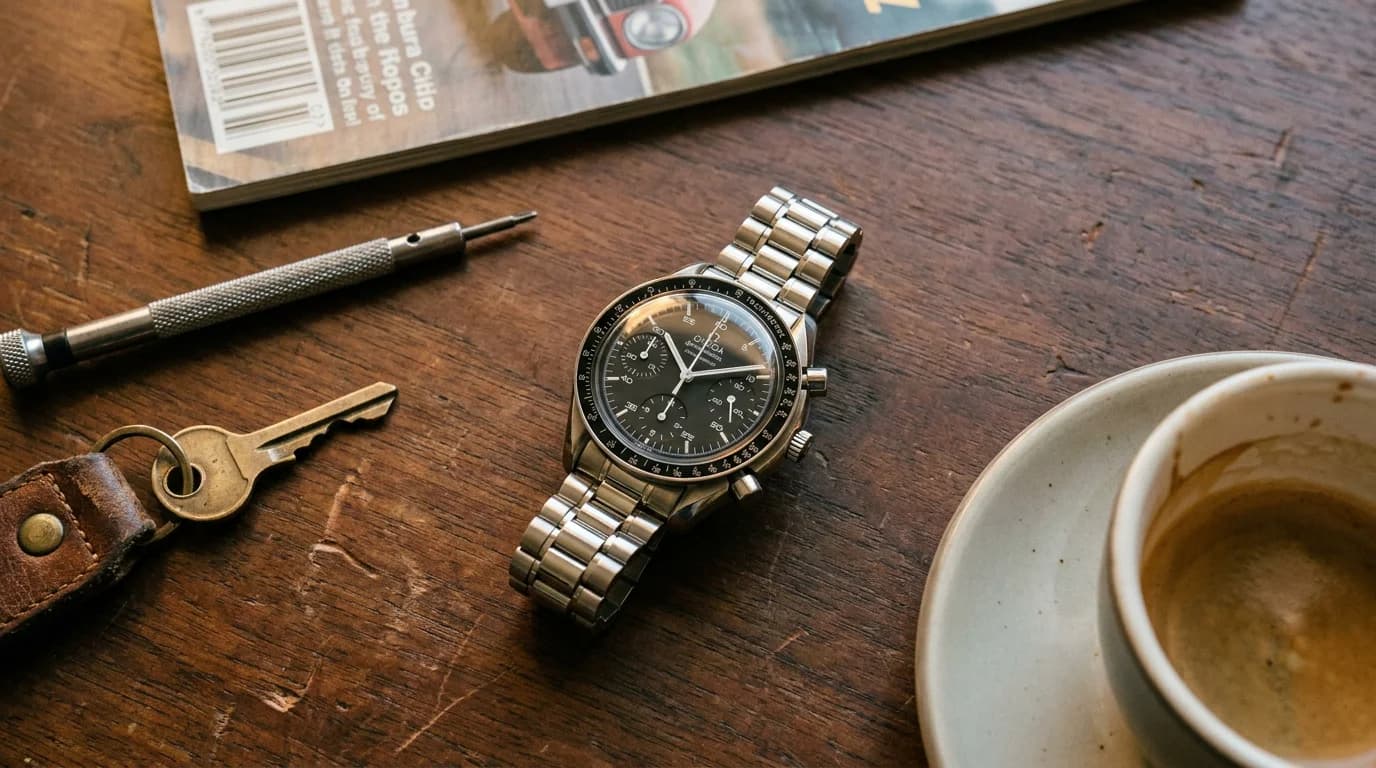
The Omega Speedmaster Reduced is the watch most Speedmaster collectors dismissed for 20 years. A 39mm automatic chronograph, smaller than the Moonwatch, with a modular movement that makes purists wince. Omega built it from 1988 to 2009 to sell more Speedmasters to people who found the 42mm Moonwatch too big and the hand-winding too inconvenient. The watch community largely treated it as the consolation prize.
That position has changed. The volume reference 3510.50 is up 17.3 percent over five years on WatchCharts, against the Omega Speedmaster index up 2.8 percent over the same period. The watch sells in a median 10 days, faster than 96 percent of the WatchCharts catalog. The Schumacher variants in red, yellow, and blue, once joke-priced on forums, now trade $2,500 to $3,000.
The Reduced was never the watch you bragged about. It is becoming the watch buyers keep. This is a working dealer's read on the lineup, the references that matter, the movement asterisk every buyer needs to know, and which configuration makes sense for which collector.
All images in this post are AI-generated and may not perfectly represent the actual watch references discussed. They are intended for illustration only.
The short answer
The Omega Speedmaster Reduced is the brand's 39mm automatic chronograph, produced 1988 to 2009. The volume reference 3510.50 with black dial trades $2,500 to $3,200 pre-owned. The 2006 sapphire upgrade 3539.50 runs slightly higher. The Schumacher trio (3510.61 red, 3510.12 yellow, 3510.81 blue) trades $2,500 to $2,950. The JDM Marui blue 3510.82 is the rarest at $3,500 to $5,000. The two-tone 175.00.03 sits $2,000 to $2,800. The movement is an ETA 2890-2 or 2892-A2 base with a Dubois-Depraz 2020 chronograph module mounted dial-side, branded as Omega caliber 1140, 1141, 1143, or 3220 depending on production year. The case is the same lyre-lug Speedmaster silhouette in 39mm with hesalite crystal and aluminum tachymeter bezel. Subdial layout differs from the Moonwatch: running seconds at 3, 12-hour totalizer at 6, 30-minute totalizer at 9. The big asterisk: the modular movement requires Omega service exchange in most cases, budget $1,500 to $1,800, which can be half the watch's value.
What the Reduced Actually Is
Omega introduced the Speedmaster Reduced in 1988 to broaden the Speedmaster's audience. The dial-marked name is "Speedmaster Automatic." The community-coined name "Reduced" stuck because the 39mm case is the obvious difference from the 42mm Moonwatch.
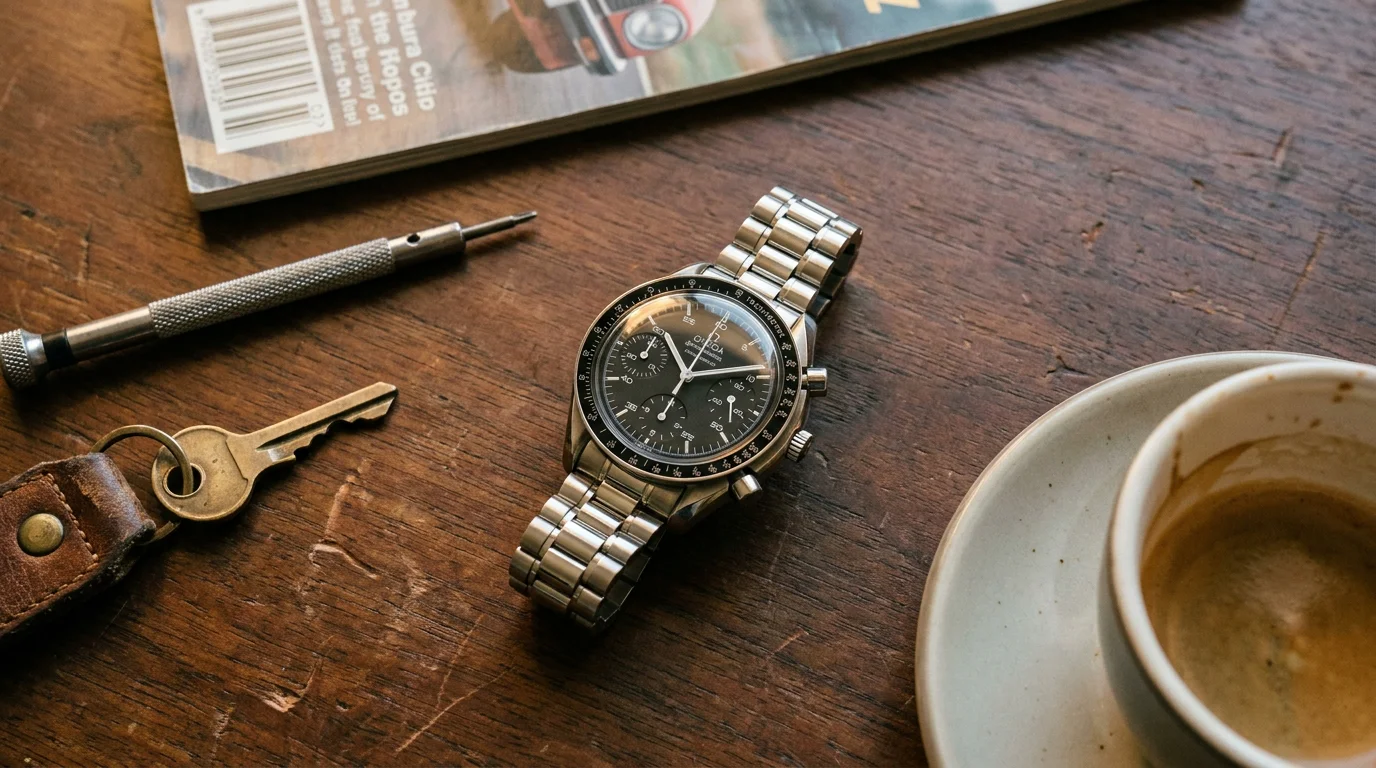
The volume reference 3510.50 in its natural element. The 39mm case, hesalite crystal, and tachymeter bezel carry the same Speedmaster design language as the Moonwatch, just at a different scale.
The original reference was ST 175.0032 on a leather strap, with ST 375.0032 the bracelet variant. Omega changed its reference coding system in the late 1980s, after which the volume reference became 3510.50 (or 3810.50 for the leather version). The case kept the Moonwatch's twisted "lyre" lugs, the black dial, the black aluminum tachymeter bezel, and the hesalite crystal. Fratello's Speedy Tuesday piece on the Reduced traces how the 39mm platform eventually spawned the Day-Date, Perpetual Calendar, Moonphase, and Mark 40 variants.
If the 39mm case of the Reduced fits your wrist, it is also worth knowing that Omega just gave the modern catalog its own answer to this size question. Our guide to the 2026 Speedmaster 38mm refresh covers the new Calibre 3330/3332 references that bring round sub-dials back to a compact Speedmaster for the first time since this original Reduced.
Why it isn't a Moonwatch
The Speedmaster Reduced has been listed as a Moonwatch by unscrupulous sellers for years. It is not one. The Moonwatch designation belongs to the hand-wound Speedmaster Professional that NASA flight-qualified in 1965. The Reduced has an automatic modular movement, a smaller case, and "Automatic" printed under the Speedmaster name on the dial.
The fast tells when authenticating:
- Dial text: "Speedmaster Automatic" on the Reduced, "Speedmaster Professional" on the Moonwatch
- Case diameter: 39mm vs 42mm (a tape measure ends the argument)
- Subdial layout: running seconds at 3 on the Reduced, 30-minute totalizer at 3 on the Moonwatch
- Crown and pushers: slightly off-axis on the Reduced (the chronograph pushers sit higher than the crown), perfectly aligned on the Moonwatch
For the broader authentication framework, see our frankenwatch primer.
The Movement: The Asterisk Every Buyer Should Know
The Reduced runs a modular movement, and the modular construction is the single most important thing a buyer needs to understand before paying.
The base is an ETA 2890-2 automatic time-only movement (the no-date sibling of the famous ETA 2892-A2 that powers half the Swiss industry). Mounted to the dial side of that base is a Dubois-Depraz 2020 chronograph module, which adds the start, stop, and reset functions plus the totalizers. Omega rebadged the assembly under different caliber names over the years:
- Caliber 1140 (1988): ETA 2890-2 base, gold-plated module
- Caliber 1141 (1996): same base, rhodium-plated module
- Caliber 1143 (1996-1997): ETA 2892-A2 base, Dubois-Depraz 2020
- Caliber 3220 (2000-2009): ETA 2892-A2 base, mostly cosmetic updates
Total assembly thickness is roughly 6.5mm, notably slimmer than the 8mm of a Valjoux 7750-based chronograph. The modular layout produces one functional quirk that Worn & Wound flagged in their long-term review: the minute totalizer shows a continuous reading rather than a jumping minute hand, because all three chronograph indicators are driven from the base movement.
The service problem
The Dubois-Depraz module is the watchmaker problem. Most independent watchmakers will service the ETA base but refuse to open the chronograph module. The standard solution is a full movement exchange via Omega service, which runs $1,500 to $1,800 in the U.S. as of 2026.
That number is the asterisk on every pre-owned Reduced purchase. If the watch needs service and you paid $2,800, you are spending more than half the purchase price to restore it. The math changes the buy: pay a premium for a recently serviced example with paperwork, or factor an upcoming service into your budget. An unserviced 1990s modular automatic chronograph is a bet, not a buy.
Subdial layout vs the Moonwatch
| Position | Speedmaster Moonwatch | Speedmaster Reduced |
|---|---|---|
| 3 o'clock | 30-minute totalizer | Running seconds |
| 6 o'clock | 12-hour totalizer | 12-hour totalizer |
| 9 o'clock | Running seconds | 30-minute totalizer |
The layout difference is the easiest visual authentication. If a listing photo shows a Speedmaster with running seconds at 9, that is a Moonwatch. If running seconds sit at 3, that is a Reduced.
The References That Matter
3510.50: The Volume Black Dial
The 3510.50 is the reference that defines the Reduced for most buyers. Black dial, black aluminum tachymeter bezel, hesalite crystal, three sub-registers, twisted lyre lugs in 39mm steel. Produced from 1988 (initially under the ST 175.0032 code) through 2006, with the caliber evolving from 1140 to 3220 across that run.
Pre-owned, clean 3510.50 examples with box and papers trade $2,500 to $3,200, with recently serviced examples reaching $3,500. WatchCharts has the reference up 8.8 percent over the past year and 17.3 percent over five years, outperforming the broader Omega Speedmaster index by 14.5 percentage points over the five-year window. The watch takes a median 10 days to sell.
3539.50: The Sapphire Upgrade (2006-2009)
In 2006, Omega replaced the hesalite crystal with sapphire and lightly redesigned the dial. The reference became 3539.50.00. Production ran for three years before the entire Reduced line was discontinued in 2009. Sapphire examples typically command a $200 to $400 premium over hesalite 3510.50 references.

The 2006-2009 sapphire upgrade 3539.50. Same case and movement as the 3510.50, but a clean sapphire crystal in place of the hesalite. The trade-off is period character for scratch resistance.
The aesthetic question matters here. The hesalite gives the Reduced the same "warm" plexiglass distortion as the Moonwatch and reads more vintage-correct. The sapphire reads cleaner and never scratches but loses some of the period character. Buyer's call.
The Schumacher Trio (1996-1999)
Omega signed Michael Schumacher as a brand ambassador after his 1996 Ferrari move and built a colored-dial Speedmaster Reduced series to commemorate his career chapters. The three variants, catalogued in Chrono24 Magazine's deep history of the Reduced:
| Reference | Dial Color | F1 Chapter Commemorated | Pre-Owned (2026) |
|---|---|---|---|
| 3510.61 | Ferrari red | 1996 move to Ferrari | $2,500 to $2,950 |
| 3510.12 | Jordan yellow | Earlier Jordan years | $2,400 to $2,800 |
| 3510.81 | Benetton blue | Earlier Benetton years | $2,500 to $2,900 |

The 3510.61 Ferrari red commemorating Schumacher's 1996 move to the Scuderia. Checkered chapter ring, lacquered red dial, and the same Caliber 1141 as the period 3510.50.
The Schumachers were not numbered limited editions. They were standard production through 1999. The dials feature checkered chapter rings, colored hands, and the same Caliber 1141 movement as the period 3510.50. WatchCharts shows the 3510.61 red up 11.1 percent over the past year.
3517.30: The 2000 World Champion Racing
Released after Schumacher's 2000 F1 World Championship, the 3517.30 ran 10,000 numbered pieces: 6,000 with black dials and 4,000 with white. Red and orange checkered markings ring the outer dial, the word "Racing" sits above the 6 o'clock sub-register, and Schumacher's signature is engraved on the snap-back caseback alongside the production number. Pre-owned, the 3517.30 trades $2,500 to $3,200 with full set.
3510.82: The JDM Marui Blue
The Marui-exclusive 3510.82 is the deep-cut Reduced. Built for the Japanese Domestic Market through Marui department stores in the early 2000s, the run was 1,000 pieces. It is the only Speedmaster Reduced with a steel bezel insert (rather than aluminum) and the only blue-dialed standard-production Reduced. Pre-owned examples trade $3,500 to $5,000 when they appear, which is rarely.
175.00.03: The Two-Tone
The two-tone steel-and-gold Reduced (also catalogued as 3310.20) is the most overlooked reference in the lineup. Produced in the 1990s with gold pushers, crown, bezel, and indices on a steel case, paired with a two-tone bracelet. Trades $2,000 to $2,800 pre-owned. The reference became newly interesting in 2024 when Omega reintroduced two-tone Moonwatch options after a long absence, which retroactively positions the 175.00.03 as a period piece rather than a compromise.

The two-tone 175.00.03 reads dressier than its steel siblings and lands in dress watch territory more cleanly than the standard Reduced. Omega's 2024 two-tone Moonwatch revival has retroactively pulled this reference back into relevance.
The Market Math
The Reduced has appreciated faster than the broader Speedmaster catalog over five years, and the structural drivers are clear.
| Reference | 1-Year Change | 5-Year Change |
|---|---|---|
| 3510.50 (Black) | +8.8% | +17.3% |
| 3510.52 (LE) | +13.3% | +66.0% |
| 3510.61 (Schumacher Red) | +11.1% | n/a |
| 3510.80 | +1.6% | +40.0% |
Source: WatchCharts, data through April 2026.
Three reasons the line is moving:
- Discontinued in 2009. Fixed supply with no factory replacement. The Speedmaster Racing and Speedmaster 38 collections that followed are different watches with different cases and movements.
- 39mm reads modern again. The size that felt small in 2010 is mainstream in 2026, and the Reduced lands in the wearable sweet spot for under-7-inch wrists.
- The Moonwatch retail keeps climbing. A new hesalite Moonwatch retails around $7,200 in 2026, and the pre-owned figure sits near $5,200. The Reduced delivers the same Speedmaster case language at 40 to 50 percent of that cost.
How the Reduced Compares to the Moonwatch Professional
For buyers cross-shopping the two, the trade-offs are clean. The Moonwatch carries the heritage, the manual winding, and the cultural weight that lands a watch on the wrist of Buzz Aldrin. The Reduced carries the convenience of automatic winding, the better proportions on a smaller wrist, and a pre-owned price roughly half of what the Moonwatch costs.

The 3510.50 on the wrist. The 39mm case and 44mm lug-to-lug wear better than the spec sheet suggests, and the Speedmaster design language reads clearly even at the smaller scale.
| Factor | Moonwatch (310.30.42) | Reduced (3510.50) |
|---|---|---|
| Case diameter | 42mm | 39mm |
| Crystal | Hesalite or sapphire | Hesalite (3510.50) or sapphire (3539.50) |
| Movement | Caliber 3861 hand-wound | Caliber 3220 automatic modular |
| Heritage | NASA-qualified, Apollo lunar | Schumacher F1, automatic convenience |
| Retail (new) | Approx. $7,200 (hesalite) | Discontinued 2009 |
| Pre-owned (2026) | $5,000 to $6,500 | $2,500 to $3,500 |
| Service complexity | Standard, manual-wind chrono | Modular, Omega exchange required |
For deeper context on the Moonwatch and its peers, see our Speedmaster Professional vs Rolex Daytona breakdown.
Who Should Buy Which Reference

The 3510.12 Jordan yellow, the dial color most likely to surprise people who associate Schumacher only with Ferrari. The Schumacher Reduceds carry real motorsport history at attainable pricing.
Lowest entry into the Speedmaster family. Reference 3510.50 black dial with the 3220 caliber at $2,500 to $3,000. Recently serviced, full set if possible.
For 1990s wrist preferences or smaller wrists. Any 39mm Reduced. The lug-to-lug is roughly 44mm, the case wears smaller than 39mm suggests, and the 18mm strap width opens the watch to leather and NATO options.
For Schumacher and F1 collectors. The 3510.61 Ferrari red at $2,500 to $2,950, or pick the dial color that matches the chapter you want to commemorate.
For collectors chasing the deep cuts. The 3510.82 JDM Marui blue at $3,500 to $5,000 when one surfaces, or the 3517.30 Racing limited at $2,500 to $3,200.
For period-correct two-tone fans. The 175.00.03 at $2,000 to $2,800. The reference is now interesting again given Omega's renewed two-tone Moonwatch lineup.
For value-first buyers without service appetite. Skip the unserviced examples entirely. Pay the premium for a serviced 3510.50 with paperwork and recent Omega receipts at $3,000 to $3,500, and you remove the service overhang.
For buyers who want the round sub-dial look brand new. Skip pre-owned entirely and look at the current catalog. Our 2026 Speedmaster 38mm refresh guide covers the modern references that borrow this same three-circle dial layout, backed by a current warranty and COSC certification.
The Honest Take
The criticisms of the Reduced are fair. The modular movement makes service expensive and dependent on Omega's parts pipeline. The watch is easy to misrepresent as a Moonwatch by sellers who hope buyers won't notice. The crown and pusher offset is awkward to some eyes. The first-generation bracelets stretched and rattle now.
The case for the Reduced is also fair. The Speedmaster design language at 40 to 50 percent of the Moonwatch's pre-owned price. Automatic winding convenience that the Moonwatch will never offer. A 39mm case that wears better than the 42mm Pro on most wrists in 2026. A five-year appreciation track that has outperformed both the Omega Speedmaster index and the broader watch market. A genuine cultural moment around the Schumacher era that holds up as motorsport collectible territory expands.
The Reduced will never be a Moonwatch. It does not need to be. It is the cleanest entry into the Speedmaster family for buyers who want the look without the manual winding or the larger case, and the pre-owned market has finally caught up to that proposition.
Pay attention to service status, walk away from unserviced examples at top-of-band prices, and the Reduced is the smartest Speedmaster purchase in 2026 outside of the Moonwatch itself.
Browse authenticated pre-owned Omega watches at 5dwatches.com.