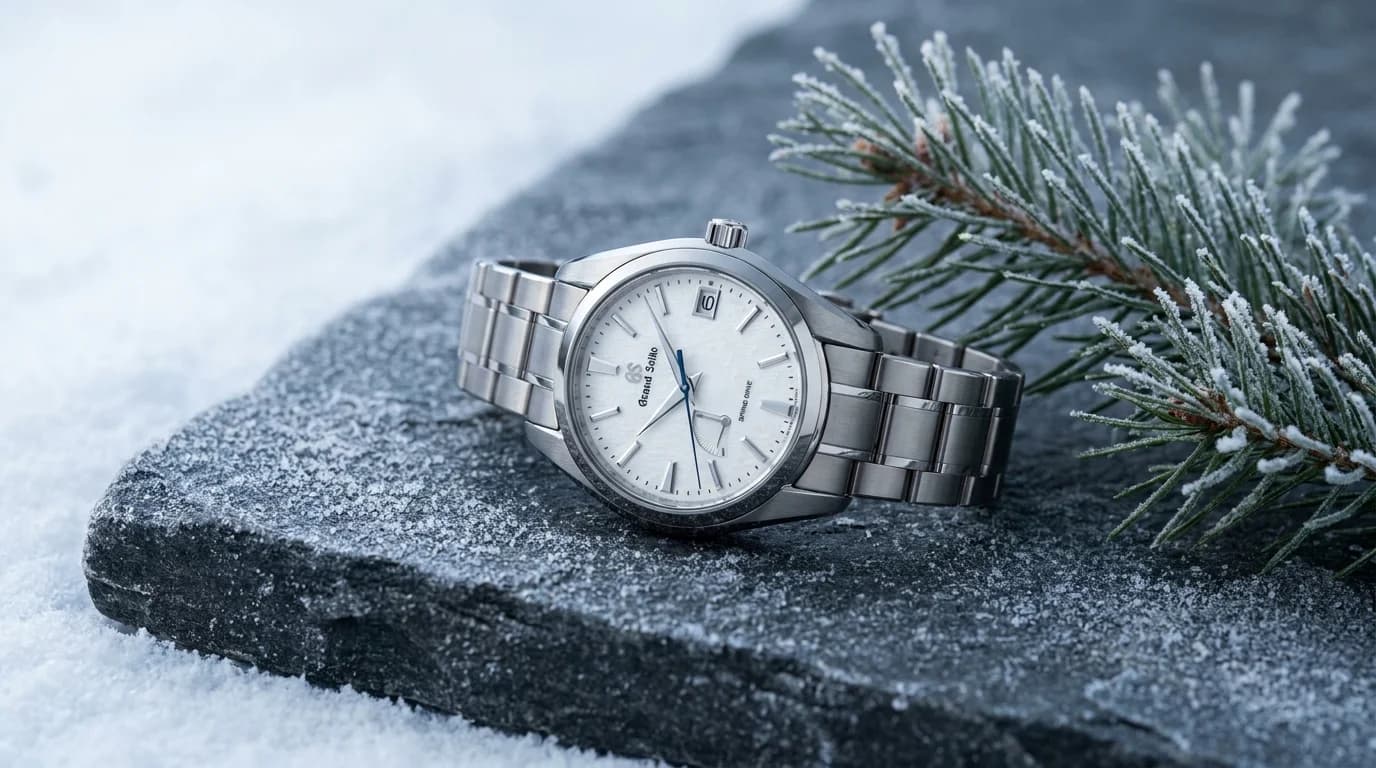
The Grand Seiko Snowflake is the watch most people have heard of but never seriously researched. The name lands, the photos look stunning, and then buyers hit the price — $6,900 retail for a titanium watch from a brand they cannot place in a hierarchy — and they close the tab.
That is the wrong response. The Snowflake is one of the most defensible purchases in the $5,000–$7,000 watch market, and understanding why requires knowing what the movement actually is.
Images in this post are AI-generated for editorial illustration. They may not represent the exact watch configuration. For accurate product photography, visit grand-seiko.com.
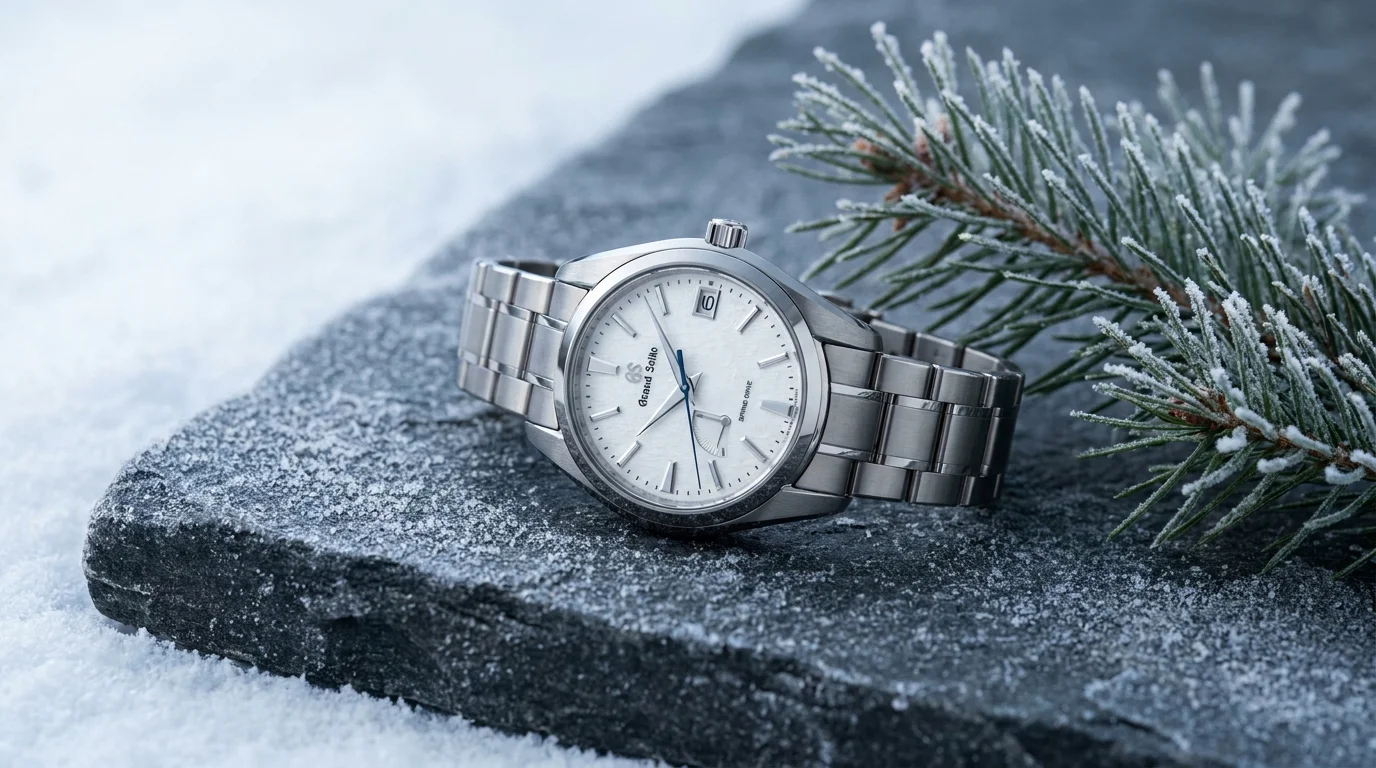 Grand Seiko Snowflake SBGA211, Spring Drive 9R65, 41mm titanium. Retail $6,900. Pre-owned excellent condition with full set: $4,800–$5,600. AI-generated editorial image.
What the Spring Drive Actually Is
The Spring Drive is not a quartz watch with a mechanical crown. It is not a standard automatic with a quartz regulator bolted on. It is a third category of watchmaking that exists nowhere else in the industry.
The mainspring provides mechanical energy — wound by the rotor, stored and released like any automatic. The wheel train transmits that energy to the hands. But instead of an escapement and balance wheel regulating the release rate, the Spring Drive uses a tri-synchro resonator: a glide wheel that spins freely on the gear train, with a generator attached that converts its rotation into electrical energy. A quartz oscillator uses that electrical energy to produce a precisely timed signal, which feeds an electromagnetic brake — the Tri-synchro regulator — that controls the glide wheel's rotation.
The result: a mechanically powered watch regulated to one second per day. No battery. No external power source. Accuracy that exceeds COSC certification by a wide margin. The 9R65 in the SBGA211 runs to Grand Seiko's own standard of ±1 second per day — stricter than COSC's ±4–6 seconds per day by a factor of four.
No Swiss manufacturer offers this at any price. The Spring Drive is a Seiko patent.
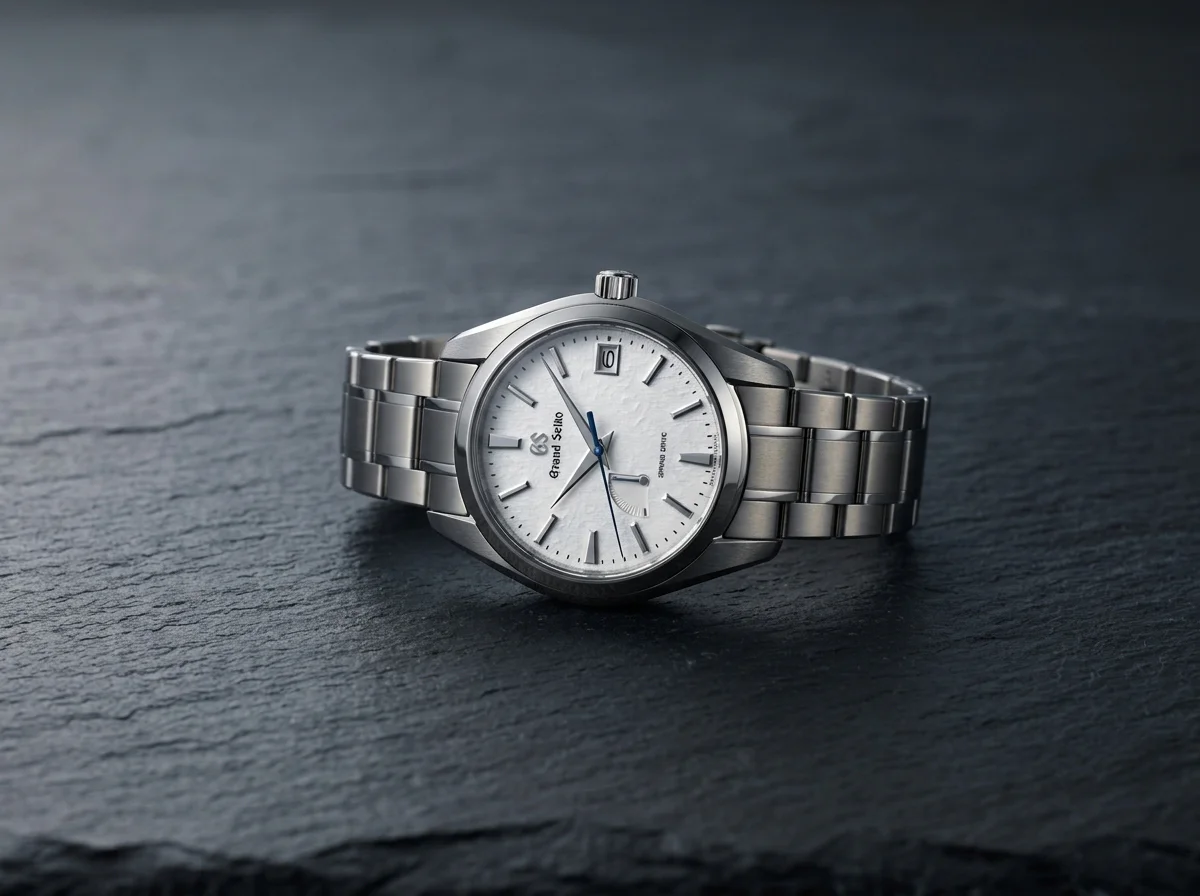 The Snowflake dial surface changes completely with light direction. Photographs do not fully represent the three-dimensional texture. AI-generated editorial image.
The Dial: What "Shinshu" Means
The SBGA211's white dial is made at the Shinshu Watch Studio in the Japanese Alps. Grand Seiko makes specific dials at specific studios, each linked to a regional landscape or seasonal inspiration. The Snowflake dial references the frost patterns found on trees in the Shinshu winter — the dimpled, layered texture is hand-applied and catches light differently at every angle.
This is not a printed pattern or a coating applied at scale. The dial surface is a three-dimensional object. Under direct light it appears bright white; under diffused light it takes on grey tones; in shadow it shows subtle depth. Photographs of the SBGA211 consistently fail to represent what the dial looks like in person. This matters when buying pre-owned: a Snowflake with no visible damage in photos may have scratched dial texture that only shows under inspection.
What to check on dial condition when buying pre-owned:
- View under raking light at a low angle — this reveals scratches on the textured surface that straight-on photographs hide
- The indices are applied separately from the dial body; check that they sit flush and have not shifted
- The power reserve indicator at 9 o'clock is a hand-applied component; check its alignment
 The Snowflake at 41mm titanium is noticeably lighter than steel alternatives at this size. The titanium bracelet contributes to this. AI-generated editorial image.
The Titanium Case: Why It Matters
Most buyers in this price range are comparing the Snowflake against steel watches — Omega Speedmaster, Tudor Black Bay, entry Rolex. The SBGA211's high-intensity titanium is 30% lighter than stainless steel by volume and meaningfully harder, which is why the case holds its polished and brushed surfaces better over time.
The Zaratsu polishing on Grand Seiko cases is the same hand-finishing technique used by the brand across its entire lineup: a flat-polishing process that produces perfectly planar surfaces and sharp, mirror-like edges with no distortion. It is visible under close inspection as the optical difference between a polished surface that appears to have depth and one that simply reflects light.
A Snowflake that has been polished by an inexperienced watchmaker will show rounded edges and softened transitions between polished and brushed surfaces. This is the second condition check: compare the case edge definition against reference photos to confirm original surfaces are intact.
The Full Set Question
Full set — original outer box, inner case, warranty card, and cushion — adds a meaningful premium to the SBGA211. Grand Seiko boxes are substantial, designed to present the dial story visually. More importantly, the warranty card establishes the service and ownership history that matters for Spring Drive watches, where knowing the last service date affects buying confidence.
A Snowflake with full set in excellent condition runs $4,800–$5,600 as of June 2026. Watch only, good condition, runs $4,000–$4,800. The full set premium here is higher than on Rolex — budget for it.
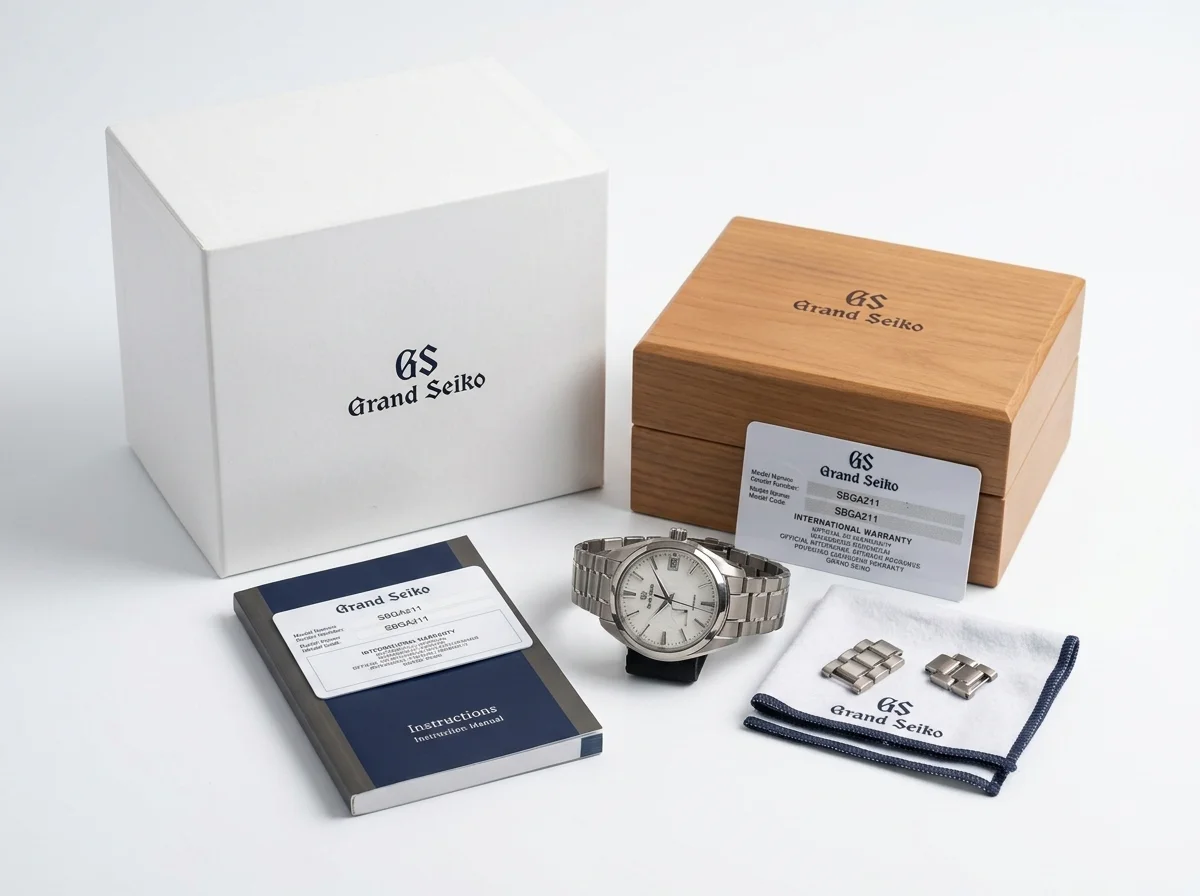 Full set matters more on Grand Seiko than on most Swiss alternatives. Box and warranty card add $400–$800 to the SBGA211 value. AI-generated editorial image.
The Comparable Watches at This Price
The Snowflake at ~$4,800–$5,600 pre-owned competes directly with:
| Watch | Movement | Water Resistance | Pre-Owned Range |
|---|---|---|---|
| GS Snowflake SBGA211 | Spring Drive 9R65 (±1s/day) | 100m | $4,800–$5,600 |
| Omega Speedmaster Pro | Calibre 3861 (COSC) | 50m | $4,200–$5,000 |
| Tudor Black Bay 58 | MT5402 (COSC) | 200m | $2,800–$3,500 |
| Rolex Explorer 124270 | Calibre 3230 (±2s/day) | 100m | $6,800–$7,500 |
The Snowflake has the most technically interesting movement of that group, the most distinctive dial, and the lightest case. It has lower water resistance than the Tudor — 100m versus 200m — and it trades at a steeper retail discount than the Explorer. For a buyer who plans to wear the watch rather than trade it, the Snowflake wins on technical merit at this price range.
The Grand Seiko secondary market overview covers current pricing data and the broader market context in more depth.
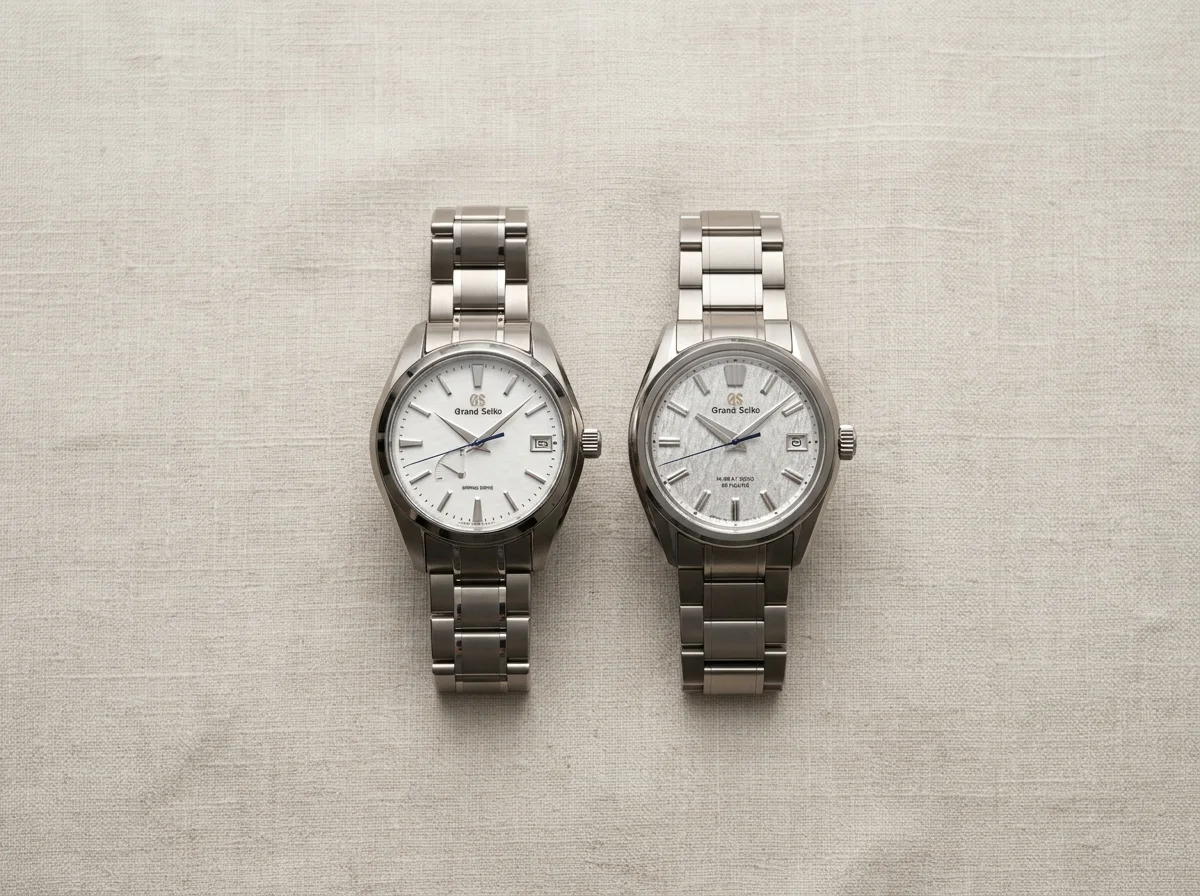 Snowflake beside White Birch SLGH005. Both Spring Drive with iconic textured dials. The White Birch retails at $7,800 and runs $5,000–$7,500 pre-owned. AI-generated editorial image.
Where to Buy
The SBGA211 remains in production, so new stock at authorized dealers is available. The pre-owned advantage is purely about price — not availability. For a buyer who wants delivery this week at under retail, the secondary market delivers.
Check for service history, verify full set, inspect dial condition under raking light, and confirm crown thread engagement. For Grand Seiko pre-owned, the full set and dial condition checks are more important than on most watches.
Browse Grand Seiko pre-owned at 5dwatches.com/shop/grand-seiko.