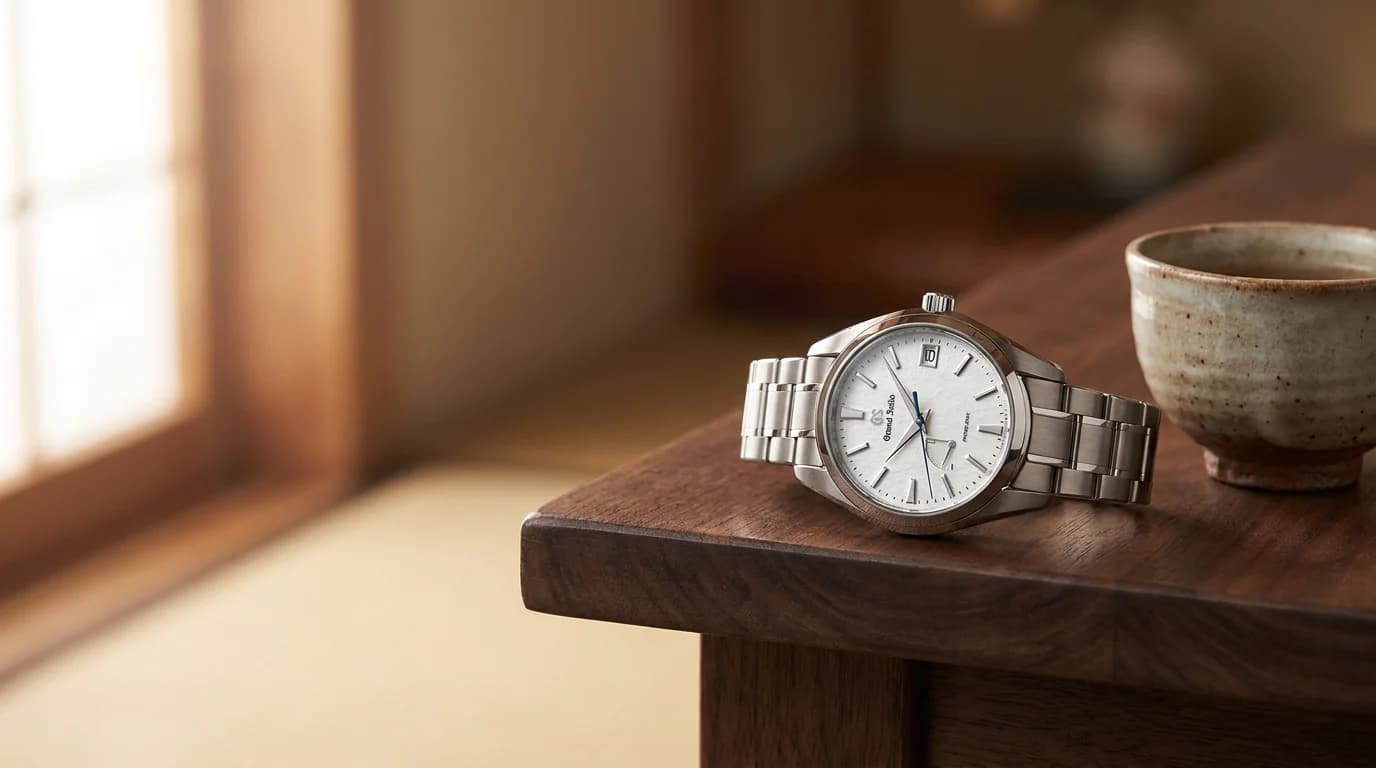
Most buyers still think of Grand Seiko as a collector's niche. The secondary market disagrees.
WatchCharts puts the SBGA211 Snowflake at a secondary market value of roughly $4,611 — trading 33.2% below its $6,900 retail price, and it sold faster than 95% of watches on the market in May 2026. That combination — a meaningful retail discount and genuinely fast liquidity — is unusual. Most watches that trade at a steep discount do so because they sit. The Snowflake moves.
The broader Grand Seiko index is up. The brand is gaining secondary market traction while most Western buyers still treat it as an exotic.
Images in this post are AI-generated for editorial illustration. They may not represent the exact watch configuration. For accurate product photography, visit grand-seiko.com.
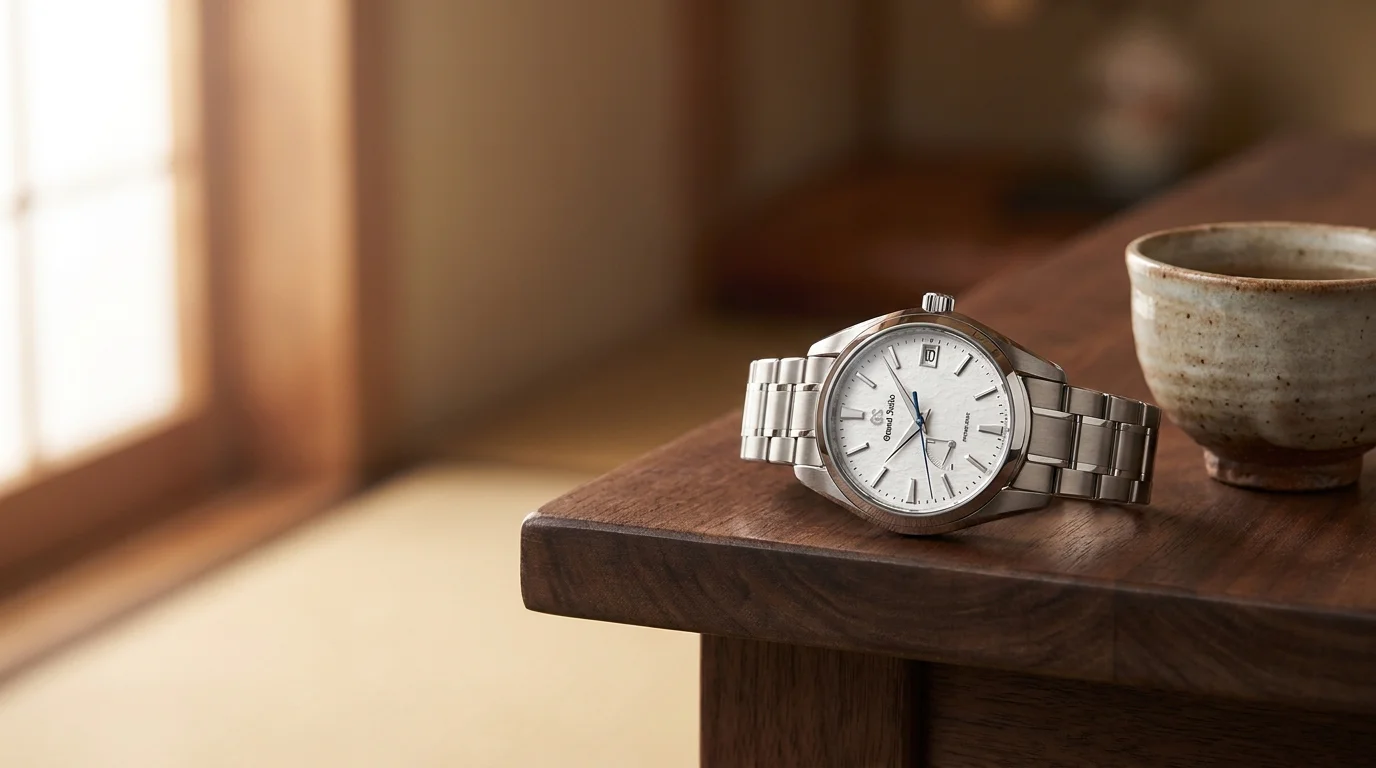 Grand Seiko Snowflake SBGA211, Spring Drive calibre 9R65, 41mm titanium. Secondary market ~$4,600 vs $6,900 retail as of June 2026. AI-generated editorial image.
What Is Actually Happening in the Market
SBGA211 Snowflake models that traded around $4,200–$4,500 in early 2024 are now consistently hitting $5,200–$5,600 on the secondary market. The SBGH273 Whirlpool has moved similarly. These are not minor fluctuations — they represent a genuine shift in how the Western collector base is pricing Grand Seiko.
The movement driving this is straightforward. Rolex raised prices again in January 2026. A steel Submariner 126610LN now lists at $10,800 retail — a 34% increase since 2020 — while the grey market has cooled, with Subs trading around $12,500–$13,800. Buyers who entered the market expecting Rolex premiums are recalibrating. Grand Seiko offers comparable finishing quality at a fraction of the allocation friction.
The new Grand Seiko Ushio 300 Diver (ref. SLGB023 and SLGB025), released at $12,400 in Spring 2026, adds a news hook to this narrative. It is Grand Seiko's most compact dive watch ever — 40.8mm, high-intensity titanium, Spring Drive calibre 9RA5 — and it answers the single most common collector complaint about GS dive watches: they were too large.
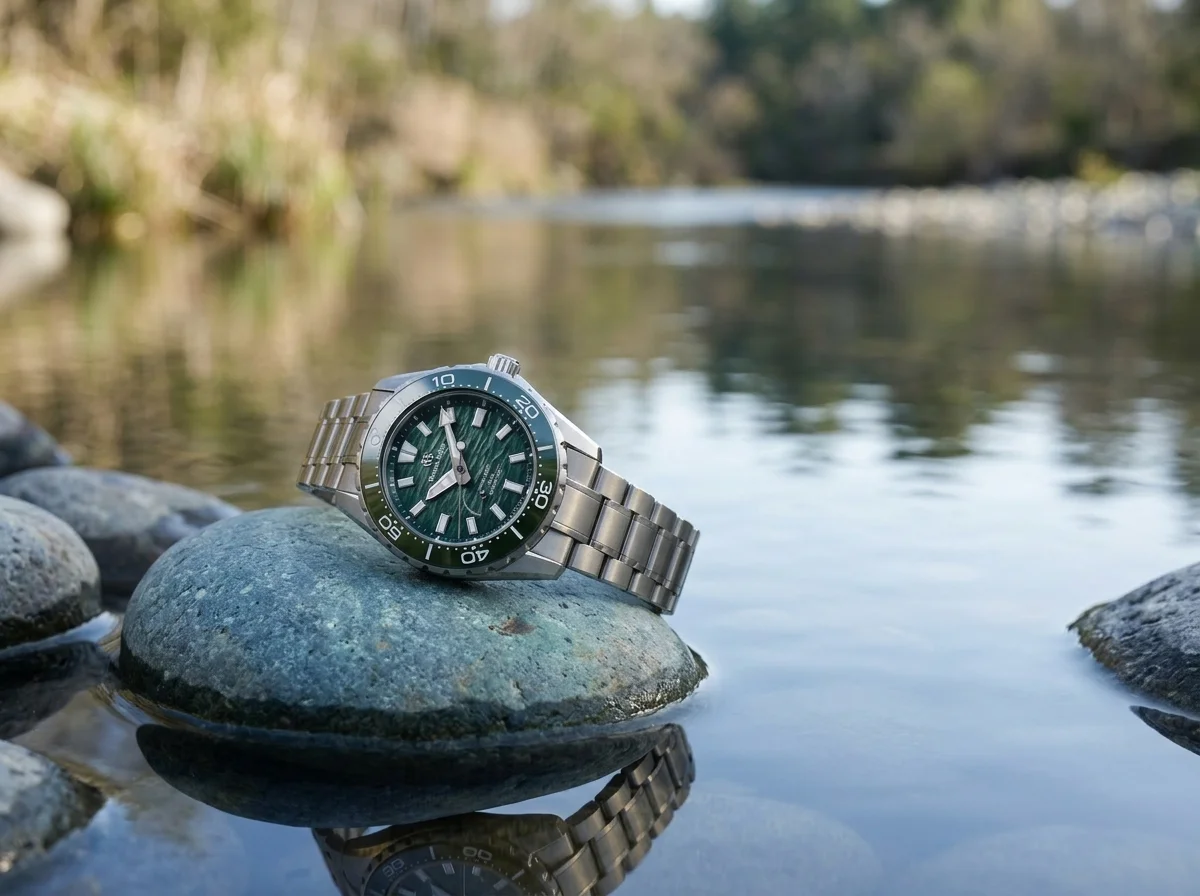 Grand Seiko Ushio 300 SLGB023, Spring Drive 9RA5, 40.8mm titanium, $12,400 retail. AI-generated editorial image.
Understanding Grand Seiko's Secondary Market Structure
Not all Grand Seiko references trade equally. The hierarchy matters when you are buying pre-owned.
Standard open-production Heritage references trade at roughly $2,500–$4,500 pre-owned, often well below retail. Cult references like the Snowflake and White Birch hold closer to retail at $4,500–$7,500, sometimes higher with full set and papers.
The movement type is the primary driver of this split. Spring Drive commands a significant premium over Hi-Beat automatic, which sits above quartz. The Spring Drive deserves the premium: it uses a mechanical mainspring as its energy source but regulates via a tri-synchro resonator — a glide wheel that interacts with an electromagnetic brake controlled by a quartz oscillator. The result is a mechanical watch that achieves one-second-per-day accuracy. There is no equivalent architecture anywhere else in the industry at any price.
WatchCharts data puts average Grand Seiko value retention at approximately -38% below retail across all references. That average is skewed heavily by open-production standard references. The Spring Drive / iconic dial segment trades far tighter — and that is the segment worth buying pre-owned.
The Dial Identity Rule
Grand Seiko's finishing is its differentiation. The brand's dials are hand-finished and often inspired by Japanese seasonal landscapes: the Snowflake's white textured surface references frost patterns in Shinshu; the White Birch captures winter light through bare trees. These dials are not interchangeable with anything Swiss.
Full set (box, outer box, papers) affects valuation more significantly for Grand Seiko than for most Swiss references, because the brand's story is central to the collector experience. A Snowflake with no papers takes a meaningful hit. Papers and outer box restore it.
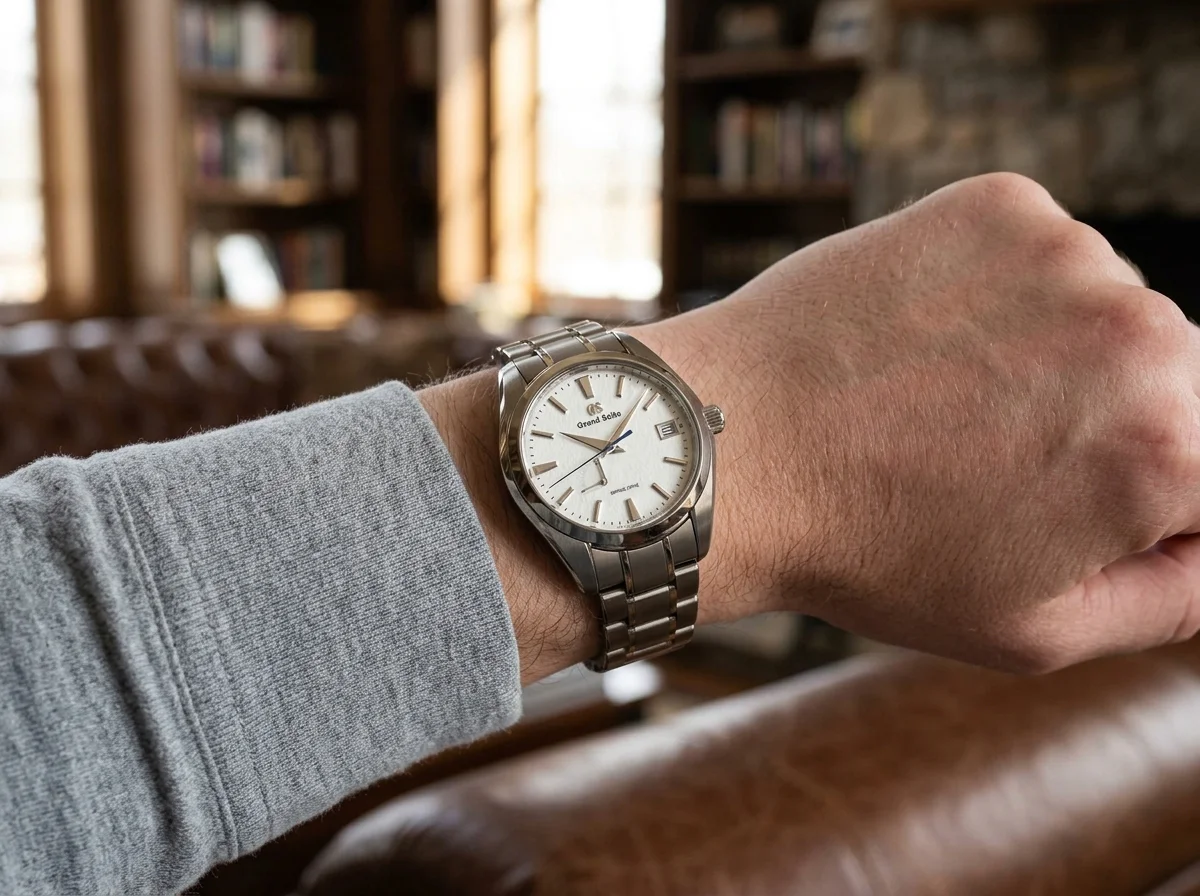 The Snowflake on wrist. The textured dial catches light differently at every angle — something no photograph fully captures. AI-generated editorial image.
The Buying Window Argument
The case for buying Grand Seiko pre-owned now is not primarily about appreciation. It is about access.
The Snowflake at ~$4,600 pre-owned is a Spring Drive watch — arguably the most technically interesting movement architecture in production — in a titanium case with hand-finished surfaces, for the price of a steel Omega Seamaster Diver. That is not a subtle value gap.
The risk is that Grand Seiko's pre-owned market is still thin outside the dedicated collector community. Grand Seiko's secondary market is thin because most buyers outside the watch community do not recognize the name. What moves Grand Seiko prices is movement type, dial identity, and full set. If you need to sell quickly and you are not selling into an enthusiast channel, you will take a discount.
Buy Grand Seiko pre-owned if: you plan to wear it, you are buying a Spring Drive or Hi-Beat reference with an iconic dial, and you have full set. Avoid quartz references above $3,000 pre-owned — the liquidity risk is real.
| Reference | Movement | Pre-Owned Range | Retail |
|---|---|---|---|
| SBGA211 Snowflake | Spring Drive 9R65 | $4,500–$5,600 | $6,900 |
| SLGH005 White Birch | Spring Drive 9R31 | $5,000–$7,500+ | $7,800 |
| SBGH273 Whirlpool | Hi-Beat 9SA5 | $9,200–$9,800 | $12,500 |
| SLGB023 Ushio 300 | Spring Drive 9RA5 | New — no pre-owned yet | $12,400 |
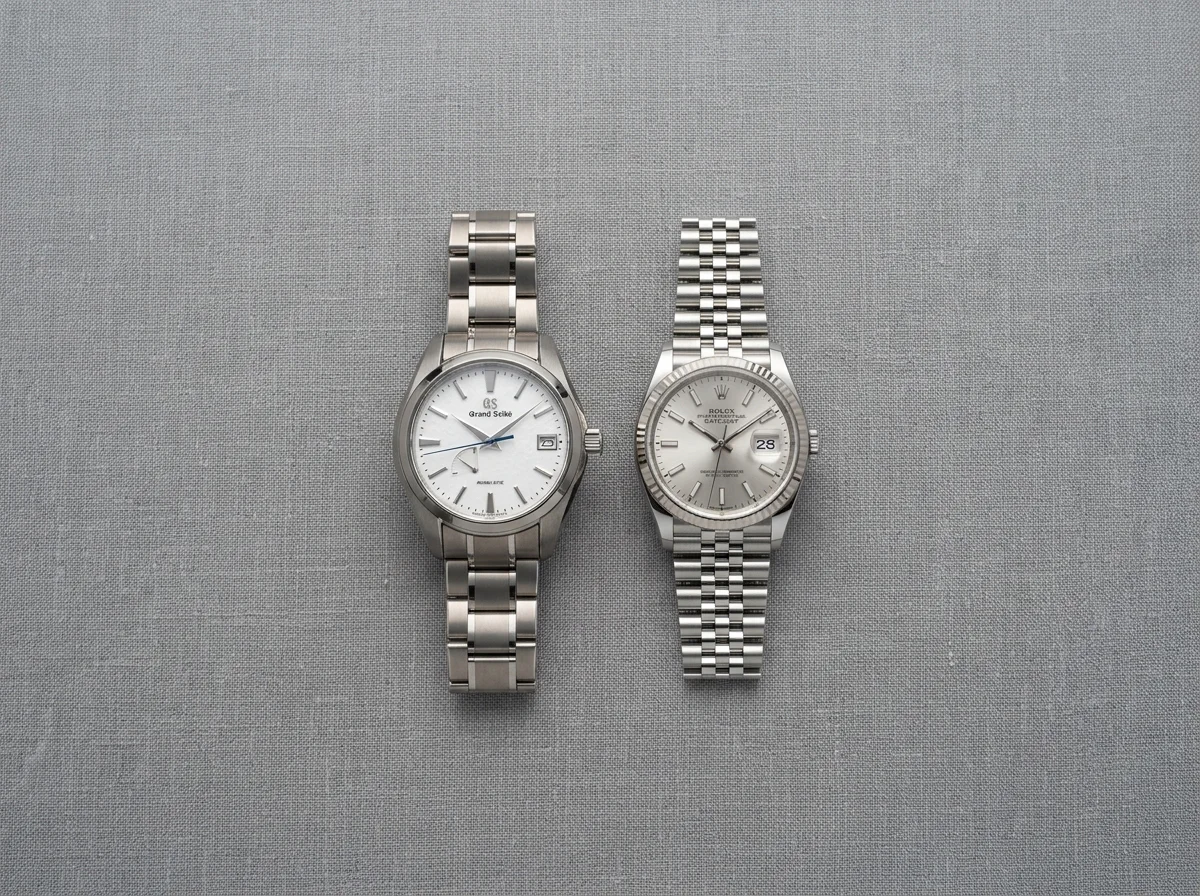 Pre-owned Grand Seiko against Swiss alternatives at a similar price point. The case for GS holds up under comparison. AI-generated editorial image.
The One Watch to Start With
If you are new to Grand Seiko and want one pre-owned reference as an entry, it is the SBGA211 Snowflake.
The reasons are practical: it is the most liquid Grand Seiko on the secondary market, the Spring Drive architecture makes it the right movement to own, the titanium case is genuinely lighter and more comfortable than anything Swiss at this price, and the dial is distinct enough that it does not feel like a compromise. You are not buying a "cheaper version of something else." You are buying something that does not exist in the Swiss catalogue.
Pre-owned Snowflakes in excellent condition with full set are trading around $4,800–$5,600 on Chrono24 and the WatchCharts marketplace as of June 2026. That is the range to target. Anything priced above recent sold comps without a compelling reason — regional exclusivity, perfect condition, rare bracelet variant — warrants scrutiny.
Browse Grand Seiko pre-owned inventory at 5dwatches.com/shop/grand-seiko. For the full Spring Drive vs Hi-Beat breakdown, the Snowflake buying guide goes deeper on condition grading and what full set looks like in practice.