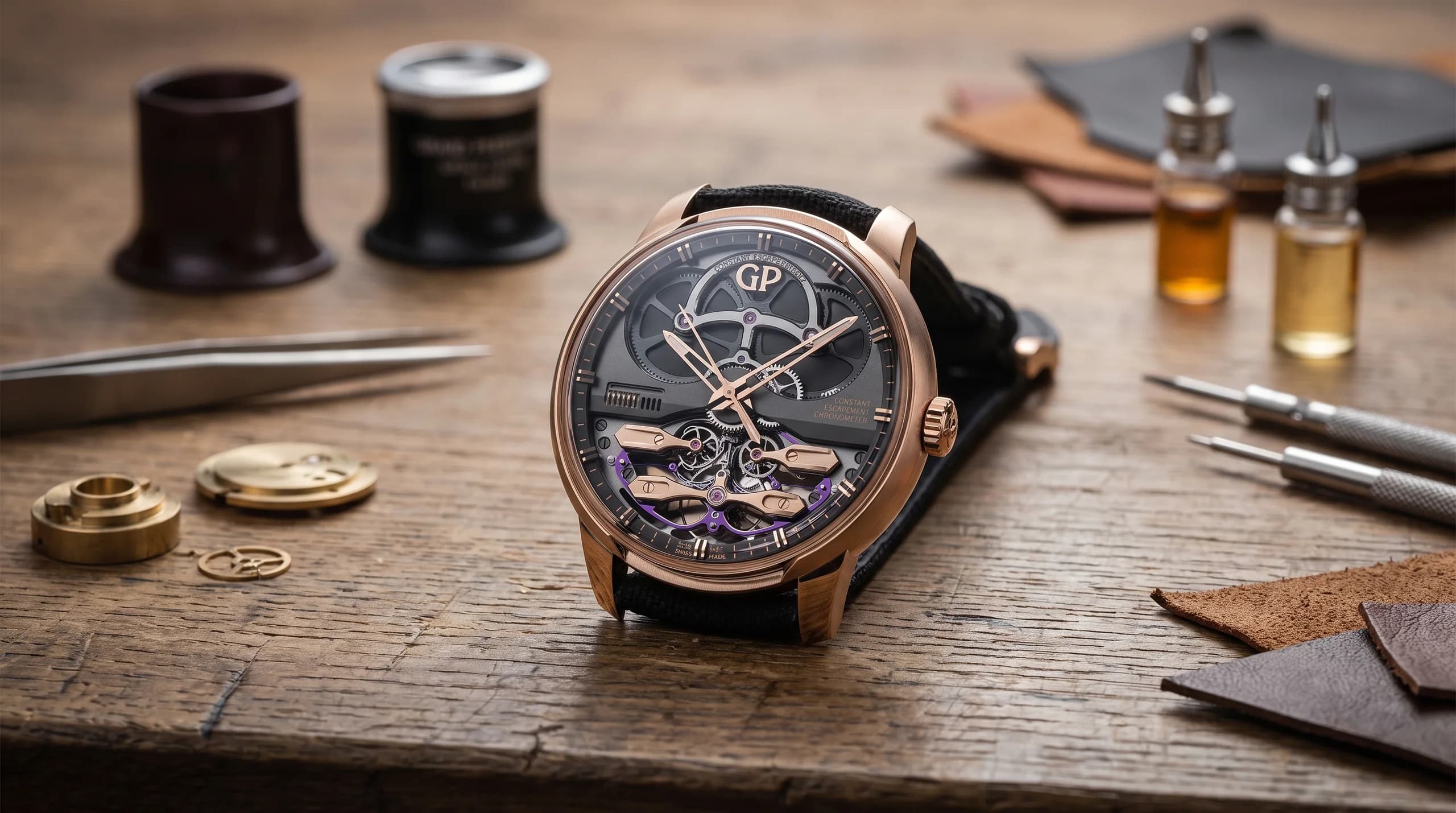
Wind a mainspring fully and it pushes hard. Let it run most of the way down and it pushes weakly. That taper in torque is normal, expected, and has been a known problem in mechanical timekeeping for about 400 years. Constant force is the umbrella term for any mechanism built to solve it.
The short answer: constant force delivers steady, even torque to a watch's escapement regardless of how wound the mainspring is. Historically this was solved with a fusee and chain system. Modern watchmaking mostly uses a remontoir d'egalite (a small secondary spring rewound at intervals) or, more recently, a silicon constant-force escapement built directly into the going train.
Why declining torque is actually a problem
A balance wheel wants a consistent push to swing at a consistent rate. A mainspring does not deliver a consistent push. Fully wound, it can deliver noticeably more torque than it does in its last few hours before needing a rewind, and that taper can translate into rate variation, a watch running slightly fast when freshly wound and slightly slow as the power reserve drops.
Isochronism helps, but does not solve it
Modern balance springs are designed with isochronism in mind, meaning the oscillation period stays close to constant across a range of amplitudes. That is real engineering and it minimizes the problem significantly. It does not eliminate it, which is why constant force mechanisms still exist at the high end of watchmaking despite isochronism improvements over the past century.
The old solution: fusee and chain
Long before wristwatches, pocket watch and clock makers solved this with a fusee, a cone-shaped pulley connected to the mainspring barrel by a tiny chain (or, in cheaper versions, a cord). As the mainspring unwinds and its torque drops, the chain pulls from a progressively wider part of the cone, mechanically compensating for the lost force. It works, but it takes real space and complicates a movement considerably.
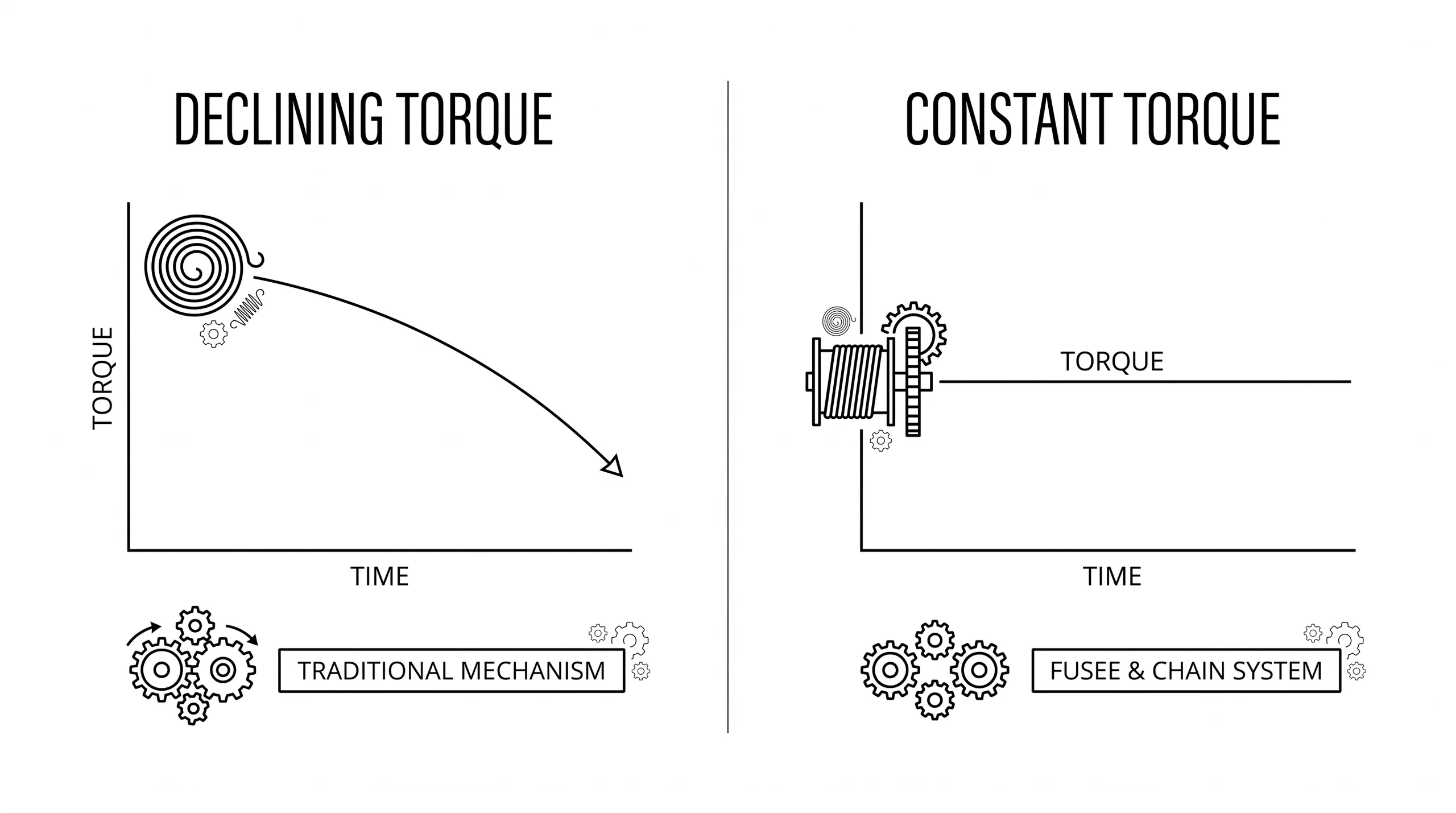
Declining mainspring torque on the left. A fusee and chain system flattening that curve on the right.
Why it mostly disappeared from wristwatches
A fusee and chain needs height and width a modern wristwatch case rarely has to spare, and the chain itself is a delicate, labor-intensive part to hand-make and service. A. Lange & Söhne is one of the few manufactures still building fusee-and-chain wristwatches today, largely as a display of traditional capability rather than a practical necessity.
The modern solution: remontoir d'egalite
A remontoir d'egalite (literally "equality rewinder") takes a different approach. Instead of compensating for the mainspring's taper directly, it inserts a small secondary spring between the mainspring and the escapement. That secondary spring is rewound by the mainspring at very short, regular intervals, often once per second, and it is the secondary spring, not the mainspring, that actually drives the escapement.
Why this actually works
Because the secondary spring only ever holds a tiny, tightly controlled amount of energy before being rewound again, its own torque taper is negligible over that short interval. The escapement effectively never feels the mainspring's long-term decline at all. F.P. Journe uses this approach across several calibers, including the Chronometre à Resonance, where our F.P. Journe brand guide covers the broader context of why collectors chase the brand's solid gold movements and small production runs.
The newest solution: silicon constant-force escapements
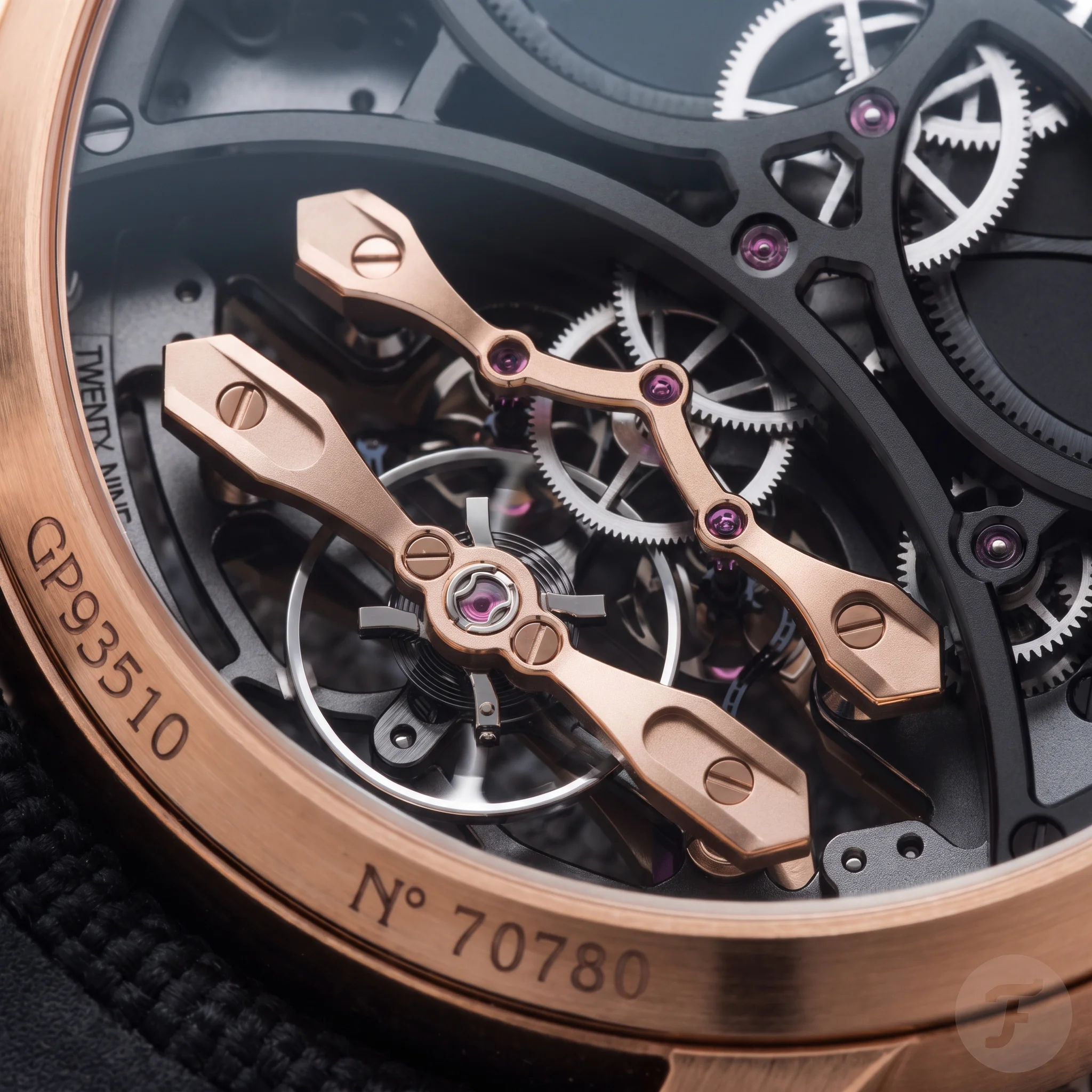
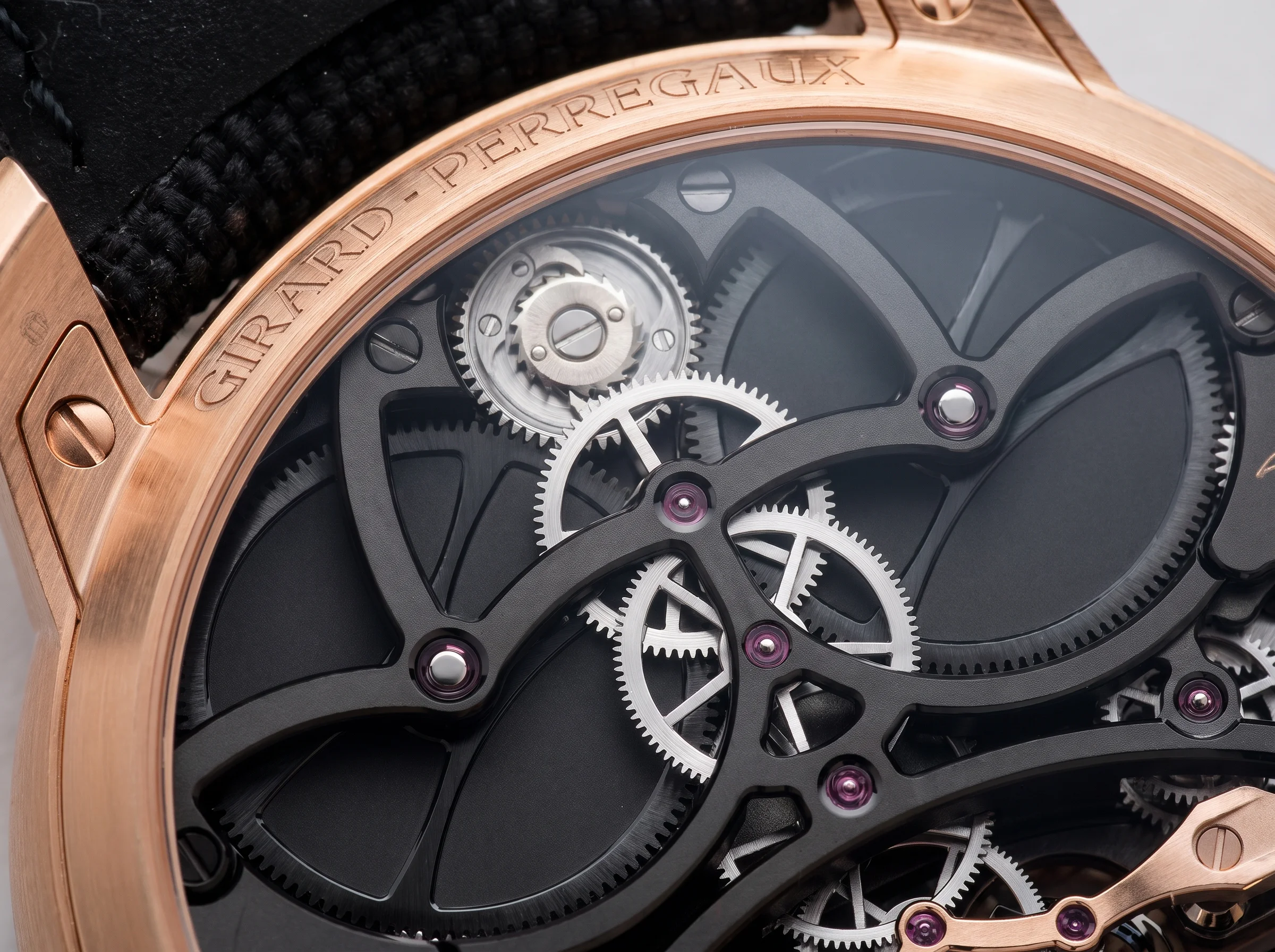
Girard-Perregaux's Constant Escapement, first shown in 2013 and refined since into the Neo Constant Escapement, takes a third approach entirely. Instead of a rewinding secondary spring, it uses a pair of extremely thin, flexible silicon blades that snap between two positions like a switch, releasing energy to the escapement in uniform, discrete packets rather than a continuous variable flow.
What the purple actually is
The purple tint visible on the blades in photos is not decorative. It comes from an oxide layer applied during the silicon fabrication process, and it has become something of a visual signature for the mechanism across Girard-Perregaux's marketing.
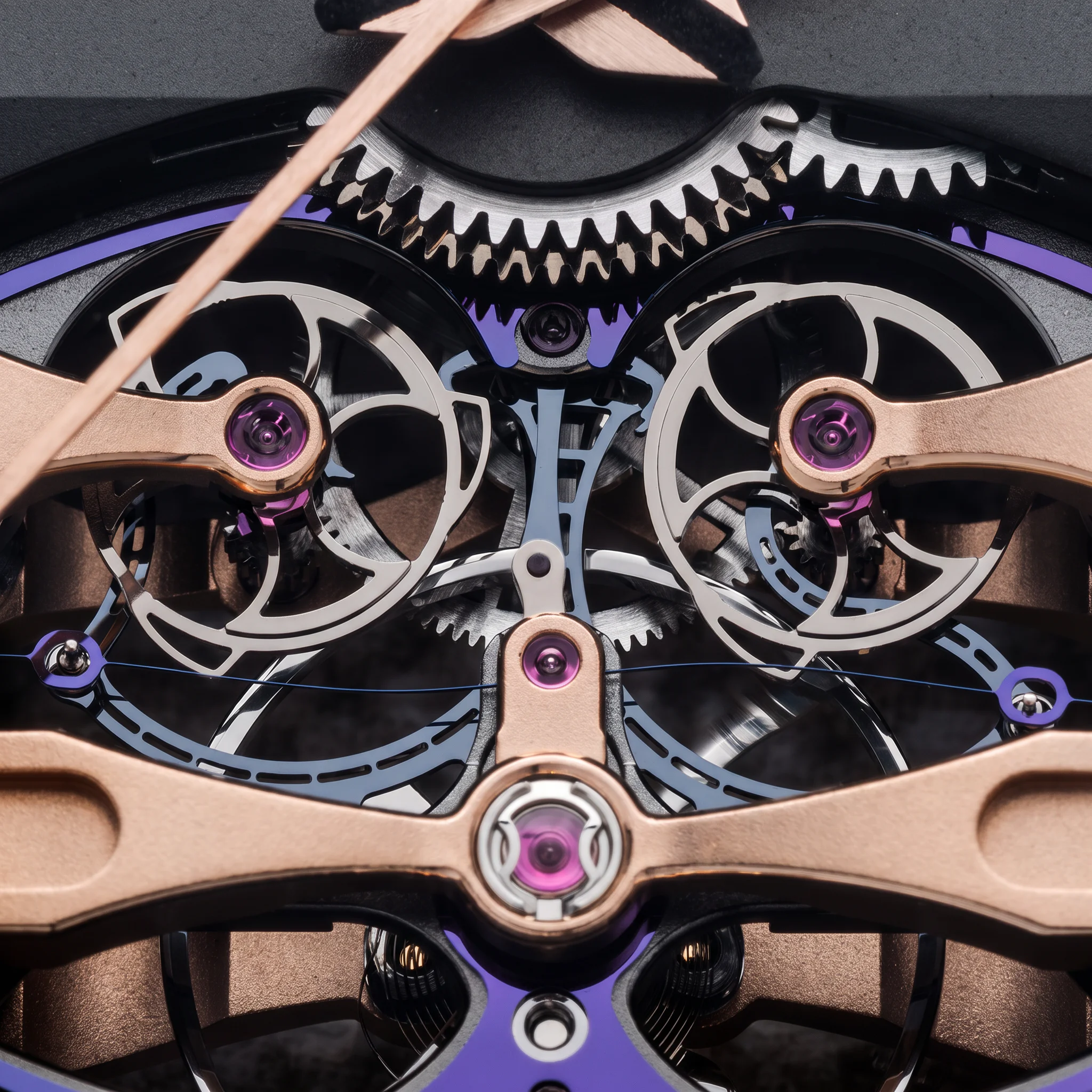
The twin silicon blades that give the Neo Constant Escapement its name and its distinctive purple tint.
Why silicon changes the calculation
Silicon is antimagnetic, extremely light, and can be manufactured with tolerances that are difficult to achieve in traditional metal escapement parts. That makes a mechanism this delicate actually viable for daily wear in a way a comparably fine metal version might not be, since silicon does not require the same lubrication a metal escapement does at these contact points.
Comparing the three approaches
| Mechanism | Era | How it works | Where you still find it |
|---|---|---|---|
| Fusee and chain | 1400s onward | Cone-and-chain mechanically compensates for spring taper | A. Lange & Söhne (Zeitwerk, Richard Lange) |
| Remontoir d'egalite | 1700s onward, revived modern | Secondary spring rewound at short intervals drives escapement | F.P. Journe, several independents |
| Silicon constant escapement | 2013 onward | Flexible silicon blades release energy in discrete packets | Girard-Perregaux Constant Escapement / Neo |
Does constant force actually matter for everyday accuracy?
Honestly, for most owners, less than the marketing implies. Modern isochronism-tuned balance springs already keep rate variation small across most of a mainspring's power reserve. Constant force earns its keep at the extremes, the last few hours before a rewind, and in complications where steady torque genuinely affects output, like a chronograph or a resonance mechanism that depends on two balances staying precisely synchronized. As with resonance watches, the appeal here is as much about mechanical achievement as it is about a measurable everyday accuracy gain, and being honest about that distinction is worth more than oversell copy that promises constant force will transform your daily timekeeping.
Any regulating organ, constant force included, ultimately still depends on the hairspring doing its job well. A perfect torque supply feeding a poor hairspring will not produce a great rate.
FAQ
What is a remontoir d'egalite?
A small secondary spring inserted between the mainspring and the escapement, rewound at short, regular intervals so the escapement always receives steady torque regardless of the mainspring's own charge level.
Is constant force the same as a tourbillon?
No. A tourbillon rotates the escapement to average out the effect of gravity on rate in different positions. Constant force addresses torque delivery, a separate problem. Some watches combine both.
Why did fusee and chain mostly disappear from watchmaking?
It requires significant case space and a hand-finished chain that is expensive and delicate to produce and service, which made it impractical once wristwatches shrank case sizes.
What makes the Girard-Perregaux Constant Escapement different from a remontoir?
It uses flexible silicon blades that snap between two positions to release energy in discrete packets, rather than a spring that gets rewound at intervals. Both aim at the same result through different mechanisms.
Does a constant force watch need special servicing?
Generally serviced like any high-complication watch, though a silicon-based mechanism specifically avoids some traditional lubrication requirements at the escapement contact points, which can simplify certain service steps.
Browse authenticated pre-owned independent watchmaking at 5dwatches.com.