The Short Answer
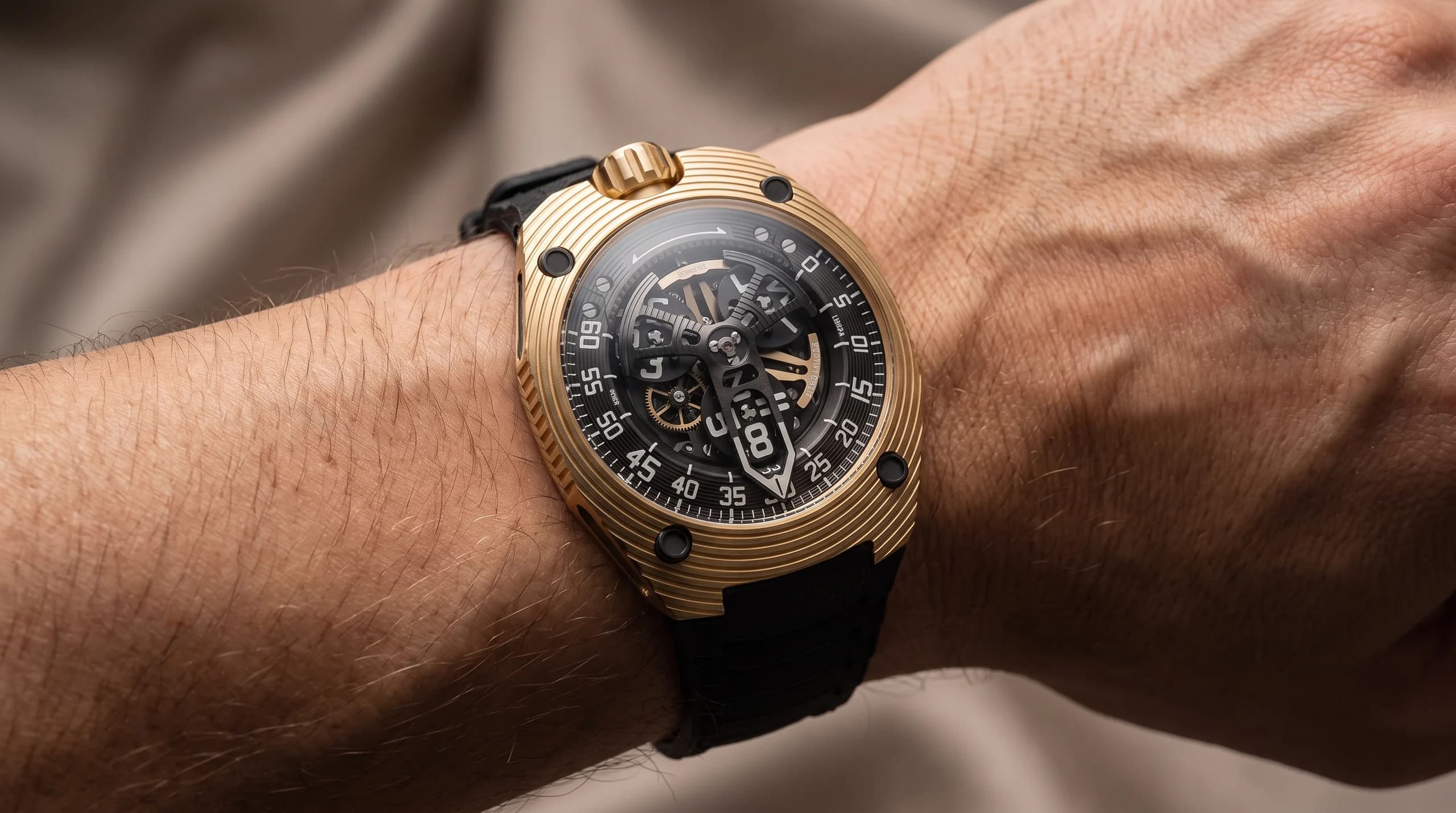
URWERK just brought its UR-150 Scorpion back in gold. The Golden Scorpion is a 2N yellow gold version of the satellite-hour UR-150, limited to 25 pieces at CHF 105,000, announced September 4, 2026.
It keeps the same wandering-hour display as the steel and titanium Scorpion versions: three rotating hour satellites and a long retrograde minute hand that snaps back to zero in a hundredth of a second at the top of each hour. Nothing about how you read the time is new. What changes is the case, and the price.
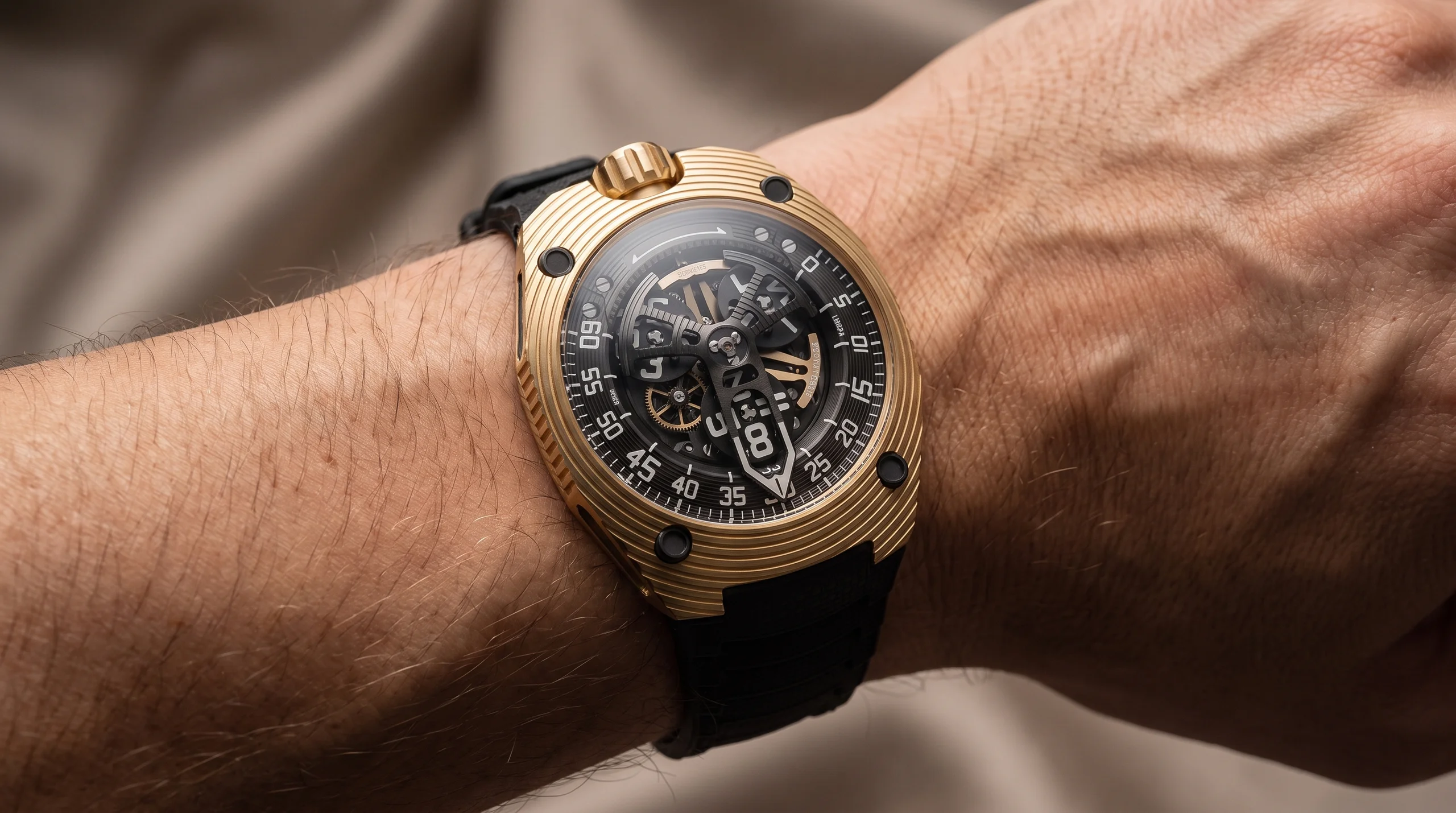 The Golden Scorpion trades the Titan and Dark versions' titanium for a 2N yellow gold case middle.
The watch photos in this article were generated with AI image tools, conditioned on real reference photography of the URWERK UR-150 Scorpion family so the case shape and dial layout are accurate to the real watch.
Why URWERK Builds Watches Like This
URWERK was founded in 1997 by Felix Baumgartner and designer Martin Frei, with Felix's father Thomas Baumgartner contributing engineering. The brand's whole identity rests on one idea: telling time the way 17th-century Ottoman pocket watches sometimes did, with wandering or satellite hour displays instead of a hand sweeping a full circle.
The UR-150 Scorpion line takes that satellite-hour idea and pairs it with a curved, elongated case shape the brand nicknames after the scorpion's tail. It first appeared in steel, then blue, then a limited Dark PVD version. Gold is new for this specific case.
The Family, Not Just the Gold One
Two other UR-150 Scorpion versions are in current production alongside the Golden Scorpion. The Titan and Dark editions both run titanium cases at 42.49mm by 52.31mm, limited to 50 pieces each, priced at roughly $108,740 and $109,420 respectively.
The Golden Scorpion is smaller in production (25 pieces against 50) and the only version in solid gold, which is why it costs more despite sharing the same movement and display architecture as its titanium siblings.
How the Satellite Hour Display Works
Instead of a single hour hand, the UR-150 mounts three discs, each printed with four consecutive hour numerals, on a rotating carousel beneath the dial.
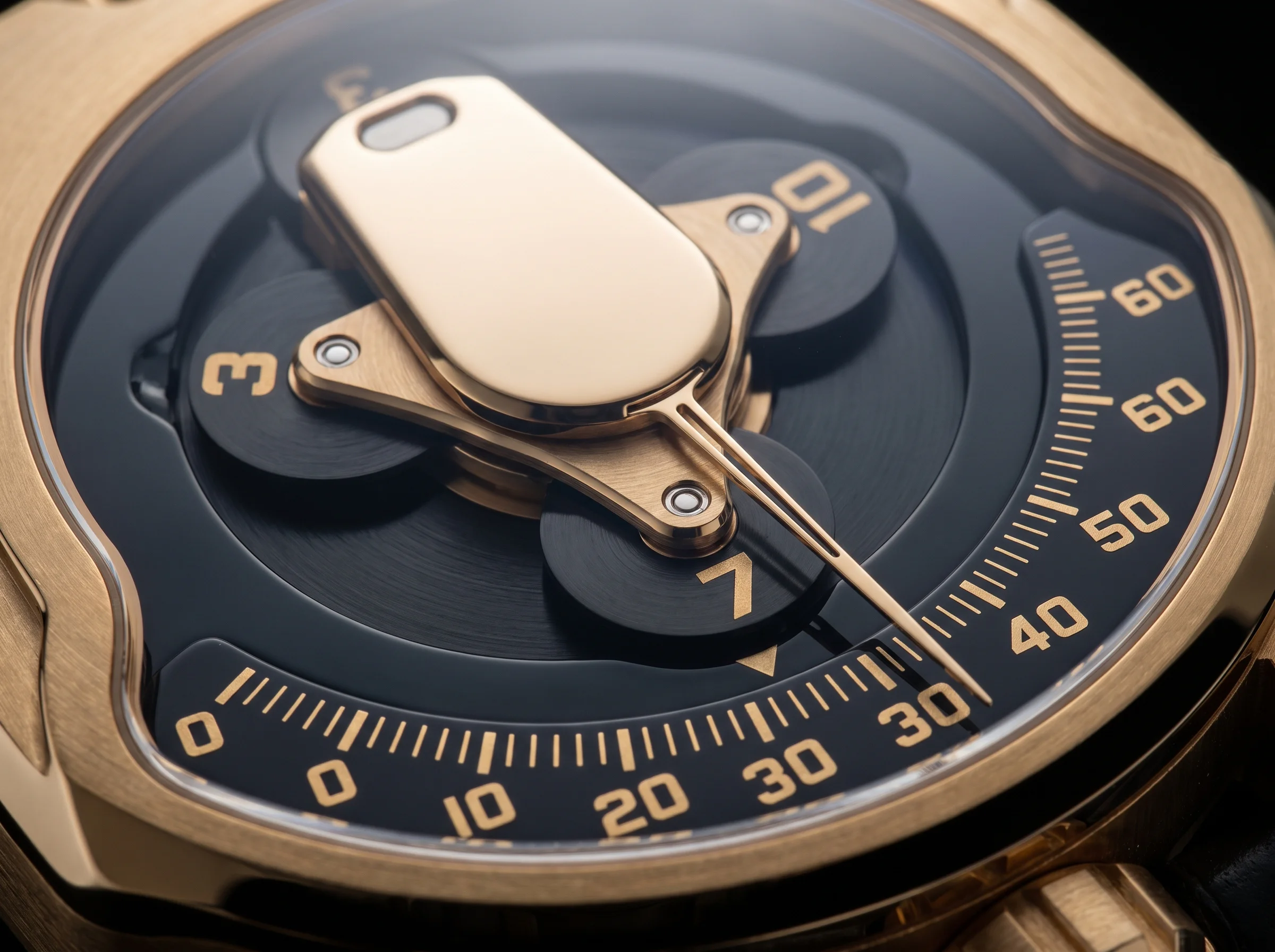 One satellite disc shows through the dial aperture at a time, sliding the current hour numeral along the retrograde minute track.
As the current hour's disc slides along, its printed numeral travels beneath a fixed minute scale while a slim retrograde hand sweeps across a 240-degree arc. At the top of the hour, the hand does not creep back to its starting position. It resets in about a hundredth of a second, a mechanical detail that took real engineering effort to make look instantaneous.
The Gold Case, Specifically
The Golden Scorpion's case middle is 2N yellow gold, measuring 42.5mm wide by 51mm long by 14.8mm thick, an elongated shape rather than a round one. The caseback stays grade 5 titanium treated in black PVD, which keeps weight down even with a solid gold front.
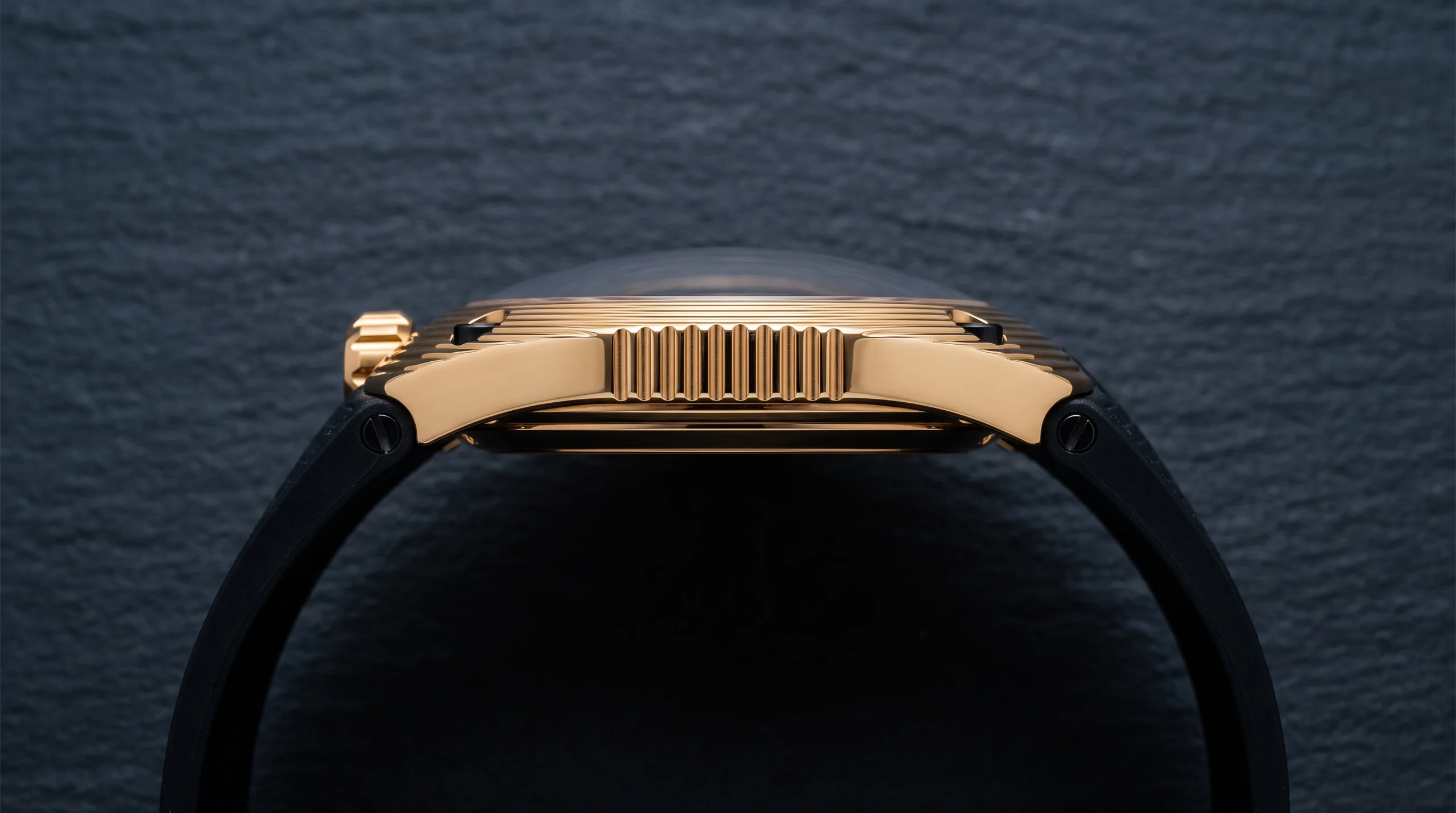 The crown sits at one end of the case's elongated shape rather than on a flank, an unusual layout even by independent-watchmaking standards.
The Movement Underneath
URWERK builds the UR-150 around caliber UR-50.01, an automatic movement based on a Vaucher ébauche with URWERK's own satellite display module on top, governed by a double turbine that regulates the winding rotor's speed.
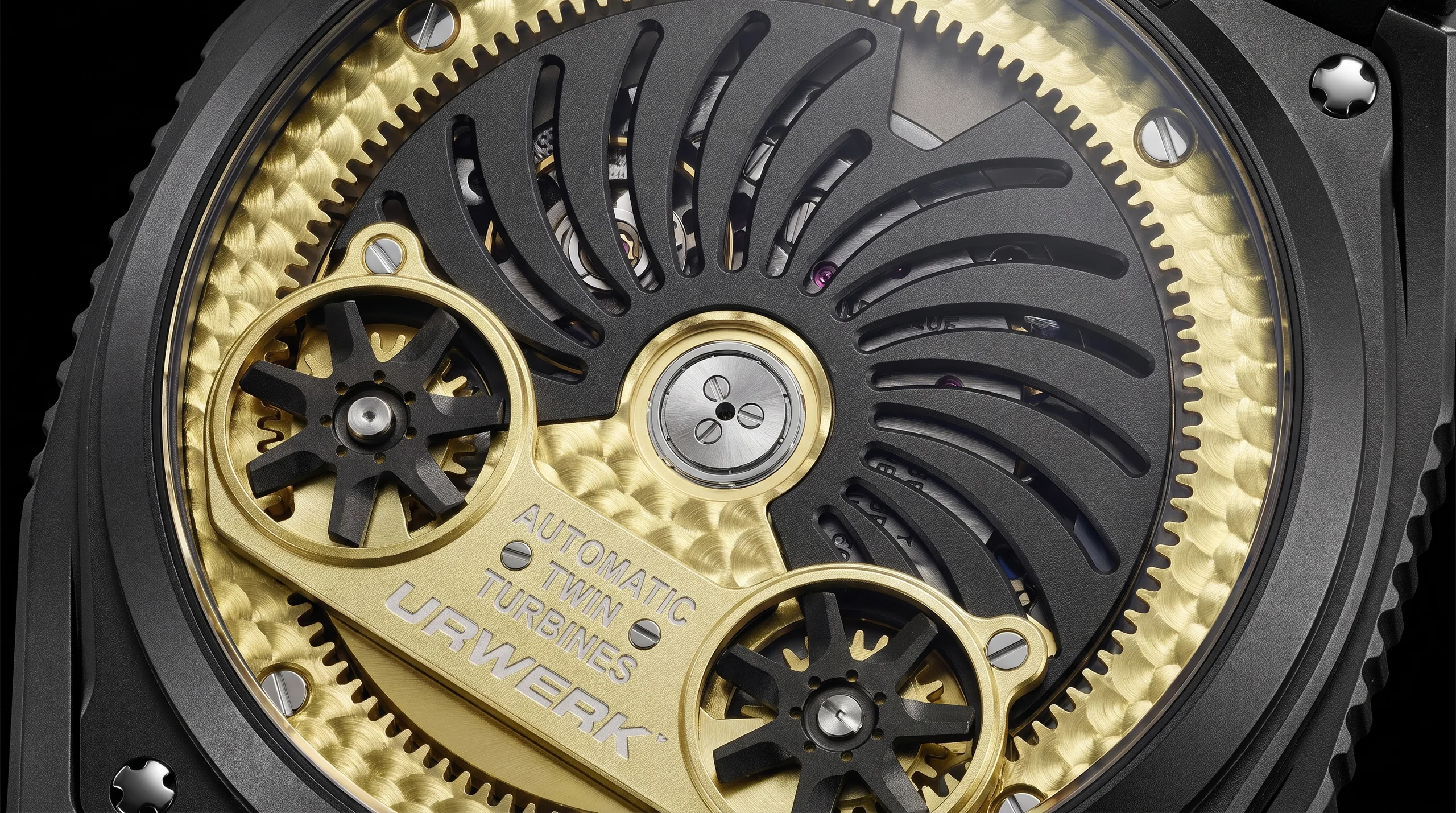 The double turbine sits under the rotor, slowing it down so aggressive wrist motion does not over-wind the mainspring.
The caliber runs at 28,800 vibrations per hour with 38 jewels and a 43-hour power reserve. Water resistance is rated to 50 meters, which is genuinely useful on a watch this architecturally dense, most watches at this level of mechanical complexity settle for far less.
Why a Double Turbine at All
An automatic rotor spinning too fast can, over time, over-wind or stress a mainspring, especially on an active wrist. The double turbine acts as an air brake, absorbing excess rotor energy so the winding stays smooth regardless of how much the wearer moves.
Price and Positioning
URWERK priced the Golden Scorpion at CHF 105,000, excluding taxes, roughly CHF 4,000 to 5,000 above the titanium versions despite the smaller run of 25 pieces.
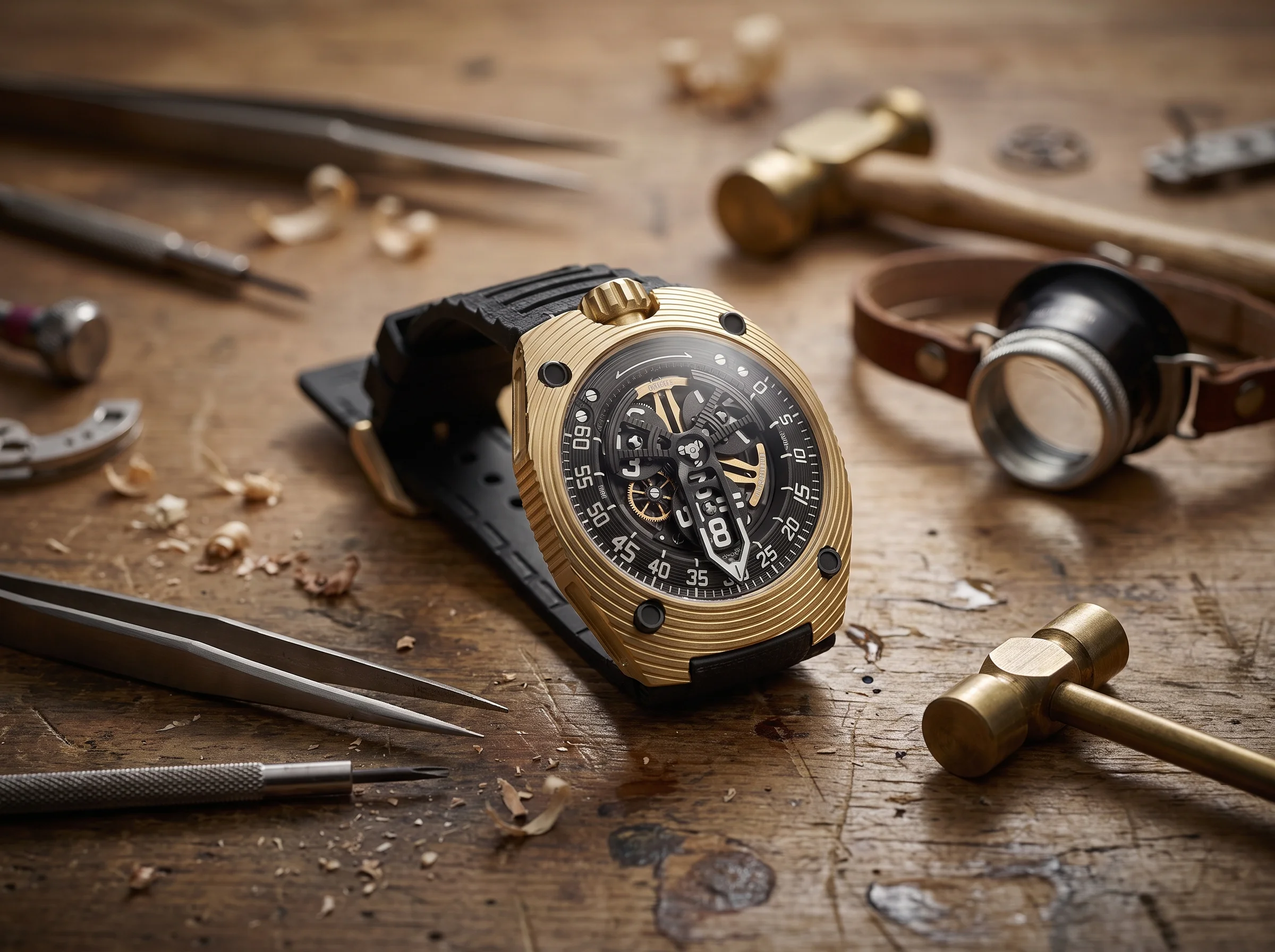 Satellite-hour watches like this one are built and regulated individually, not on a production line.
The Honest Trade-Off
A satellite-hour display is objectively harder to read at a glance than a simple pair of hands, and the retrograde minute hand's instant reset, while satisfying, adds mechanical failure points a conventional sweep hand never has. What a buyer gets in return is a display architecture almost nobody else in the industry builds, on a case shape unique to URWERK, from a manufacture with a genuine three-decade track record in exactly this kind of watchmaking.
FAQ
What is the URWERK UR-150 Golden Scorpion?
It is a 2N yellow gold version of URWERK's UR-150 Scorpion satellite-hour watch, limited to 25 pieces at CHF 105,000, announced September 4, 2026. It uses the same caliber UR-50.01 as the titanium Titan and Dark versions.
How does the UR-150's satellite hour display work?
Three discs, each printed with four hour numerals, rotate on a carousel beneath the dial. The current hour's numeral slides along a fixed minute scale while a retrograde hand sweeps a 240-degree arc, resetting to zero in about a hundredth of a second at the top of each hour.
How is the Golden Scorpion different from the UR-150 Titan and Dark?
The Golden Scorpion uses a 2N yellow gold case middle instead of titanium, is limited to 25 pieces instead of 50, and costs more (CHF 105,000 versus roughly $108,740 to $109,420 for the titanium versions), though all three share the same movement and display.
What is a double turbine on a watch movement?
It is a mechanical air brake fitted beneath an automatic rotor that regulates how fast the rotor spins, protecting the mainspring from over-winding on an active wrist. URWERK uses one in caliber UR-50.01.
Who founded URWERK?
Felix Baumgartner and designer Martin Frei founded URWERK in 1997, with Felix's father Thomas Baumgartner contributing engineering. The brand debuted at the AHCI that year and has focused on satellite and orbital hour displays ever since.
Related Reading
- F.P. Journe: The Connoisseur's Independent, and Why Collectors Keep Chasing It
- Chronoswiss Brand Guide: The Independent Behind the Regulator Dial
- The A. Lange & Söhne Lange 1 Buying Guide: The Independent Benchmark, Read by a Dealer
- H. Moser & Cie: The Rebel Independent That Made Minimalism a Statement