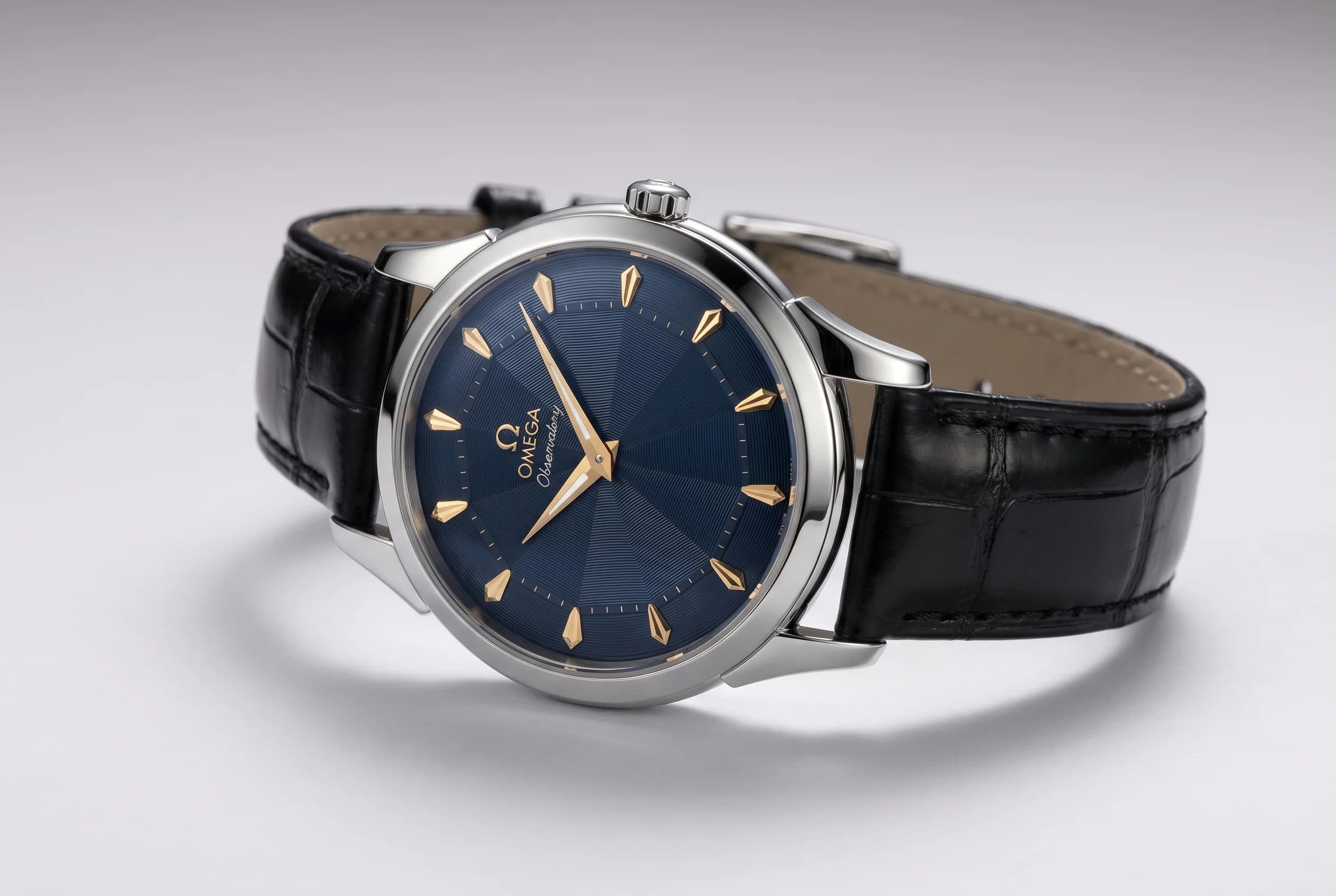
The Constellation has spent the last two decades as Omega's third sibling. The Speedmaster gets the moon stories. The Seamaster gets James Bond. The Constellation gets sold. That changes with the Observatory.
Announced March 26, 2026, the Constellation Observatory is not a refresh. Omega built nine new references, introduced two new in-house calibers, developed a new acoustic certification methodology, and reached back to 1952 for the design language. The result is a sub-collection that earns its name through a genuine technical first: the world's first two-hand watch certified to Master Chronometer standards.
All images in this post are AI-generated and may not perfectly represent the actual watch references discussed. They are intended for illustration only.
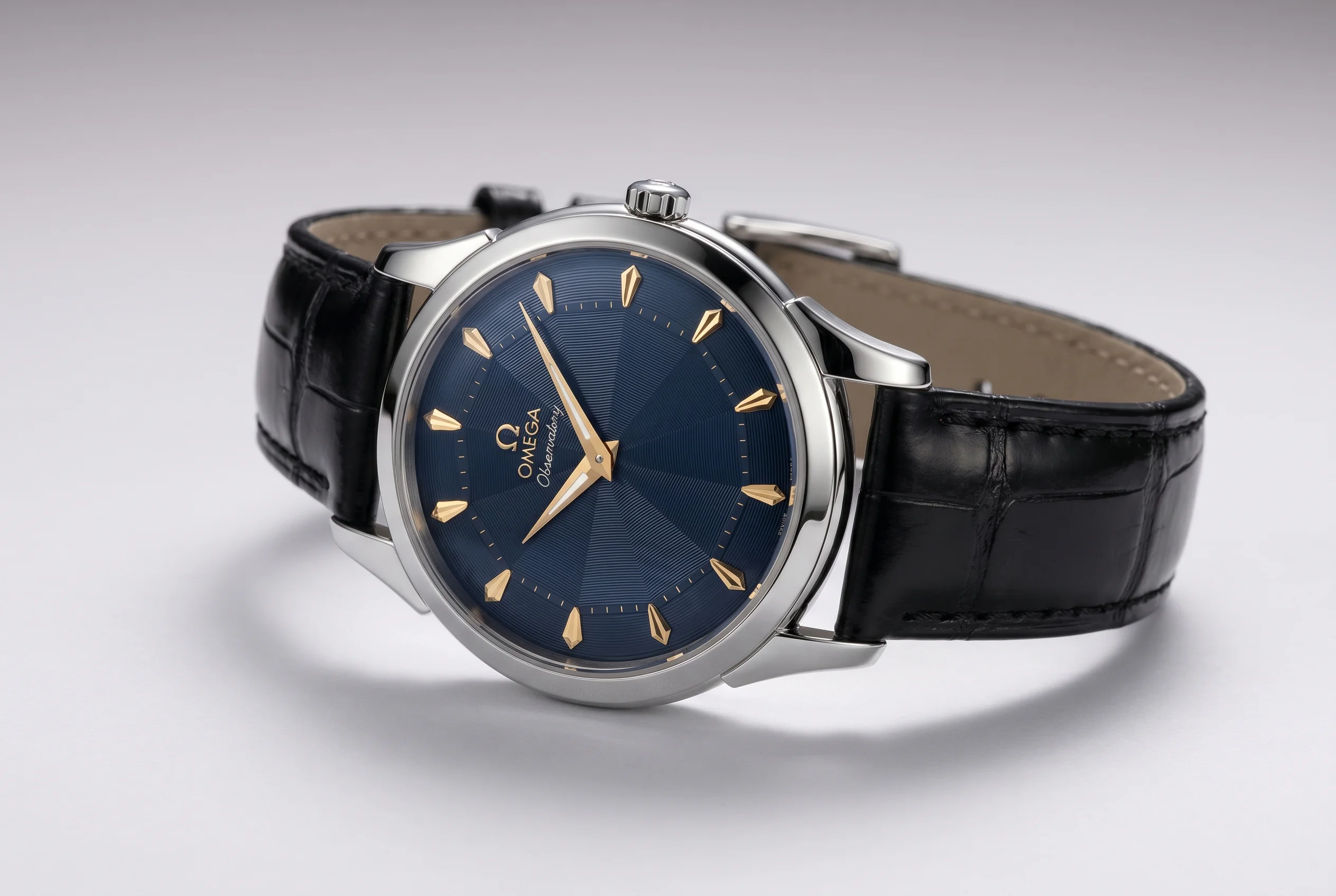
The Observatory in O-MEGASTEEL with the blue pie-pan dial, reference 140.13.39.21.03.001, the steel reference at $10,900 retail.
The Short Answer
The Observatory launches with nine references at 39.4mm, priced from $10,900 in O-MEGASTEEL to $59,100 in full Moonshine Gold. The headline innovation is METAS Master Chronometer certification on a two-hand movement, made possible by a new acoustic testing method developed at Omega's Laboratoire de Précision. The four steel time-only references are the value play. The black ceramic dial steel reference at $12,200 is the standout. The Moonshine Gold flagship on the brick-pattern mesh bracelet at $59,100 is the halo piece. Pre-owned values will not be readable for 12 to 18 months.
What the Observatory Actually Is
In 1952, Omega launched the original Constellation as a precision chronometer showcase. The "Observatory" name traced back to the astronomical observatories at Kew-Teddington and Geneva, where Omega had set six chronometry championship titles and two world precision records between 1933 and 1952. The eight stars on the original caseback medallion stood for those wins.
The 2026 Observatory revives that lineage with intent. The dodecagonal pie-pan dial, the dog-leg lugs, the faceted kite-form hour markers, and the Observatory medallion on the caseback all pull from the 1952 reference. What's new is everything inside the case, plus a two-hand layout the original never carried.
The Real Story: Acoustic Testing and a Two-Hand Master Chronometer
Master Chronometer certification, jointly administered by Omega and the Swiss federal metrology institute METAS, requires watches to pass eight tests including magnetic resistance to 15,000 gauss, water resistance, power reserve, and timekeeping accuracy within 0/+5 seconds per day. Until 2026, every Master Chronometer watch had a seconds hand. The certification protocol depended on it: METAS testers measured the seconds hand against reference timing to verify daily rate.
A two-hand watch breaks that protocol. Without a seconds hand to track, there's no way to read the daily rate visually.
Omega solved it by listening to the movement. The Laboratoire de Précision developed an acoustic testing methodology that captures the sound of the escapement firing and derives accuracy from the audio signal. METAS certified the method, and the Observatory became the first Master Chronometer two-hand watch in the certification's history.
This matters because dress watches without seconds hands have historically had to choose between visual cleanliness and certified accuracy. The Observatory eliminates that compromise. According to WatchTime's coverage of the launch, the acoustic protocol is now part of the standard METAS certification stack and will likely extend to future two-hand Omega releases.
The Nine References Breakdown
The collection splits cleanly into two tiers: four O-MEGASTEEL references at the entry, and five precious metal references above.
| Reference | Material | Dial | Calibre | Price (USD) |
|---|---|---|---|---|
| 140.13.39.21.02.001 | O-MEGASTEEL | Silver | 8914 | $10,900 |
| 140.13.39.21.03.001 | O-MEGASTEEL | Blue | 8914 | $10,900 |
| 140.13.39.21.10.001 | O-MEGASTEEL | Green | 8914 | $10,900 |
| 140.13.39.21.01.001 | O-MEGASTEEL | Black ceramic | 8914 | $12,200 |
| 140.53.39.21.99.001 | Moonshine Gold | Yellow | 8915 | $37,900 |
| 140.53.39.21.99.002 | Sedna Gold | Pink | 8915 | $37,900 |
| 140.53.39.21.99.004 | Canopus Gold | Silver | 8915 | $44,000 |
| 140.93.39.21.99.001 | Platinum-Gold | Yellow | 8915 | $57,800 |
| 140.50.39.21.99.001 | Moonshine Gold (full) | Yellow | 8915 | $59,100 |
The black ceramic dial reference (140.13.39.21.01.001) sits at $12,200, a $1,300 premium over the silver, blue, and green steel siblings. The premium reflects the manufacturing complexity of producing a ceramic dial with the dodecagonal pie-pan geometry. Ceramic dials resist UV fade in ways painted dials cannot, so the long-term aging story is different too.
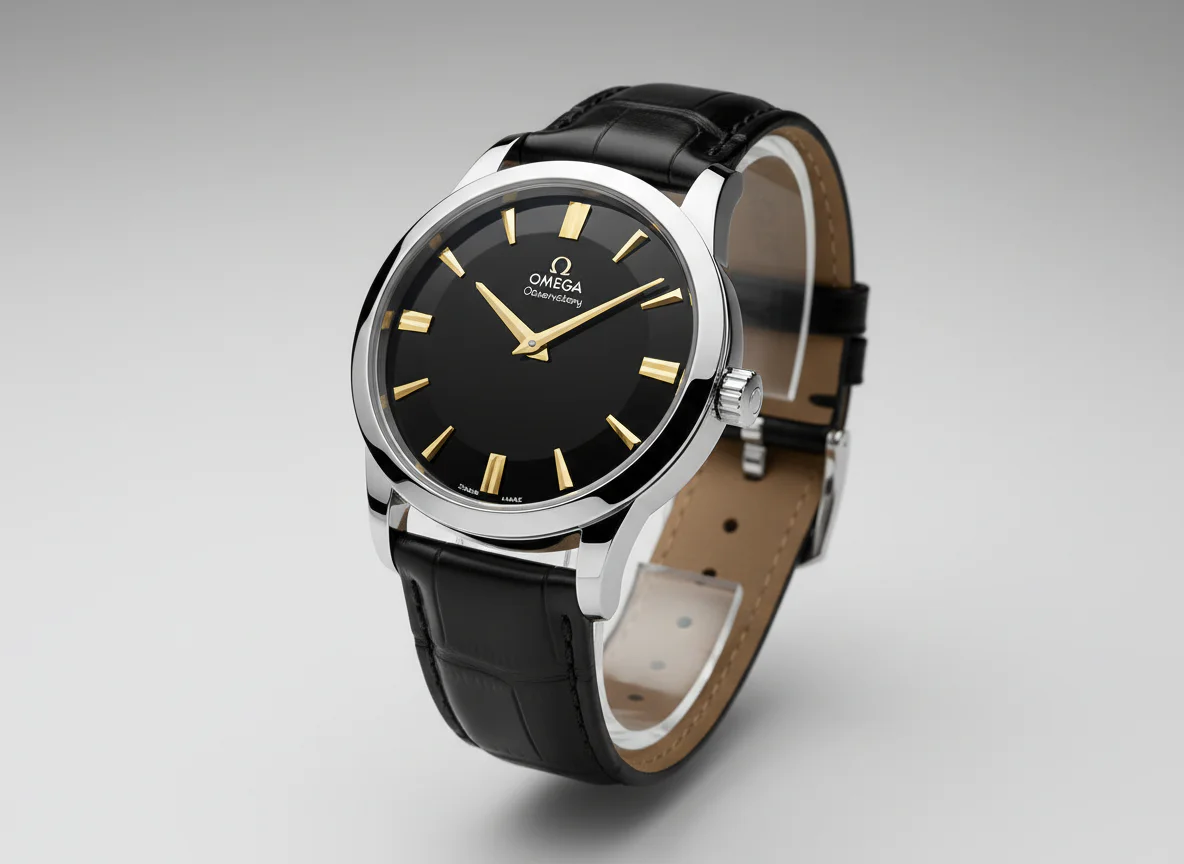
Reference 140.13.39.21.01.001 carries a $1,300 premium over its steel siblings. Ceramic resists UV fade in ways painted dials cannot.
The flagship is the full Moonshine Gold reference (140.50.39.21.99.001) on a vintage-inspired brick-pattern mesh bracelet. It's the only Observatory currently fitted with a bracelet rather than alligator leather. Per Monochrome's hands-on review, the mesh uses a modern deployant clasp with a hidden locking mechanism rather than removable links.
The Calibres: 8914 and 8915
Both new in-house calibers share identical technical architecture. The differences are in finishing and material.
- Calibre 8914: powers all four O-MEGASTEEL references. Rhodium-plated finish.
- Calibre 8915: reserved for precious metal references. Comes in three executions matching the case material (Sedna Gold, Moonshine Gold, and a "Sedna Blue Sky" variant for the Canopus Gold reference). Higher-grade finishing called "Grand Luxe" on the platinum-gold piece.
Shared specs across both:
- 39 jewels
- 29mm movement diameter
- Co-Axial escapement
- 25,200 vibrations per hour (3.5 Hz)
- 60-hour power reserve via two mainspring barrels
- Master Chronometer certified by METAS via acoustic protocol
- Visible through sapphire caseback with Constellation Observatory medallion on the rotor
The 3.5 Hz beat rate is worth flagging. Most modern Omega calibers run at 4 Hz or higher. The lower frequency on the 8914/8915 traces back to the deliberate choice to optimize for power reserve and long-term wear over high-frequency precision, since the acoustic certification handles the precision claim independently.
The Design Language: Pie-Pan, Dog-Leg, Pieces of 1952
The Observatory is the most faithful Constellation revival Omega has built since the 1990s.
The dodecagonal pie-pan dial is the visual anchor. Twelve flat angled facets meet at the center, creating a subtle geometry that catches light differently at every angle. The original 1952 Constellation used a similar pie-pan layout. The 2026 version adds a fine guilloché texture across the facets that wasn't present on the vintage piece.
The dog-leg lugs are the structural signature. Rather than straight or curved lugs, the case extends outward in elongated S-shapes that flow into the strap or bracelet. This was a 1950s detail that disappeared from the Constellation line for decades. Its return is what makes the Observatory feel period-correct rather than period-inspired.
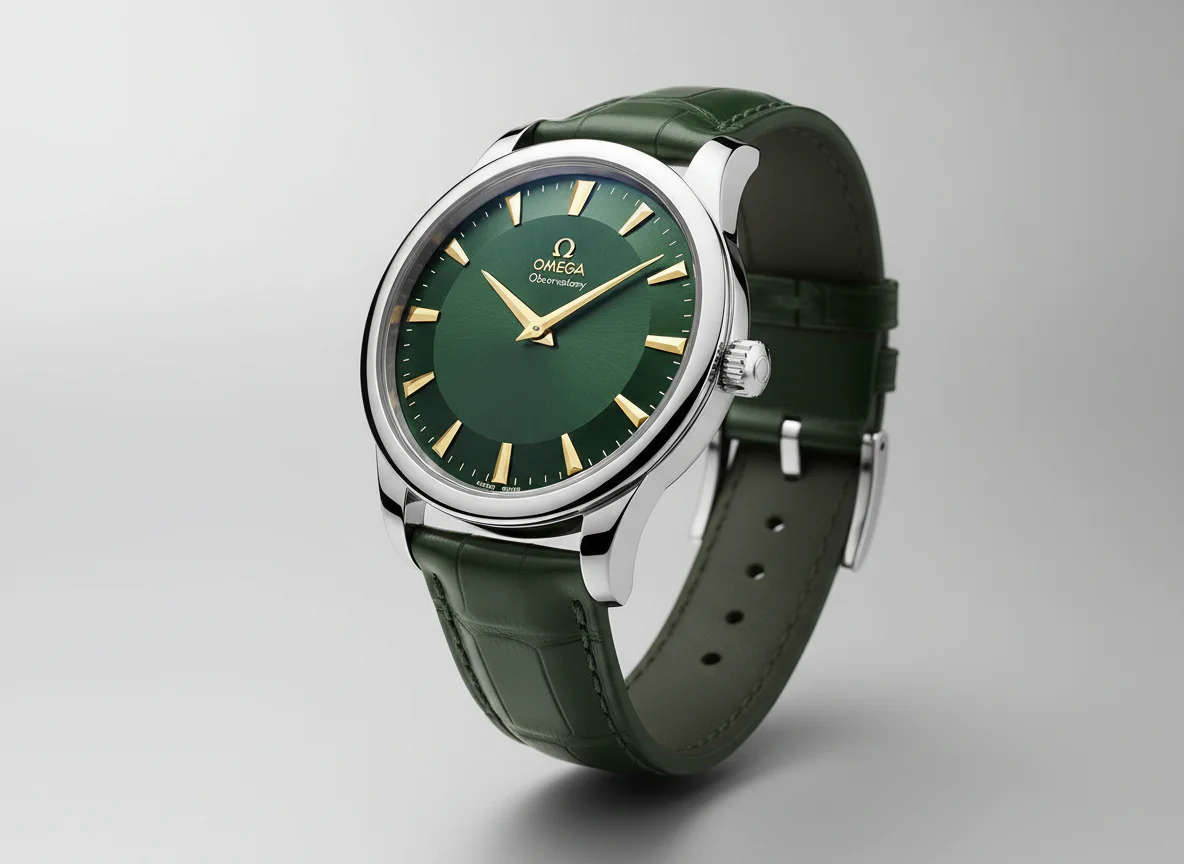
Reference 140.13.39.21.10.001 in O-MEGASTEEL with a British racing green dial, $10,900 at retail.
The faceted kite-form hour markers are 18K gold across all references, even on the steel pieces. Each marker is shaped like an elongated kite with multiple faceted surfaces that pick up light. The hands are gold dauphine-style, also faceted, with luminous inserts.
The Observatory medallion sits on the sapphire caseback rather than the dial. It carries the eight-star design from the original 1952 reference.
The Wearability Question: 39.4mm and the Mid-Size Bet
39.4mm is a deliberate choice. It places the Observatory between the 38mm dress-watch cluster (Patek Calatrava, Vacheron Patrimony, IWC Portofino in some sizes) and the 40mm sport-dress crowd (Aqua Terra, Datejust 41).
- Case diameter: 39.4mm
- Thickness: 12.23mm
- Lug-to-lug: 47.2mm
- Lug width: 19mm
12.23mm is thicker than many dress watches in this size class. The integrated movement architecture and the pie-pan dial geometry both add height. For wrists under 6.5 inches, the 47.2mm lug-to-lug will be the more relevant constraint than the case diameter.
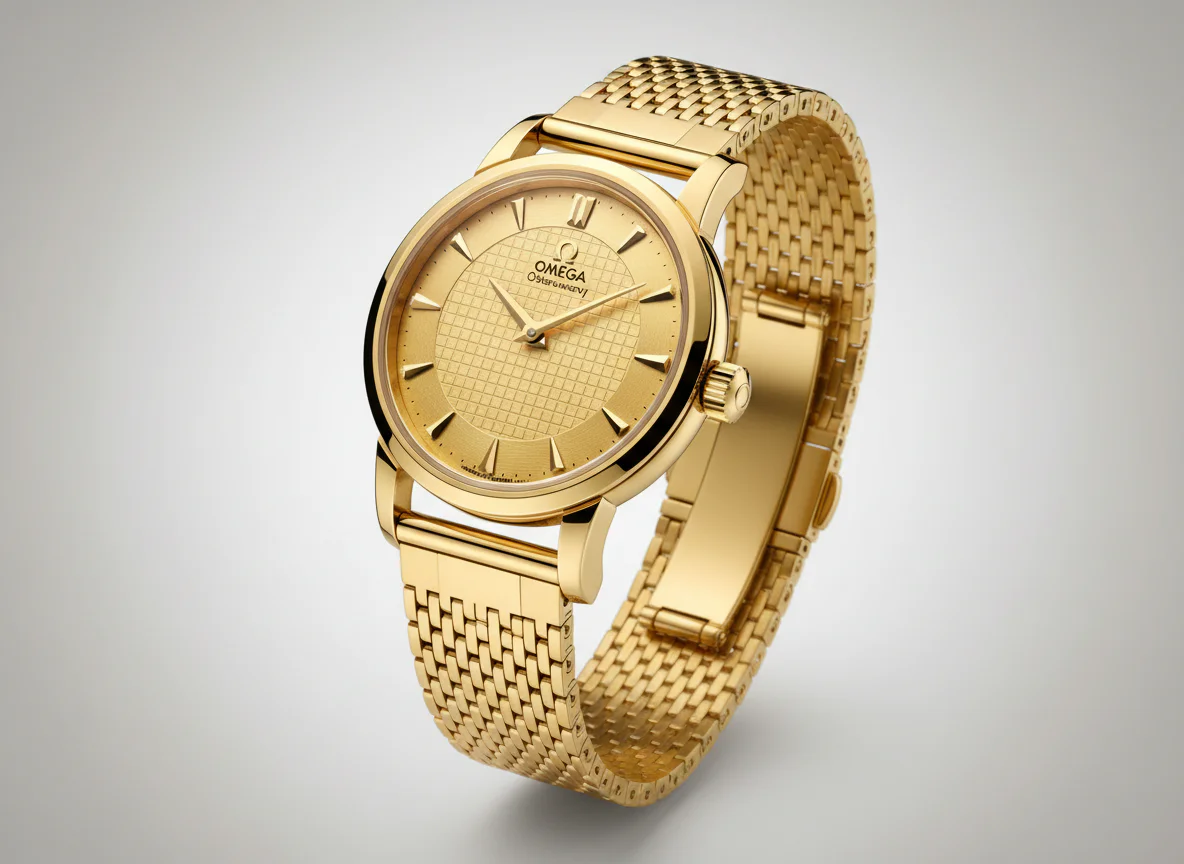
The flagship reference 140.50.39.21.99.001 in full Moonshine Gold on the vintage-inspired brick-pattern mesh bracelet, $59,100.
Steel vs Precious Metal: Which Tier Makes Sense
The four steel references at $10,900 to $12,200 are where the value math works. You're paying for the same METAS-certified two-hand movement that powers the $57,800 platinum-gold piece, just in a different case material with different finishing on the rotor and bridges.
The precious metal jump from $12,200 to $37,900 is steep, and the cost difference is mostly material. Sedna Gold (140.53.39.21.99.002) and Moonshine Gold on leather (140.53.39.21.99.001) both sit at $37,900, with the Sedna Gold piece carrying the salmon pink dial that's likely to be the secondary-market sleeper.
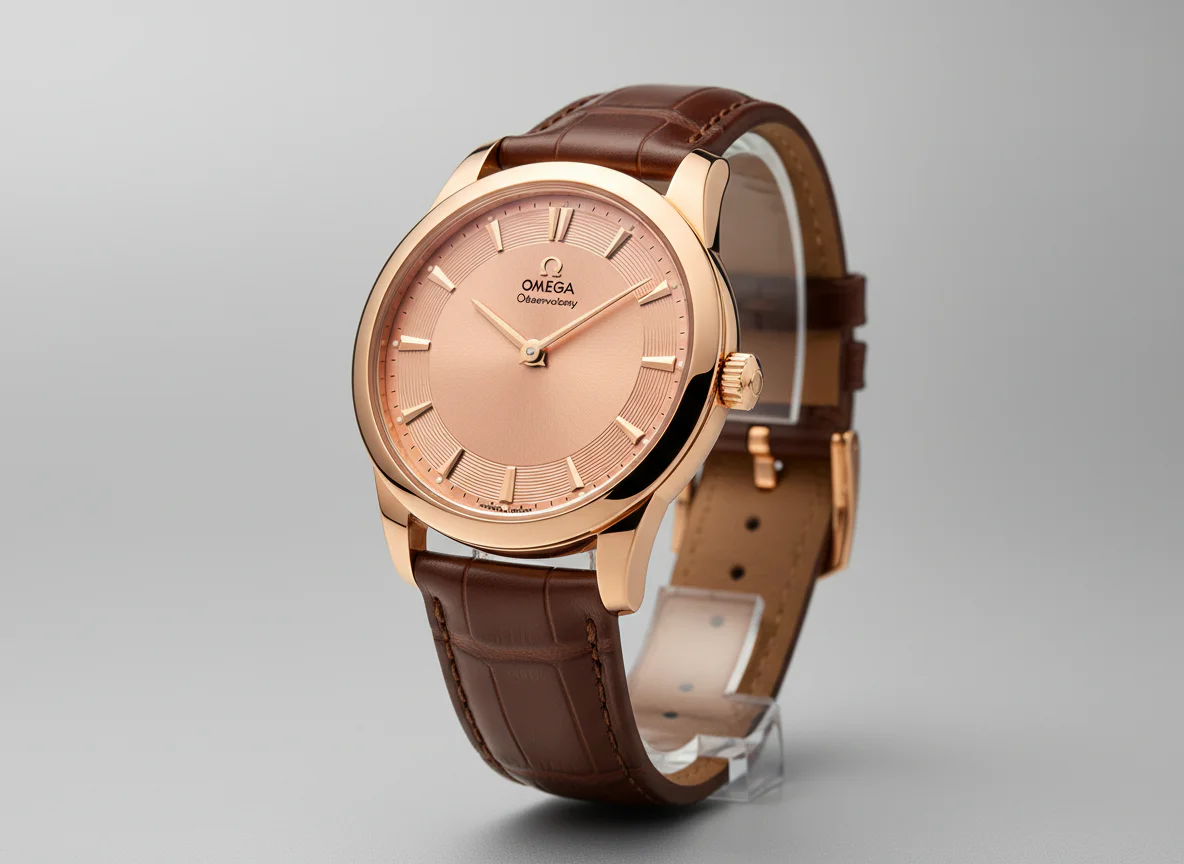
Reference 140.53.39.21.99.002 in Sedna Gold with the salmon pink dial. The secondary-market sleeper of the precious metal tier.
Canopus Gold (140.53.39.21.99.004) at $44,000 is white gold in Omega branding. Platinum-Gold (140.93.39.21.99.001) at $57,800 is a proprietary alloy that combines platinum with gold to achieve a cool silver tone with warm undertones. The "Grand Luxe" finishing on its movement adds hand-applied details visible through the sapphire caseback.
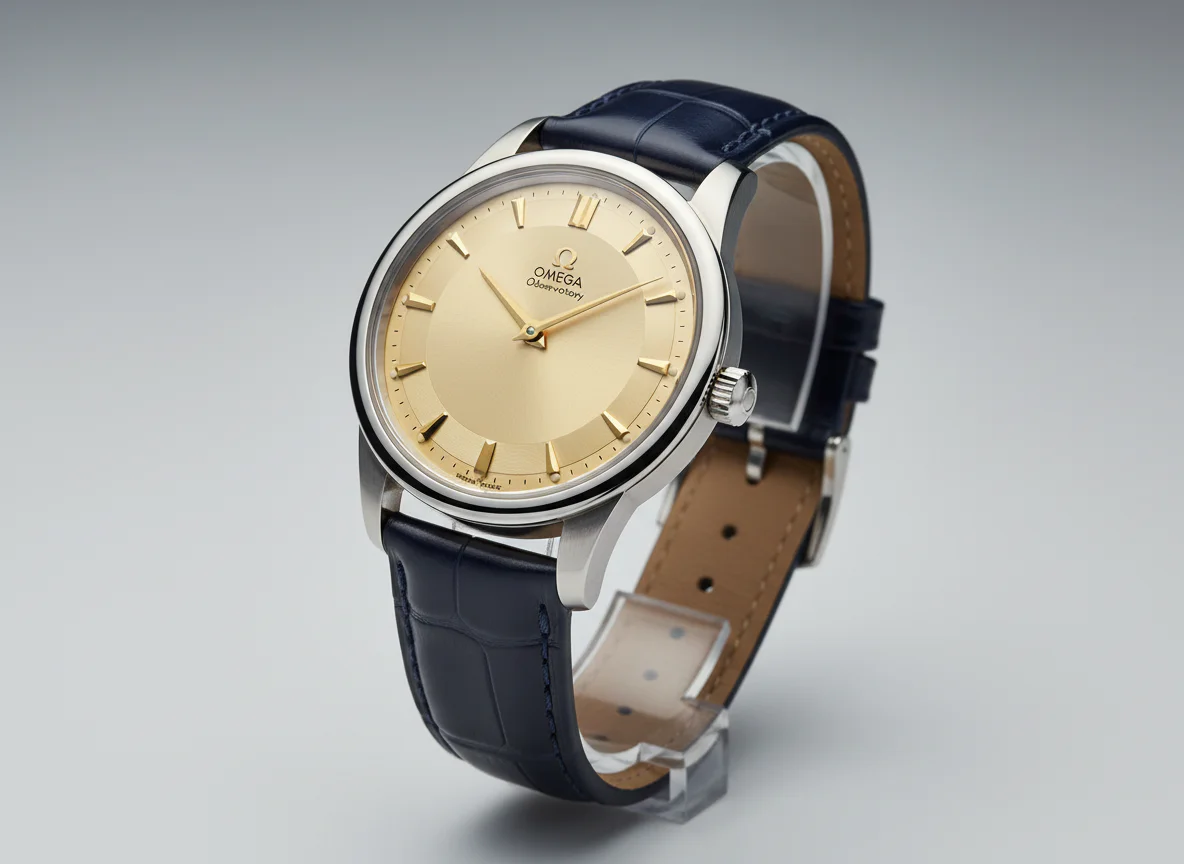
Reference 140.93.39.21.99.001 in Omega's proprietary platinum-gold alloy with the champagne yellow dial, $57,800.
The full Moonshine Gold flagship at $59,100 is the only reference where the bracelet is part of the calculation. The brick-pattern mesh adds substantial gold weight, which explains the $21,200 jump from the leather-strap Moonshine reference at $37,900.
What This Means for the Pre-Owned Market
The Observatory will not have readable pre-owned data for 12 to 18 months. Watches at this price point typically need that long for first-owner sell-through to establish a baseline.
Three predictions worth tracking:
- The four steel references will likely trade close to retail or at modest discounts for the first 6 to 12 months. Master Chronometer certification, in-house caliber, and a clean technical story usually support secondary-market values in steel Omega.
- The black ceramic dial reference (140.13.39.21.01.001) will be the steel piece to watch. It's the only one with a meaningful production-cost differentiator, and ceramic dials don't fade.
- The precious metal pieces will follow the gold-spot floor. With gold above $4,500 per ounce, the material content sets a price floor on secondary-market trades that didn't exist five years ago. We covered the gold-floor dynamic in our pre-owned market analysis, and the same logic applies here.
For broader context on Omega's pre-owned positioning, see our Speedmaster Professional vs Rolex Daytona breakdown and our guide to the best watches under $10,000 in 2026, where the steel Observatory at $10,900 sits right at the ceiling.
Who Should Actually Buy One
The Observatory is a dress watch first. If your rotation is sport-heavy and you want one elegant piece for jacket-and-tie occasions, the steel references make sense. The blue dial (140.13.39.21.03.001) and black ceramic (140.13.39.21.01.001) are the most versatile, with the ceramic carrying the better long-term aging story.
If you already own a Datejust, an Aqua Terra, or a Patek Calatrava and you're adding a piece for collection-completeness reasons, the Observatory is a strong move because the technical first (two-hand Master Chronometer) gives the watch a story beyond its design. Among watches that should anchor a serious collection, a certified-accurate dress watch fills a specific gap that sport watches cannot.
If you're chasing a flagship piece, the Moonshine Gold mesh (140.50.39.21.99.001) is the only reference that captures the full Observatory design intent. The brick-pattern bracelet on a yellow gold dial in a yellow gold case is the most cohesive expression of the 1952 reference.
The Honest Take
The Observatory is the most considered Constellation Omega has launched in two decades. The acoustic Master Chronometer story is a genuine technical achievement, the design pulls from a specific historical reference rather than a generic vintage mood board, and the steel pricing puts a Master Chronometer two-hand dress watch into reach at $10,900.
The criticism worth flagging: the 12.23mm case thickness is more than the design language suggests it should be, and the lack of a steel bracelet option below the $59,100 Moonshine Gold flagship limits everyday-wear flexibility. Some buyers will want a steel mesh option. Omega has not announced one.
For the right buyer, this is a dress watch worth tracking carefully on the pre-owned market. The first 12 months will tell us whether the technical story translates into stable secondary-market value, or whether the Observatory follows other recent Constellation launches into discount territory.
Browse authenticated pre-owned Omega watches at 5dwatches.com.