
A COSC certificate tells you a movement passed a lab test before it was cased. It does not tell you anything about the finished watch on your wrist six months later. Jaeger-LeCoultre's answer to that gap is the Master Control Chronometre collection, and the number that matters here is not the accuracy spec on the box. It is 1,000.
The short answer: every Master Control Chronometre passes standard COSC chronometer certification at the movement stage, then goes through Jaeger-LeCoultre's own 1,000 Hours Control (branded the High Precision Guarantee, or HPG) as a finished, cased watch. That second test simulates altitude changes, shocks, and temperature swings over roughly three days, and it grades eight separate finishing techniques on top of the timing result.
What COSC actually certifies, and where it stops
COSC (Contrôle Officiel Suisse des Chronomètres) tests a bare movement, uncased, over 15 days in five positions and three temperatures. It is a real standard and it is not nothing. Roughly 3 percent of Swiss mechanical movements carry it.
The gap in the middle
Here is the part that gets glossed over in marketing copy: a COSC-certified movement can still run poorly once it is cased, timed with a different mainspring tension, or worn on a bracelet that transmits shock differently than a test rig. The case, the dial train, the crown tube, all of it changes once assembly is finished.
Jaeger-LeCoultre's 1000 Hours Control exists specifically to close that gap. It does not replace COSC. It comes after it.
What the 1,000 Hours Control actually checks
The name is literal. The finished, cased watch runs for roughly 1,000 hours, about 42 days, under conditions designed to mimic a week of real wear compressed into a lab cycle. According to Jaeger-LeCoultre's own published testing protocol, the watch is checked across:
| Test category | What it simulates |
|---|---|
| Altitude | Sea level up to 1,004 meters |
| Shock resistance | Impacts from 25G to 50G |
| Positional accuracy | Multiple wrist orientations, worn and set down |
| Temperature range | 18°C to 35°C |
| Water resistance | Verified to the watch's rated depth |
| Power reserve | Confirmed against the stated spec |
That is the timing half. The other half is a finishing audit most competitors do not publish at all.
Eight finishing checks, not just a time trace
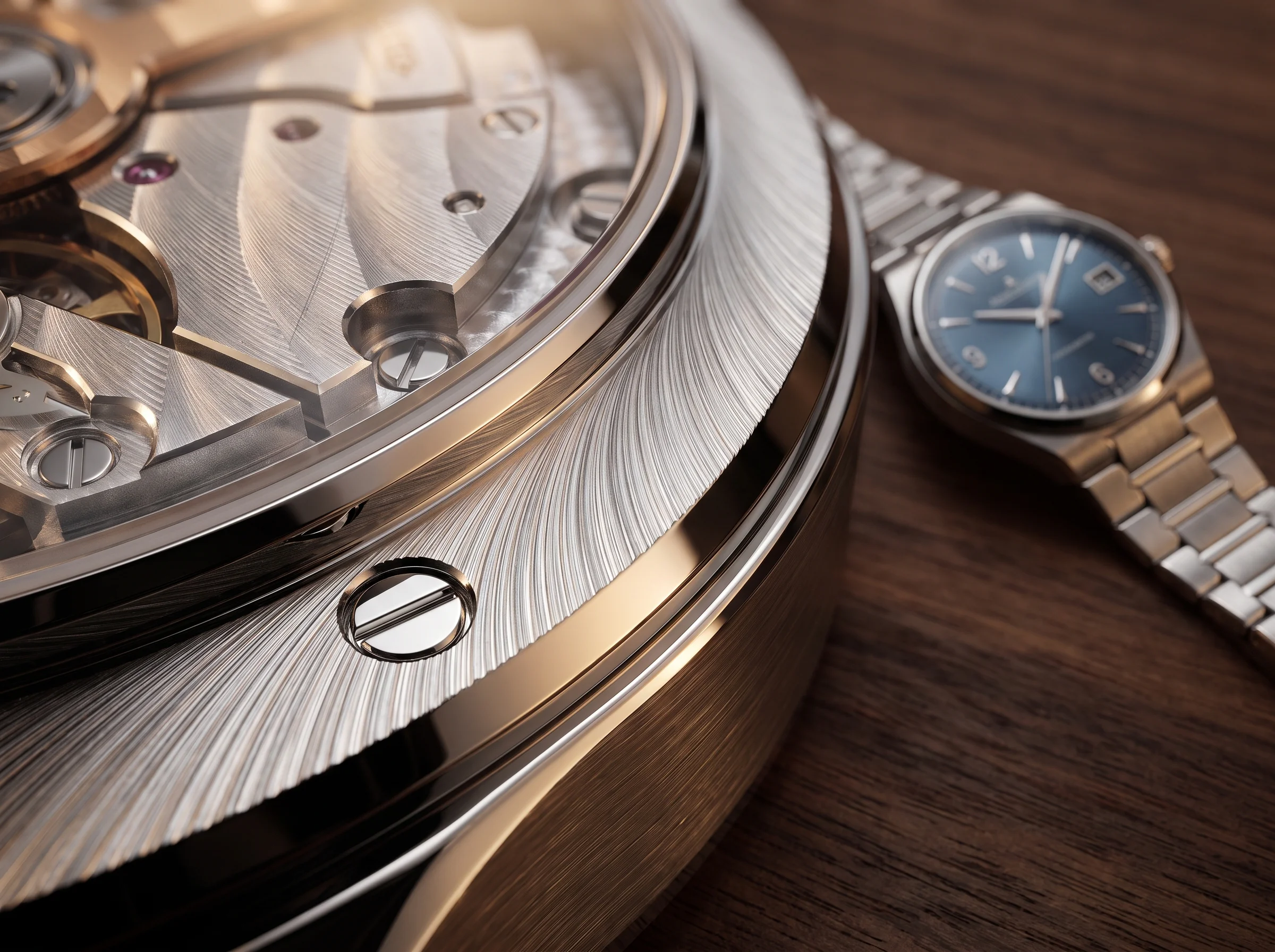
JLC's HPG also inspects eight specific hand-finishing techniques before a watch passes: circular graining, Côtes de Genève striping, circular smoothing (perlage), burnishing, polished screw heads, linear smoothing (satin brushing), sunk and polished jewel countersinks, and beveled (chamfered) edges. A watch can be accurate and still fail this half of the test if the finishing does not meet spec.
Macro detail of Côtes de Genève striping and a hand-beveled bridge edge, the kind of finishing the HPG audit inspects piece by piece.
The two references leading the current collection
The Master Control Chronometre line spans several complications, but two references anchor the current lineup for a pre-owned buyer trying to understand the range.
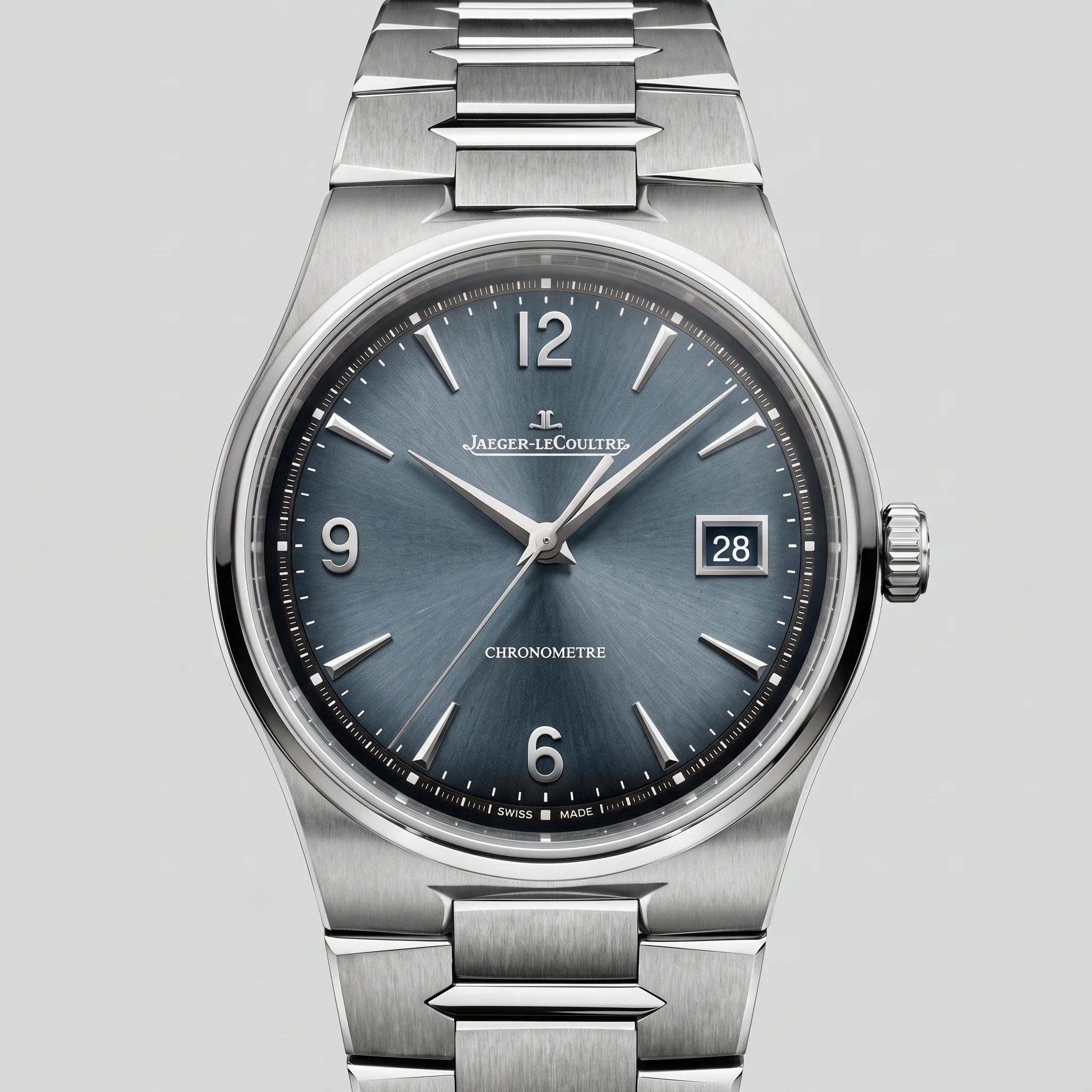
Q4158120: the three-hand Date
The Q4158120 is the entry point: a 40mm steel case, blue sunburst dial, applied Arabic numerals at 9 and 6, and the word "CHRONOMETRE" printed above six o'clock as the only real giveaway that this passed a stricter bar than most three-hand watches in its price range. It runs on JLC's automatic caliber 899, with roughly 40 hours of power reserve.
Q4178180: the Perpetual Calendar
Step up to the Q4178180 and you get a full perpetual calendar, day, date, month, and moonphase across four sub-dials, in the same integrated steel case language and blue dial treatment. A perpetual calendar this compact, at this level of finishing, and still HPG-tested as a finished watch is not common outside JLC and a handful of German manufactures.

Why this matters if you are buying pre-owned
This is where it gets practical for a buyer looking at the secondary market instead of a boutique. A watch that passed HPG left the factory already stress-tested past what most owners will ever put it through in daily wear. That does not mean a 6-year-old example cannot need a service. It means the baseline it started from was higher.
What to actually check before buying
Ask for the original box and papers referencing the HPG seal, request a fresh timing check from the seller (a watch that is running well outside COSC spec, roughly minus 4 to plus 6 seconds a day, is worth asking questions about), and inspect the bracelet links for stretch the same way you would on any integrated-bracelet sports watch. None of that is JLC-specific. It is just good practice, and it applies double to a watch marketed on precision.

A finished watch, not just a bare movement, sits on the timing machine during the 1,000 Hours Control.
How it stacks up against other in-house precision claims
Regulation and accuracy claims show up across the industry in different forms. If you want the fundamentals of the part that actually regulates rate, our hairspring explainer covers the physical component doing the work. If you are comparing precision philosophies across brands, Omega's co-axial escapement takes a mechanical route to the same goal: less friction, more consistent rate over time, less servicing sensitivity. JLC's approach is different. It does not change the escapement design. It tests the finished product harder.
FAQ
Does every Jaeger-LeCoultre watch get the 1,000 Hours Control?
No. It is specific to watches marketed as "Chronometre" within lines like Master Control, Polaris, and certain Reverso references. Standard Master Control watches without the Chronometre designation are not held to this second test.
Is HPG the same thing as COSC?
No. COSC certifies the bare movement before casing. HPG tests the finished, cased watch afterward, including shock, altitude, temperature, water resistance, and finishing quality. A Master Control Chronometre passes both.
What movement is inside the Q4158120?
The automatic caliber 899, with roughly 40 hours of power reserve, visible through a sapphire caseback.
Can a pre-owned Master Control Chronometre still be accurate years later?
Yes, assuming normal servicing. The 1,000 Hours Control tests the watch when new. Like any mechanical watch, rate can drift with wear, lubricant age, and magnetism exposure, which is why a timing check before purchase still matters.
How does the Perpetual Calendar differ from the Date model beyond the complication?
Both share the case language and dial color, but the Q4178180's calendar module adds thickness and a more complex assembly, which is reflected in a meaningfully higher price point new and pre-owned.
Browse authenticated pre-owned Jaeger-LeCoultre watches at 5dwatches.com.