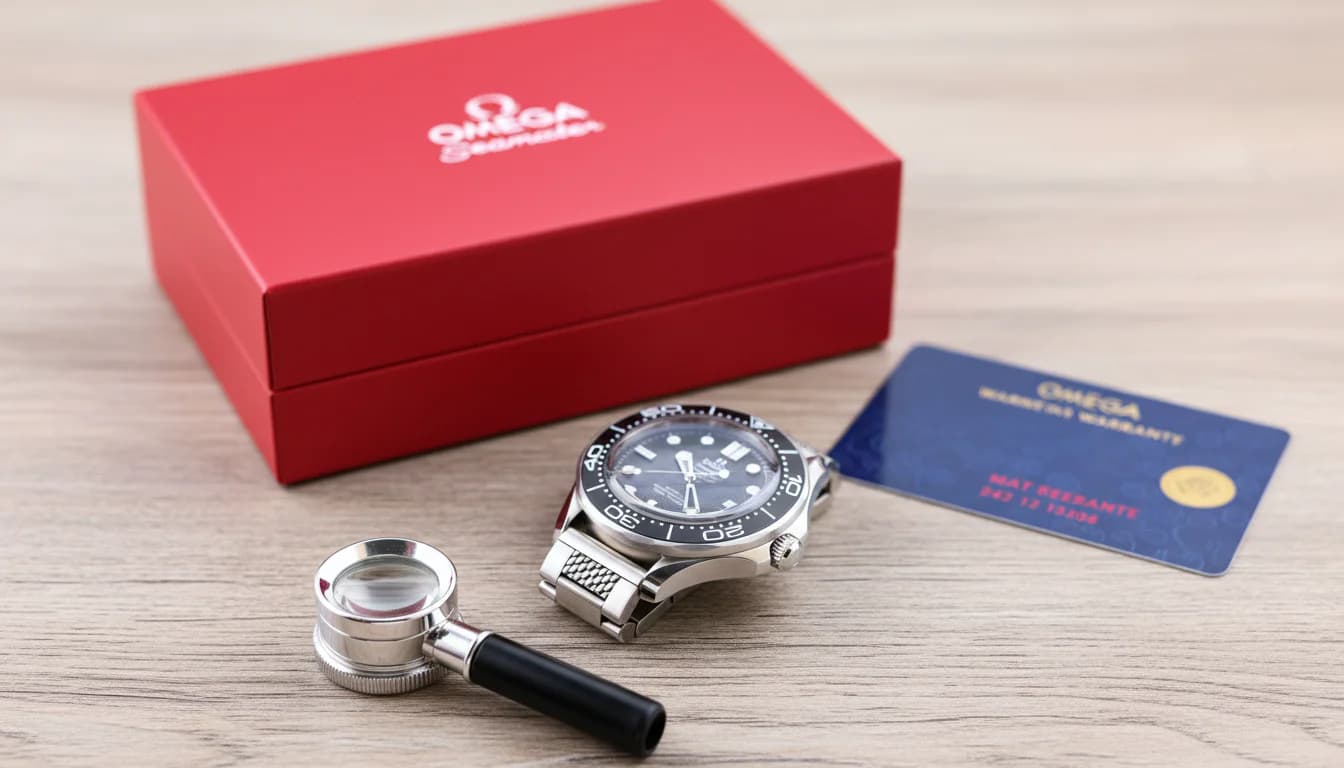
The Short Answer
Authenticating a pre-owned Omega comes down to five checkpoints: the serial number, the movement, the caseback engraving, the dial printing, and the documentation. A genuine Omega has a laser-etched seven or eight-digit serial that matches the movement and the warranty card, clean Cotes de Geneve finishing on the caliber, sharp evenly-spaced dial text, and a helium escape valve that seats correctly on dive references. A fake usually fails at least two of these at once.
None of these checks are foolproof on their own. Together, they catch almost every counterfeit in circulation.
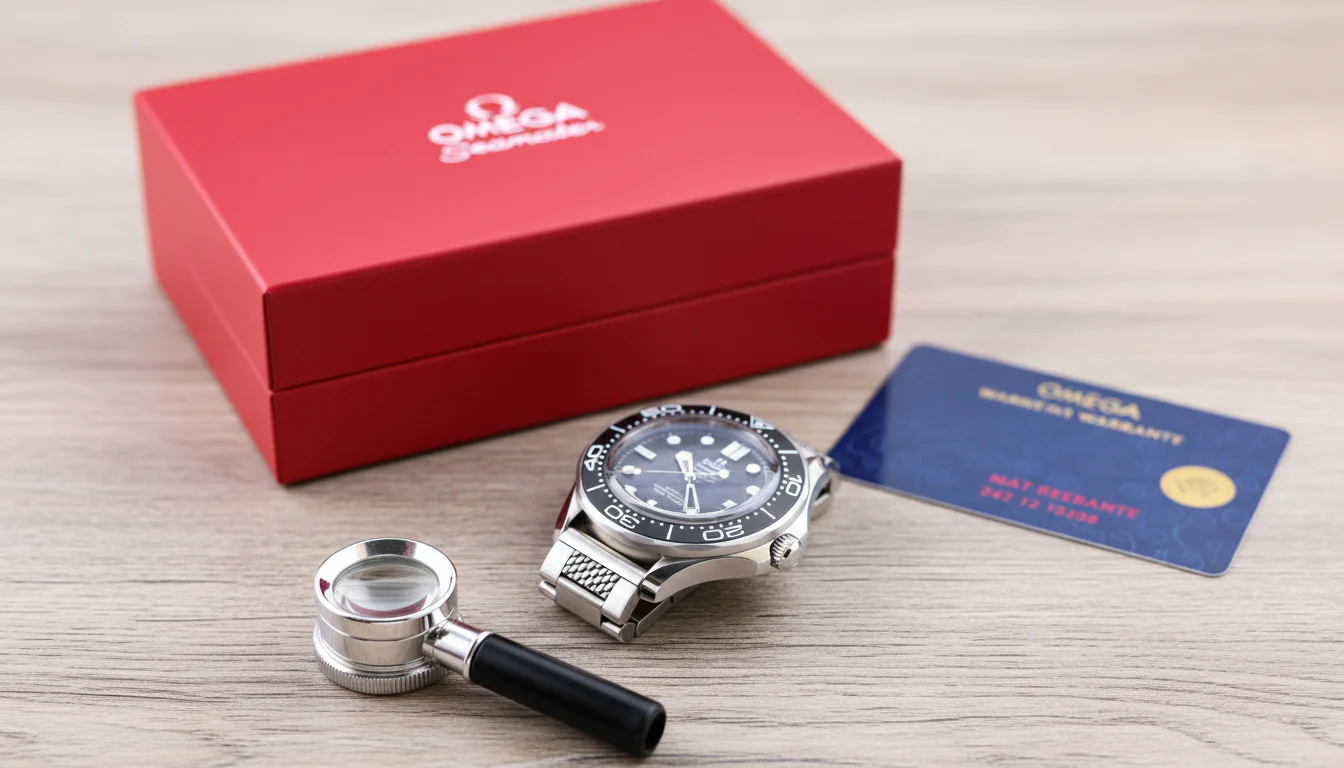 Documentation is a starting point, not proof. It still has to match the watch and the movement.
The watch photos in this article were generated with AI image tools, conditioned on real reference photography of Omega Speedmaster and Seamaster models so the case shapes, dial layouts, and construction details are accurate to the real watches.
Start With the Serial Number
Every genuine Omega carries a serial number, seven digits on older references and eight digits on current production. Where it sits depends on the era and model: laser-engraved on the case lug, the exterior caseback, or the interior caseback on some vintage pieces.
That number has to match in three places: the case, the movement, and the warranty card if one is included. If the seller cannot show you all three, or the numbers do not line up, stop there.
What a Fake Serial Looks Like
Shallow or uneven etching is the most common tell. A real serial is crisp and consistent in depth. A faked one often looks scratched in by hand, or is missing from the movement entirely even though the case has one.
Open the Caseback and Look at the Movement
Most modern Omegas ship with a sapphire exhibition caseback, and that transparency is a gift to anyone trying to authenticate one. A real Co-Axial or Master Chronometer caliber shows clean, even Cotes de Geneve striping, rhodium-plated bridges, and neat, precise engraving of the caliber number, the serial, and the Omega branding around the caseback ring.
A fake movement is the easiest place for a counterfeiter to cut corners, because most buyers never look closely. Under a loupe, counterfeit movements typically show rough, unpolished gear edges, visible plastic components, and stamped lettering instead of engraved.
There is also a simple functional test. Omega's Co-Axial escapement produces a smooth sweeping seconds hand, not the one-tick-per-second stutter of a cheap quartz movement standing in for an automatic.
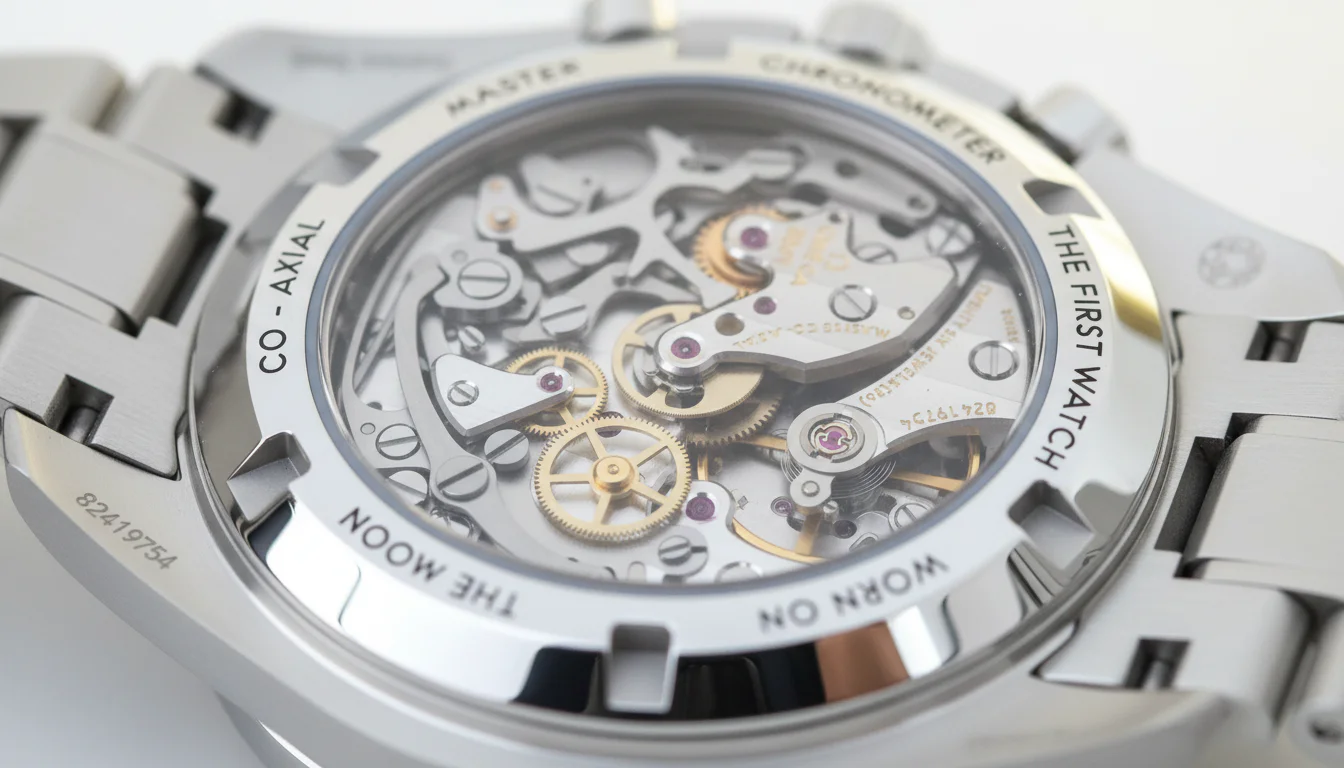 Engraved serial, engraved caliber ring text, and striped bridges. A counterfeit rarely gets all three right at once.
Seamaster-Specific: the Helium Escape Valve
On Seamaster dive references, the helium escape valve on the case side should sit correctly aligned to its marked position and screw down smoothly with no wobble. A crooked or loose valve is a manufacturing detail counterfeiters consistently get wrong.
Check the Dial Under Magnification
Genuine Omega dial printing is sharp, evenly spaced, and slightly raised when you look closely. The OMEGA wordmark should be balanced and centered, with no lettering that curves upward or crowds into the logo.
Fakes tend to blur at the edges of small text, smudge the date window numerals, or misalign the applied hour markers. On Speedmaster chronographs specifically, incorrect subdial spacing shows up often enough on fakes that it is worth checking against a known-genuine reference photo before you buy.
Lume quality is a fast secondary check. Omega uses high-grade Super-LumiNova that charges quickly under a light and glows strongly for hours. Dim, patchy, or slow-to-charge lume points toward a counterfeit.
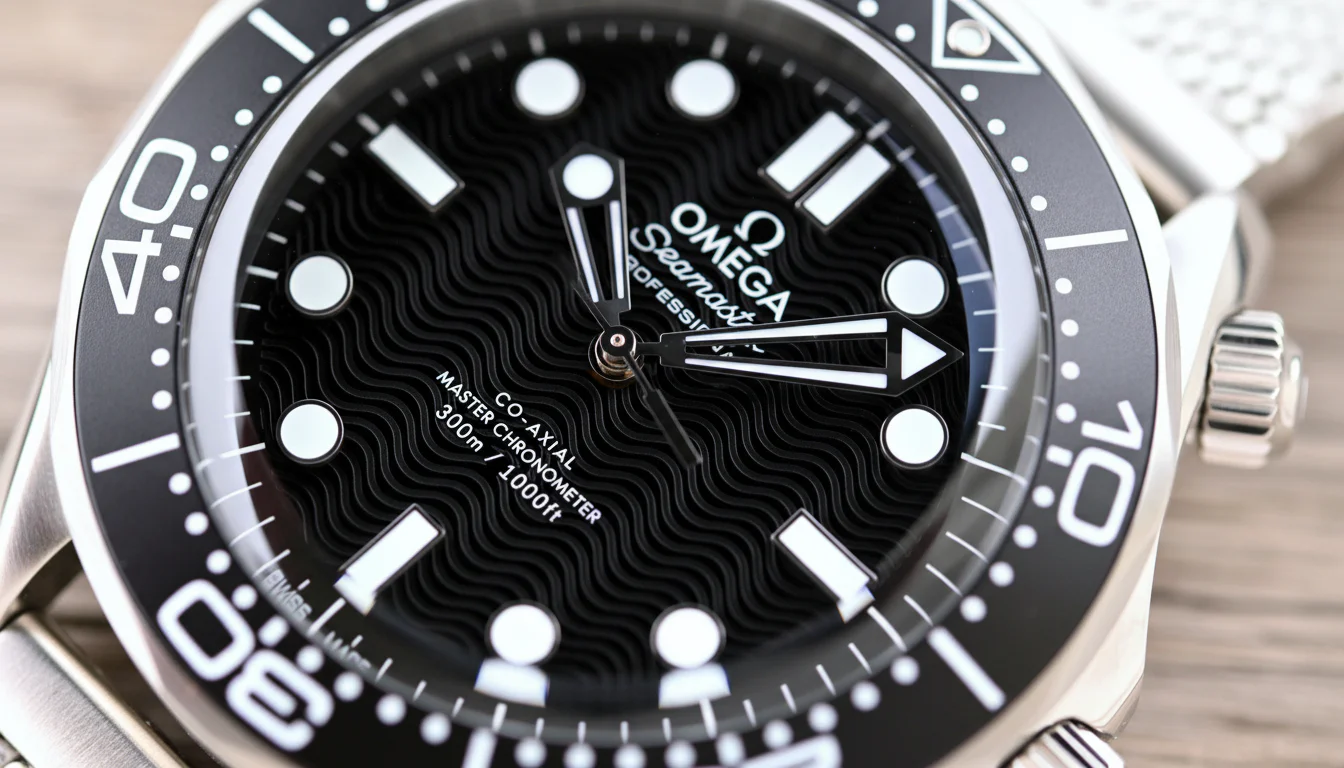 Sharp printing, centered wordmark, evenly applied markers. Blurry text is one of the fastest tells in the business.
Weight, Bracelet, and Feel
Real Omega cases and bracelets use 316L stainless steel, titanium, 18k gold, or ceramic depending on the model, and the finished weight reflects it. A counterfeit built from cheaper alloys with hollow bracelet links feels noticeably lighter in the hand than the genuine article, even before you look at a single detail.
Run your thumb across the bracelet's clasp. A genuine Omega clasp articulates smoothly with no play, and the engraving is sharp and centered. Loose links, a mushy clasp action, or crudely stamped lettering inside the clasp all point the same direction.
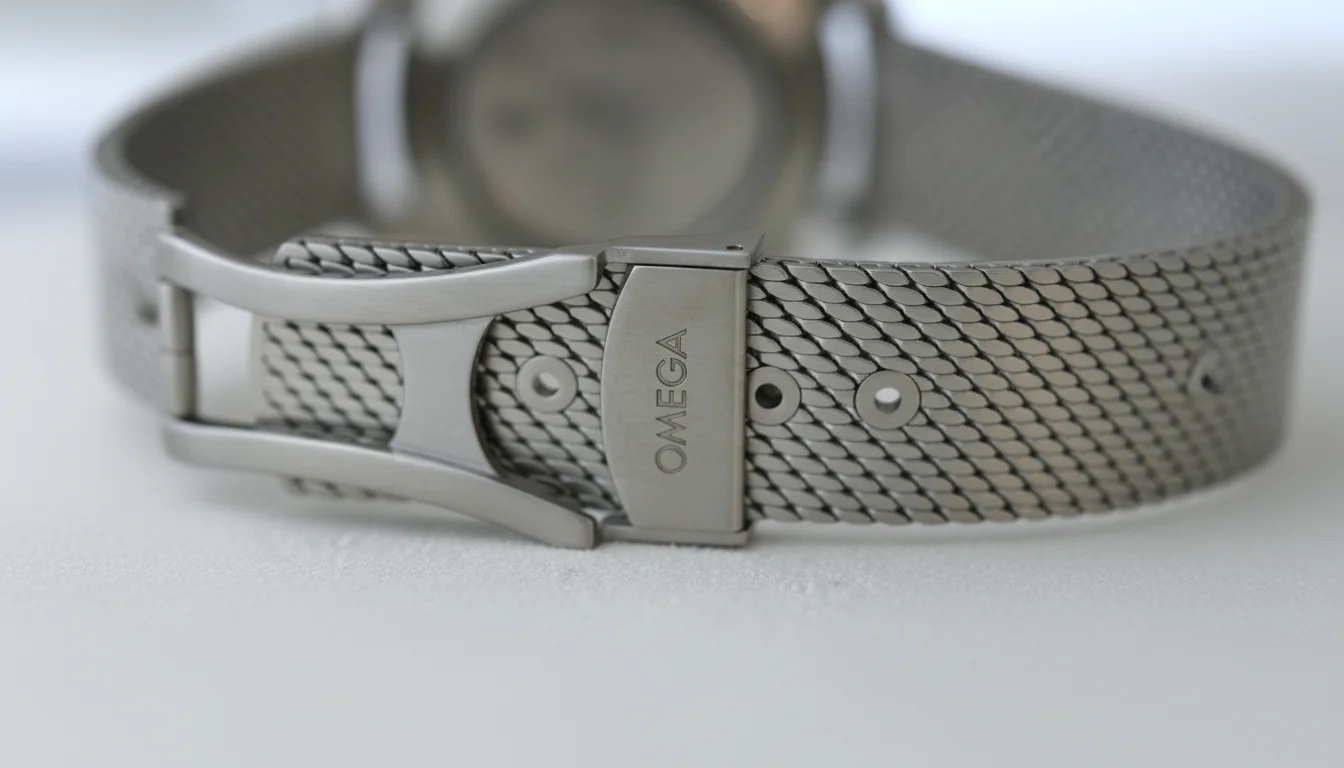 A sharp, centered engraving and smooth-running mesh. A clasp is a small part, but it is not a hard one to fake badly.
Documentation and Professional Verification
A warranty card is not proof by itself, since cards can be faked or mismatched too, but a genuine one should carry a serial that matches the watch and the movement. Current Master Chronometer models can also be checked against Omega's own certification database through the My OMEGA portal.
When real money is on the line, and it usually is with Omega, the most reliable step is still a physical inspection by an authorized service center or an experienced dealer who can open the case and confirm the movement matches the case and papers. No amount of photo comparison replaces that.
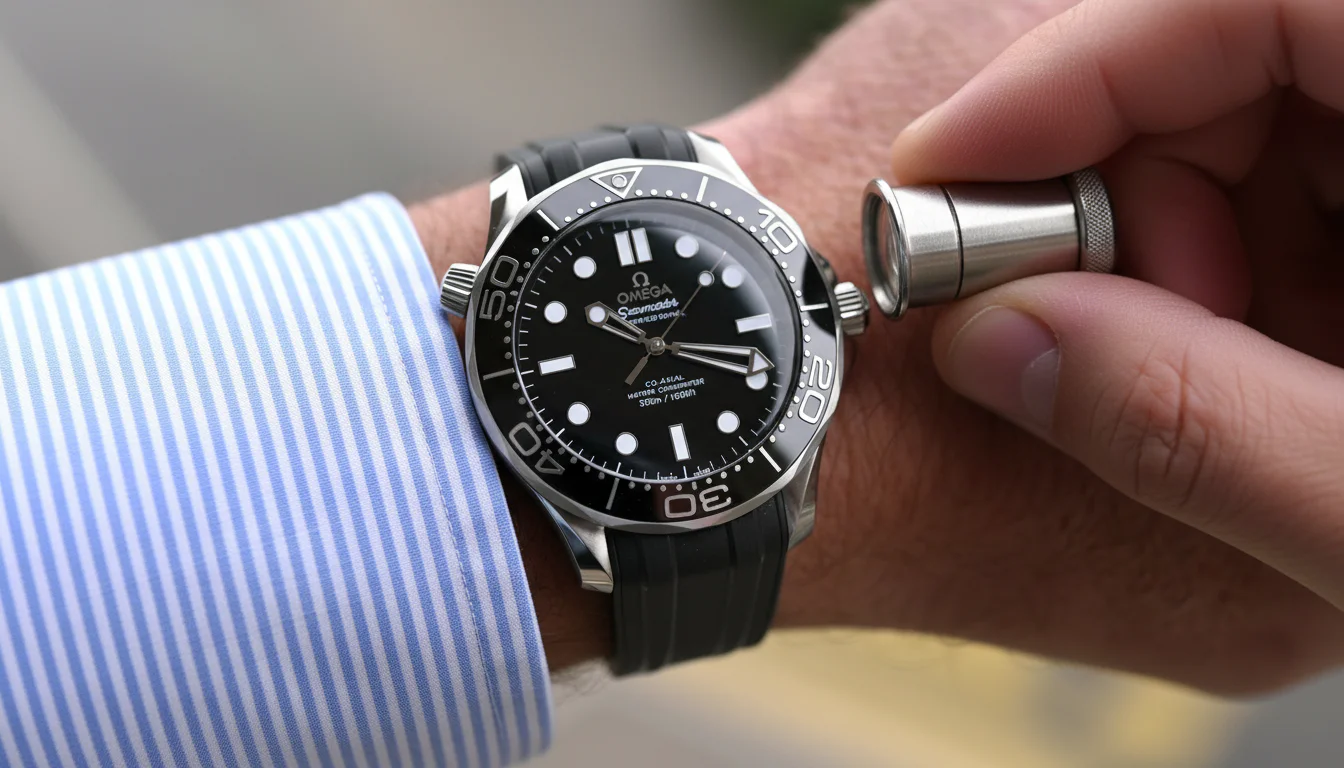 A loupe in hand is the fastest way to catch the small stuff before you buy.
FAQ
How can I tell if my Omega is real or fake?
Check the serial number for consistency between the case, movement, and warranty card, inspect the movement finishing through the caseback, and look for sharp, evenly spaced dial printing. A genuine Omega passes all of these together, not just one.
Where is the serial number on an Omega watch?
Depending on the model and era, it is laser-engraved on the lug, on the exterior caseback, or on the interior caseback on some vintage pieces. It should also appear on the movement itself.
Does a smooth sweeping second hand mean an Omega is genuine?
It is a strong positive sign, since Omega's Co-Axial escapement produces a smooth sweep rather than a one-tick-per-second jump. It is not conclusive on its own, since some fakes use higher-beat quartz movements to mimic the sweep.
Can a warranty card guarantee an Omega is authentic?
No. Warranty cards can be forged or mismatched to a different watch. A genuine card is a supporting data point, not proof, and its serial number still needs to match the case and movement.
Is it worth paying for a professional Omega authentication?
Yes, for anything above a few hundred dollars. A watchmaker or authorized service center can open the case and confirm the movement matches the case and papers, which no amount of photo inspection can fully replace.
Related Reading
- How to Authenticate a Pre-Owned Rolex: A Dealer's Checklist
- The Omega Speedmaster Moonwatch Buying Guide: Every Reference, the Calibre 3861, and What Pre-Owned Actually Costs
- Omega Seamaster Diver 300M Buying Guide: A Working Dealer's Read on Bond's Watch
- Grey Market vs Authorized Dealer vs CPO: Where Should You Actually Buy?