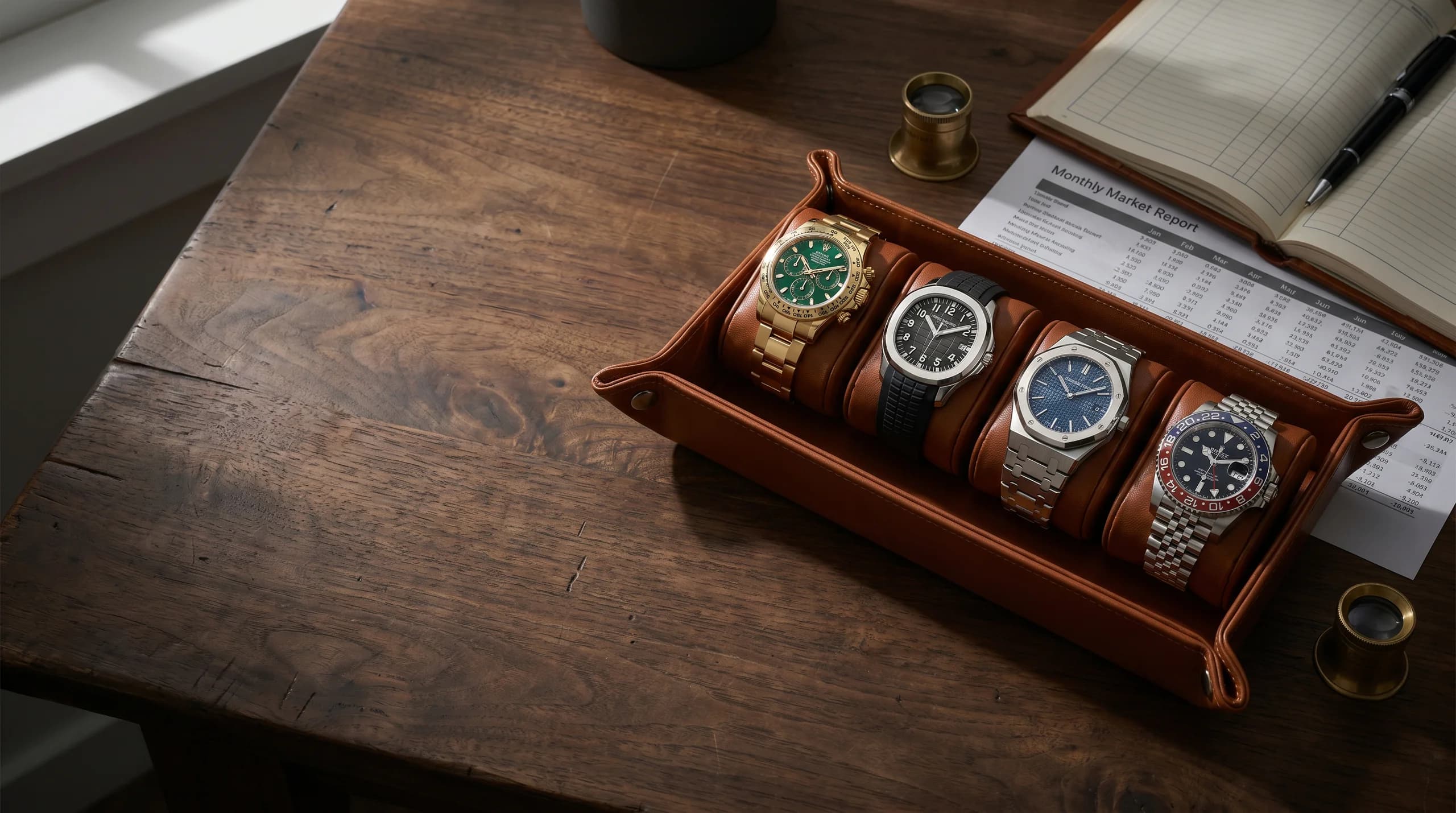
The WatchCharts May 2026 Watch Market Update dropped last week with the April 2026 data, and the headline number is the cleanest read on secondary market health in four years. The Overall Market Index gained +2.1% in April, the largest single-month move since the 2022 peak unwound. Rolex appreciated +2.5%. Patek Philippe and Audemars Piguet both extended their multi-month positive trends. Only four of the 27 major tracked brands lost ground. The breadth is what matters.
In April 2025, the question for working dealers was whether the secondary market correction had bottomed. In April 2026, the question is whether the recovery has legs. WatchCharts' Q1 2026 data answers that question: more than 70% of brands posted positive Q1 performance, against just 3% (Rolex alone) in the year-ago quarter. The recovery is no longer concentrated in the Big Three. It has gone broad.
All images in this post are AI-generated and may not perfectly represent the actual watch references discussed. They are intended for illustration only.
The Short Answer
April 2026 was the broadest positive month in the WatchCharts data since pre-2022. Top performers: Rolex +2.5% (Sky-Dweller +2.6%, Daytona +2.2%, Air-King +2.1%, GMT-Master +1.8%), Cartier +1.7%, Patek Philippe +1.3% (Aquanaut +2.5% the standout collection), Omega +1.1%, Audemars Piguet +0.9% (Royal Oak +1.0%). The Tudor index moved +6.4% but that was a Black Bay Chrono dial-mix technicality rather than a true broad-Tudor move.
The four losers were small, niche brands: BVLGARI (-0.2%), Parmigiani Fleurier (-0.4%), Piaget (-0.7%), Bell & Ross (-0.9%). All four moves are within normal monthly noise.
The Rolex GMT-Master collection moved +1.8% driven almost entirely by the discontinued Pepsi 126710BLRO, which gained 12% across Q1 2026. The Pepsi has been the single most active reference in the secondary market since the W&W signal in April. We covered the dynamics in detail in our Pepsi GMT discontinuation market impact and the 30-day post-W&W market check.
The macroeconomic backdrop is supportive: gold corrected from its January peak but central bank buying remains structural, the Big Four (Rolex/Patek/AP/Richard Mille) plus Cartier continue to capture a growing share of total market value, and the 15% U.S. tariff on Swiss imports is now baked into pricing rather than disrupting it.
The April 2026 Data
The WatchCharts Overall Market Index is the cleanest benchmark available for secondary market direction. It tracks 300 watches across the top 10 luxury brands, weighted by transaction value, rebalanced annually on January 1. Here are the April 2026 brand-level moves:
| Brand | April 2026 | Q1 2026 Direction |
|---|---|---|
| Rolex | +2.5% | Up |
| Patek Philippe | +1.3% | 11+ consecutive months up |
| Audemars Piguet | +0.9% | Up |
| Cartier | +1.7% | Up |
| Omega | +1.1% | Up |
| Tudor | +6.4%* | Up (technical) |
| BVLGARI | -0.2% | Flat |
| Parmigiani Fleurier | -0.4% | Down |
| Piaget | -0.7% | Down |
| Bell & Ross | -0.9% | Down |
*Tudor's +6.4% headline number was driven by dial-variant mix changes in the Black Bay Chrono 79360N rather than broad-Tudor appreciation. We covered the full Tudor Black Bay family pricing structure in our Tudor Black Bay buying guide earlier today.
Within Rolex, the sport collections drove the +2.5% brand-level move:
| Rolex Collection | April 2026 |
|---|---|
| Sky-Dweller | +2.6% |
| Daytona | +2.2% |
| Air-King | +2.1% |
| GMT-Master II | +1.8% |
| Submariner | +1.0% (estimated) |
The Sky-Dweller +2.6% is the headline collection mover, partly tied to gold spot retracement (see our gold correction analysis from yesterday). Daytona +2.2% reflects ongoing structural demand and the Rolesium 126502 release reshaping the steel Daytona conversation. The full Daytona pricing structure is covered in our Rolex Daytona buying guide.
What's Driving Patek's Run
 The Patek Philippe Aquanaut 5167A appreciated +2.5% in April 2026, the strongest single-collection move in the Patek catalog. The Nautilus 50th anniversary year is the broader narrative driving Patek interest.
Patek Philippe is now on an 11-month consecutive positive performance streak at the brand level. April 2026 (+1.3%) was a continuation, not an outlier. The Aquanaut collection at +2.5% was the standout, but the entire Patek catalog moved positively in April.
Three drivers behind the Patek run:
1. Nautilus 50th anniversary year. The Nautilus turns 50 in 2026. Patek released four limited editions at Watches and Wonders 2026 (the 5610/1P platinum 38mm ultra-thin, the white gold blue-dial variant, plus two others) and is expected to use the October Grand Exhibition in Milan as the platform for additional 50th-anniversary releases. The anniversary creates a structural collector pull on the entire Nautilus and Aquanaut catalog.
2. Aquanaut moving up the desirability curve. Historically the Nautilus carried the dominant collector attention; over the past 18 months the Aquanaut has narrowed the gap. The 5167A in steel on rubber strap has consistently outperformed the Nautilus 5711 reissue references on a percentage basis since late 2024.
3. Reduced gross supply. Patek's published 2024 production was approximately 73,000 watches, the same total as 2023. Demand has grown across the same supply base. The math is straightforward.
The 11-month Patek brand-level streak is the longest broad-positive run for any major brand since the 2021-2022 peak unwound. WatchCharts data suggests that even a single negative month would not break the structural pattern.
The AP Royal Oak Stabilization
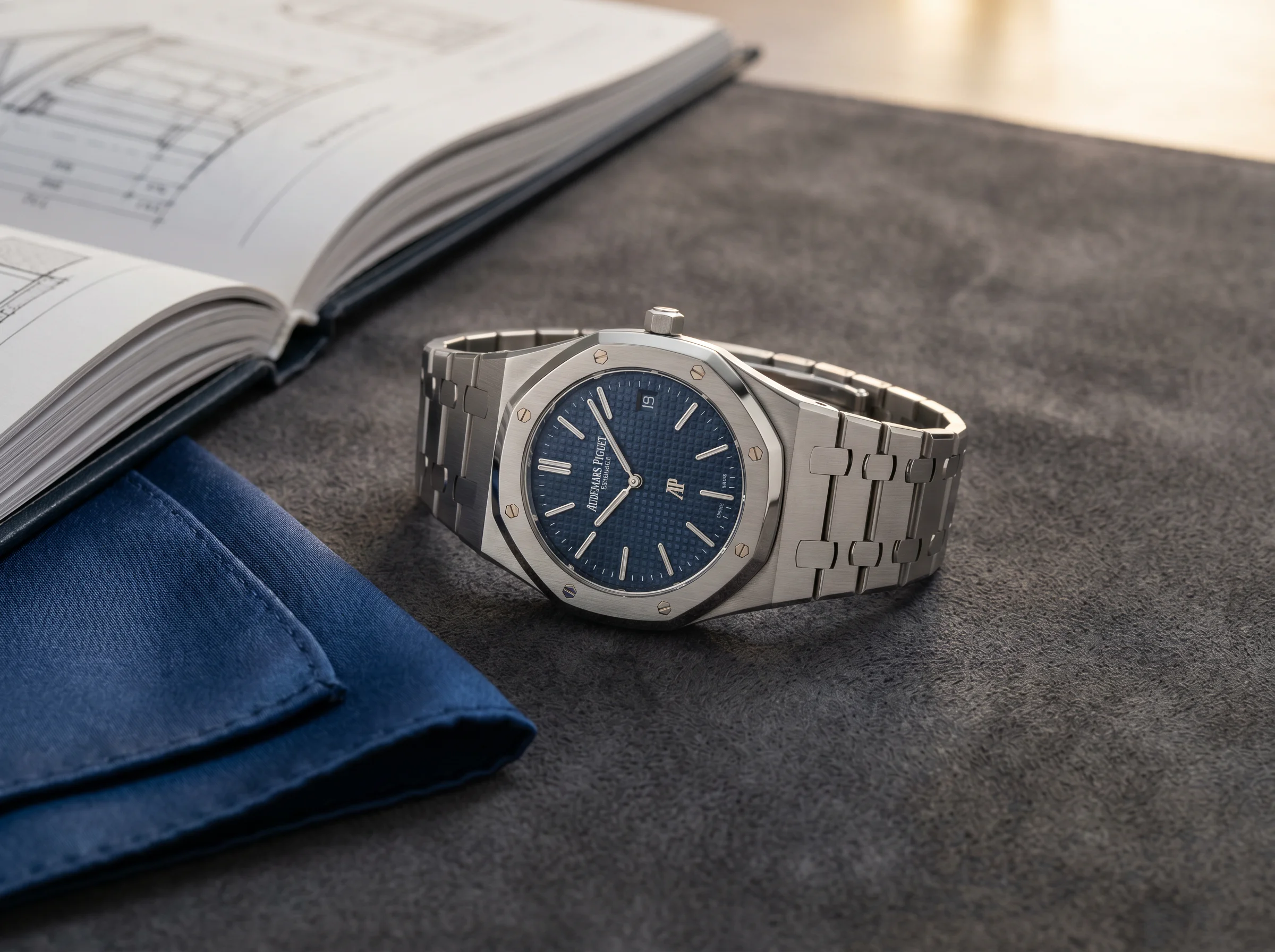 Audemars Piguet appreciated +0.9% at the brand level in April 2026, with the Royal Oak collection up +1.0%. The Royal Pop launch on May 16 has not disrupted the Royal Oak secondary market — see our one-week-later analysis for the full picture.
Audemars Piguet at +0.9% extended its own multi-month positive trend. The Royal Oak collection moved +1.0%. The brand has been the slowest-moving of the Big Three on the recovery curve, partly because Royal Oak secondary premiums had less room to compress during 2022-2024 (AP's strategic boutique-only retail model limited the gray-market overhang that affected Rolex and Patek).
The Royal Pop launch on May 16 was the test event for whether AP's broader strategic positioning would disrupt the Royal Oak secondary market. The answer, six days later, was no. The Royal Pop transacted at $1,351 on StockX rather than reaching MoonSwatch-level mainstream resale heat, and the Royal Oak market held its position. Our Royal Pop one-week-later market check covered the precedent in detail.
For dealers and collectors, the takeaway is that the Royal Oak has stabilized into a slow-positive trajectory rather than continuing the volatile cycles of 2021-2023. That stability is the structural foundation for the +0.9% brand-level move.
Cartier and Omega: The Mid-Market Story
 Cartier appreciated +1.7% in April 2026, leading the mid-market segment. The Tank family has been the broadest collection-level gainer in the Cartier catalog through 2025-2026.
Cartier and Omega are the structural mid-market leaders in the WatchCharts data. Cartier at +1.7% in April was the strongest non-Rolex brand-level move. Omega at +1.1% extended its own consistent positive trend.
Cartier's recovery has been the most visible mid-market story of 2025-2026. The Tank family (Must, Solo, Française, Américaine, Louis Cartier) has appreciated consistently across the past 12 months. The Santos collection has held steady. The Pasha has shown signs of life after a multi-year dormancy. The broader Cartier story is that the brand has successfully repositioned itself from "jewelry-watch retailer" back to "serious watchmaker" in collector perception, and the secondary market has rewarded that positioning.
Omega's recovery has been steadier and quieter. The Speedmaster Professional Moonwatch has held secondary value through every market environment since 2020. The Seamaster 300 Professional has appreciated modestly. The newer first-light limited editions (we covered the Omega Seamaster 007 First Light Chronograph earlier this week) have performed well at launch and held value through the early secondary market window.
For the mid-market dealer audience, Cartier and Omega represent the steadier, less-volatile inventory option versus the Big Three at the top. The percentage moves are smaller (1-2% per month rather than 2-4%), but the consistency is higher.
What Lost Ground
Only four of 27 major brands lost ground in April 2026. The list:
- BVLGARI (-0.2%): Within monthly noise. The Octo Finissimo collection has held value but lacks the secondary market depth of the Big Three competitors.
- Parmigiani Fleurier (-0.4%): Tonda PF range has corrected modestly from 2024 highs. Lower-volume brand with more dispersion in secondary pricing.
- Piaget (-0.7%): Polo and Altiplano collections have softened. The brand has been working through inventory restructuring.
- Bell & Ross (-0.9%): The largest loser, but on a small base. The military-style aviation aesthetic has seen demand soften versus the broader return-to-dress-watches movement.
All four moves are within normal monthly noise. None of the four represent a brand in structural trouble. The market is broadly positive; the few negative moves are concentration-level rather than systemic.
The 12-Month Transformation
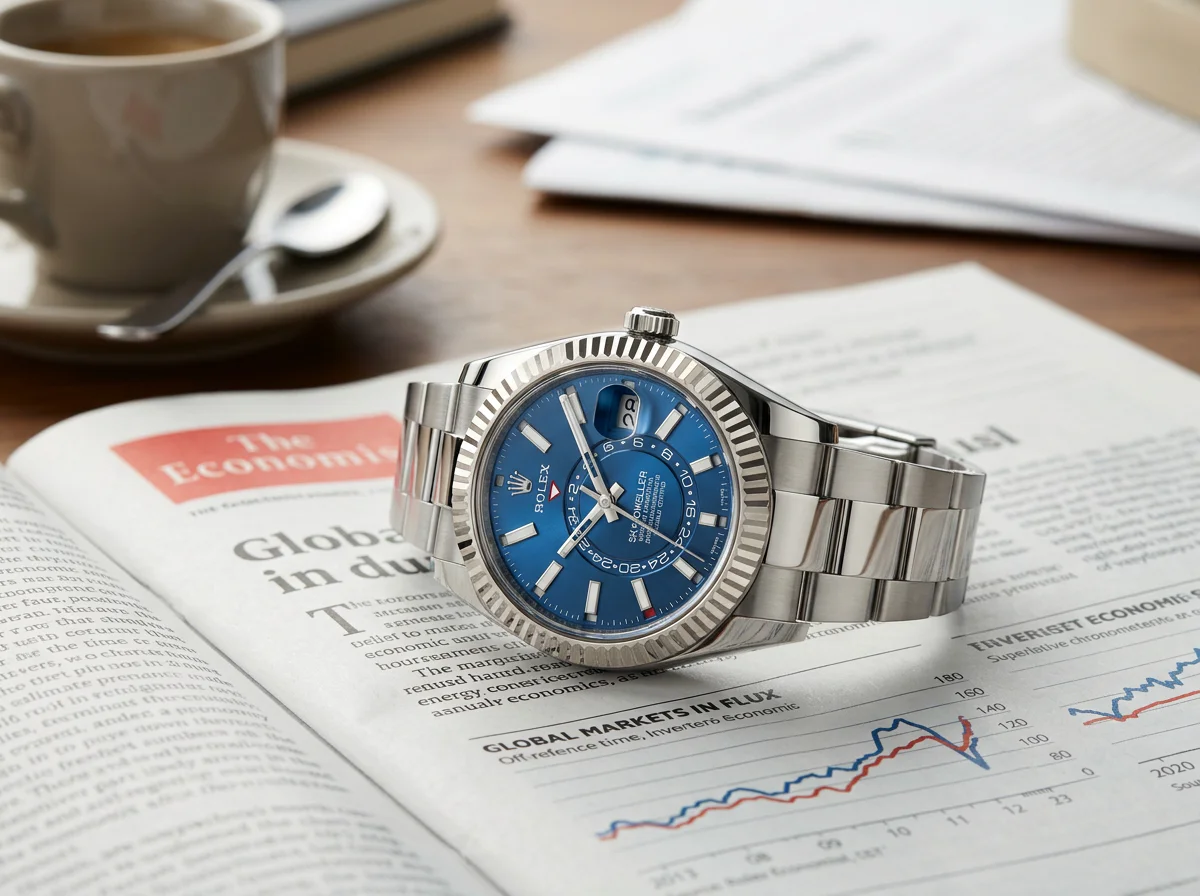 The Rolex Sky-Dweller 336934 led Rolex collections in April 2026 at +2.6%. The annual calendar complication has been the quiet outperformer in the Rolex catalog for most of 2026.
The 12-month transformation in the WatchCharts data is the most important context for the April 2026 numbers. In Q1 2025, only 3% of major brands posted positive performance — Rolex alone. By Q1 2026, 70% of brands posted positive performance.
That breadth change is what differentiates the 2026 recovery from the false-bottom moves of 2024. In late 2023 and through most of 2024, the WatchCharts data showed Rolex and Patek occasionally moving positive while the rest of the market stayed flat or down. That pattern matched the structural truth that the Big Three were oversupplied at the secondary market level and were absorbing inventory before broader demand recovery.
The pattern in 2026 is different. Rolex, Patek, AP, Cartier, Omega, and the broader catalog are all moving positive together. The breadth has historically been the signal of durable recovery rather than transient bounce.
For dealers building inventory positioning for Q3 2026 and beyond, the April data argues for:
- Maintaining or expanding inventory in the Big Three (Rolex, Patek, AP) at current pricing
- Expanding mid-market inventory (Cartier, Omega) given consistent positive trajectory
- Holding lighter inventory in the small-volume tail brands (Parmigiani, Piaget, Bell & Ross) until breadth-level data turns positive there too
- Pricing pre-owned inventory at slight discounts to current retail rather than at deep discounts; the breadth of recovery suggests the floor has stabilized
Reading This Into June and July
The May data drops in mid-June, which will be the first read on whether the April +2.1% was a one-month surge or the beginning of a sustained acceleration. Two key signals to watch:
1. Does Rolex hold above +1.5%? The +2.5% April was the strongest single-month Rolex move in over two years. Even +1.5% in May would be a strong continuation signal. A drop back below +1.0% would suggest April was a one-off rather than a trend acceleration.
2. Does breadth hold above 70%? The Q1 2026 data showed 70% of brands positive. May data needs to maintain or expand that number. A drop back toward 50% would signal that the April surge was concentrated rather than broad.
The macroeconomic backdrop will matter. Gold spot has corrected 18% from its January peak (see our gold correction analysis). The 15% U.S. tariff on Swiss imports remains. Inflation has ticked up to 3.8% in April. The Federal Reserve interest rate decision in mid-June will influence sentiment. Watch market direction is not perfectly correlated with these inputs but is meaningfully influenced.
For collector buyers: the secondary market broad-positive direction means that "buying at the bottom" is largely a closed window. Pricing has firmed across the board. Targeted buying based on specific reference value rather than market-timing is the better approach for the second half of 2026.
For sellers: the broad-positive direction creates the cleanest exit window for inventory in two years. Pre-owned references that were trading at deep discounts in late 2023 are now trading at much shallower discounts. The April data argues for listing rather than holding.
The Working Dealer's Bottom Line
April 2026 was the broadest single-month positive move in the WatchCharts data since the 2022 peak. The breadth is what differentiates this signal from prior bounces. Rolex, Patek, AP, Cartier, Omega all positive together. 23 of 27 major brands in positive territory. Only four brands losing ground, and all four within monthly noise.
The secondary market correction that began in mid-2022 has now unwound to the point where 70% of major brands are appreciating quarter-over-quarter. Pre-owned pricing on most references has firmed. The Rolex sport pillar (Daytona, GMT, Submariner) is leading the appreciation curve. Patek and AP are extending multi-month streaks. Cartier and Omega are establishing the mid-market floor.
For 5D Watches and the broader dealer community, the April 2026 data is the cleanest "the recovery is real" signal in four years. Buyers acting on the assumption that pricing will continue to soften are now reading the market against the trend. Pricing will likely continue to firm through the second half of 2026, particularly if gold rallies back above $5,000 (forcing the Rolex mid-year price increase the company telegraphed in January) or if the broader luxury consumer-spending environment holds.
The May data, due in mid-June, will be the first real confirmation or refutation of the April surge. Our read is that the underlying breadth strongly favors continuation rather than reversal.
Browse authenticated pre-owned luxury watch inventory at 5dwatches.com.
All market data sourced from WatchCharts May 2026 Market Update. WatchCharts Overall Market Index methodology: 300 watches across the top 10 luxury brands, weighted by transaction value, rebalanced annually on January 1.