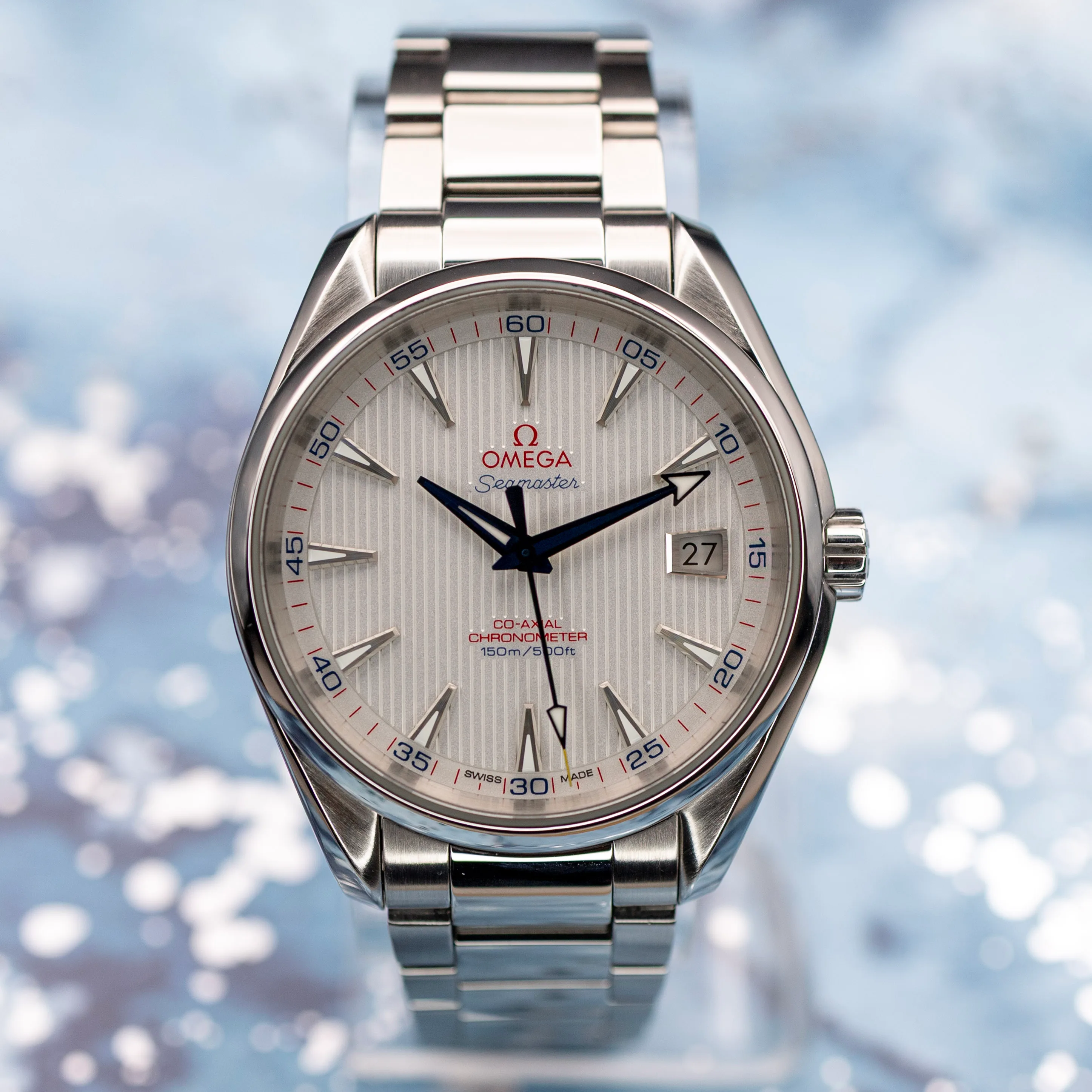
Everything about this watch points at the ocean. The dial pattern copies the deck of a sailboat. Teak, which is the wood they use on boats. The line is called Aqua Terra, which means water and land. And Omega nicknamed this one the Captain's Watch.
So you think, boat watch.
This edition is based on a golf tournament.
What the Omega Aqua Terra Captain's Watch Actually Is
Omega was the official timekeeper of the 2012 Ryder Cup, which is the golf tournament where the United States plays Europe. The red numbers and the blue hands on this dial represent the two teams.
A lot of people bought this one because it looked patriotic. They bought a golf watch and never knew it.
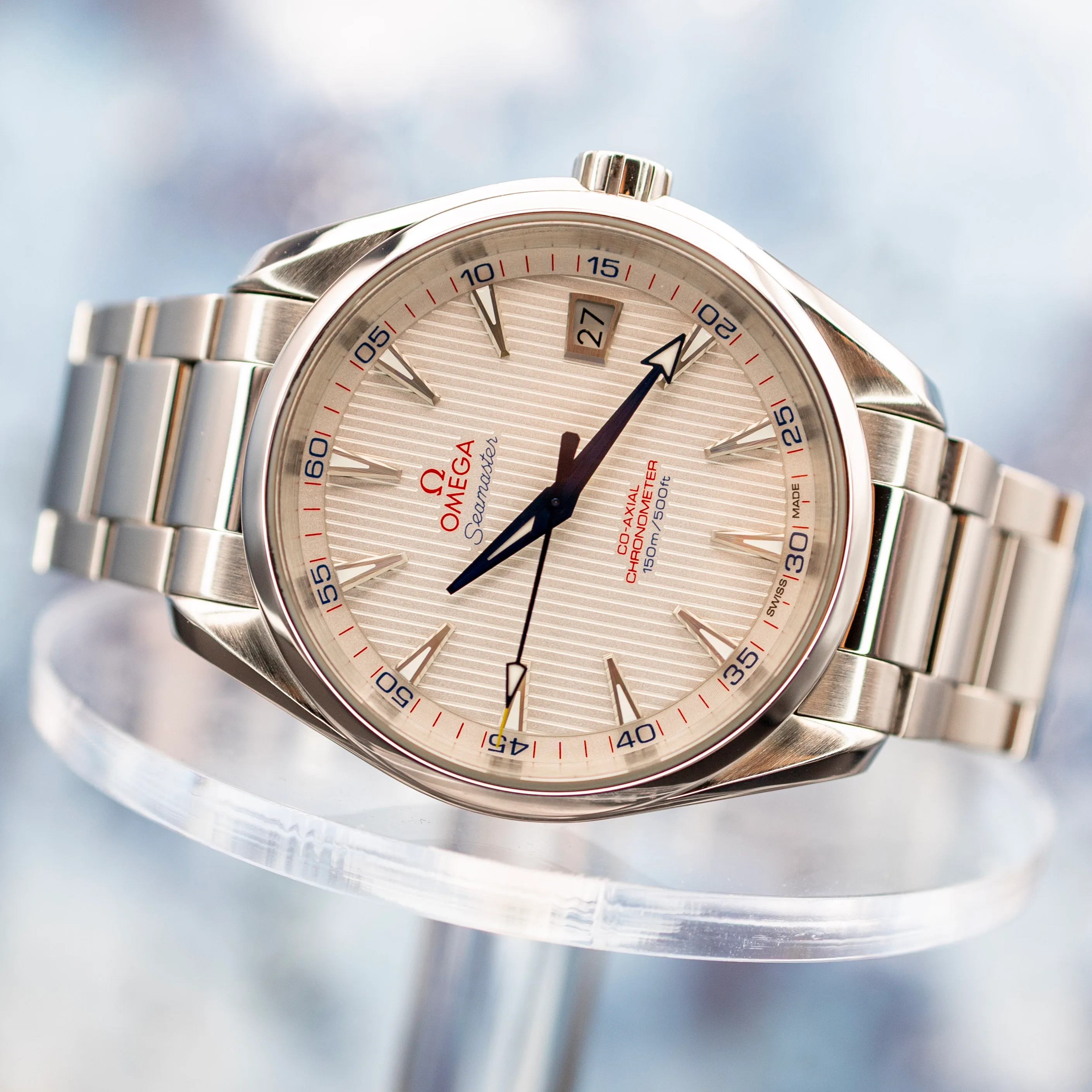
The full name is the Omega Seamaster Aqua Terra 150M Co-Axial Chronometer, reference 231.10.42.21.02.002. It's forty-one and a half millimeters across and thirteen millimeters thick, on a stainless steel bracelet.
New, it was around $5,500. Today it usually trades between $3,500 and $4,500 depending on condition and whether you get the box and cards with it.
Is the Captain's Watch a Limited Edition?
No, and this one comes up constantly in listings.
Being called the Captain's Watch and being built for the Ryder Cup makes it sound like it should be limited. It isn't. There's no number on the case back and no edition count anywhere on the watch.
The Ryder Cup Aqua Terras didn't get a real limited edition until 2016, and that's a different reference number entirely.
If someone is selling you this reference with the word "limited" in the title, they either don't know or they're hoping you don't.
Why the Warranty Card Date Confuses People
The card on the one I have says November 2020, which makes it sound like a 2020 watch.
It isn't. Omega stopped making this generation around 2016.
Omega sends blank warranty cards to dealers. The dealer fills in the date the day it actually sells. So that date isn't when the watch was built. It's when it finally sold.
Go looking at other examples of this reference and you'll find a lot of them with 2019 and 2020 dates on the card. That's four or five years sitting in a glass case with nobody buying it.
There's an upside to all that shelf time, though. A watch sitting in a store isn't getting banged up on somebody's wrist, which is why so many of these still look almost new.
And it's worth saying the market has turned. This reference bottomed out around $3,400 last winter and it's been climbing since, back up near $4,000. A watch nobody wanted at retail is getting wanted now.
The Movement, and What Golf Does to a Watch
Since it's a golf watch, it's worth asking what golf actually does to a watch, because almost nobody talks about it.
You're swinging a metal club at around a hundred miles an hour and slamming it into the ground. That shock travels up the club, through your hands, and into whatever is on your wrist.
Inside every mechanical watch there's a coil called a hairspring. It's thinner than a human hair and it runs the whole thing. Bend it, shock it, or get it near a magnet, and you're pretty much wearing a bracelet.
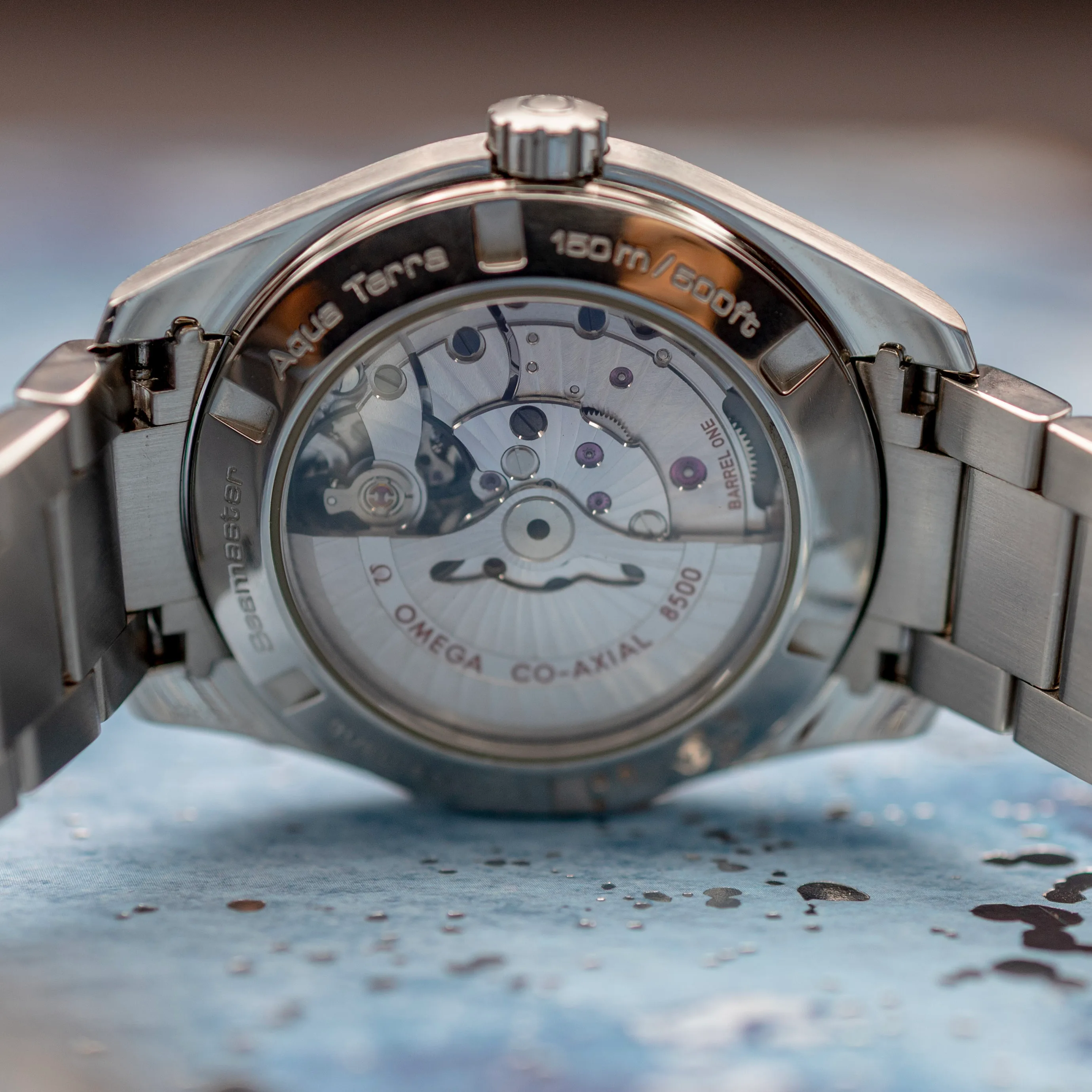
This runs Omega's calibre 8500, with sixty hours of power reserve and a display back so you can see the whole thing.
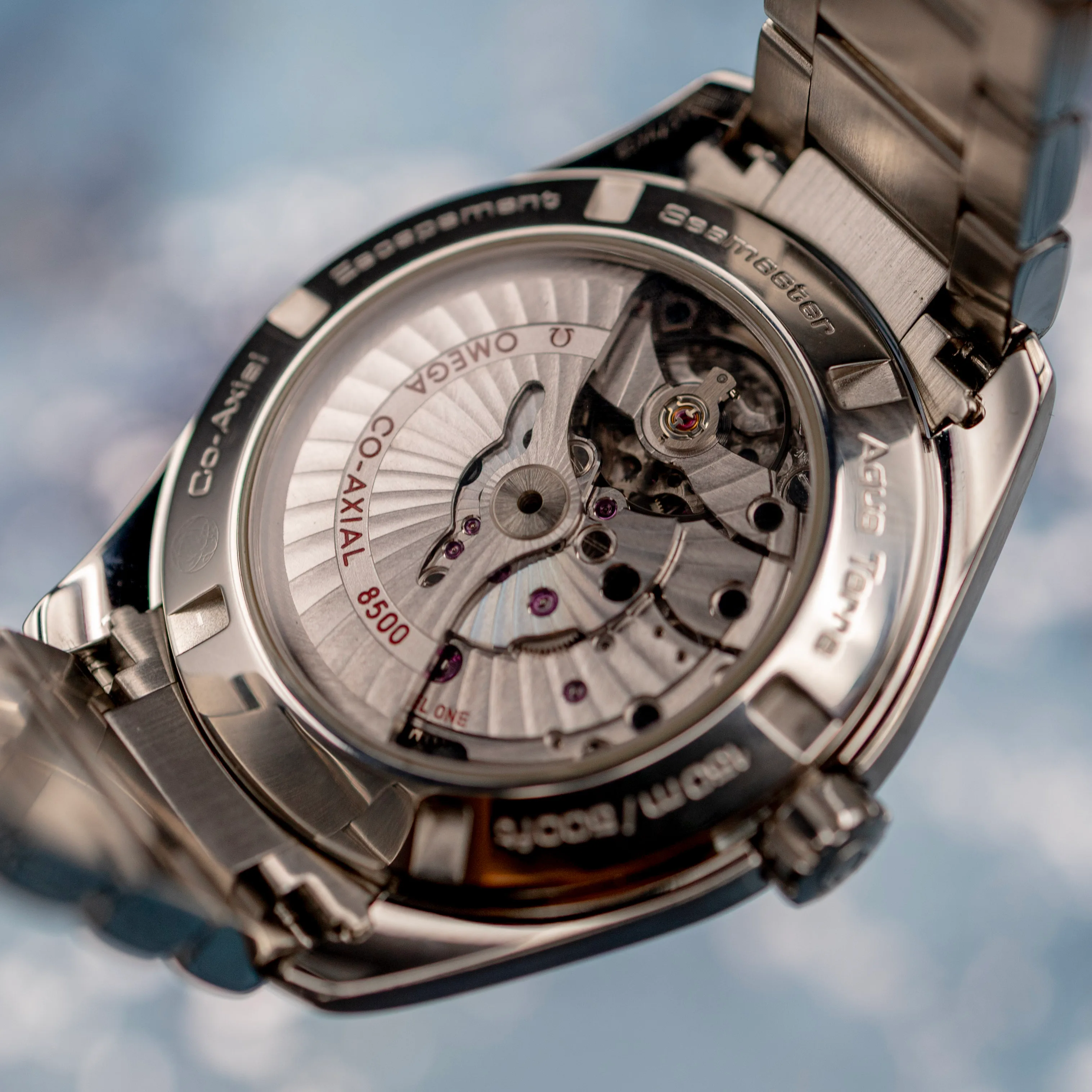
The hairspring in it isn't metal. It's silicon. Magnets don't bother it, it doesn't rust, and it tends to take a hit better than a traditional one.
So when Omega needed a watch to put in front of professional golfers, this was the movement they had.
The Dial Is Where the Money Went
In a photo it looks white. It's actually silver, with thin lines cut horizontally across it.
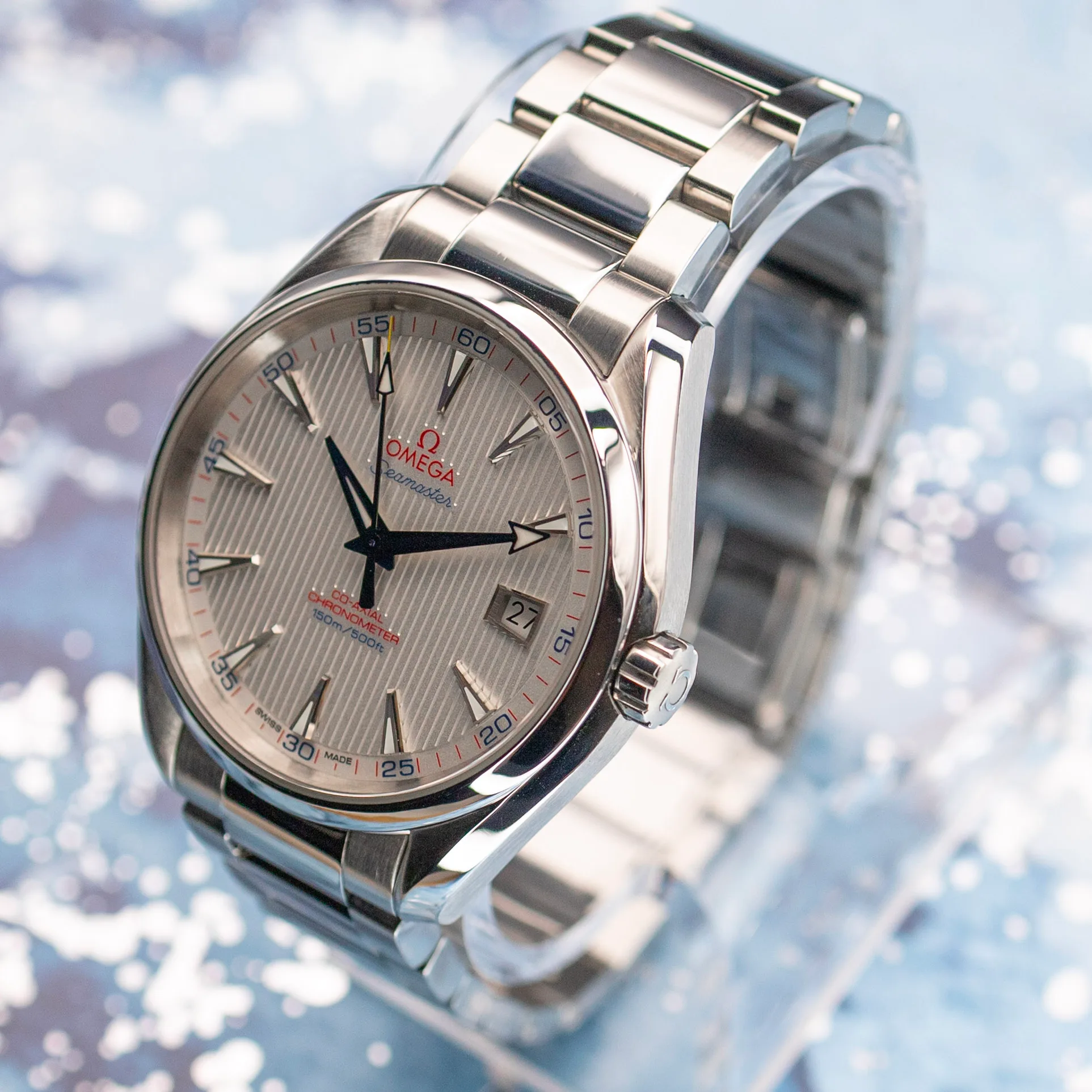
Tilt it under a light and it moves from white, to silver, to almost gold. The lines catch light one direction and go flat the other. There's more happening on this dial than on half the watches I've reviewed, and none of it shows up in a listing photo.
The markers are small metal pieces applied to the dial rather than printed on. You can see it in the shadow each one throws.
The red numerals split people, and Omega seems to have known it. Four years later they made another version and took the red out. So they probably decided it wasn't working either.
I don't hate it. But if you want one watch you wear to everything, this probably isn't it.
The Case: Not a Thin Watch
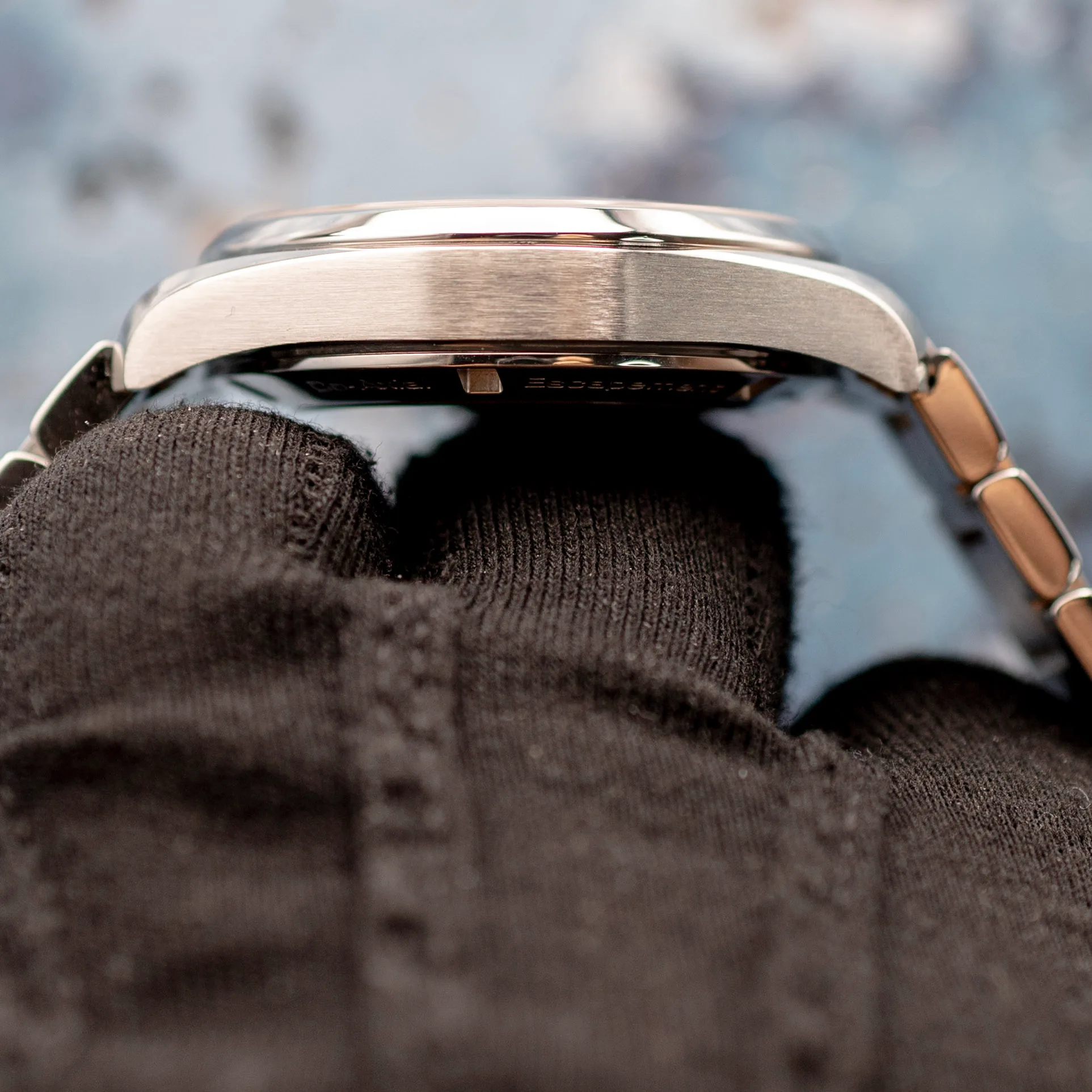
The bezel is plain and polished. No numbers, no teeth, nothing to read. With nothing happening on the bezel, your eye goes straight to the dial.
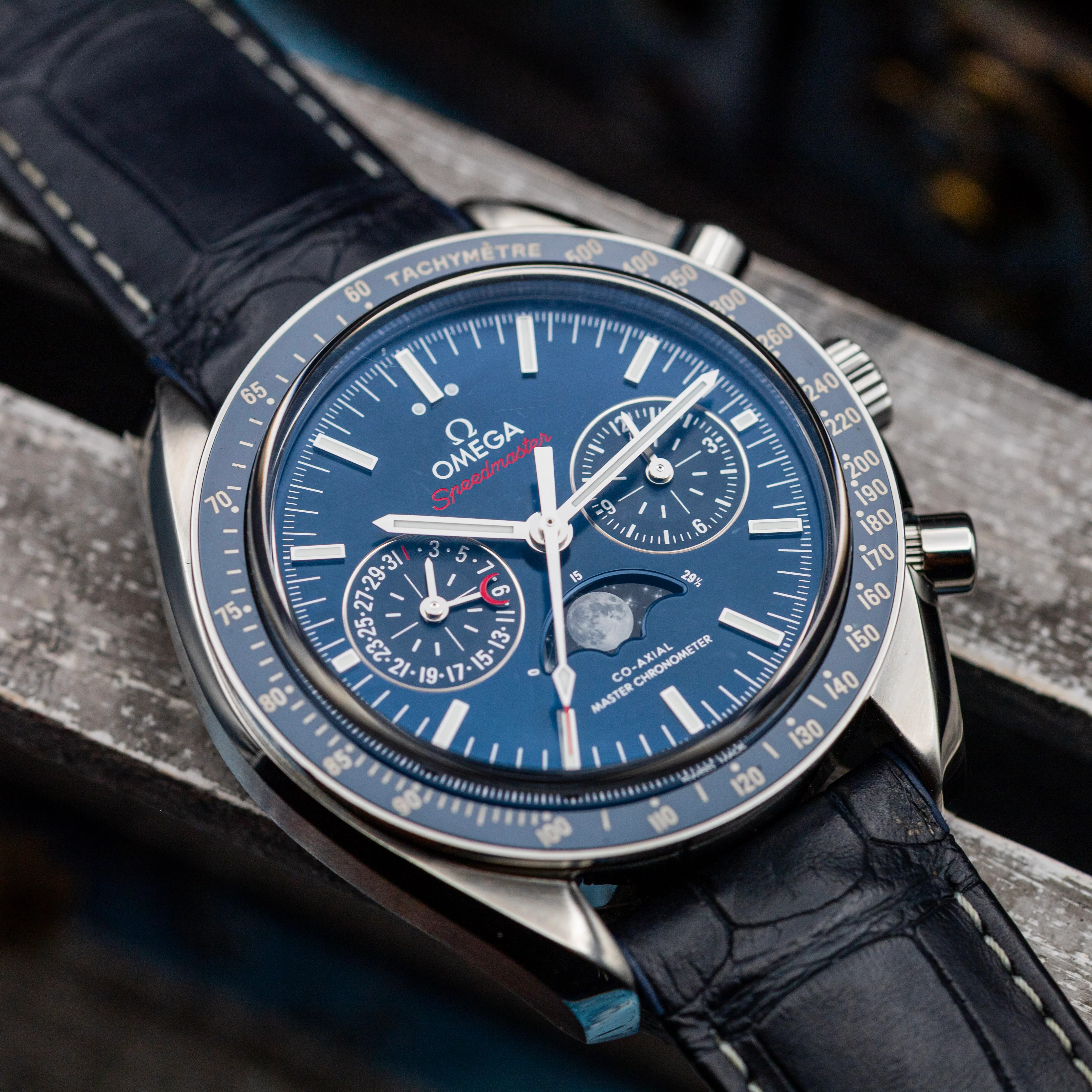
At thirteen millimeters it isn't thin, though it's definitely not as thick as the Speedmaster Moonphase I reviewed recently.
What it is, is short top to bottom. The lugs turn down hard, so it grips your wrist instead of hanging off it. It'll go under a cuff, but I wouldn't call it a dress watch.
Has This Omega Been Polished?
I get this question on every used watch I sell, usually around eleven at night.
I don't know who owned this one before me, so I'm not going to tell you it's never been polished. Nobody can prove that without the ownership history. The most anyone can honestly say is that they don't see any sign of it. If somebody promises you more than that, they're guessing.
Most people go looking for scratches, which is the wrong thing to look at. A polishing wheel doesn't just take off scratches. It takes off metal, and metal doesn't come back.
Three things I check on any used watch:
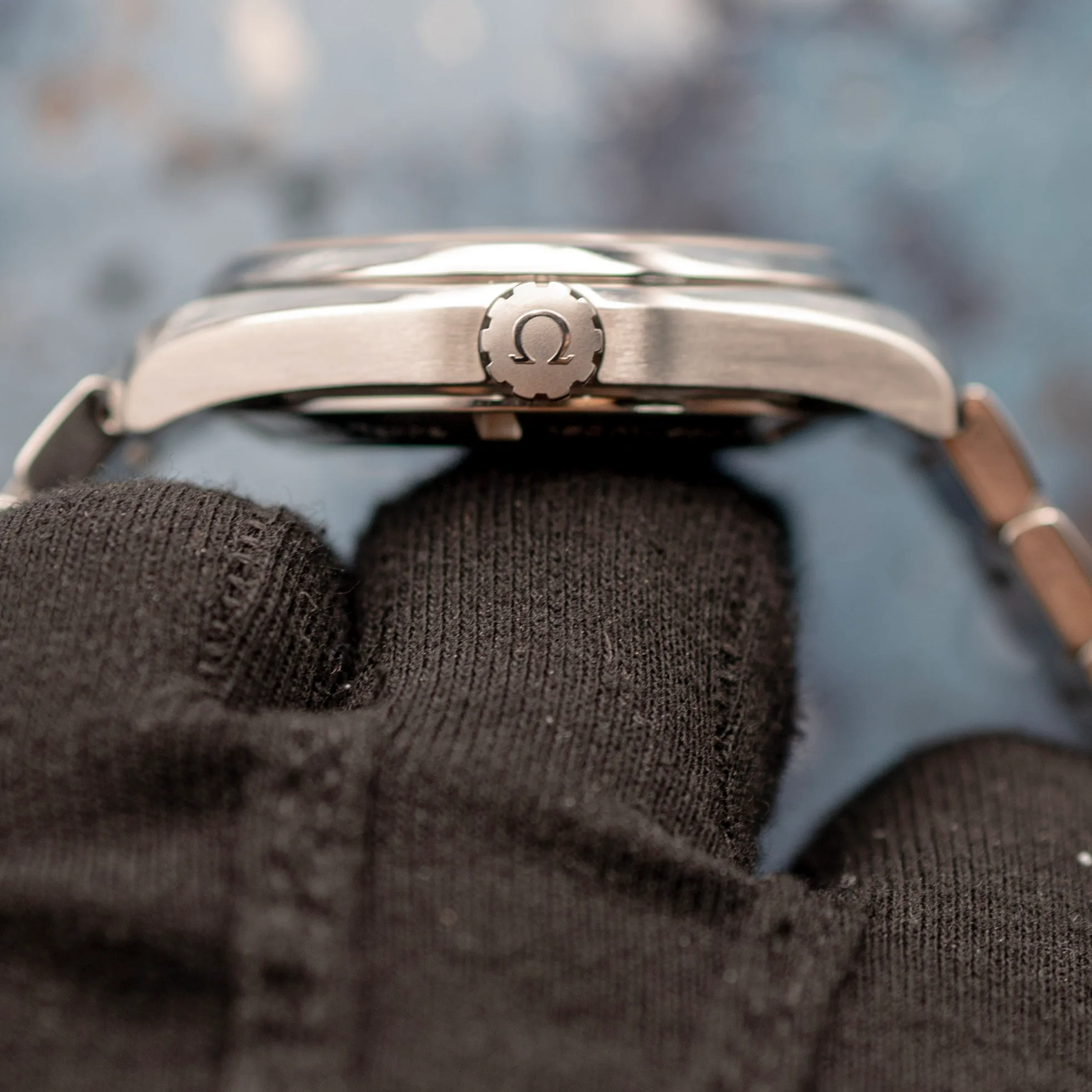
The edges. Part of the case is brushed and part is polished. Where they meet there's a line, and from the factory it's sharp enough to catch with a fingernail. Once it's been polished, that line goes soft and rounded. This catches most of them.
The lugs. From the factory the tips are flat and the same thickness the whole way down. Polished lugs go thin and rounded. Compare the left side to the right, too, because a hand polish usually won't match side to side.
Light at a shallow angle. Hold a light almost flat against the case. Polished steel shows swirls or a texture like an orange peel. Factory steel just looks flat.
Don't bother checking the bezel. It's polished from the factory, so it tells you nothing.
On this example the edges are still sharp, the lug tips are flat and the sides match, and there are no swirls under a loupe. That looks like a case nobody has touched. It isn't proof, but it's the best anybody can honestly give you.
The Box Problem
The box is the worst part of this watch. The card holder is peeling, the lining inside is peeling, and even the pillow the watch sits on is peeling. Meanwhile the watch itself is nearly perfect.
Here's the part most people don't realize. Omega doesn't ship the box together with the watch. They go to the dealer separately and the dealer pairs them up the day it sells. So there's really no such thing as "the original box" on an Omega. It's whatever box the dealer had on the shelf.
Which means the box tells you nothing about the watch. The cards do, because the cards carry the serial number.
Omega has had this problem for about thirty years. The old red boxes fell apart, and now the white material inside the wooden ones does the same thing.
Wearing It Every Day
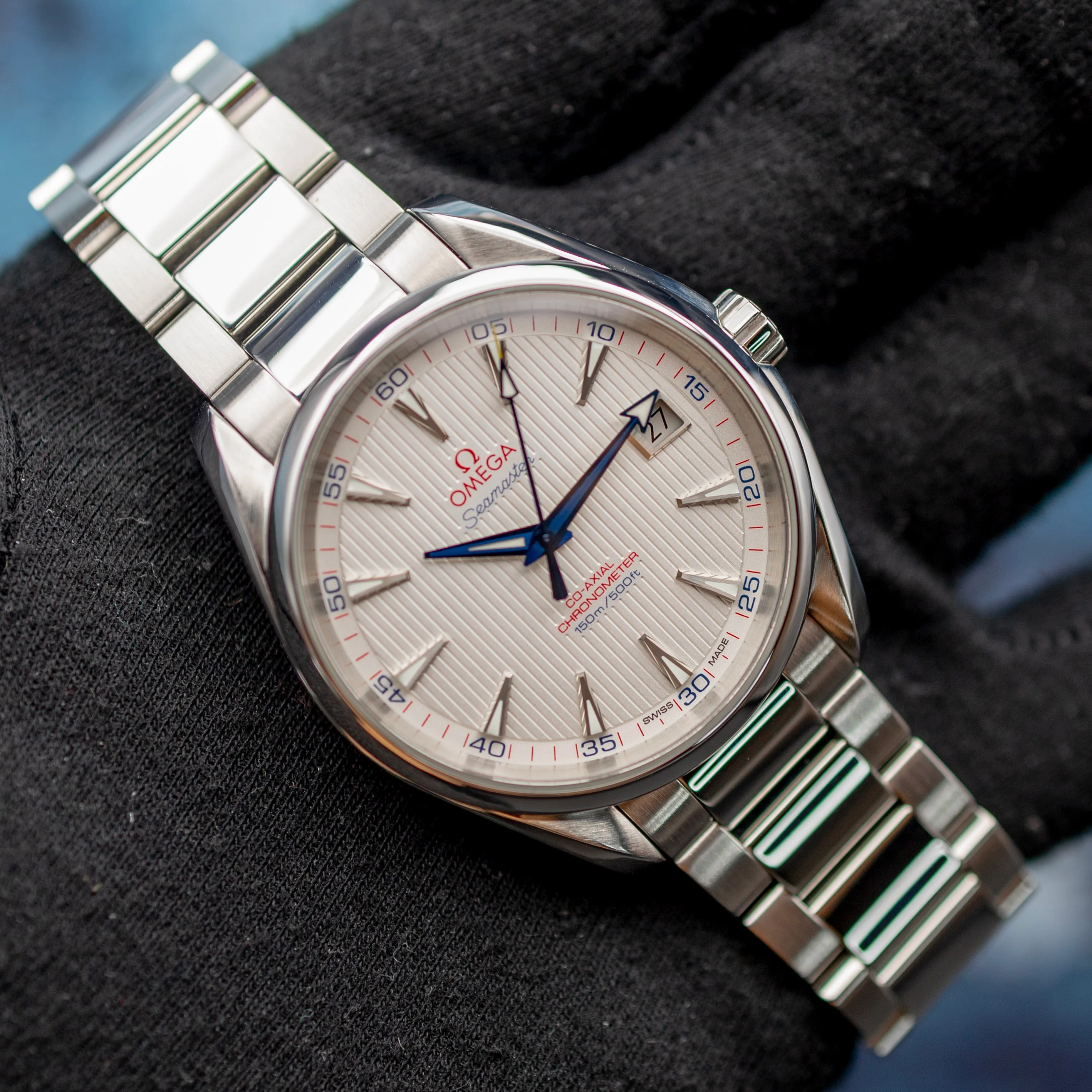
This one is on the bracelet with all the links, and it'll fit a big wrist. I've got a 7.25 inch wrist and it dwarfs me.
There's no quick-release on this generation, so if you want it on leather you'll need a tool.
I don't like screw-down crowns and I say that in every review. You unscrew it to set the time and then you have to screw it back down, every single time. It does earn the watch points, since it's part of why this handles 150 meters, so I understand why it's there. I still don't like it.
This one is better than most, though. It threads smoothly and usually catches on the first try. A Breitling tends to fight you.
Once it's open the winding is clean. Not silky, not gritty. It feels solid, like there's real metal in there. Not as enjoyable as the IWC Portugieser I reviewed recently, but still really nice.
The date is one click out and the time is two, with the seconds hand stopping when you pull it. That's the whole operating manual.
There's nothing to complain about, but there's also nothing to write home about. No second time zone to get out of sync, no chronograph to reset. There's the time and there's the date.
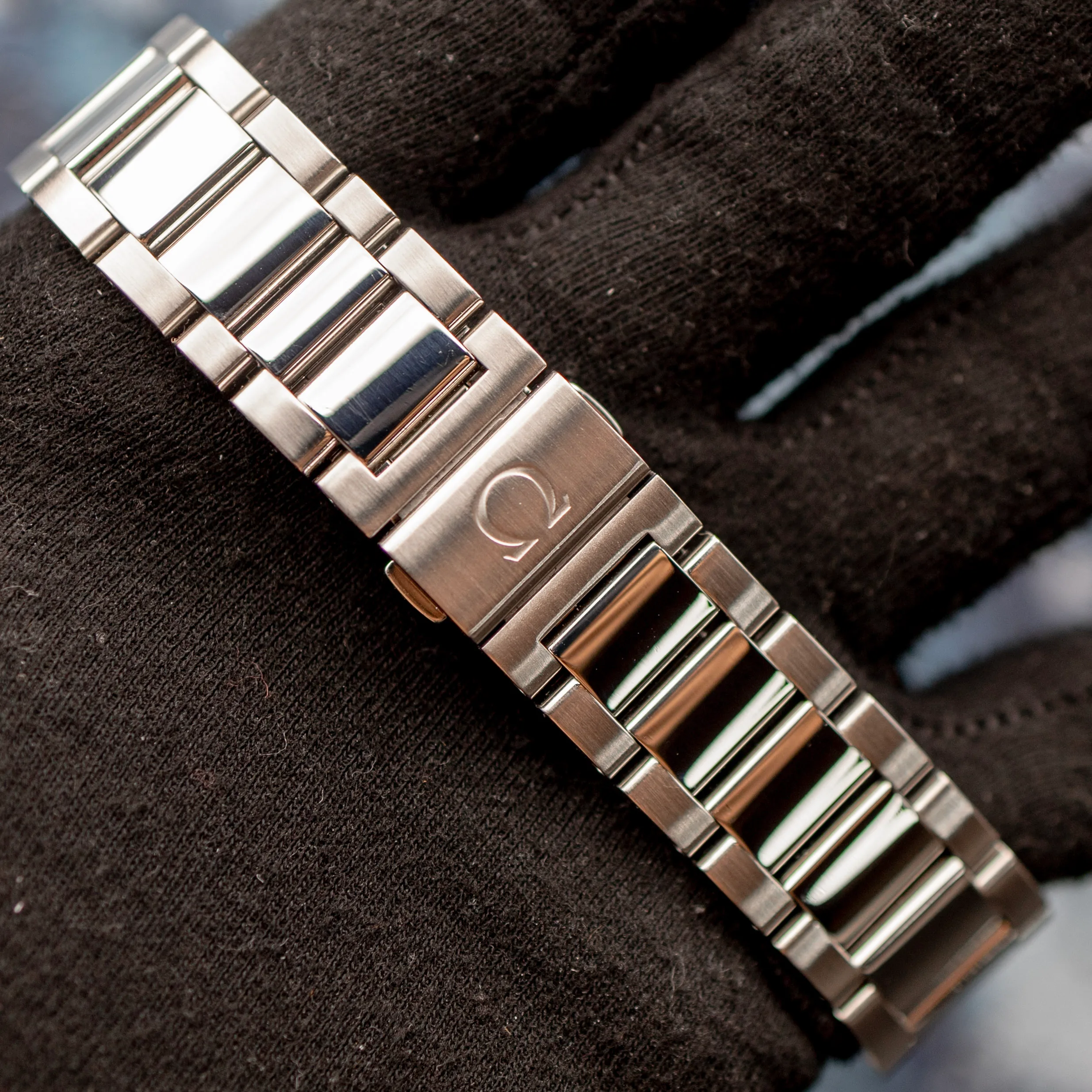
It's good to 150 meters with sapphire front and back, so it's tougher than it looks. It's steel, so it isn't light, but it sits still on the wrist rather than sliding around.
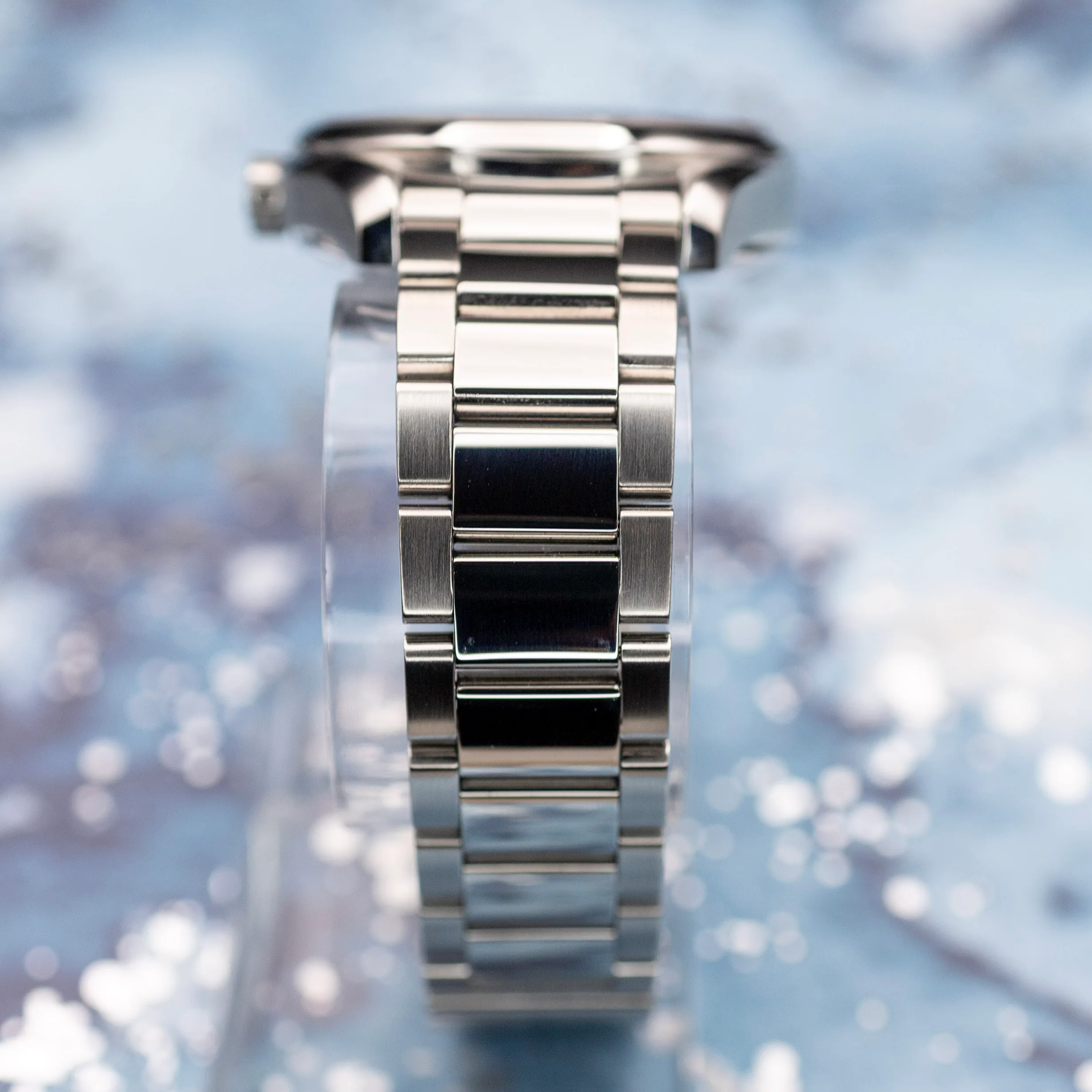
So is it the one you'd actually wear? Yes. But the reason that's true is the same reason it isn't exciting. It doesn't ask anything of you.
The 2012 Ryder Cup, and Why the Name Is a Little Cruel
Since this is a Ryder Cup watch, the 2012 tournament is worth telling.
It was played at Medinah, outside Chicago, and it's one of the most famous collapses in golf. Going into the final day the Americans were up ten to six, and people on television were saying it was already over.
Since this is a story, you can probably guess Europe won. Fourteen and a half to thirteen and a half.
In Europe they call it the Miracle at Medinah. Over here it's the Meltdown.
The captain this watch is named after was Davis Love III, who blew a four-point lead at home. That's what he tends to get remembered for.
So it's a watch named after a captain who lost in about the worst way possible. Nobody at Omega planned that, but it's stuck to the watch now.
Omega Aqua Terra vs Rolex Datejust
I'll probably get some mean comments for this, but this is Omega's version of a Rolex Datejust.
Same job. Steel case, plain bezel, date window, wears with just about anything.
The Rolex costs roughly two and a half times more and holds its value better. The Omega has the better movement on paper and lets you see it through the back, plus a dial with real texture that Rolex won't give you at this price.
So it isn't really about which is better. It's about what you're paying for. With the Rolex you're paying for everybody knowing what it is. With this, you just get the watch.
If that sounds bad, buy the Rolex. If it sounds like a deal, this one is for you.
What to Wear It With
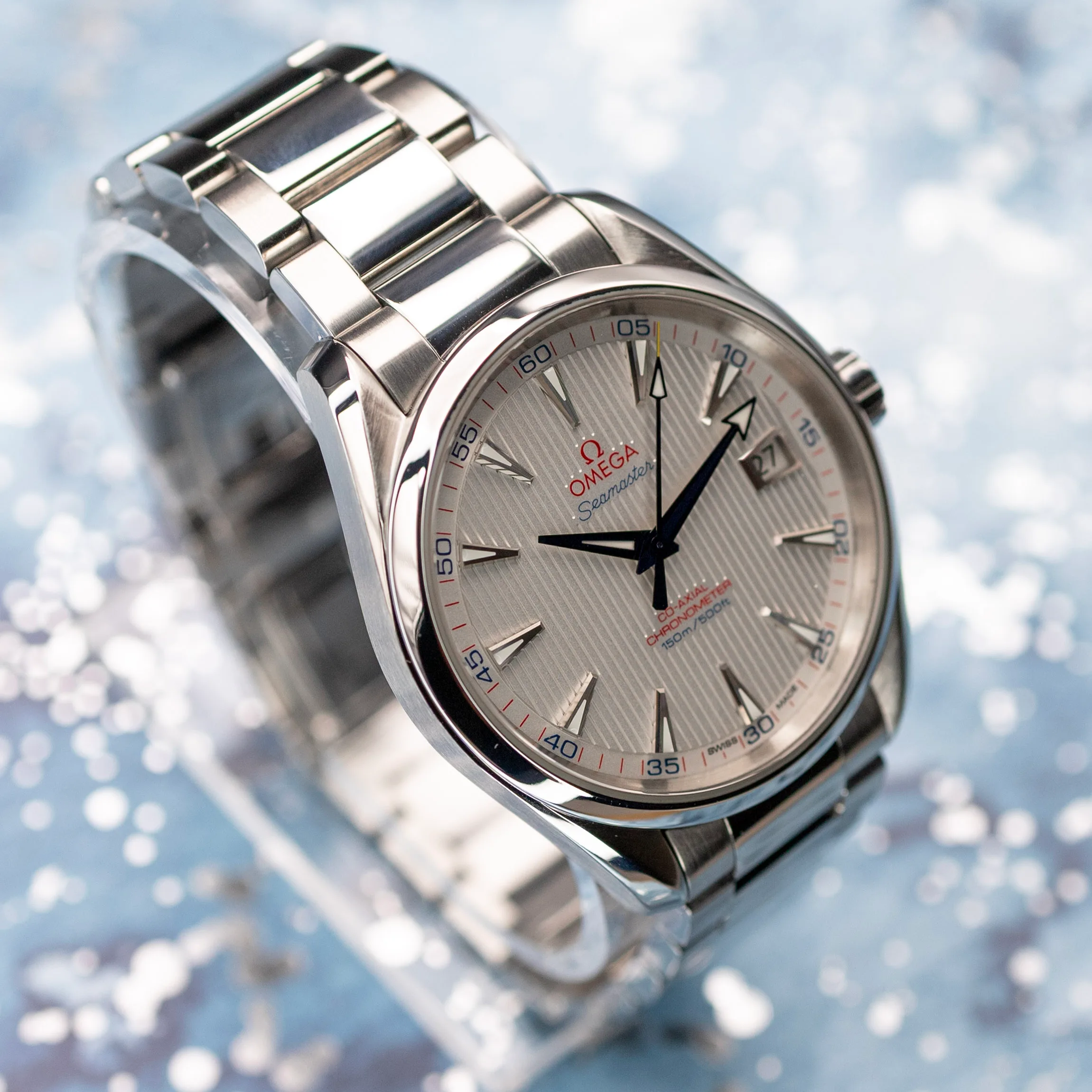
It works with a rolled-sleeve button-down, under a suit sleeve, with jeans and a t-shirt, and in an office all day.
It doesn't work with a tuxedo. And I'd skip the beach. It handles water fine, it just doesn't look right there.
This probably shouldn't be your only watch. Most days you'll like the red. Some days you'll wish you'd grabbed something quieter.
The 5D Score: 61/100
That places it fourth on the leaderboard.
It beats the Breitling Superocean by five points, and it does it without ever being interesting. Better dial, better movement, better proportions. It just quietly does everything a little better.
It loses to the Panerai PAM 311 by three points for the opposite reason. That Panerai has a single-button chronograph, my favorite crown with a lever on it, and no date window on a twenty-two-thousand-dollar watch. You can argue about all of it. There's nothing here to argue about.
Five watches in, so it's early, but the ones scoring high aren't the nicest ones. They're the ones where somebody made a choice. Good choice or bad choice, it doesn't matter. This one doesn't really make any.
Aesthetics & Heritage — 28/50
- Styling: 7
- Movement & Craftsmanship: 7
- Cool Factor: 4
- Legacy: 4
- Value & Collectibility: 6
Wearability & Utility — 33/50
- Comfort: 8
- Usability & Tactility: 6
- Features & Complications: 4
- Build Quality: 8
- Versatility: 7
Total: 61/100
Is the Omega Aqua Terra Captain's Watch Worth It?
At $5,500 retail nobody wanted it. At $3,500 to $4,000 used, the math changes. A silicon-hairspring Co-Axial movement, a teak dial that moves under the light, and a case that hasn't been touched on most examples because they sat in a store for half a decade.
The red numerals are the one thing you need to decide on before buying. If they bother you, they'll bother you every morning. If they don't, this is a lot of watch for the money.
Buying used comes with its own risk — condition, authenticity, and whether the seller stands behind the sale after your money's gone. If you'd rather buy with someone who answers the phone after the sale than gamble on a stranger's listing, reach out — I deal in exactly this kind of piece, and my reputation is on the line with every deal I do.
FAQ
Is the Omega Aqua Terra Captain's Watch a limited edition?
No. Reference 231.10.42.21.02.002 was regular production with no edition number on the case back. The first genuinely limited Ryder Cup Aqua Terra came in 2016 under a different reference.
Why is it called the Captain's Watch?
It's tied to Omega's role as official timekeeper of the 2012 Ryder Cup and to the United States team captain that year, Davis Love III.
What do the red numbers and blue hands mean?
They represent the two teams that play the Ryder Cup, the United States and Europe.
What is the Omega Aqua Terra Captain's Watch worth?
It usually trades between $3,500 and $4,500 depending on condition and whether the box and cards are included. It bottomed near $3,400 in late 2025 and has been recovering since.
What movement is in it?
The Omega calibre 8500, a co-axial automatic with roughly sixty hours of power reserve and a silicon hairspring, visible through the display case back.
How big is it and will it fit my wrist?
41.5mm across and 13mm thick, with lugs that turn down sharply so it wears smaller than the diameter suggests. On my 7.25 inch wrist it's a large watch.
Why does my warranty card say a later year than the watch?
Omega ships blank cards to dealers, who fill in the date at the point of sale. The card date is when the watch sold, not when it was made.