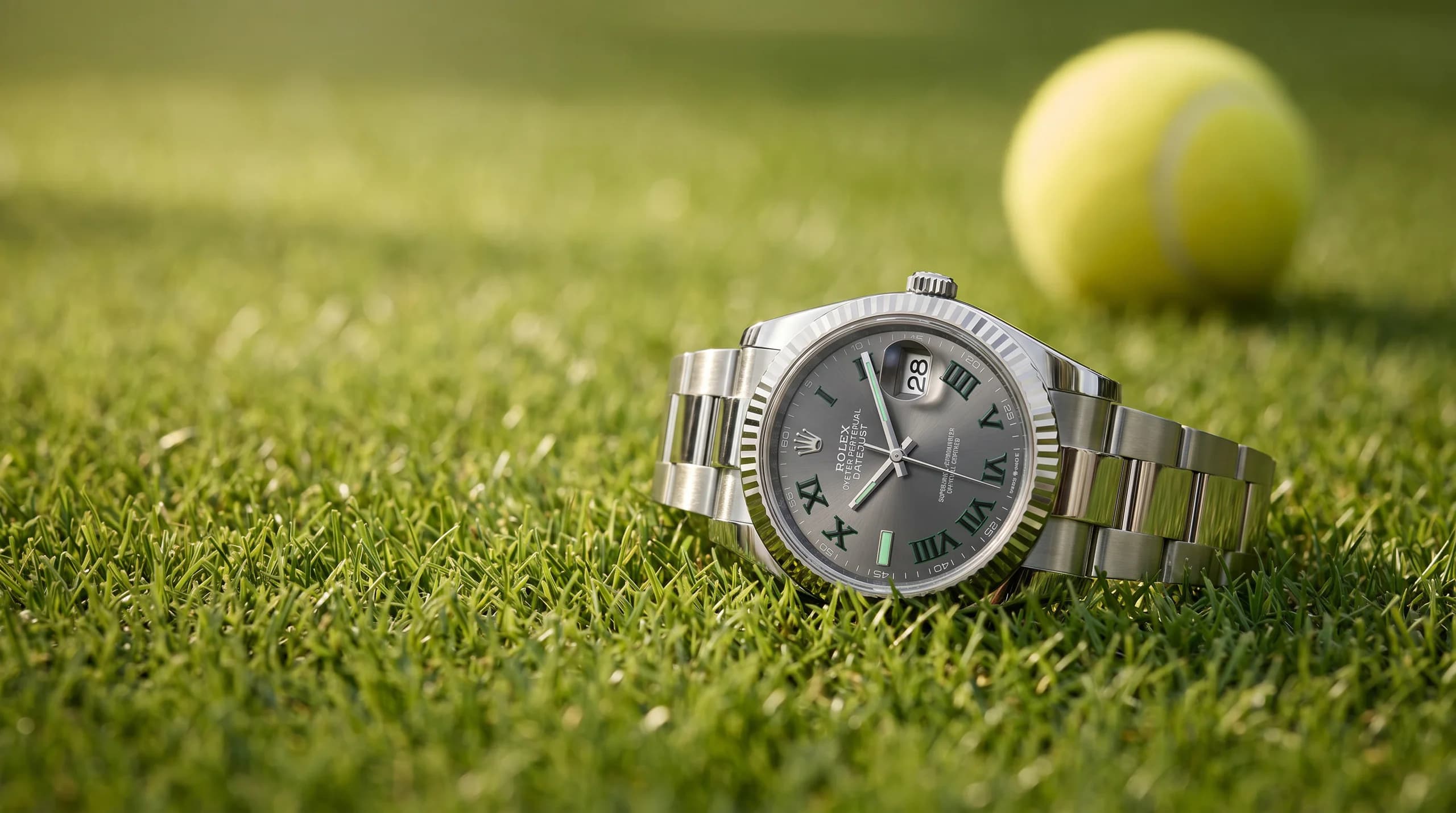
Wimbledon is on right now, and if you have watched any of it, you have seen more Rolex than you probably registered. The green clock over Centre Court. The crown on the scoreboard. The dial on the umpire's chair. None of it is an advertisement, and that is the whole point.
Rolex has kept time at Wimbledon since 1978, and out of that partnership grew one of the most recognizable dials in modern collecting: the slate-grey Datejust with green Roman numerals that everyone calls the "Wimbledon." Here is the twist. Rolex never named it that.
The short answer
Rolex has been the Official Timekeeper of The Championships, Wimbledon since 1978, one of the longest partnerships in sport. It has never run a Wimbledon ad campaign and never officially called any watch a "Wimbledon." The nickname attached itself to one Datejust configuration, a slate-grey sunburst dial with green-outlined Roman numerals, because collectors read the colors as Centre Court grass and an overcast London sky.
If you want the tennis connection on your wrist, that Datejust is the buy, and the pre-owned market is the sane way in. Steel examples run roughly $10,000 to $15,000, with two-tone gold higher. It trades above an equivalent standard Datejust, which tells you the nickname is doing real work.
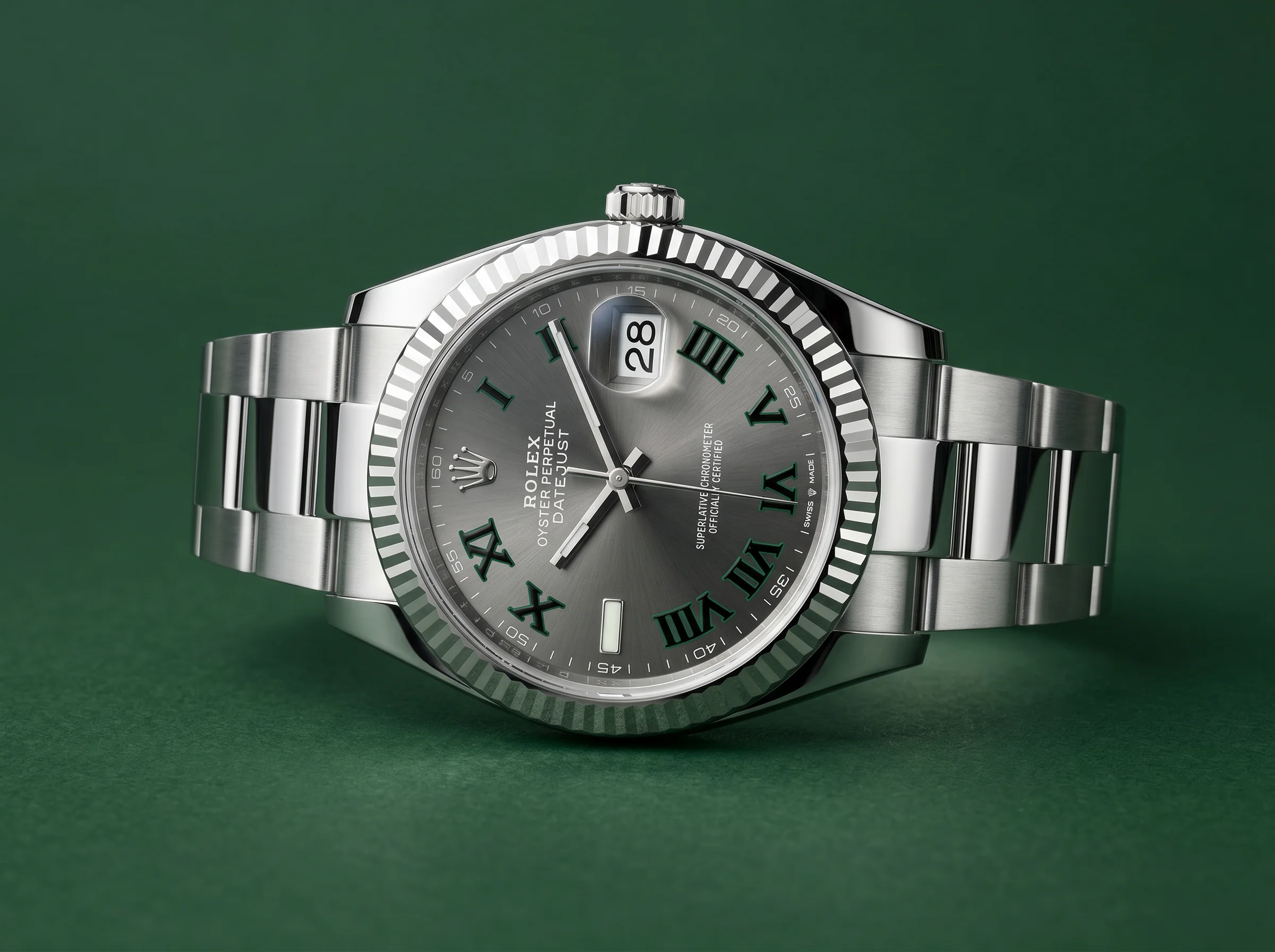
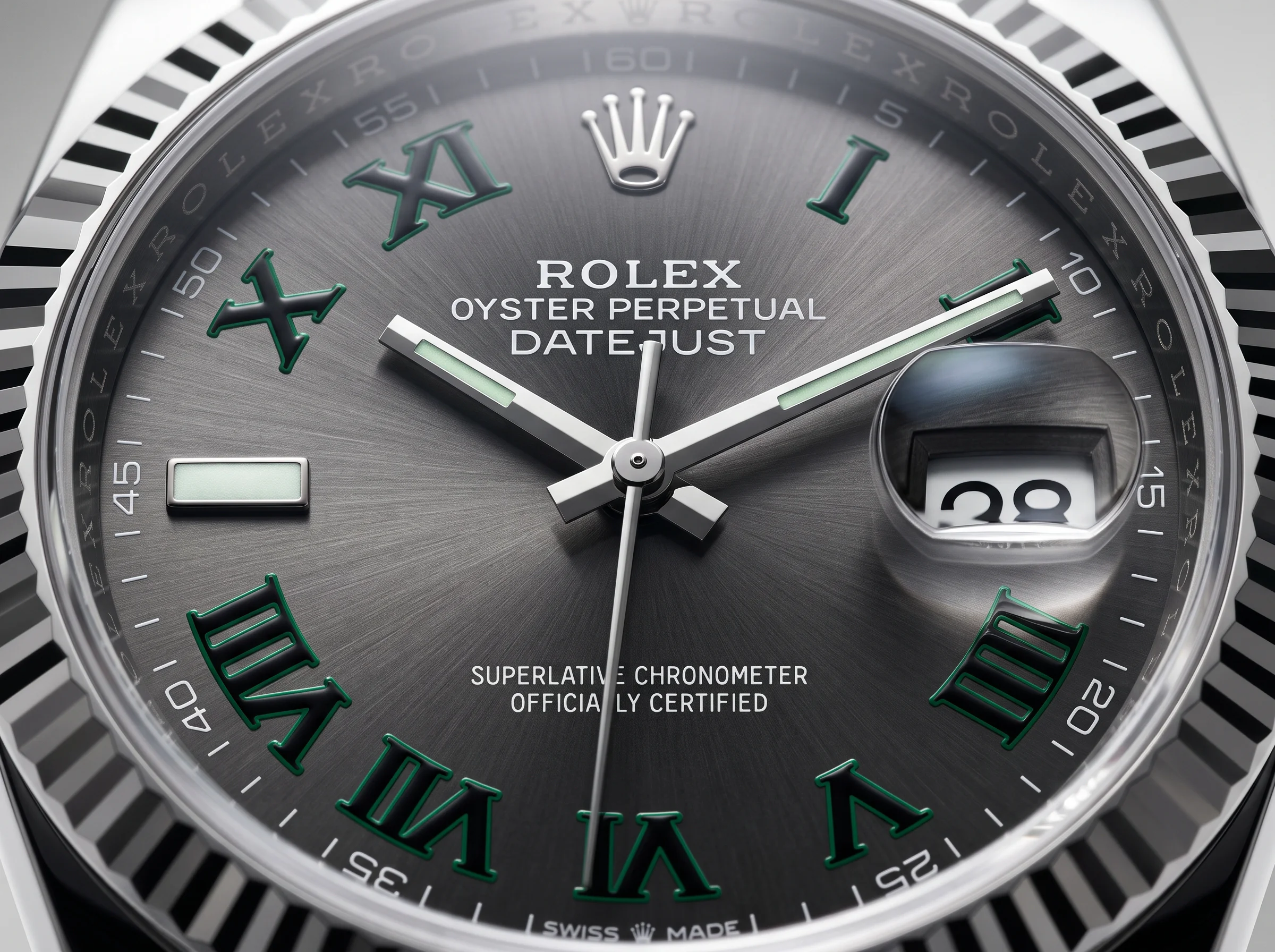
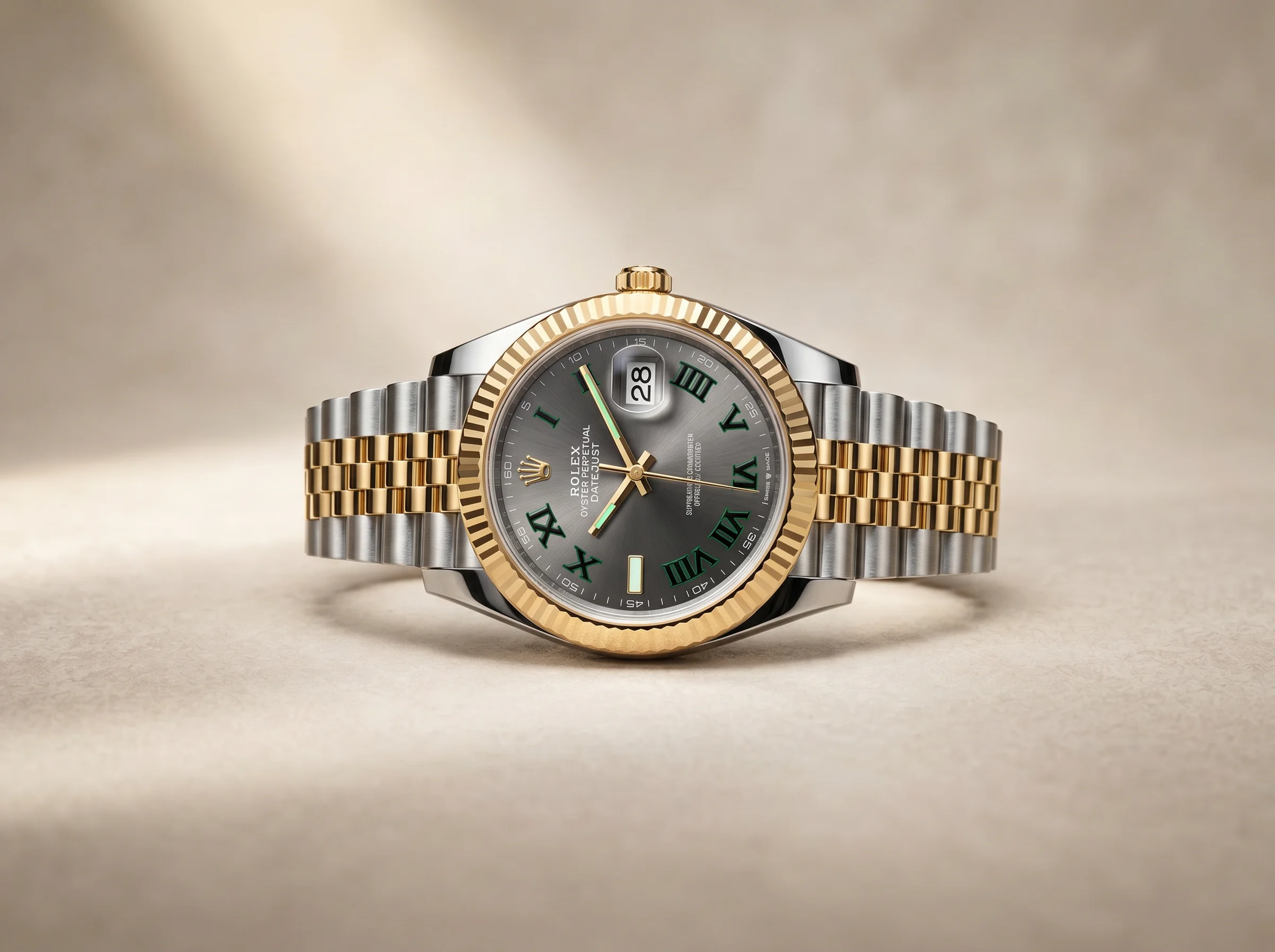
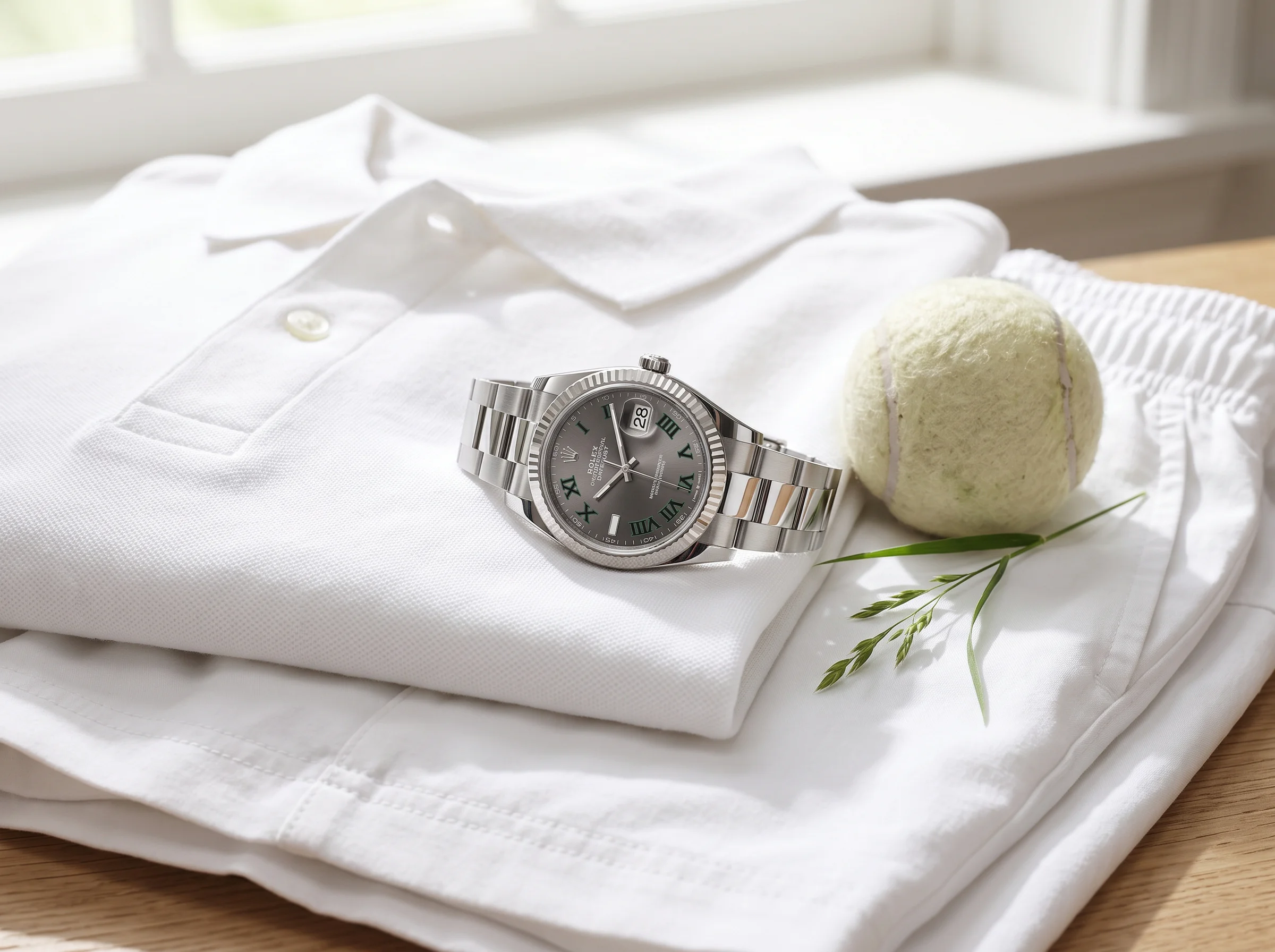
The images in this article are AI-generated editorial illustrations. They represent the references discussed and are not photographs of specific watches for sale.
Rolex does not sponsor Wimbledon. It keeps its time.
Rolex's tennis strategy is the same one it runs everywhere: be useful first, and let the prestige follow.
When Rolex became Wimbledon's timekeeper in 1978, it was not a sports brand. It was the watch you wore up Everest or down to the seabed. What it brought to the All England Club was function, precise timing systems and photo-finish equipment, as Bob's Watches recounts. The clocks went on the scoreboards and the umpire's chair before anyone thought of them as branding.
That approach is the Rolex playbook, and it reaches well past London. The crown is now Official Timekeeper of all four Grand Slams, plus the ATP and WTA Finals, the Davis Cup, and the Laver Cup. It is the same move Rolex made this year in New York, mounting a permanent clock over Rockefeller Center, which we broke down in our read on what that clock signals. Rolex builds landmarks, not billboards.
The Testimonee roster
Rolex does not call its athletes ambassadors. It calls them Testimonees, people meant to testify to the brand's values through their careers.
The current tennis roster is stacked with the sport's actual leaders. Reigning men's champion Jannik Sinner opened play on Centre Court this year, and defending women's champion Iga Swiatek is in the draw, as Time and Tide reported. Six-time Grand Slam champion Carlos Alcaraz is a Testimonee too, though a wrist injury kept him out of Wimbledon this year. Coco Gauff, Taylor Fritz, Ben Shelton, and Mirra Andreeva fill out a deep bench, alongside legends like Roger Federer, Bjorn Borg, Rod Laver, and Chris Evert.
The "Wimbledon" dial is a nickname, not a model
The watch everyone calls the Wimbledon is a Datejust, and only a Datejust.
The recipe is fixed: a slate-grey sunburst dial, black enamel Roman numerals outlined in green, and a single luminous baton at 9 o'clock where the IX would sit. The Roman numerals do not glow, so only the hands and that one baton carry lume. Miss either the grey base or the green outlines, and you are looking at a different Datejust.
Rolex introduced the dial in 2009 on the now-discontinued Datejust II (refs. 116333 and 116334), then carried it onto the Datejust 41 and, later, the Datejust 36. There was no commemorative edition and no press release. The name formed on its own, and Rolex has been happy to let it run.
The Federer effect
If the Wimbledon dial belongs to anyone, it belongs to Roger Federer.
Federer holds the record with eight Wimbledon singles titles, and he lifted his last one in 2017 wearing a yellow Rolesor Datejust 41 with this exact dial. The nickname jumped from forum slang into everyday use in 2022, when he sat courtside at Wimbledon, sidelined by a knee injury, wearing the grey-and-green steel version. No campaign, no product code. WatchGuys notes that single image drove a real bump in secondary-market demand. Some dealers now quietly call it the "Federer" dial.
The references and what they cost
The dial spans the current Datejust lineup, so the choice is really about size, metal, and bracelet.
Every current Wimbledon Datejust runs Rolex's in-house caliber 3235, with a 70-hour power reserve, the Chronergy escapement, and the Superlative Chronometer rating of -2/+2 seconds per day. The older Datejust II versions used the caliber 3136 with a 48-hour reserve. Here is a working snapshot of the secondary market.
| Reference | Size and metal | Bezel | Pre-owned range |
|---|---|---|---|
| 126200 | 36mm steel | smooth | $10,000 to $12,000 |
| 126234 | 36mm steel | white gold fluted | $12,000 to $14,000 |
| 126300 | 41mm steel | smooth | $12,000 to $15,000 |
| 126334 | 41mm steel | white gold fluted | $15,000 to $18,000 |
| 126333 | 41mm yellow Rolesor | gold fluted | $16,000 to $22,000+ |
Prices reflect current listings from Chrono24 and WatchGuys, and they move with condition, box and papers, and bracelet choice. The two-tone Everose version (ref. 126331) sits at the top of the range. For the smart-money way into gold on any Rolex, our Rolesor guide lays out the trade.
What to actually buy
For most buyers, the steel Datejust 41 or 36 with the Wimbledon dial is the sweet spot.
You are paying for the dial, so buy the one you love and do not overthink the case metal. The steel 126300 or 126234 gives you the whole look for the least money. The 36mm suits smaller wrists and reads a touch dressier, while the 41mm has the presence most buyers want.
A few honest notes before you commit:
- The numerals do not glow. Only the hands and the 9 o'clock baton light up, so low-light legibility is not this dial's strength.
- It trades at a premium. Expect to pay more than an equivalent silver or blue Datejust. That premium is the nickname, and it has held.
- Buy pre-owned. Retail supply is tight, and the secondary market lets you pick the exact reference without a waitlist.
If you like a Rolex nickname with a real story behind it, the Day-Date's "President" tag works the same way, which we untangle in why the Day-Date is called the President.
The bottom line
Rolex has spent nearly fifty years keeping time at Wimbledon without ever selling a "Wimbledon" watch. The dial got its name from the culture, not the catalog, and that is exactly why it stuck. Buy the grey-and-green Datejust because you like it, buy it pre-owned to skip the waitlist and the retail premium, and know you are wearing a nickname Rolex was smart enough never to claim. Browse authenticated pre-owned Rolex Datejust at 5dwatches.com.