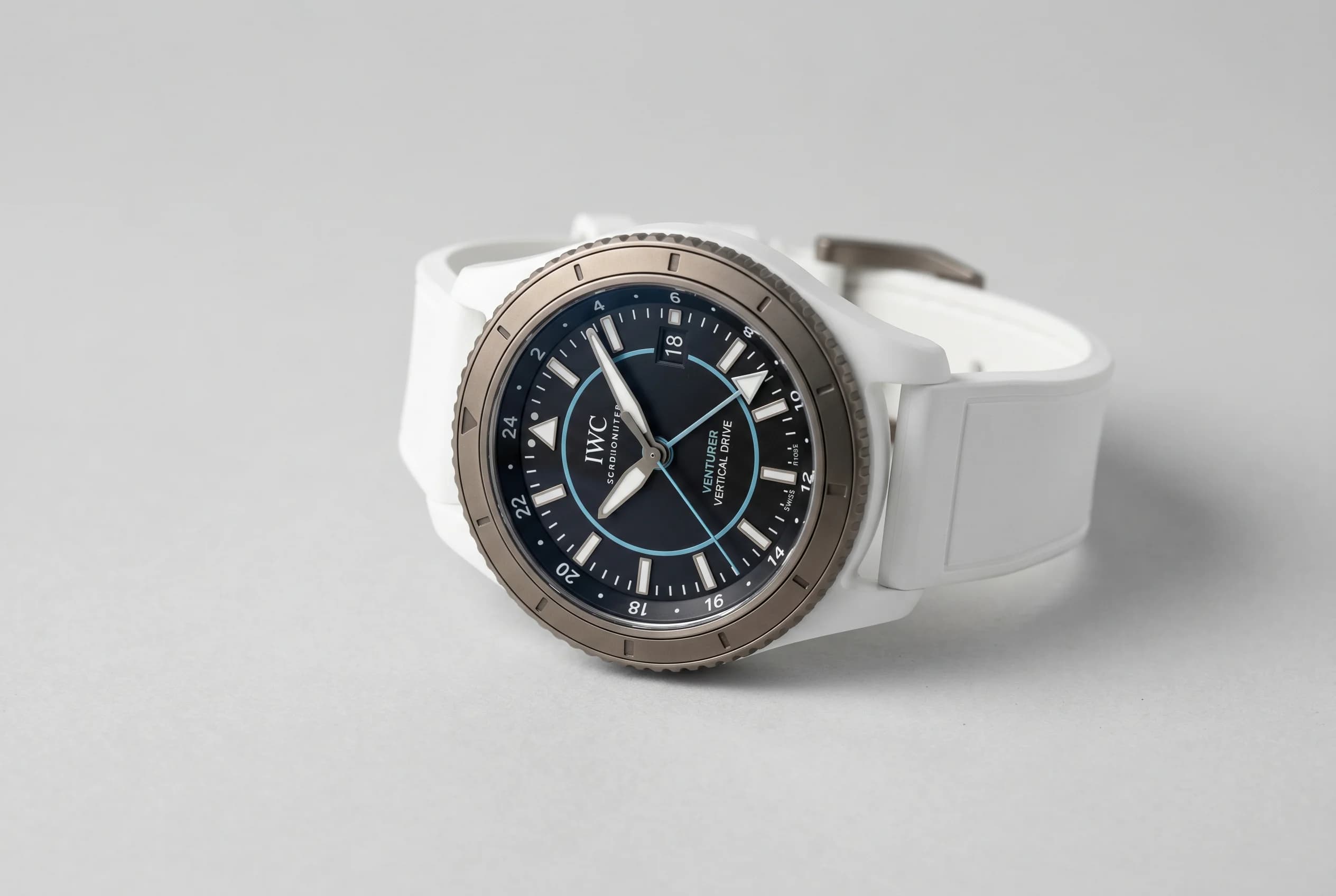
For 90 years, every IWC Pilot's Watch has had a crown. The Mark XI carried one for the Royal Air Force. The 1936 reference 325 carried one for the German Luftwaffe and Swiss aviation industry. Every Mark XII, XV, XVI, XVII, XVIII, and XX carried one. The Big Pilot's oversized conical crown became the brand's most recognizable visual element, designed to be operated with flight gloves at altitude.
The Pilot's Venturer Vertical Drive doesn't have one.
Launched at Watches and Wonders 2026 in partnership with Vast (the commercial space station company building Haven-1), the Venturer is the first IWC tool watch designed and engineered from the ground up for human spaceflight. The crownless construction is the headline design decision, but it's not a marketing stunt. The watch is officially certified for spaceflight by Vast, slated to fly on Haven-1 in 2027, and represents a fundamentally different engineering approach to a tool watch than anything in IWC's 90-year aviation catalog.
This is a working dealer's read on the Venturer Vertical Drive. The technical execution, why the crownless design actually works, what the Vast partnership signals, and what it tells us about IWC's strategic direction over the next decade.
All images in this post are AI-generated and may not perfectly represent the actual watch references discussed. They are intended for illustration only.
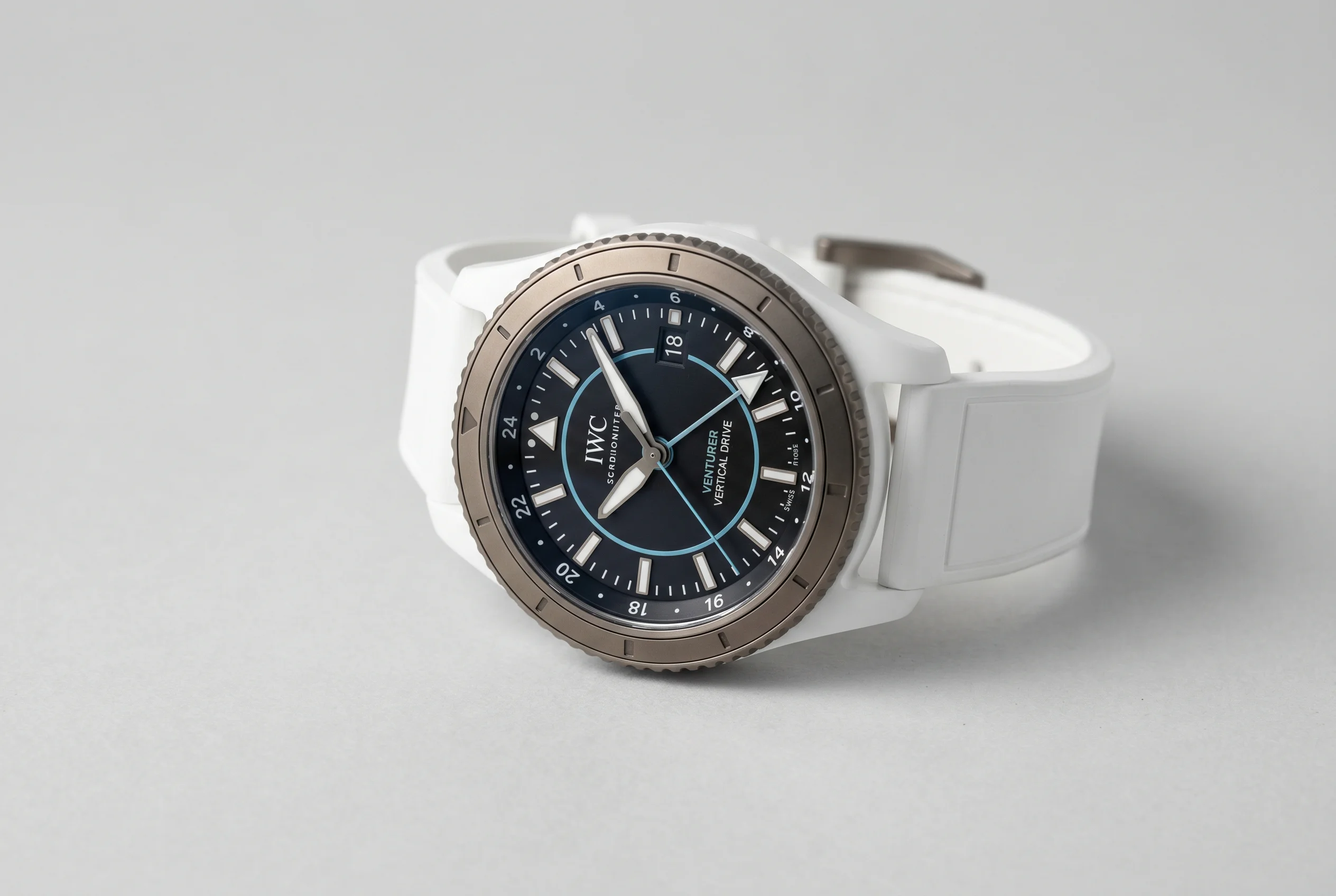
The Venturer Vertical Drive in white zirconium oxide ceramic with Ceratanium bezel. No crown anywhere on the case. The notched bezel and a side rocker switch handle every function the crown used to.
The Short Answer
The IWC Pilot's Venturer Vertical Drive (reference IW328601) is a 44.3mm crownless tool watch in white zirconium oxide ceramic with a Ceratanium notched rotating bezel, powered by the new in-house Caliber 32722 automatic with 120-hour power reserve and integrated GMT module. Setting and winding are performed entirely through the patent-pending rotating bezel system transmitted to the movement via a clutch mechanism called the Vertical Drive, with a Ceratanium rocker switch on the left side of the case selecting between functions (winding, time setting, GMT setting). The watch is officially certified for spaceflight by Vast, slated to fly aboard Haven-1 in 2027. It is not limited edition, retailing at $28,200 USD / €28,900 / CHF 24,000, available now through IWC boutiques and authorized dealers. Water resistance is 100m. The Venturer signals IWC's strategic intent to lead commercial spaceflight watchmaking the way Omega has led NASA-era spaceflight for sixty years.
Why a Crownless Watch Exists
The crown is not a sacred design element. It's an engineering compromise that has lasted because nothing better existed. Crowns are useful on Earth because they let humans set and wind watches with their fingers. In space, that calculus changes.
According to Worn & Wound's hands-on coverage from Vast headquarters in Los Angeles, IWC's engineering division XPL started development on the Venturer with a single question: what does a watch actually need to do in space? The answer drove three structural design decisions.
1. Astronauts wear gloves. During EVA (extravehicular activity, the official term for spacewalks), astronauts wear pressurized space suits with thick rigid gloves. A traditional crown is functionally inoperable through that glove. Even pulling the crown out to engage the setting position is challenging without bare-finger dexterity.
2. Crowns protrude. A protruding crown on a 3 o'clock position is an impact hazard inside a spacecraft. Onboard equipment, control panels, and personal interaction surfaces are designed for minimum protrusion to avoid accidental contact. A traditional watch crown could damage equipment or be damaged itself during routine spacecraft operations.
3. The microgravity winding problem. Automatic watches rely on a rotor that swings as the wearer moves their arm. In microgravity, the rotor still works (the inertia of the oscillating mass produces effective rotation when the wearer moves), but the swing patterns and wind efficiency are different from terrestrial use. A backup manual winding system that doesn't require a crown becomes a meaningful redundancy.
The Venturer solves all three problems with the rotating bezel system. The bezel is grippable through gloves, the case has no protruding elements, and the bezel can manually wind the movement when rotated counterclockwise.
The Vertical Drive Mechanism: Patent-Pending
The technical innovation that makes the crownless design viable is what IWC calls the Vertical Drive. It's a clutch system that transmits rotation of the external bezel to the winding stem inside the movement, allowing the bezel to perform every function a traditional crown would perform.
Here's how it works in practice:
- The wearer presses the rocker switch on the left side of the case to select a mode (winding, hour-hand setting, or GMT setting). The rocker is a flat lever-style switch in Ceratanium, large enough to operate with gloves.
- The wearer rotates the bezel to execute that function. Counterclockwise rotation winds the movement (manual backup to the automatic rotor). Clockwise or counterclockwise rotation in setting modes adjusts the relevant hands.
- The clutch system inside the case transmits the bezel rotation to the appropriate movement component based on which mode the rocker switch has selected.
According to The 1916 Company's coverage of the launch, the Vertical Drive is patent-pending and represents IWC's first ground-up reengineering of how a watch interface works.
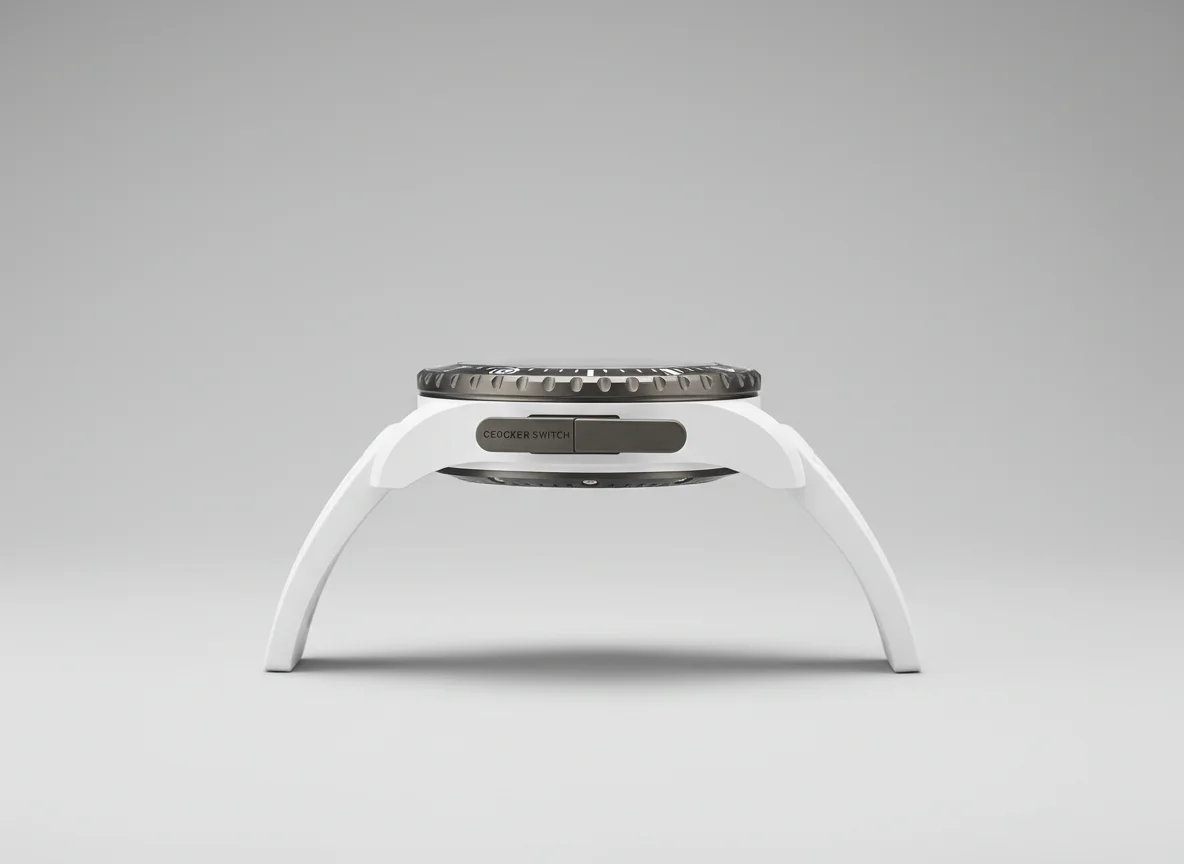
The Ceratanium rocker switch on the left side of the case. This is the function selector that tells the Vertical Drive clutch system which component the bezel should adjust on the next rotation.
The notched bezel is essential to the system. Standard rotating bezels on dive watches are unidirectional (anti-clockwise only) and used purely for elapsed-time tracking. The Venturer's bezel rotates in both directions and serves as the primary user interface for the entire watch. The notches give astronauts a tactile grip through gloves and are sized for spacesuit-finger operation.
The Caliber 32722 Movement
Inside the Venturer is the new in-house Caliber 32722, derived from IWC's existing 32-series automatic family but extensively modified for the crownless interface and the integrated GMT requirement.
| Spec | Detail |
|---|---|
| Type | Automatic (bidirectional Pellaton winding) |
| Frequency | 4 Hz (28,800 vph) |
| Jewels | 21 |
| Power reserve | 120 hours (5 days) |
| Functions | Hours, minutes, central seconds, date, integrated GMT |
| GMT module | Integrated into the caliber (NOT a module on top of a base) |
| Winding | Hybrid: automatic rotor + manual via bezel rotation |
The 120-hour power reserve is critical for the spaceflight mission profile. According to Watch Collecting Lifestyle's coverage, mission schedules in commercial spaceflight are not organized around watch-winding intervals, so a 5-day reserve gives crews flexibility to handle the watch on their own time without daily attention. The same reserve is useful terrestrially as a 5-day weekend buffer.
The integrated GMT module is the second technical decision worth flagging. Instead of mounting a GMT module on top of an existing time-only base caliber (the conventional approach), IWC engineered the GMT functionality directly into the 32722. The result is a thinner movement and cleaner mechanical integration with the Vertical Drive system, which has to interact with multiple setting positions through the rocker switch.
Manual winding via the bezel takes time. According to user reports from the Vast partnership testing, fully winding the watch from a stopped state requires several minutes of bezel rotation, which is why the automatic rotor remains the primary winding mechanism. The manual backup is for situations where the rotor hasn't been able to keep up with crew activity levels.
Why GMT Instead of Chronograph
A space-purpose tool watch could reasonably be a chronograph. NASA's Speedmaster lineage has been chronograph-based for sixty years. IWC's choice of a GMT for the Venturer reflects a specific operational reality of modern human spaceflight that wasn't part of the Apollo-era equation.
A spacecraft in low Earth orbit completes one full orbit roughly every 90 minutes. Astronauts experience approximately 16 sunrises and sunsets per 24-hour period. Without consistent reference timing, circadian rhythm and operational scheduling become disorienting. The standard solution since the ISS era has been to run mission schedules on UTC (Coordinated Universal Time), giving crews a fixed 24-hour reference regardless of orbital sunrise count.
According to Worn & Wound's interview with Vast COO Kris Young, the GMT-with-24-hour-reference layout was a deliberate choice for crew coordination on Haven-1. The Venturer displays mission time on a 24-hour scale around the dial perimeter (tracked by an arrow-tipped GMT hand) while the central hour and minute hands display home time, settable to any Earth time zone. The wearer always has both reference frames simultaneously visible.
For terrestrial use, the same architecture functions as a conventional GMT travel watch. The dual-time display works equally well for an astronaut on Haven-1 and a frequent flier between Geneva and New York.
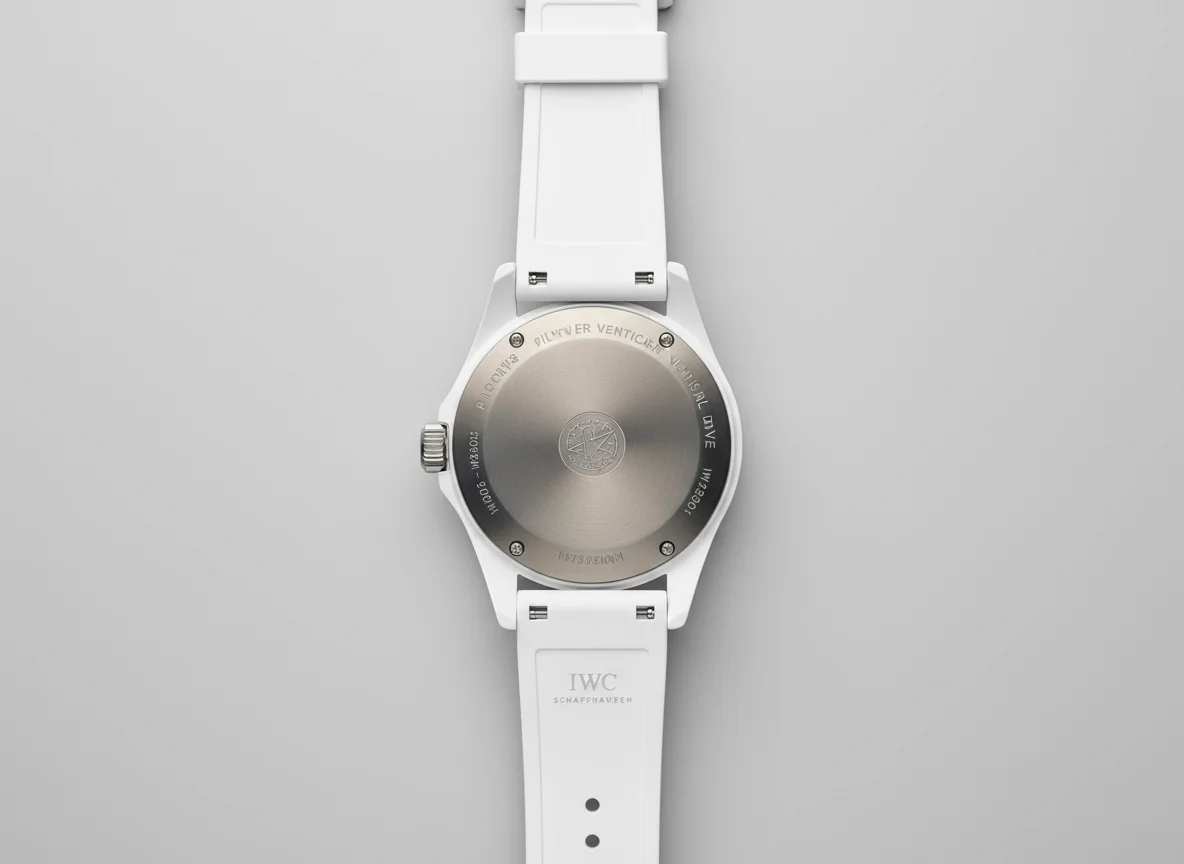
The solid Ceratanium caseback. No display window because the Venturer is built for spaceflight durability over movement viewing. Engravings include the Vast partnership marking.
The Materials: Why Ceramic and Ceratanium
The case construction is white zirconium oxide ceramic for the body, with a Ceratanium bezel and caseback. Both choices are driven by spaceflight conditions.
White zirconium oxide ceramic is the same material IWC has used in pilot's watches since 1986, but the Venturer pushes it further. Ceramic handles thermal extremes without distorting (essential when temperatures swing from +100°C in direct sunlight to -150°C in shade during orbital exposure). It's also dramatically lighter than steel or titanium, important for keeping launch payload weight down on missions where every gram counts. The white color is functional too: it reflects radiant heat, reducing temperature fluctuation on the wearer's wrist during EVA.
Ceratanium is IWC's proprietary titanium-ceramic hybrid, introduced in 2017. It combines the lightness and toughness of titanium with the scratch resistance and thermal stability of ceramic. Used on the bezel (which takes the most operational wear from the rotation system) and the caseback (which faces the wearer's body), it solves the durability problem without adding the weight that would come from a fully ceramic case.
According to HiConsumption's coverage of the Vast certification testing, Vast's engineering team in Long Beach subjected the watch to 9.56 gRMS vibration loads across all three axes (well above typical ascent forces) plus pressure chamber simulations replicating Haven-1 environmental conditions. The watch passed every certification benchmark.
The Vast Partnership: What Changes for IWC
The Vast collaboration is the strategic story under the technical specs. Vast is a commercial space station company building Haven-1, scheduled for first launch in Q1 2027 aboard a Falcon 9 booster. Haven-1 is the prototype for a successor to the International Space Station and a stepping stone to Vast's larger plans for crewed orbital habitation.
IWC's Pilot's Venturer Vertical Drive will be aboard Haven-1 when it launches. According to WatchCollectingLifestyle's coverage of the partnership, this makes the Venturer the first commercial space station timepiece in history. It also makes IWC the official timekeeper of Vast's commercial spaceflight operations.
The strategic significance is meaningful. For sixty years, the relationship between Swiss watchmakers and human spaceflight has been defined by Omega's Speedmaster Professional, the watch NASA flight-qualified in 1965 and that has accompanied every U.S. crewed space mission since. Omega's marketing strategy still leans heavily on the moon-watch story, even though commercial spaceflight is now a dramatically different operational environment than the Apollo era.
IWC is positioning the Venturer as the watch for the post-NASA era of human spaceflight. The Vast partnership puts an IWC on the first commercial space station in 2027. If commercial spaceflight scales as expected (SpaceX, Blue Origin, Vast, and other startups all expanding crewed operations through the late 2020s), IWC will have the strongest brand association with that era. The Venturer is the platform watch for that strategy, not a one-off.
The non-limited production run is the strongest evidence of the platform intent. IWC could have made the Venturer a 100-piece limited edition, charged $80,000+, and treated it as a collector trophy. Instead, the watch is in regular production at $28,200, which signals that IWC plans to evolve the Venturer line over multiple years and references rather than retiring it after the Haven-1 launch.
The 90-Year Pilot Lineage Context
The Venturer makes more sense when read against the full IWC Pilot's catalog, not just as a standalone release.
IWC introduced the original Pilot's Watch reference 325 in 1936 at the request of Ernst Homberger's pilot sons, who wanted a cockpit-ready instrument with a black dial, anti-magnetic iron casing, and oversized luminous numerals. The 325 established the brand's pilot watch identity and the basic Flieger dial template that has carried through to the modern Mark XX.
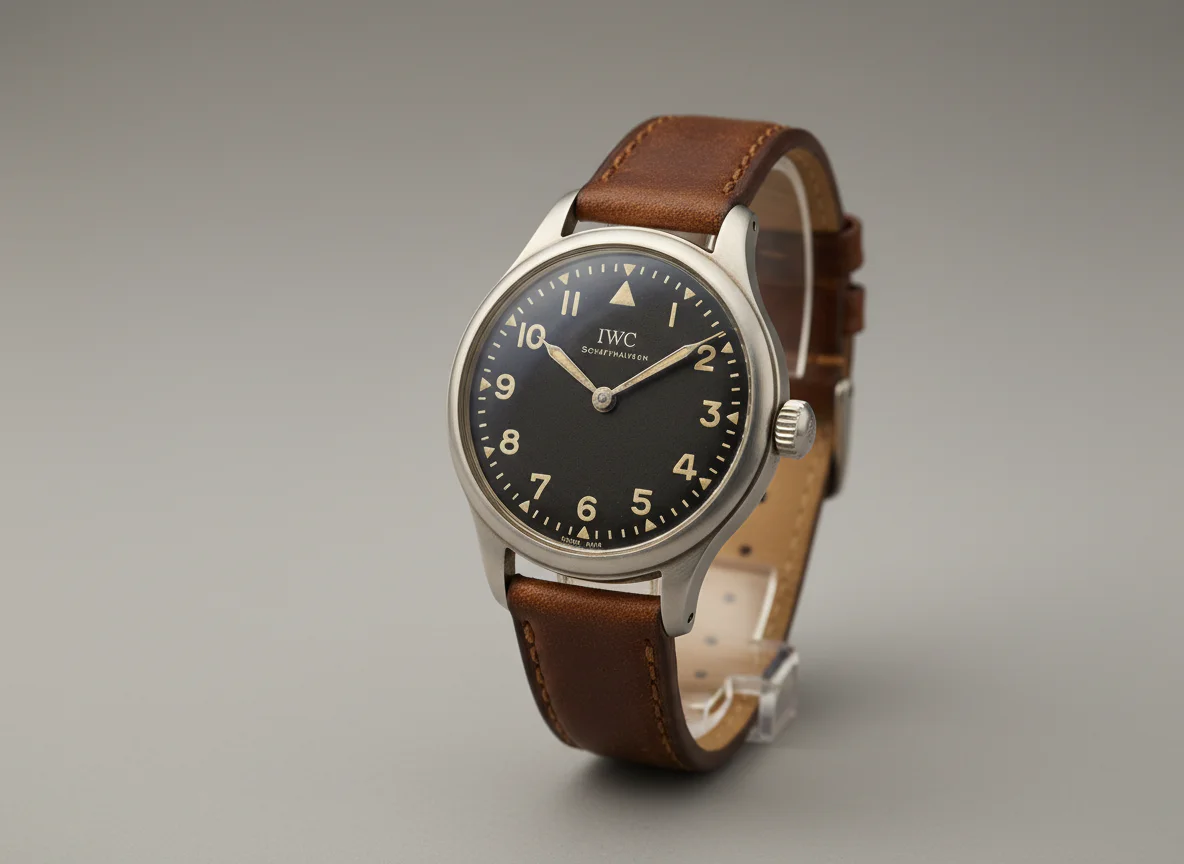
The 1936 IWC Pilot's Watch reference 325. The watch that started the brand's 90-year aviation lineage. Traditional crown at 3 o'clock. The Venturer Vertical Drive is the first IWC pilot's watch ever produced without one.
The Mark XI for the British Royal Air Force in 1948 added soft-iron antimagnetic shielding and hacking seconds for navigator timing. The Big Pilot lineage started with the 1940 reference 431 and emphasized oversized crowns for glove operation, which became the brand's most recognizable sport-watch detail. Every reference in the Mark XII through Mark XX run has carried a traditional crown at 3 o'clock with date integration.
The Venturer Vertical Drive breaks that 90-year continuity with a single design decision. Looked at from the catalog perspective, it's the most radical IWC Pilot's Watch ever produced. Looked at from the spaceflight requirements perspective, it's a logical engineering response to a different operational environment than aviation.
For broader IWC Pilot's catalog context, see our pre-owned IWC Pilot's buying guide covering the Mark XVIII, Mark XX, Top Gun, and Big Pilot lineup.
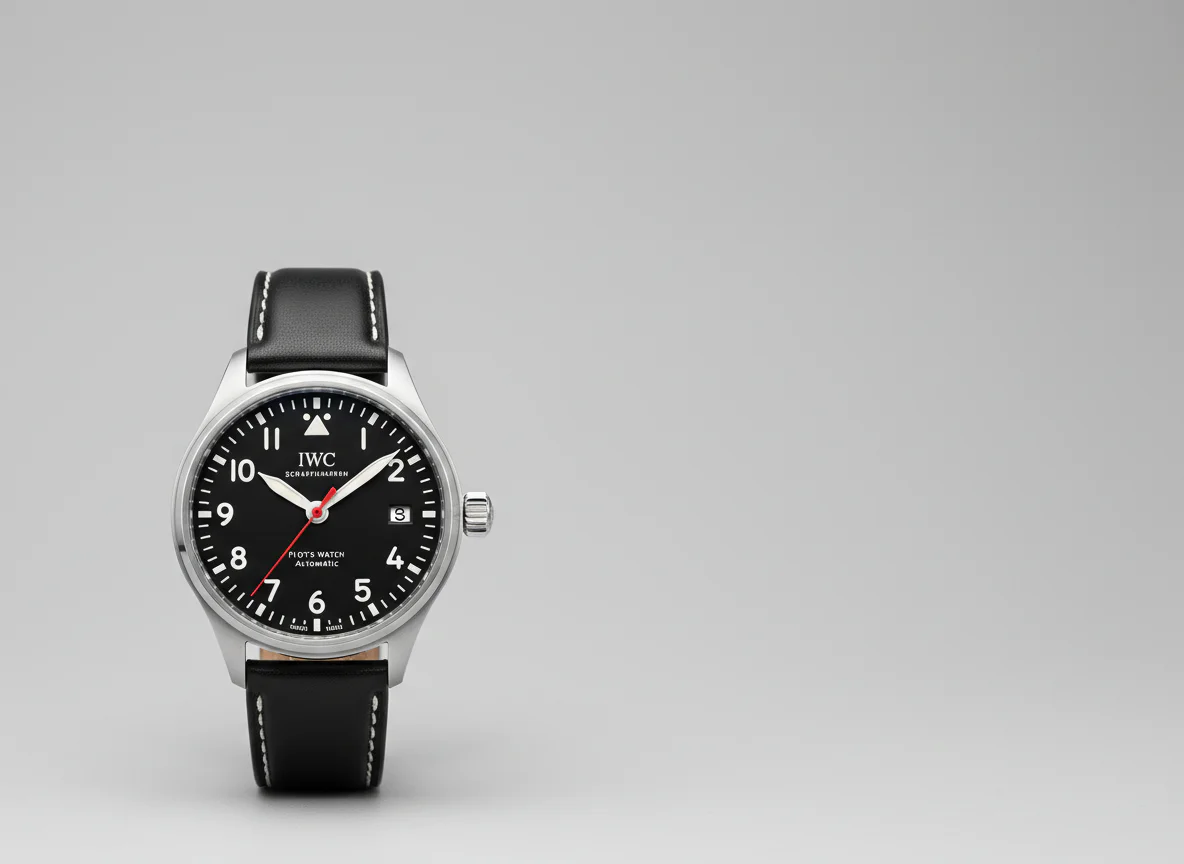
The Mark XX with its traditional crown at 3 o'clock. Every IWC Pilot's Watch in the modern catalog has a crown except the Venturer.
Wearability and the 44.3mm Question
The Venturer is 44.3mm in diameter and 16.7mm thick. By modern wrist standards, that's a large watch. The dimensions are defensible given the use case (crew operating with gloves need more dial real estate, more bezel diameter for grip, more case thickness for the Vertical Drive clutch mechanism), but they place the watch outside the comfort zone for most terrestrial buyers with wrists under 7.5 inches.
Three details soften the dimensions in practice:
- The lugless integration. The white FKM rubber strap flows directly from the case with no traditional lugs, which makes the lug-to-lug measurement (57.5mm) less wrist-spanning than a traditional design at the same diameter would suggest.
- The white ceramic. Light-colored cases visually shrink on the wrist compared to dark colors. The Venturer reads smaller than a 44.3mm steel watch would.
- The thinner-than-expected bezel. The notched Ceratanium bezel is functional rather than dramatic in profile, keeping the visual mass focused on the dial rather than the bezel ring.
For buyers with wrists under 7 inches, the Venturer will likely be too large. For wrists 7 inches and above, it sits proportionally similar to a Big Pilot 43mm despite the slightly larger numerical diameter.

The Venturer Vertical Drive on wrist in a technical environment. The white ceramic and lugless integration soften the 44.3mm dimensions in practice.
Who Should Actually Buy One
The Venturer is a niche purchase even within high-end watch collecting. The audience tiers are clear.
Commercial spaceflight enthusiasts. Buyers tracking SpaceX, Vast, Blue Origin, and the broader commercial space industry who want a watch that reflects the post-NASA era. The Venturer is the only mechanical watch currently designed and certified for that environment.
Modern tool-watch collectors who value engineering over heritage. The Vertical Drive system, the integrated GMT caliber, and the certified spaceflight specifications represent more genuine engineering content than most luxury sport watches at this price point. Buyers who care about technical innovation over conventional luxury positioning will find the Venturer's $28,200 retail meaningful.
IWC collectors completing the technical lineage. Buyers who already own modern Mark XX or Big Pilot references and want the brand's most ambitious tool watch as a portfolio piece. The Venturer reads cleanly against the rest of the catalog as the technical apex.
Travelers who want a serious GMT in unconventional packaging. Stripped of the spaceflight context, the Venturer functions as a 5-day-power-reserve in-house GMT in scratch-resistant ceramic at a price competitive with conventional luxury sport-watch GMTs. For frequent international travelers who don't want a Rolex GMT-Master II for security reasons or aesthetic preference, the Venturer is a defensible alternative.
The watch is not for traditional luxury watch buyers who care about value retention or pre-owned market liquidity. The Venturer's pre-owned market won't develop meaningfully for 24 to 36 months, and its long-term value will depend on whether the Haven-1 mission and subsequent commercial spaceflight operations support sustained brand association.
The Honest Take
The Venturer Vertical Drive is the most strategically significant IWC release of the past decade. The crownless construction, the Vertical Drive clutch system, the integrated GMT caliber, and the Vast partnership all represent engineering and brand-positioning ambition that didn't exist in IWC's catalog before 2026. The watch is a serious technical achievement and a clear signal of where the brand intends to position itself over the next decade of commercial spaceflight expansion.
The criticism worth flagging: the 44.3mm by 16.7mm dimensions limit the practical wearability for many buyers, the ceramic case material has lower long-term repairability than steel or titanium (a chipped ceramic case typically requires full replacement rather than service), and the $28,200 retail places the watch in a price band where the cross-shopping competition (Rolex GMT-Master II, Omega Aqua Terra Worldtimer, Tudor Pelagos FXD GMT) is established with stronger pre-owned positioning.
For the right buyer, the Venturer is the most interesting tool watch IWC has launched in 30 years. It tells a coherent technical story rooted in commercial spaceflight rather than retreaded NASA Apollo nostalgia, it executes that story with engineering depth that competes with anything in the segment, and it does it at a non-limited price point that positions the watch as a platform for IWC's next decade. For buyers who care about being early to a category that will likely matter increasingly through the 2030s, this is that category's flagship.
For broader IWC catalog context, see our pre-owned IWC Pilot's buying guide covering the conventional terrestrial pilot's watch lineup that the Venturer departs from.
Browse authenticated pre-owned IWC watches at 5dwatches.com.