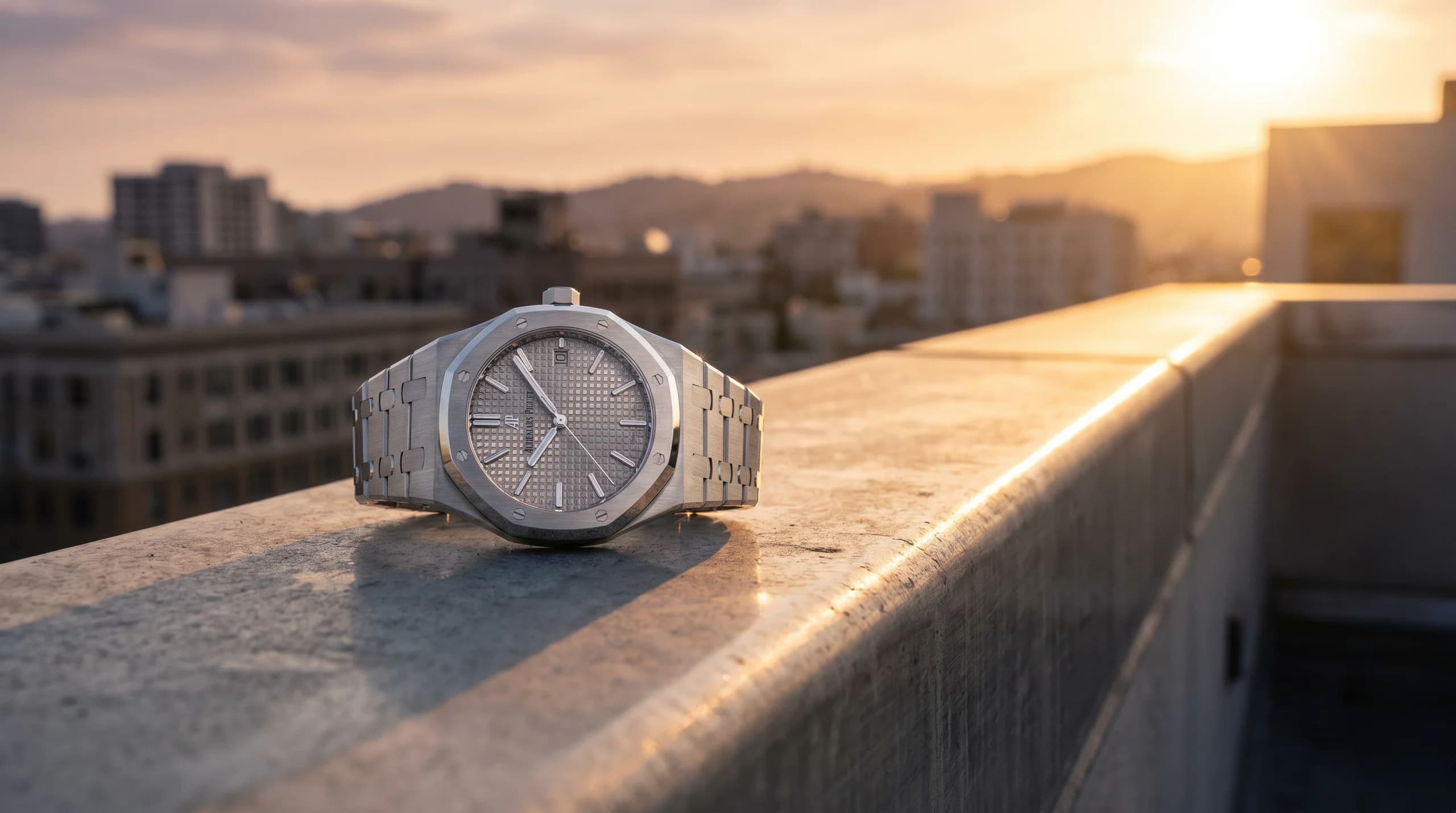
The Audemars Piguet Royal Oak is the watch that invented the luxury sports watch category. When Gérald Genta sketched it in October 1971 and AP launched it in 1972, the watch industry could not understand what they were looking at. A stainless steel watch priced higher than gold dress watches. An eight-screw bezel with a porthole shape. An integrated bracelet that flowed seamlessly into the case. The market response in year one was lukewarm. Fifty-four years later, the Royal Oak is the most-copied design template in modern watchmaking and one of the strongest pre-owned market performers in the industry.
The current Royal Oak lineup runs across four core families. The Selfwinding 41mm with central seconds (current reference 15510), the Jumbo Extra-Thin 39mm (current reference 16202), the Chronograph 41mm (current reference 26240), and the smaller-size 37mm and below for narrower wrists. Each family has its own generational succession, its own movement evolution, and its own collector positioning.
This is the comprehensive 2026 buying guide. Every modern Royal Oak generation decoded with retail prices, secondary market data, and the honest dealer read on which to buy.
All images in this post are AI-generated and may not perfectly represent the actual watch references discussed. They are intended for illustration only.
The current Audemars Piguet Royal Oak Selfwinding 41mm reference 15510ST in stainless steel with silver-grey Grande Tapisserie dial. The most-traded modern Royal Oak reference at $33,900 retail and $46,000 to $55,000 on the secondary market.
The Short Answer
If you are scanning, the buy logic compresses to a few decisions.
- For the modern Royal Oak workhorse: the 15510ST (current 41mm Selfwinding, caliber 4302, 70-hour reserve). Retail $33,900. Secondary $46,200 to $55,000 depending on dial and condition.
- For the connoisseur's choice: the 16202ST Jumbo Extra-Thin (current 39mm, caliber 7121, 50th anniversary refresh). Retail $40,100. Secondary $63,000 to $85,000.
- For value at modern proportions: the discontinued 15400ST (2012-2018) at $35,400 secondary market. The strongest dollar-per-Royal-Oak value among recent references.
- For timing functionality: the 26240ST Chronograph at $45,000 to $58,000 secondary.
- For smaller wrists: the 37mm Selfwinding 15550 at approximately $44,000 to $50,000 secondary, or the discontinued 15450 at $35,000 to $42,000.
- For Genta-era heritage: the original 5402 from 1972-1995 in steel, the watch that started the entire luxury sports watch category. Pricing varies widely with condition and serial range.
The Royal Oak 15510ST has appreciated 16.4 percent over the past 12 months according to WatchCharts data, outperforming both the broader Audemars Piguet brand index and the overall luxury watch market.
The Royal Oak Selfwinding 41mm (The Modern Workhorse)
The Selfwinding 41mm is the most-bought Royal Oak family ever produced. It launched in 2005 with the reference 15300, introducing a 41mm case that grew from the original 39mm Jumbo proportions. The wider case allowed for a thicker movement, a central seconds hand (which the Jumbo does not have), and broader buyer appeal beyond the connoisseur audience.
Four generations have run through the Selfwinding family.
Royal Oak 15300 (2005-2012)
The 15300 was the original 41mm Selfwinding. Caliber 3120 inside, central seconds hand, date at 3 o'clock, integrated bracelet with the new wider proportions. The watch positioned the Royal Oak for the broader collector base that had grown around AP through the 1990s and 2000s.
Secondary market pricing currently runs $36,000 to $42,000 for clean examples with full sets. The 15300 is the entry tier into the modern 41mm Selfwinding family, trading at a $10,000 to $15,000 discount to the current 15510ST while delivering the same fundamental Royal Oak template.
Royal Oak 15400 (2012-2018)
The 15400 replaced the 15300 in 2012 with subtle case refinements and updated dial finishing. Same caliber 3120, same 41mm proportions, refined Grande Tapisserie dial textures, broader dial color options including the iconic blue and the green that drew sustained collector demand in later years.
Secondary market pricing currently runs $32,000 to $38,000 for clean examples, with the WatchCharts market value sitting around $35,406. The 15400 has appreciated 10.9 percent year-over-year through 2026, outperforming the broader brand index.
The 15400 is the best value play in the modern Royal Oak Selfwinding family. It is the discontinued reference closest to current production specs, with no meaningful mechanical difference from the 15500 that followed and a substantial price discount to both. Clean blue dial 15400ST examples remain in particularly strong demand.
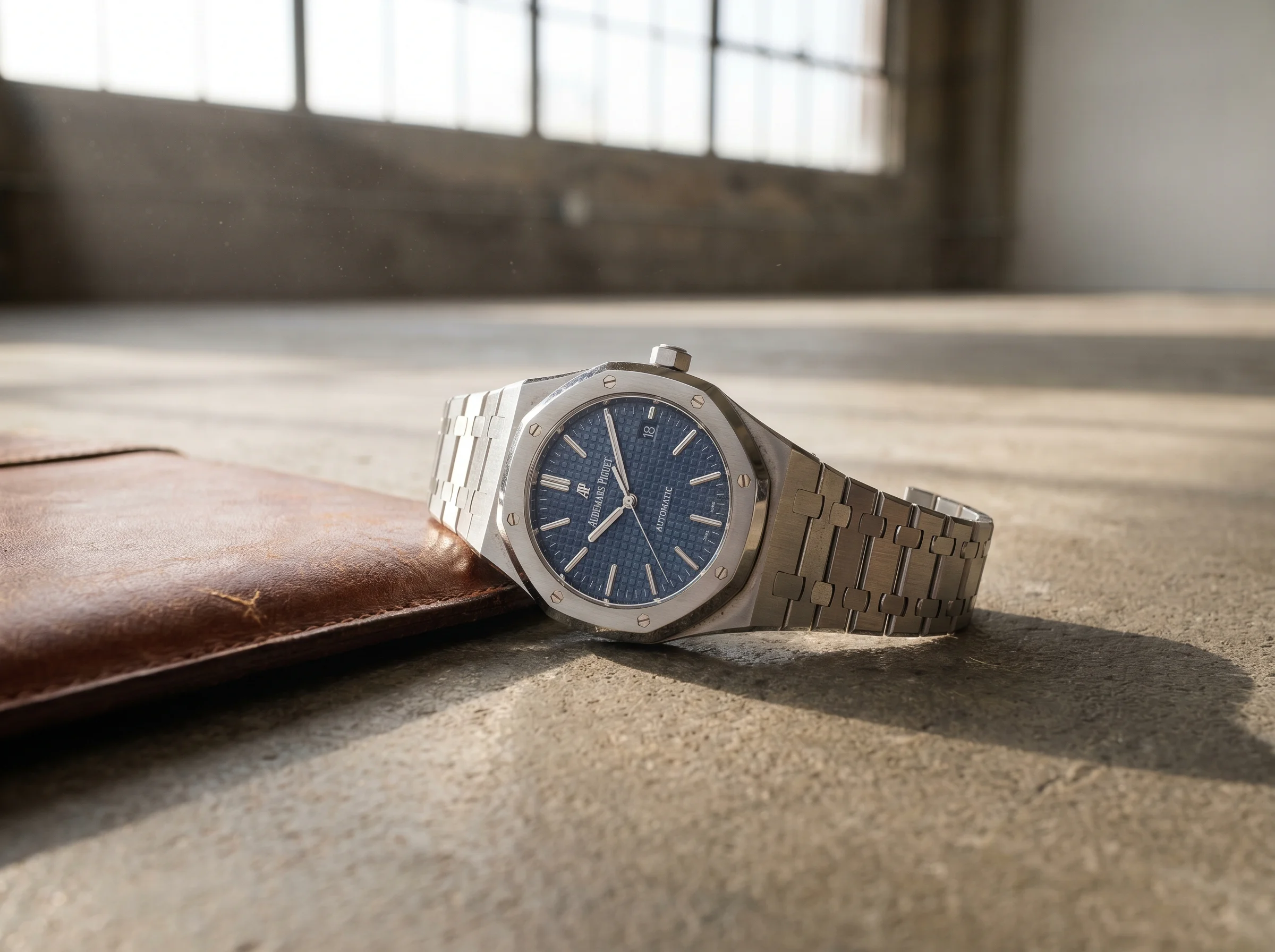 The discontinued Royal Oak Selfwinding 15400ST in steel with blue Grande Tapisserie dial, produced 2012 to 2018. The best dollar-per-Royal-Oak value among modern references at $32,000 to $38,000 secondary.
Royal Oak 15500 (2018-2022)
The 15500 marked a generational shift. The caliber 3120 was replaced by the new in-house caliber 4302 with a 70-hour power reserve (up from 60 hours), the case proportions were subtly refined, and the dial finishing was upgraded again. The watch was the bestseller of the modern Royal Oak Selfwinding generation through its production run.
Secondary market pricing currently runs $38,000 to $42,000 for clean examples, with the WatchCharts market value sitting around $40,019. The 15500 is up 10.4 percent year-over-year through 2026.
The 15500 sits in a specific market position. It is the most recently discontinued Selfwinding reference, it carries the same modern movement as the current 15510, and it trades at a meaningful discount to the 15510 while losing essentially nothing functionally. For buyers who want the modern movement and 70-hour reserve at a sub-$45,000 entry point, the 15500ST is the smart play.
Royal Oak 15510 (2022-present)
The 15510 launched in 2022 as part of the Royal Oak's 50th anniversary refresh. The case geometry was refined, the bracelet was reworked for improved comfort, and the in-house caliber 4302 was carried over from the 15500. The anniversary editions carried commemorative "50 Years" rotors visible through the sapphire caseback.
Retail in 2026 is $33,900. Secondary market pricing runs $46,200 to $55,000 for clean examples depending on dial color and condition, with the WatchCharts market value sitting around $46,200. The 15510ST has appreciated 16.4 percent year-over-year, outperforming both the brand index (up 5.5 percent) and the overall luxury watch market (up 9.5 percent).
The 15510ST is the textbook modern Royal Oak. It carries the strongest brand pedigree, the most refined movement, and the broadest dial color options in current production. The blue Grande Tapisserie dial remains the most-requested configuration, followed by black, silver-grey, green, and white in roughly that order.
The Royal Oak Jumbo Extra-Thin (39mm) Family
The Jumbo Extra-Thin is the connoisseur's Royal Oak. It carries the original 1972 Genta proportions in their purest form. 39mm case, slim profile, no central seconds hand (just hours, minutes, and date), and the integrated bracelet that flows seamlessly into the case in the way the original was designed.
The Jumbo family has run through four major modern references.
Royal Oak Jumbo 5402 (1972-1995)
The 5402 is the original Royal Oak. The reference that Genta designed in 1971 and AP launched in 1972 with the "A-series" Petite Tapisserie blue dial that defined the entire category. The watch struggled commercially in its first three years before becoming the bestseller that saved AP through the quartz crisis.
Vintage pricing varies dramatically with serial number, dial generation, and condition. Clean A-series examples (1972-1975) command $100,000+ at auction. Later production runs trade in the $50,000 to $90,000 range depending on condition and provenance.
Royal Oak Jumbo 15202 (2005-2022)
The 15202 was the modern Jumbo. It carried the caliber 2121 (the ultra-thin movement Jaeger-LeCoultre developed in 1967 and AP used through this entire generation), the 39mm case with the slim profile, and the original Genta tapered link bracelet design.
Secondary market pricing currently runs $62,000 to $75,000 for clean examples, with the WatchCharts market value sitting around $63,196. The 15202 was discontinued in 2022 as part of the 50th anniversary refresh, and prices have continued to appreciate steadily as production ended.
The 15202 is the watch most Royal Oak collectors aspire to. It carries the closest modern interpretation of the original 1972 Jumbo proportions, the historically significant caliber 2121, and the discontinued status that ensures permanent collector demand. Clean steel examples in blue dial with full sets remain the strongest performers.
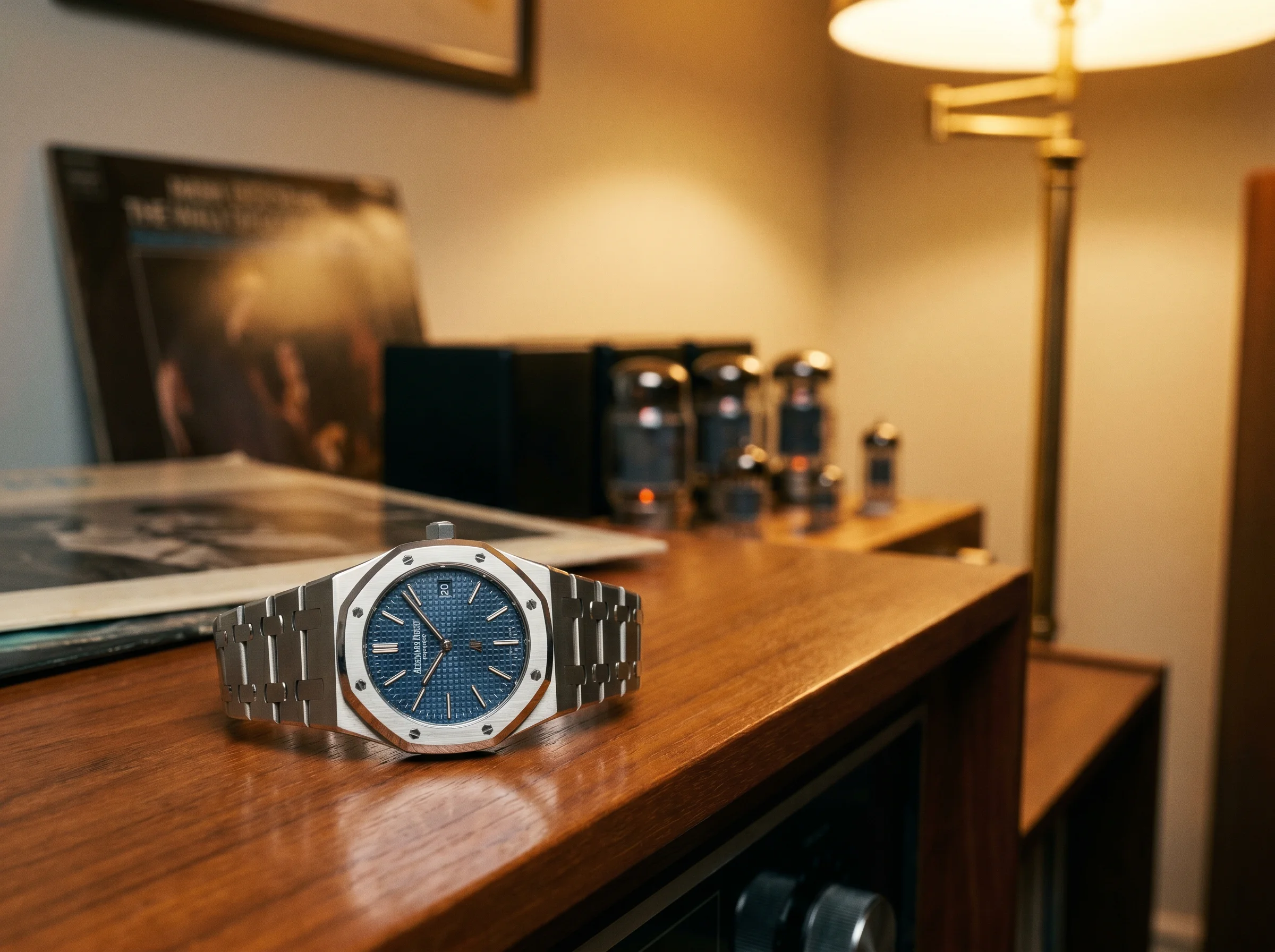 The discontinued Royal Oak Jumbo Extra-Thin 15202ST in steel with blue Petite Tapisserie dial. The connoisseur's choice, trading at $62,000 to $75,000 on the secondary market.
Royal Oak Jumbo 16202 (2022-present)
The 16202 replaced the 15202 in 2022 with the new in-house caliber 7121 (55-hour power reserve, quick-set date) and refined case geometry. The smoked dial finishing is more polished than the 15202, the date window is slightly redesigned, and the bracelet has been subtly reworked for improved articulation.
Retail in 2026 is $40,100. Secondary market pricing currently runs $63,000 to $85,000 for clean steel examples, depending on dial color and condition. The 16202 sits at the top of the modern Royal Oak hierarchy in pure dollar terms.
The 16202 is the harder buy. AD allocations are extremely limited, the wait can run multiple years, and the secondary market premium is the largest in the modern Royal Oak lineup. For buyers committed to current production at the Jumbo proportions, the 16202 is the answer. For buyers who can accept neo-vintage or recently discontinued status, the 15202 is the meaningfully cheaper alternative.
The Royal Oak Chronograph (41mm)
The Royal Oak Chronograph adds timing functionality to the 41mm Selfwinding template. The family launched in 1997 with the 25860 (using a modified Frédéric Piguet movement) and ran through several generations before AP brought chronograph production fully in-house.
Royal Oak Chronograph 26331 (2017-2022)
The 26331 used the caliber 2385 (a self-winding chronograph movement derived from Piguet) and ran from 2017 to 2022. The reference carried a 41mm case, three-register chronograph layout with subdials at 3, 6, and 9 o'clock, and date window at 4 o'clock.
Secondary market pricing currently runs $38,000 to $48,000 for clean steel examples depending on dial configuration.
Royal Oak Chronograph 26240 (2022-present)
The 26240 replaced the 26331 in 2022 with the new in-house caliber 4401 flyback chronograph movement. The flyback function is the meaningful upgrade. The dial layout was refined with a slightly cleaner subdial geometry, the case proportions were updated for the 50th anniversary refresh, and the watch positioned itself as AP's contemporary chronograph flagship in steel.
Retail in 2026 is approximately $45,400. Secondary market pricing runs $45,000 to $58,000 for clean steel examples, with panda dial configurations and certain color combinations commanding premiums.
The 26240ST in the panda dial (black with silver subdials) is the most-requested configuration on the secondary market. The contrast between the black main dial and the silver subdials creates the strongest visual reading of any modern Royal Oak chronograph.
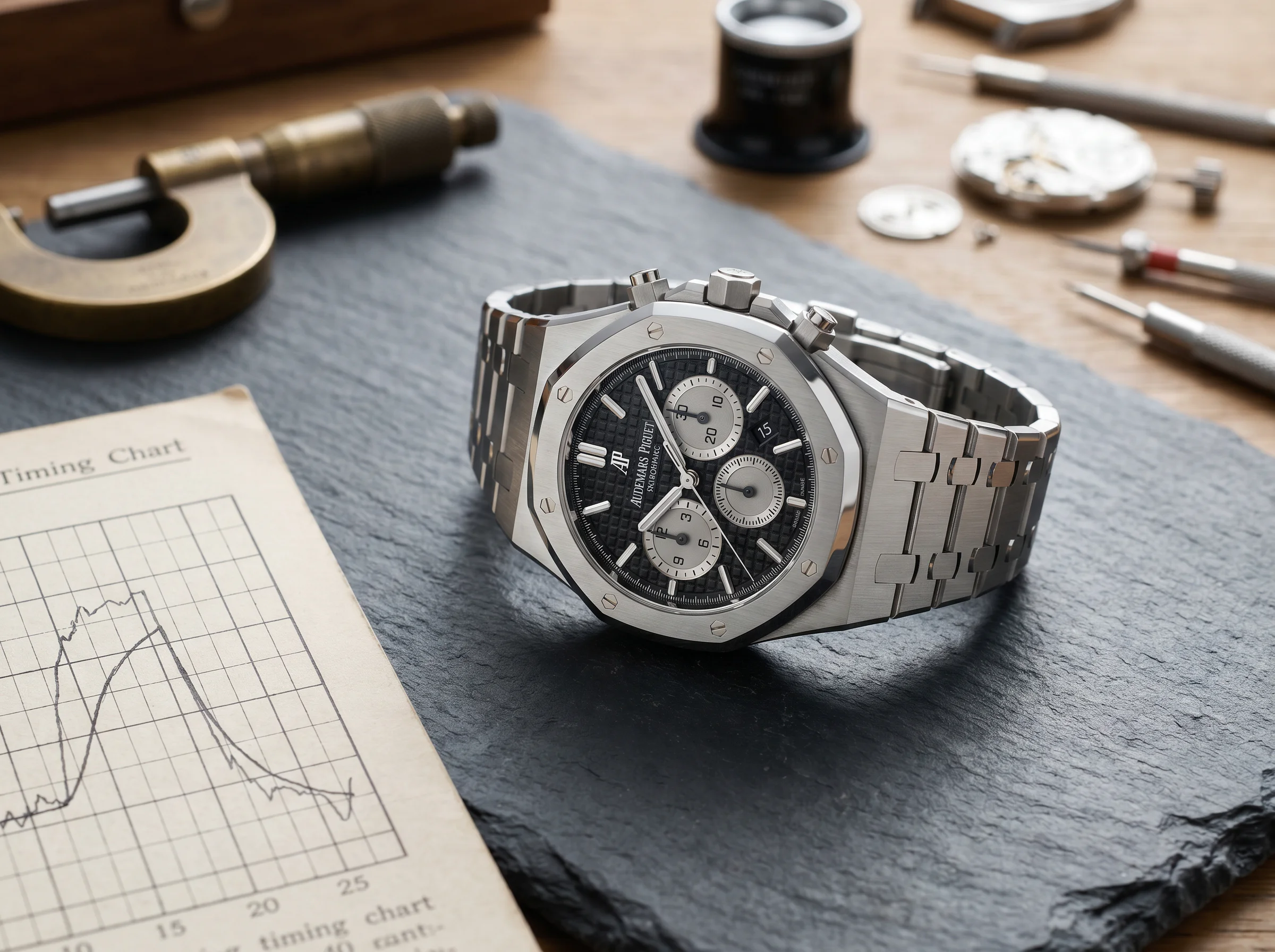 The current Royal Oak Chronograph 26240ST with black panda dial and in-house caliber 4401 flyback chronograph movement. Retail $45,400, secondary $45,000 to $58,000.
The Smaller Sizes: 37mm, 34mm, 33mm
The Royal Oak's smaller sizes serve buyers with narrower wrists, collectors looking for proportions closer to the original 1972 Jumbo, and the broader unisex market.
Royal Oak Selfwinding 37mm 15450 (2012-2024)
The 15450 was the mid-size 37mm Selfwinding, with the caliber 3120 and standard date display. The reference was the workhorse Royal Oak for buyers with sub-7-inch wrists or anyone preferring proportions between the 39mm Jumbo and 41mm Selfwinding.
Secondary market pricing currently runs $35,000 to $42,000 for clean steel examples.
Royal Oak Selfwinding 37mm 15550 (Current)
The 15550 is the current 37mm Selfwinding, with the in-house caliber 5900 and a refreshed case geometry. The reference is positioned as the unisex everyday Royal Oak, with stronger dial color variety than the 41mm lineup and the same modern in-house movement family.
Retail in 2026 runs from approximately $32,500 for steel. Secondary market pricing runs $42,000 to $50,000 depending on dial and bracelet configuration.
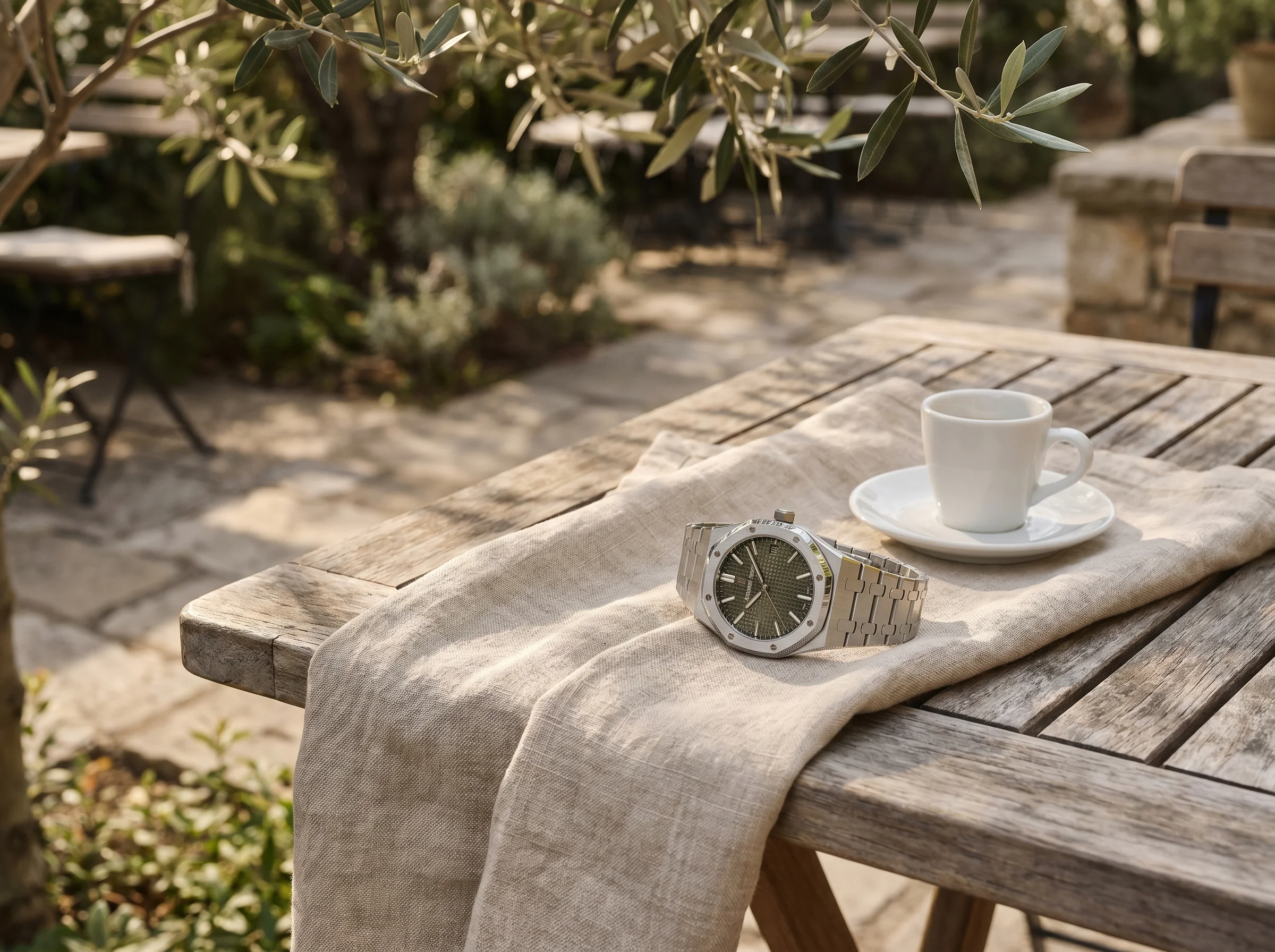 The Royal Oak Selfwinding 37mm 15550ST in steel with smoked green dial. The current mid-size Royal Oak for narrower wrists at $32,500 retail.
Lady-Size Royal Oak (34mm and 33mm)
The 77350 (current) and 77351 (Frosted Gold) are the contemporary lady-size Royal Oak references at 34mm. The 67651 quartz references at 33mm and below serve the smaller-wrist segment. Pricing for these references varies widely with material (steel, two-tone, full gold), gem-set bezels, and dial complexity.
The Royal Oak Price Matrix
| Reference | Family | Production | Material | Retail (2026) | Secondary |
|---|---|---|---|---|---|
| 15510ST | Selfwinding 41mm | Current | Steel | $33,900 | $46,200-$55,000 |
| 15500ST | Selfwinding 41mm | 2018-2022 | Steel | Discontinued | $38,000-$42,000 |
| 15400ST | Selfwinding 41mm | 2012-2018 | Steel | Discontinued | $32,000-$38,000 |
| 15300ST | Selfwinding 41mm | 2005-2012 | Steel | Discontinued | $36,000-$42,000 |
| 16202ST | Jumbo Extra-Thin | Current | Steel | $40,100 | $63,000-$85,000 |
| 15202ST | Jumbo Extra-Thin | 2005-2022 | Steel | Discontinued | $62,000-$75,000 |
| 5402 | Jumbo Extra-Thin | 1972-1995 | Steel | Discontinued | $50,000-$100,000+ |
| 26240ST | Chronograph 41mm | Current | Steel | $45,400 | $45,000-$58,000 |
| 26331ST | Chronograph 41mm | 2017-2022 | Steel | Discontinued | $38,000-$48,000 |
| 15550ST | Selfwinding 37mm | Current | Steel | $32,500 | $42,000-$50,000 |
| 15450ST | Selfwinding 37mm | 2012-2024 | Steel | Discontinued | $35,000-$42,000 |
Rose gold and Everose configurations across all families typically run 2 to 3x the steel equivalents at both retail and secondary. Platinum and ceramic references run higher still.
Dial Color Hierarchy
Royal Oak dial colors have a measurable impact on secondary market values. The current hierarchy from highest to lowest premium:
| Dial Color | Premium vs Base |
|---|---|
| Blue Petite/Grande Tapisserie | Reference standard (+0%) |
| Smoked Green (Khaki) | +5 to 10% |
| Smoked Grey | +0 to 5% |
| Black | +0 to 5% |
| White | -5 to 0% (modest discount) |
| Silver-Grey | -5 to 10% (largest discount) |
| Mother of Pearl | Varies with configuration |
| Frosted Gold dials | Premium across all configurations |
Blue is the consistent reference standard across all Royal Oak families. It is the dial color Genta designed for the original 1972 5402, it is the most-photographed, and it remains the most-requested on the secondary market. Newer dial colors like smoked green have gained collector momentum in the past three years.
How to Choose: Buyer Profile Matrix
First Royal Oak Buyer (Modern Production)
The 15510ST is the right starting point. The current 41mm Selfwinding offers the broadest dial options, the most refined movement, the strongest brand pedigree, and the most liquid secondary market. The blue Grande Tapisserie dial is the canonical first-Royal-Oak configuration.
If you can accept neo-vintage status, the 15500ST at $38,000 to $42,000 saves roughly $10,000 against the current 15510 with no meaningful functional sacrifice. The 15500 has the same in-house caliber 4302, the same 70-hour reserve, and the same fundamental case template.
Connoisseur / Long-Hold Collector
The 16202ST Jumbo is the modern collector's reference. It carries the original 1972 proportions in their purest current production form, the new in-house caliber 7121, and the strongest brand pedigree at the highest tier.
For collectors prioritizing horological significance over current production status, the 15202ST at $62,000 to $75,000 is the smart alternative. The 15202 carries the historically important caliber 2121 (the ultra-thin movement that defined the modern Jumbo era), the Genta-era proportions, and the discontinued status that ensures permanent collector demand.
Timing Functionality
The 26240ST Chronograph is the current flagship at $45,400 retail and $45,000 to $58,000 secondary. The flyback movement is the meaningful functional upgrade over the previous-generation 26331, and the panda dial configurations carry the strongest secondary market demand.
Smaller Wrist or Mid-Size Preference
The 15550ST 37mm Selfwinding at $32,500 retail is the current mid-size Royal Oak. For buyers preferring proportions closer to the original 1972 Jumbo, the 15450 at $35,000 to $42,000 secondary delivers similar character at lower cost. Both wear well on wrists in the 6.5 to 7-inch range.
The Royal Pop Spillover Context
The May 16, 2026 launch of the Swatch x Audemars Piguet Royal Pop raised concerns about whether the $400 bioceramic pocket watch collaboration would damage Royal Oak pre-owned values. The first-week market data covered in our Royal Pop one-week-later analysis showed no evidence of that concern materializing.
The 15510ST continued to appreciate through the launch week. The 16202 Jumbo did not move. The discontinued 15400 and 15500 references continued to outperform brand average. The pocket watch format separation from wristwatch market dynamics held as expected, in line with the MoonSwatch precedent that did not damage Speedmaster Professional pre-owned values.
A Working Dealer's Read
The Royal Oak is one of the strongest pre-owned market performers in modern watchmaking. The brand has built sustained demand across 54 years of production, the design template remains unrivaled, and the secondary market has continued to appreciate steadily even through cyclical luxury watch market softness.
For most first-time Royal Oak buyers, the 15510ST in blue or silver-grey is the right answer. For buyers prioritizing value, the 15400 or 15500 at sub-$42,000 secondary delivers the same fundamental Royal Oak template at meaningful discount. For collectors building toward Jumbo ownership, the 15202 remains the smart neo-vintage play.
For pre-owned buyers, AD allocation at retail is constrained for every steel Royal Oak reference, with waits running multiple years for the most-requested configurations. The pre-owned market is where most Royal Oak buying actually happens.
Browse authenticated pre-owned Audemars Piguet at 5dwatches.com. The Royal Oak inventory at 5D Watches spans the modern 15510 and 15500 references, the discontinued 15400, and the Jumbo and Chronograph families that anchor the upper tier of the lineup.
Frequently Asked Questions
What is the current Audemars Piguet Royal Oak retail price?
In 2026, the Royal Oak Selfwinding 37mm 15550ST starts at $32,500. The 41mm Selfwinding 15510ST retails at $33,900. The Royal Oak Jumbo Extra-Thin 16202ST retails at $40,100. The Royal Oak Chronograph 26240ST retails at approximately $45,400. Rose gold and Everose configurations run 2 to 3x the steel equivalents.
Which Royal Oak holds value best?
The 16202 Jumbo Extra-Thin has the strongest secondary market premium at $63,000 to $85,000 against $40,100 retail. The 15202 (discontinued 2022) continues to appreciate steadily and now trades $62,000 to $75,000. The current 15510ST is up 16.4 percent year-over-year through 2026, outperforming both the AP brand index and the broader luxury watch market.
Is the 15400 or 15500 the better buy on the pre-owned market?
Both are excellent values. The 15500 carries the modern in-house caliber 4302 with 70-hour reserve and trades at $38,000 to $42,000. The 15400 carries the older caliber 3120 with 60-hour reserve and trades at $32,000 to $38,000, a roughly $4,000 to $6,000 discount. For buyers prioritizing the modern movement, the 15500 is worth the premium. For pure value, the 15400 is the smart play.
Did the Royal Pop hurt Royal Oak pre-owned values?
No. The data through the first week post-launch shows no evidence of damage to any Royal Oak reference. The 15510ST continued to appreciate at 16.4 percent year-over-year, and the 16202 Jumbo, 15400, and 15500 all held their pre-launch trajectories. The MoonSwatch precedent suggests this pattern should hold over the next 12 to 18 months.
What is the difference between the Royal Oak Jumbo and Selfwinding?
The Jumbo Extra-Thin is the 39mm time-only-with-date Royal Oak with the slimmer case and no central seconds hand. The Selfwinding is the 41mm Royal Oak with the wider case, the central seconds hand, and the modern in-house caliber. The Jumbo carries the original 1972 Genta proportions and is the connoisseur's choice. The Selfwinding is the modern workhorse.
Where should I buy a pre-owned Royal Oak?
Buy authenticated pre-owned from a dealer with verifiable authentication standards. Browse authenticated pre-owned Audemars Piguet at 5dwatches.com. Avoid private sales without box and papers, avoid grey market listings without provenance documentation, and avoid any seller who cannot answer specific questions about serial number ranges, dial variants, and service history.